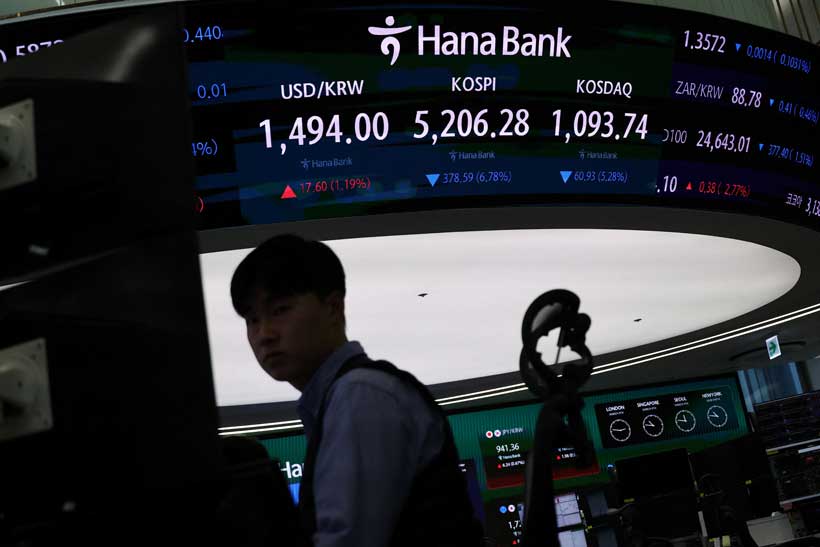
Asian stock markets extended their sharp selloff on Wednesday as investor concerns over artificial intelligence (AI) valuations deepened ahead of a crucial round of earnings from major U.S. technology companies and the Federal Reserve’s latest monetary policy decision. The decline reflects growing skepticism over whether massive investments in AI infrastructure will generate sustainable profits, while renewed tensions in the Middle East added fresh inflationary risks through higher oil prices.
The market downturn comes after months of extraordinary gains driven by optimism surrounding AI, particularly among semiconductor manufacturers and technology giants. However, disappointing earnings signals and concerns over corporate cash flows are prompting investors to reassess whether the sector’s lofty valuations remain justified.
Asian Markets Extend AI Driven Selloff
Technology heavy markets across Asia led the global decline as semiconductor stocks came under intense pressure.
South Korea’s KOSPI plunged more than 11 percent, reaching its lowest level since April after suffering another double digit loss a day earlier. Taiwan’s benchmark index dropped 5 percent, while Japan’s Nikkei declined 2.6 percent. The broader MSCI Asia Pacific index excluding Japan also fell sharply, highlighting widespread investor caution across the region.
Stay ahead of the geopolitical week.
MD Briefing delivers expert analysis across five global fronts — the Indo-Pacific, energy, geoeconomics, European security, and the Middle East — every Monday morning. Free.
The weakness was concentrated in technology stocks that have largely fueled this year’s market rally through expectations of sustained AI demand.
Chip Stocks Face Growing Scrutiny
Semiconductor companies remained at the center of the selloff despite reporting robust financial results.
South Korean memory chip giant SK Hynix reported operating profits that increased more than sixfold compared with the previous year. Nevertheless, its shares fell 9 percent after investors judged the results against exceptionally high expectations.
Market participants are increasingly demanding stronger evidence that companies can convert enormous AI related capital expenditure into long term profitability. Investors are also seeking clearer commitments regarding shareholder returns and long term supply agreements before assigning premium valuations.
The reaction illustrates how market expectations have evolved from rewarding growth alone to demanding measurable financial returns.
Big Tech Earnings Become Critical Test
Attention has now shifted to earnings from Microsoft and Meta, which are expected to provide important insight into the financial sustainability of AI investments.
The results follow disappointing updates from Alphabet and Tesla, whose weaker cash flow performance raised concerns that rising AI spending may be placing increasing pressure on corporate finances.
Investors will closely examine whether major technology companies can demonstrate that billions of dollars invested in AI infrastructure are producing corresponding improvements in revenue growth and profitability.
Failure to provide convincing evidence could accelerate the ongoing market correction.
Oil Prices Rise as Middle East Tensions Return
Geopolitical developments added another layer of uncertainty after renewed military activity between the United States and Iran pushed energy prices higher.
Brent crude rose more than 3 percent while West Texas Intermediate crude also gained over 3 percent following reports of Iranian ballistic missile launches and renewed concerns over the security of shipping through the Strait of Hormuz.
The waterway remains one of the world’s most strategically important energy corridors, and any disruption raises fears of tighter global oil supplies and renewed inflationary pressures.
Higher energy prices have complicated the outlook for financial markets by increasing uncertainty over future monetary policy.
Federal Reserve Decision in Focus
The Federal Reserve’s policy announcement has become increasingly significant as investors attempt to balance slowing market sentiment against persistent inflation risks.
Markets remain divided over whether the central bank will maintain current interest rates or opt for another increase. Rising oil prices have strengthened expectations among some analysts that policymakers may adopt a more cautious stance toward inflation.
A more hawkish outcome could place additional pressure on technology stocks, whose high valuations remain particularly sensitive to higher borrowing costs.
Analysis
The latest market correction suggests that the AI investment narrative is entering a more demanding phase. Investors are no longer rewarding technology companies solely for expanding AI infrastructure but increasingly expect tangible financial returns from unprecedented levels of capital expenditure.
At the same time, renewed geopolitical tensions in the Middle East have introduced fresh inflation risks through higher oil prices, complicating the Federal Reserve’s policy choices and adding further uncertainty to global financial markets. Higher interest rates typically reduce the attractiveness of high growth technology stocks by increasing financing costs and lowering future earnings valuations.
While the long term outlook for artificial intelligence remains strong, the market appears to be transitioning from optimism driven by expectations to a phase focused on profitability, efficiency, and sustainable returns. Companies that fail to demonstrate clear commercial benefits from their AI investments may continue to face heightened investor scrutiny, making upcoming earnings reports a defining test for the next phase of the global AI driven market cycle.
With information from Reuters.