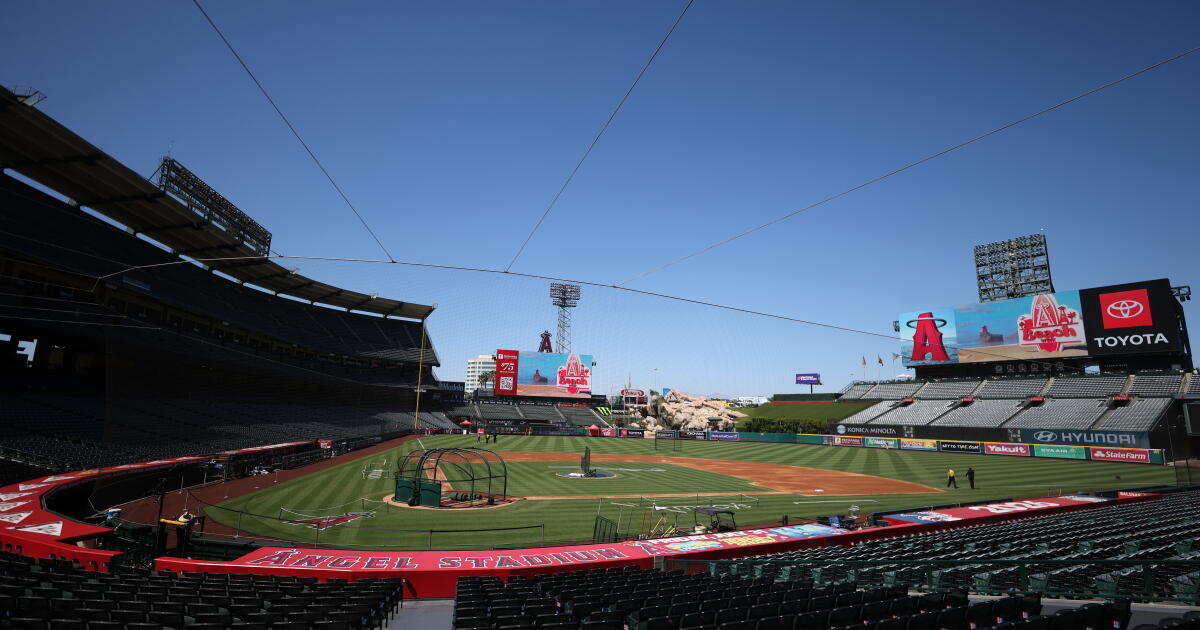
The words “Anaheim Angels” are now enshrined in California law.
Whether the baseball team that calls Angel Stadium home reverts to its hometown name remains to be seen. On Thursday, however, Gov. Gavin Newsom signed into law the “Home Run for Anaheim Act,” a step that elected officials in Orange County consider a significant step in that direction.
The new law, introduced by Assemblyman Avelino Valencia (D-Anaheim), cleared the state legislature without a single vote against it.
The law does not mandate the Angels — playing under a Los Angeles name in Anaheim’s city-owned stadium — revert to the Anaheim Angels name.
For now, in fact, the law does absolutely nothing. On Friday, the Los Angeles Angels play at Angel Stadium.
Instead, the law provides the city with an incentive to dangle before the team. If the Angels — whether under current owner Arte Moreno or a future owner — wish to develop the 150-acre Angel Stadium property, state law would prioritize affordable housing within the site.
In an era where team owners covet the profits from development around stadiums and arenas — including places for fans to eat, drink and shop 365 days a year, not just on game days — the city of Anaheim could seek an exemption from the affordable housing law. That wouldn’t rule out housing on the site, but it would give a team more flexibility to build whatever project might be considered most profitable.
If the city obtains the exemption, the new law says, “then any materials, including, but not limited to, a lease, deed of sale, and promotional or marketing materials, shall refer to that team as the Anaheim Angels.”
Moreno has twice reached deals with the city to develop the land, only to see the city walk away both times. In the last deal, he rejected the city’s request to rename the team the Anaheim Angels.
“We are proud to call Angel Stadium of Anaheim our home,” Angels spokeswoman Marie Garvey said, “and any other comment about the future would be premature.”
Moreno, 80, has shown no public interest in a third negotiation with the city. The Angels’ current stadium lease extends through 2032, and the team has options to extend the lease through 2038.
By year’s end, the city has said it anticipates the release of a long-awaited property assessment, which is expected to show Angel Stadium needs hundreds of millions of dollars in upgrades to remain viable for the long-term. The city and team may not agree on who should pay for them, and real estate development around the stadium could be part of the solution for funding a new or renovated stadium.
The city could use the exemption as leverage in discussions with Moreno or a new owner, although leverage could work both ways.
When Anaheim sued the Angels over the 2005 name change, city-commissioned experts testified in court that the Anaheim name was worth hundreds of millions of dollars to the city over the life of the lease. That could compel an owner to ask the city to contribute to the cost of building a new stadium in exchange for the return of the Anaheim name.
An almost vacant large urban site — an aging stadium surrounded by 130 acres of parking lots, sitting between three freeways and a train station — is rare in Southern California and surely would attract development interest among potential bidders for the Angels.
But any new owner would have one more bit of leverage: Once the Angel Stadium lease expires, the owner would be free to move out of Anaheim.