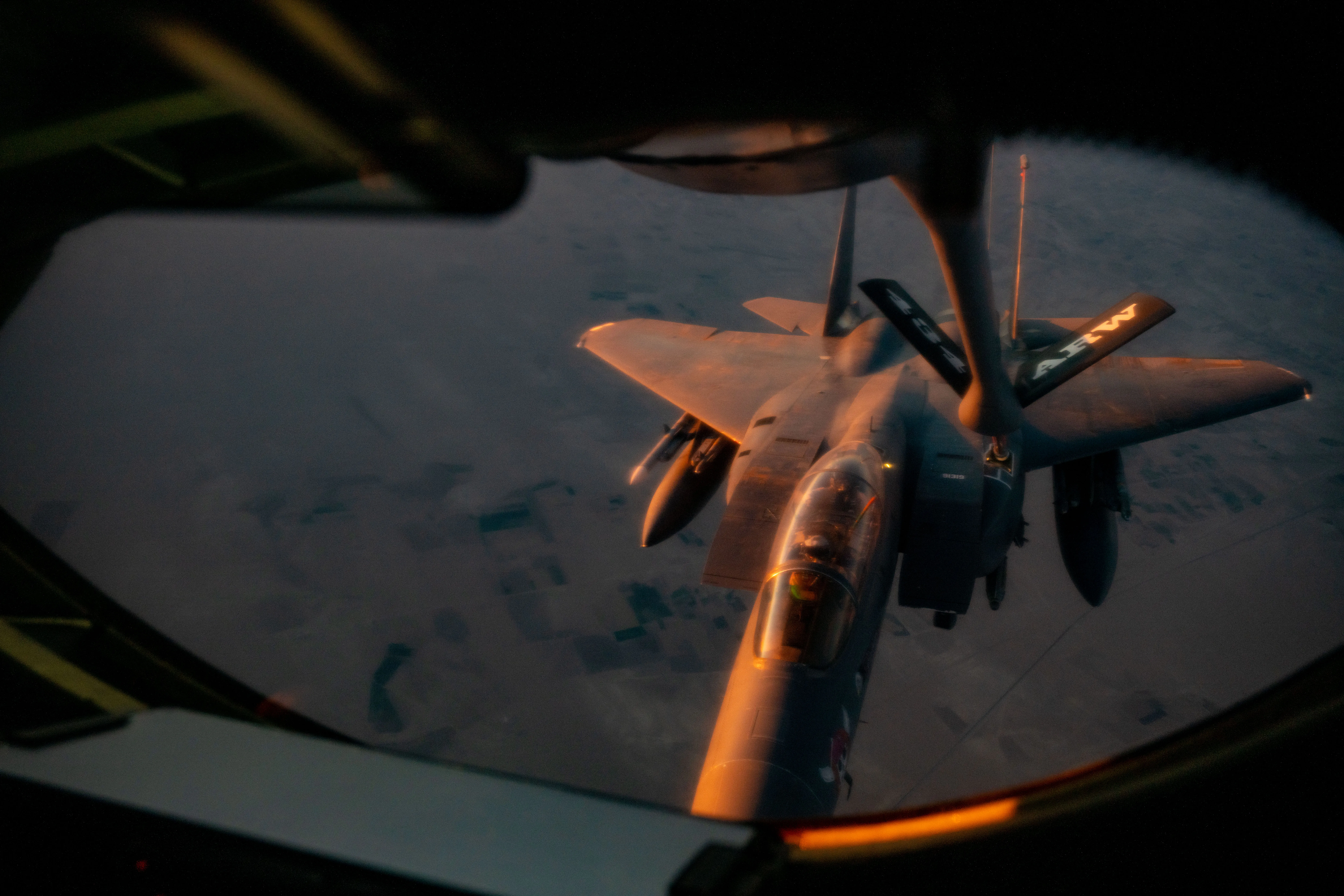
A large wave of American airpower is heading toward the Middle East to bolster forces already there as U.S. President Donald Trump considers an attack against Iran. Online flight trackers are showing F-22 Raptors, F-16 Fighting Falcons, E-3 Sentry radar planes and a U-2 Dragon Lady spy plane either in transit across the Atlantic or newly arrived in Europe. In addition, a seventh Arleigh Burke class guided missile destroyer, the USS Pinckney, has recently deployed to the U.S. Central Command Area of Responsibility (AOR) as well, a U.S. Navy official told us.
While we don’t know whether Trump will decide to attack Iran, these are exactly the movements we’ve been expecting, but so far not seeing, in advance of a sustained operation, both defensive and offensive. The U.S. aircraft heading east represents the most intense phase of a force plus-up that began after Trump started threatening Iran over its harsh treatment of anti-regime protesters. Taken together, the force now assembling in the Middle East, combined with the Israel Air Force’s capabilities, including hundreds of fighter aircraft, as well as USAF ‘global airpower’ bomber flights, would be enough for a major operation that could last weeks not days. We will likely see additional assets deploy in the coming days.

This intensifying buildup comes against the backdrop of another round of peace negotiations between Washington and Tehran that wrapped up Tuesday morning Eastern Time with future discussions being planned. You can read more about that later in this story.
Online flight tracking data shows that at least a dozen F-22s have left Langley Air Force Base in Virginia at about 5 a.m. Eastern, heading east. Their first destination is most likely Lakenheath Air Base in the U.K., a major transit hub for aircraft moving between the U.S. and Middle East. However, we don’t know that for sure and CENTCOM has declined to talk about aircraft, ship and troop movements.
F-22s are primarily America’s most capable air-to-air fighter, but they can also be used to destroy enemy air defenses and strike other ground targets. Raptors helped protect B-2A Spirit stealth bombers during last June’s Operation Midnight Hammer attack on Iranian nuclear facilities. It should be noted that four days before Midnight Hammer, F-22s made a similar transit across the Atlantic and took part in the mission.
At least 36 F-16s appear to be on the move toward the Middle East as well. This reportedly includes 12 each from Aviano Air Base in Italy, Spangdahlem Air Base in Germany and McEntire Joint National Guard Base (JNGB) in South Carolina. As with the Raptors, these jets could be used in a defensive air-to-air role against drones and missiles or in an air-to-ground role. There are a limited number of USAF F-16s already in theater.
Two E-3 Sentry Airborne Warning And Control Systems (AWACS) jets landed at Mildenhall Air Base in the U.K. shortly after 10:30 a.m. local time (about 5:30 a.m. Eastern), aviation photographer Stewart Jack told us. With look-down radar and its advanced communications suite, as well as passive sensors, these jets would play a critical role managing the allied air battle and tracking Iranian threats, especially drones and cruise missiles.

There is also at least one U-2 Dragon Lady spy plane on the way to the region as well. As we have previously noted, the U-2 can provide high-altitude surveillance in addition to serving as a communications link between F-22s and F-35 Lighting II stealth fighters.
Yesterday, 18 F-35A Lightning II stealth fighters left Lakenheath Air Base in the U.K. headed for Muwaffaq Salti, in central Jordan, which has become a central hub for U.S. tactical jets and other aircraft. As we have explained in the past, these types of jets played a key role in Midnight Hammer, suppressing and destroying Iranian air defenses. They were also the first tactical aircraft in and the last ones out.
These movements follow previous flights of F-35A Lighting II stealth fighters, F-15E Strike Eagles, E/A-18G Growler electronic warfare jets and other aircraft to Muwaffaq Salti, where they joined tactical aircraft, including Strike Eagles, Growlers, and A-10 Thunderbolt II close support jets, already deployed. MQ-9 Reapers and special operations MC-130s and other U.S. assets are also hosted there. The Jordanian base is becoming increasingly crowded, raising questions about where additional aircraft could go. All these assets are deploying to Muwaffaq Salti despite statements from Amman that it would not allow its airspace to be used for any attack against Iran.
Taking these assets out of the fight, or not allowing overflights by other aircraft, reduces the U.S. and allies’ ability to strike targets in Iran. It is unlikely to factor into the possibility of defending against the large number of missiles and drones Iran could fire in retaliation for any attack.
There is also the possibility that Jordan issued its statement for consumption by a home audience wary of war with Iran, especially if that means fighting on the side of the Israelis. It’s also possible that messaging is intended to keep them from being struck by Iran in a massive retaliatory strike, but U.S. access to basing and airspace may be clandestinely allowed, even if to a limited degree. We just don’t know.
On the sea, with the addition of the Pinckney, the Navy now has 12 surface combatants in the area, including the Abraham Lincoln Carrier Strike Group (CSG) and its three Arleigh Burke class escorts, three independently deployed Arleigh Burke class ships in the CENTCOM region and two in the Mediterranean, and three Littoral Combat Ships (LCS) also now in the CENTCOM area. There are also nuclear submarines there, with at least one accompanying each CSG, as well as likely guided missile submarines (SSGN), but the Navy does not disclose the location of those boats.

In addition, the Gerald R. Ford CSG is now in the 6th Fleet region, a Navy official told us. The carrier and its three Arleigh Burke escorts were ordered by Trump to head to the Middle East from the Caribbean, where it took part in the mission to capture Venezuelan dictator Nicolas Maduro. There are also more than 30,000 U.S. troops in bases across the Middle East.
Having two carriers, with F/A-18E-F Super Hornets and EA-18G Growlers, and one with F-35Cs, all escorted by Aegis-equipped, missile carrying Arleigh Burkes add a significant amount of mobile firepower that gives U.S. planners increased flexibility.

As the U.S. boosts its assets, the Iranian Islamic Revolutionary Guard Corps (IRGC) has closed off the Strait of Hormuz for a live-fire exercise, state media reported. It marks the first time Iran has shut parts of the Strait since Trump threatened Iran with military action in January.
Dubbed “Smart Control of the Strait of Hormuz,” the drills began Monday and include firing anti-ship cruise missiles at targets and IRGC naval drone and submarine units carrying out operations originating from the three Iranian islands, according to Iranian media.
“The armed drones used in the exercise—capable of engaging both air and sea targets—are among the IRGC Navy’s newest strategic platforms and are deployed in significant numbers, though their names and technical specifications remain classified,” the official Iranian FARS News outlet claimed.
An official from CENTCOM, which had previously warned against Iranian actions in the Strait, declined comment on Tuesday.
You can read more about how Iran could shut down the Strait, a stragetically important chokepoint through which about 20% of the world’s crude oil passes, in our analysis of the possibility here.
In a speech Tuesday morning, Iran’s Supreme leader Ayatollah Ali Sayed Khamenei issued a threat against U.S. warships.
“We constantly hear that they have sent a warship towards Iran,” Khamenei said. “A warship is certainly a dangerous weapon, but even more dangerous is the weapon capable of sinking it.”
The Iranian leader offered no details about what weapon.
Meanwhile, as both sides rattle sabers, the indirect negotiations in Switzerland, moderated by Oman, ended on Tuesday with an agreement on a “set of guiding principles,” according to Iran’s foreign minister. Abbas Araghchi said both sides had agreed to exchange drafts on a potential deal. However, Araghchi “was as positive as he was vague, providing little clarity on what had been discussed or when the next round of discussions might be held,” The New York Times noted.
“American officials did not immediately comment publicly on the talks, but one U.S. official, speaking on the condition of anonymity to discuss private negotiations, said the two sides had made progress,” the publication added. “The official said the Iranians would provide more detailed proposals in the next two weeks to address some of the gaps between the United States and Iran, but did not provide any specifics.”
“We now have a clear path ahead, which in my view is positive,” he said.
Araghchi told Iranian state television that the talks had been “more constructive” and had made “good progress” compared with a previous round of negotiations in Oman this month.
Still, there remains a wide gap between Washington and Tehran. Trump does not want Iran to have nuclear weapons or the capacity to build them while Araghchi “has emphasized that Iran’s right to use peaceful nuclear energy is inherent, non-negotiable, and legally binding,” according to the official Iranian IRNA news outlet.
In an interview with Fox News on Tuesday, U.S. Ambassador to NATO Matt Whitaker said the Trump administration is willing to negotiate, but noted what Trump told reporters aboard Air Force One on Monday that “it would be a very bad day for Iran” if it decides not to reach an agreement.
Though these talks may be progressing to another round, remember that three days before Midnight Hammer, the White House said Trump would decide “within two weeks” about whether to strike or keep negotiating.
While Trump’s ultimate intentions toward Iran remain a mystery, this latest influx of U.S. air and sea power gives him greater options, and above all else, far more credibility that an attack could do massive damage to the Iranian regime, which could factor heavily in negotiations.
The bottomline here is that we are finally seeing the exact force mix coalesce that would be expected of a major air campaign against Iran, especially if Israel intends to play a central role with all its assets already in the region.
Contact the author: howard@thewarzone.com