LA film students are eager to pick up Hollywood’s pieces
Film student Angela Henderson was collecting her thoughts, resting on the patio of USC’s School of Cinematic Arts on a recent sunny afternoon while listening to music on her headphones as she stared into the sky. Henderson was taking a short break after applying for dozens of Hollywood jobs.
The 22-year-old cinema and media studies student graduates in December, and she’s admittedly “a little freaked out” by what awaits her.
“What if one day, I am one of those people that ends up losing a job?” Henderson said.
She isn’t wrong to wonder.
Partly fueled by media consolidation, waves of layoffs have swept across the industry, bringing job cuts to Netflix, Walt Disney and Warner Bros., recently acquired by Paramount-Skydance.
Productions keep leaving the state and artificial intelligence and vertical video are reshaping what gets made and who makes it.
Yet aspiring actors, screenwriters and directors, many of them film school students like Henderson, are still making the pilgrimage to Los Angeles. The Times spoke with some of these students about how they plan to navigate today’s Hollywood. Most are clear-eyed about the odds, and none of them are planning to quit.
“Some of us can see a lot of doom and gloom,” said Miranda Banks, a professor of film, television and media studies at Loyola Marymount University. “But this generation has their eye on the power of human creativity in a way that I’m not sure any of us in other generations have been so attuned to.”
She thinks many of her students have a good chance at making it if they are “savvy and strategic” about where the industry is headed.
“We’ve had a lot of unprecedented years, a lot of years with strange things that have impacted the industry and made things particularly challenging,” Banks added. “That has happened before. It will continue to happen.”

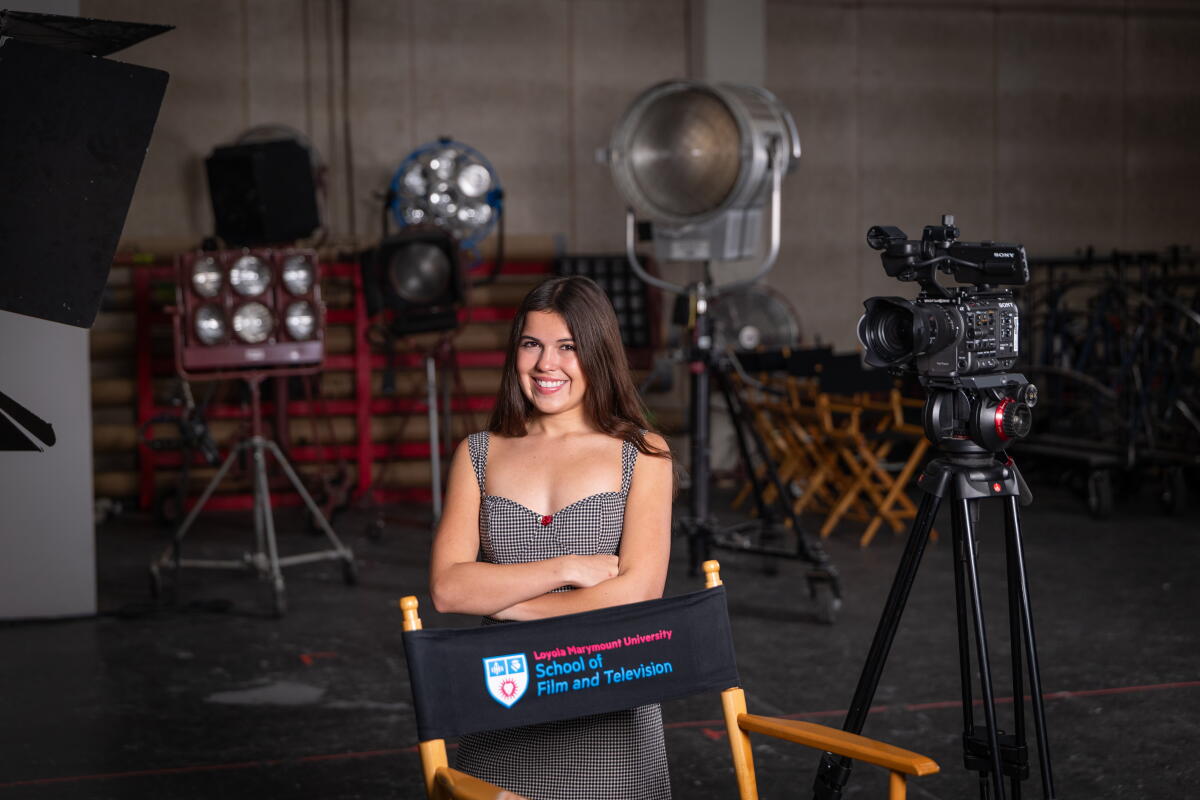
Gianna Jordano, a freshman film and television production major at Loyola Marymount University, is photographed on a film stage inside the Wil and Mary Jane Von der Ahe Communication Arts Building, which houses LMU’s School of Film and Television.
(Allen J. Schaben / Los Angeles Times)
Gianna Jordano, Loyola Marymount University, 19
When Gianna Jordano first applied to film schools, she said she knew the industry was in a bit of a “slump stage.” With fewer movies being made, the impact of AI and an overall lack of jobs, the Huntington Beach native said she was nervous about pursuing a career in the film business.
But after seeing movies like “Primetime,” “The Odyssey” and “Spider-Man: Brand New Day” in theaters this year, Jordano is more inspired than ever.
“My friends and I’ve all been watching all of these new movies, and we’re saying, ‘This is what we want to do. This is what I want to pursue in the future and be able to achieve,’” said the film and TV production major. “I feel less nervous now.”
After graduation, she plans to work her way up to directing — even if that means taking other jobs such as teaching and working in a restaurant to achieve her dream.
“The more open-minded you are, and the more willing you are to work, the easier it is to find a job, even if you’re maybe not always on the best set or doing the job that you want to do,” Jordano said.

Teddy Abularach, left, and Mitch Linebaugh, both 18, visit the Herbert E. Farmer Motion Picture Technology Collection at the USC School of Cinematic Arts.
(Genaro Molina / Los Angeles Times)
Teddy Abularach and Mitch Linebaugh, USC, 18
Freshman screenwriting majors Teddy Abularach and Mitch Linebaugh had recently moved to L.A. from New York City and Des Moines, respectively, to pursue careers in screenwriting.
Despite shared concerns about landing jobs after graduation, both are determined to succeed in the business.
.
“We’re just gonna have to work that much harder to get a job. I’m already preparing myself for a brutal postgrad life,” Abularach said. “I wouldn’t be happy if I were in another job. … Even if there’s a small chance for me to succeed and be able to pay the bills and do something that I love, it’s worth it.”
They aren’t blind to the challenges of being a screenwriter.
But Linebaugh said he worries that “everything is just going to become so uniform,” as the industry seems to lean too heavily on algorithms and audiences’ preferences.
“I don’t think people in this industry will let that happen — everyone from the writers to even the executives,” Linebaugh said. “I know the stereotype is that they like to keep their jobs, but I remain hopeful that they want to make good movies too.”
The two 18-year-olds moved to the city with every intention of staying, even as the industry’s local footprint hollows out.
Linebaugh said he’s going to give screenwriting his all, and if it doesn’t work out, he will consider graduate school or entertainment law.
Abularach said there’s no “plan B outside of entertainment.”
He’s already preparing for the life.
“I still can’t get the stereotype out of my head of the L.A. writer who does all the things in L.A., like taking pitch meetings, getting coffee and being in writers’ rooms,” added Abularach.

UCLA film student Tomas Carrasco, center, has makeup applied by UCLA student Song Diqiong, right, before performing in his short film, “D-Facer, Reality Break,” on the set inside Melnitz Hall on the UCLA campus. He wrote, produced, starred in and directed his short film.
(Genaro Molina / Los Angeles Times)
Tomas Carrasco, UCLA, 25
In a hallway lined with movie posters in UCLA’s School of Theater, Film and Television, Tomas Carrasco was in the middle of preparing to shoot his senior capstone film: a surreal horror comedy. The senior, who’s on the director’s track of UCLA’s film and television program, said he isn’t “afraid necessarily about where the industry’s heading because there’s always going to be space for artists.”
Growing up in the San Fernando Valley, Carrasco was always fascinated by moviemaking. His father worked as a soap opera editor and would sometimes bring him to set, where he learned to love the “feeling of being around people making stuff.”
He started his film education at Santa Monica College, where he took every film class offered. Now, he has his sights set on production design.
For all his artistic leanings, he said he’s well aware that movies are products that need to make money. Because of that, he sees more of the industry turning toward technology instead of taking art-centered risks.
“I see the mergers that are happening and all the AI stuff sucks. I don’t like it,” Carrasco said. “But I still have to come into class every day and do my homework. I’m thinking about where the industry is heading, but it takes up as much space as a movie idea.”
As he prepares for an uncertain future, Carrasco plans to keep working at his family’s Northridge cafe, Mate Conmigo, where he can pursue his creative ambitions while maintaining a stable job.
“I do want it as a career path, and I don’t want to be naive,” he said. “But you have to kind of be naive. You have to be delusional about wanting to have a career in the arts.”

USC film student Angela Henderson, 22, stands next to a photo of director Orson Welles at the Herbert E. Farmer Motion Picture Technology Collection at the USC School of Cinematic Arts.
(Genaro Molina / Los Angeles Times)
Angela Henderson, USC, 22
For Henderson, part of the job-induced anxiety is simple math.
“Unfortunately, it’s so hard to be able to separate myself from it,” she said. “There are hundreds of people in film programs here who all want to have the same jobs and careers.”
Raised in Eagle Rock by two musician parents, Henderson always had the world of entertainment within reach. At 10, she took up acting and started doing theater and commercials. She began college at UC Berkeley, where she realized she didn’t want to be only in front of the camera, but also to study the medium from behind it. She transferred to USC with dreams of following filmmakers like Greta Gerwig, who got their start in writing and directing their own projects.
If it takes a while for Henderson to break into the industry, so be it. She said she’s open to any kind of job, including assistant work and food service.
But Henderson said her generation of filmmakers doesn’t feel discouraged, so much as eager to incite change. They’re largely tired, she said, of watching Hollywood “recycle the same material over and over again,” and want to bring new stories to the table.
“It does feel like we’re on the verge of something new. There’s a breakthrough that’s about to happen,” Henderson said. “With all the verticals happening, and the AI slop stuff happening on social media, there’s also like this huge renaissance in indie movies … there’s still this hope that there’s something new that’s going to come.”