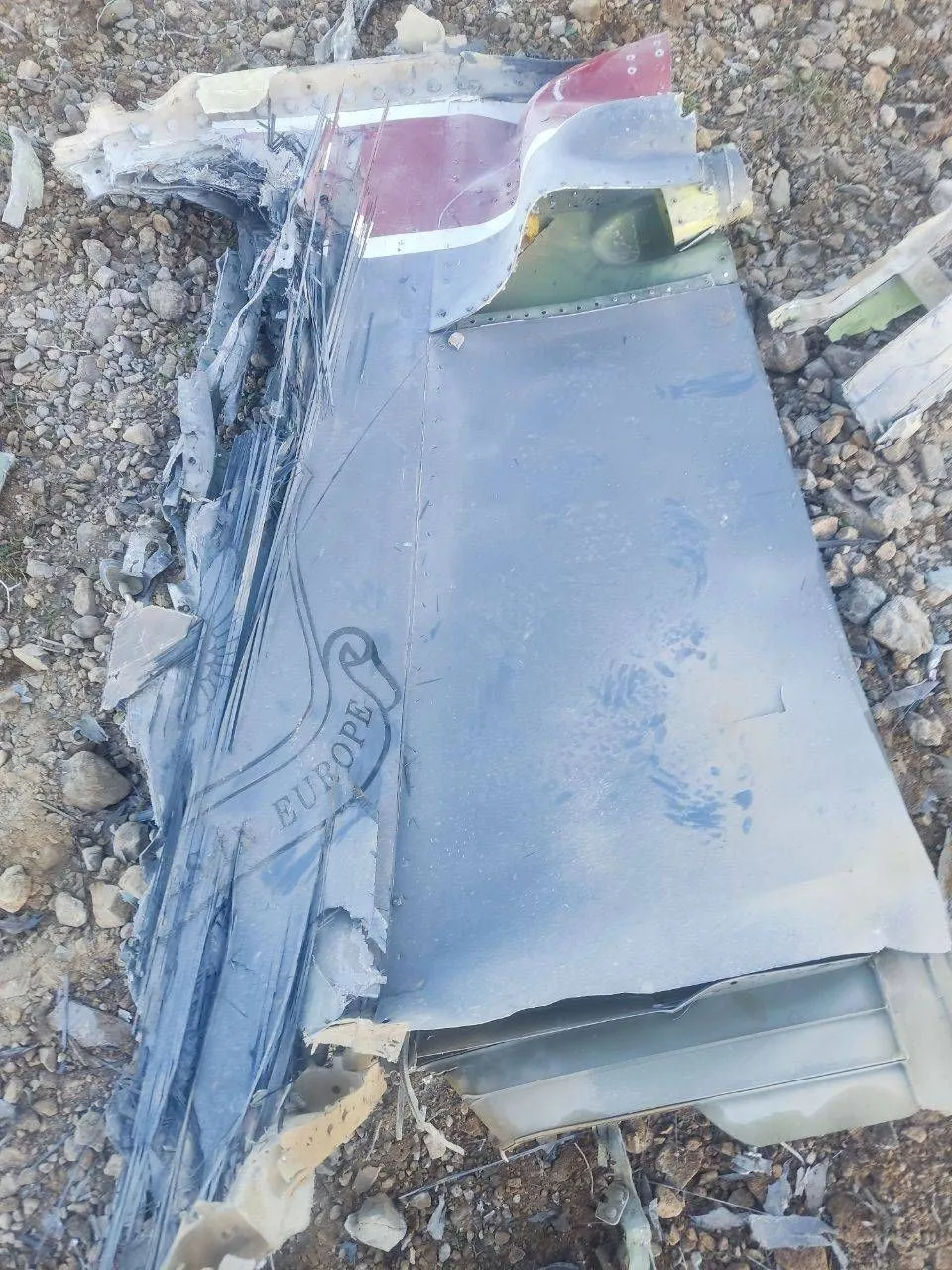
Iran’s armed forces claim that a U.S. fighter jet has been shot down over the country. According to Iranian state media, a U.S. F-35 was downed, although photos of the wreckage of a fighter on the ground point squarely to the aircraft involved being a U.S. Air Force F-15E Strike Eagle — provided they are legitimate.
UPDATE: See latest info on the loss of the F-15E over Iran and the ongoing combat search and rescue operation at the bottom of this post.


A spokesperson for Iran’s Khatam al-Anbiya central headquarters said today that an F-35 was brought down over the central part of the country by a new type of air defense system operated by the Islamic Revolutionary Guard Corps (IRGC), with little chance the pilot survived, Reuters reports. The F-15E carries two aircrew, while the F-35 is a single-seater. At this point, we have no firm indication of the fate of the crew if such an incident did indeed take place.

It also remains possible that the images of the wreckage have been manipulated, and we are dealing with misinformation. However, the photos appear genuine and are certainly consistent with parts of an F-15E, including one of the vertical tails, and parts of the wing and tail. There is also the possibility that the images derive from an earlier F-15E loss, which we will come to later.


Specifically, the tail seen here would indicate an aircraft assigned to the 494th Fighter Squadron at RAF Lakenheath in England, based on its red band. This is one of the units that has been deployed to the U.S. Central Command (CENTCOM) area of operations for Epic Fury. The 494th FS has also been extremely active over the CENTCOM area of responsibility for many years.


We should also consider that the F-15E could have come down for multiple reasons other than being shot down by air defenses, as Iran claims. Potentially, the jet could have been hit and lost its tail and even part of its wing, before returning to safe airspace. That might sound incredible, but F-15s have done this before.
Iran might also be presenting some other F-15E wreckage. Iran has collected many wrecks of foreign aircraft over the years, but where this one would have come from is not clear.
Previous documented F-15E crashes in the Middle East or Afghanistan don’t involve aircraft from the 494th Fighter Squadron, as far as we can ascertain. Specifically, since Desert Storm (when the 48th Fighter Wing operated F-111s, not F-15Es), these (non-combat) losses occurred in Iraq (April 2003, 335th FS, 4th FW), Afghanistan (July 2009, 336th FS, 4th FW), and Libya (March 2011, 492nd FS, 48th FW).
Hours before the F-35 claim, the IRGC released a video of what it said showed the successful shootdown of a U.S. F-15 over Qeshm Island, in the Strait of Hormuz. In this case, they attributed the claimed shootdown to an unnamed advanced naval air defense system. The video shows the typical ground-based FLIR systems we have seen in use by air defenses in Yemen and, more recently, Iran. The video does not show the aircraft being struck, but it does show it maneuvering and releasing flares.
That claim was swiftly rebutted by CENTCOM.
At this point, it is unclear if these various incidents are connected, especially since the IRGC specifically identified an F-35 as being shot down, while the claimed Qeshm Island video and the apparent wreckage on the ground clearly show F-15s.
It should be recalled that three F-15Es were brought down over Kuwait in a friendly fire incident earlier in the campaign. CENTCOM confirmed that the six crew members involved ejected safely, and at least some of those remained in theater and have resumed combat operations. It was reported that the three Strike Eagles were brought down by a Kuwaiti Air Force F/A-18 Hornet, although many details of the incident remain unclear. At least one of these jets was from the 48th FW, so we cannot entirely rule out the possibility that we are seeing photos of wreckage from that incident here.
Last month, the IRCG claimed that a U.S. Air Force F-35A was hit over Iran, and U.S. officials confirmed the jet made an emergency landing, with the pilot having sustained shrapnel injuries. The IRGC released a video that they claimed shows the F-35 being hit by a missile, as seen through a forward-looking infrared (FLIR) system that is identical to the kind in yesterday’s supposed footage of the shootdown.
There appear to have been near-misses for U.S. fighter jets operating over Iran, too. On March 26, videos emerged showing an apparent very close call for a U.S. Navy F/A-18E/F Super Hornet after it was targeted by what appears to have been an Iranian man-portable air defense system (MANPADS). The F/A-18 was conducting a low-level strafing run at the time.
Taken together, all these events underscore the persistent threat posed by Iranian air defenses, whatever is left of them. Despite claims from U.S. officials of aerial superiority over Iran, the continued risk from various air defense systems is something that we have repeatedly drawn attention to.
The apparent incident today comes amid continuing regional tensions, with Iran launching more attacks across the Middle East, including missile strikes targeting Israel and Bahrain, as well as a drone attack that set an oil refinery in Kuwait on fire.
We have approached CENTCOM, the Pentagon, and U.S. Air Forces in Europe for more information and will continue to update this story as more details emerge.
UPDATES:
UPDATE: 6:27 PM EST –
The video we showed earlier of Iranian law enforcement shooting at low-flying U.S. Black Hawk helicopters was geolocated to near Choram, Iran, about 70 miles north of the Persian Gulf in that country’s southwest.
UPDATE: 5:28 PM EST –
The White House has called a “lid,” meaning that Trump has no further scheduled public events or media engagements this evening. However, he and his national security team are reportedly still meeting as the search goes on for the missing F-15E aviator.
UPDATE: 5:28 PM EST –
In a brief Friday phone interview with The Independent, Trump declined to say what his course of action might be if the missing crew member of a downed F-15E is captured or harmed by Iran..
“Well, I can’t comment on it because — we hope that’s not going to happen,” the president stated before ending the call.
UPDATE: 5: 19 PM EST –
The House Armed Services Committee was “notified by the Pentagon on Friday that the status of the second F-15E Strike Eagle service member is NOT known,” the Hill reported on X.
UPDATE: 5:11 PM EST –
Trump’s national security team is gathered at the White House, ABC News is reporting on X.
The president “has been working in the Oval Office or Oval Dining Room all day receiving updates,” the network added, citing a senior official.
There has been no public comments from Trump outside of social media posts, ABC noted.
UPDATE: 4:59 PM EST –
The Washington Post is also reporting that an A-10 was struck by incoming fire over Iran. The pilot “navigated the damaged plane to Kuwaiti airspace before ejecting and was subsequently rescued,” the publication stated.
In addition, it confirmed an earlier NBC report that two U.S. Black Hawk helicopters involved in the search-and-rescue effort were also hit by Iranian fire. The Post added that the attack “injured U.S. personnel on board, though both aircraft have safely returned to their base.”
As we noted earlier in this story, The New York Times reported that an A-10 was shot down while Fox said that was inaccurate.
Neither the Pentagon nor CENTCOM have responded to requests for comment.
UPDATE: 4:22 PM EST –
NBC News reports that two U.S. helicopters taking part in the recovery of the pilot of the downed F-15E were struck by Iranian fire, but that the troops are all safe.
UPDATE: 4:08 PM EST –
NBC News stated that in a brief phone interview, President Trump “refused to discuss the specifics of ongoing search and rescue efforts in Iran after an American jet was downed.”
However, he “expressed frustration about some of the coverage of what is plainly an intense and sensitive rescue operation,” the network reported.
Asked if today’s events will affect any negotiations with Iran, the president said it would not.
“No, not at all. No, it’s war. We’re in war, Garrett,” he said.
UPDATE: 3:58 PM EST –
Now Fox News is pushing back against the New York Times story about the A-10 crash,
“An A-10 Warthog attack caught ‘enemy fire’ while a rescue operation for the U.S. crew member took place,” the network reported, citing “a well-placed source.”
We have reached out to CENTCOM, which has not responded to numerous requests for comment, for clarity on these claims.
UPDATE: 3:31 PM EST –
Video emerged purporting to show members of the Iranian Law Enforcement Command (FARAJA) firing small arms at Black Hawks flying at low altitude. While Newsmax reported that a Black Hawk was struck in Iran, it is unclear if it was during this engagement.
UPDATE: 3:25 PM EST –
Newsmax is now reporting that the Black Hawk was indeed hit and that the crew is accounted for and safe.
UPDATE: 3:15 PM EST –
Iran’s semi-official Fars news said Tehran has rejected a White House request for a 48-hour ceasefire.
“Assessments indicate that this proposal came after the escalation of the crisis in the region and serious problems for US military forces due to an incorrect estimate of the Islamic Republic of Iran’s military capabilities,” the outlet claimed. “Iran’s response to this proposal was not in writing, but rather a field response with continued heavy attacks.”
We have reached out to the White House for comment.
UPDATE: 3:03 PM EST –
The Pentagon has finally added Epic Fury to its online casualty database. To date, there have been 13 troops killed and another 365 wounded.
UPDATE: 2:58 PM EST –
The New York Times is reporting that an A-10 Warthog close support jet also crashed in the Persian Gulf region on Friday. The pilot was safely rescued, the newspaper stated, citing two anonymous officials.
“The A-10 Warthog attack plane went down near the Strait of Hormuz about the same time that an Air Force F-15E was shot down over Iran,” according to the publication.
UPDATE: 2:50 PM EST –
Israel suspended airstrikes in Iran amid the U.S. search and rescue effort after a F-15E fighter jet was downed on Friday, according to The Associated Press.
An Israeli official told the AP that the airstrikes were halted in areas “relevant” to the rescue effort.
UPDATE 2:35 PM EST –
Newsmax is reporting that in addition to the F-15E being downed and one of the pilots rescued, a Black Hawk helicopter taking part in CSAR operations may have been hit over Iran as well. While The War Zone cannot independently verify this, the claim highlights the dangerous nature of these operations.
UPDATE: 2:10 PM EST –
President Donald Trump has been briefed on the downing of the F-15E, Al Jazeera is reporting.
“He has been briefed,” White House Press Secretary Karoline Leavitt said, the White House told us.
UPDATE: 12:30 PM EST–
The critical nature and the huge challenges involved in mounting a CSAR operation in Iranian territory are something we discussed before the war began, as you can read about here.
Specifically, on the CSAR part, we highlighted:
The U.S. has the most advanced air combat capabilities on earth, but ‘shit happens,’ especially during war. Even the Houthis nearly downed U.S. fighter aircraft optimized to destroy enemy air defenses. But regardless of defenses and the state of Iran’s air defense overlay, putting Americans over Iran, and repeatedly over days and weeks, is a risk. Aircraft can malfunction, and mistakes can be made. When that happens, it will require even more risk to push combat search and rescue assets into the area to try to recover the crew. In other words, regardless of America’s outstanding air warfare capabilities, there is still a real risk involved in any operation over Iran.
And that is just what we’ve seen today.
As for CSAR operations and the packages of assets used to go in and pluck downed aircrews from deep inside contested territory, these can look different based on where the incident occurred, what the enemy’s capabilities are, what assets are available and intelligence at the time. These highly tailored groups of assets are tasked with one of the toughest missions imaginable, penetrating into potentially highly defended territory where, in some cases, even America’s most capable combat aircraft did not survive. This would likely be occurring when an enemy is on its highest alert and very active searching for the downed aircrew. In other words, they know you are coming. Executing these operations at night is ideal, but sometimes, daylight cannot be avoided, upping the danger.
The risks are immense as putting many more lives and assets, the latter of which could be more vulnerable than the one lost, at risk in order to rescue a small number or aircrew can cascade quickly into a much larger disaster. While the rotary-wing aircraft and the Pararescuemen (PJs) they carry are often the stars of the CSAR show, a huge array of assets participate in these operations to make them have the best chance at success. This includes C-130s working in the aerial refueling and support role that enables the rescue helicopters to get to their target area. Fixed-wing attack aircraft working in the ‘Sandy’ close air support role aimed at opening holes for helicopters at their landing zones and protecting them and the rescue party once on the ground. They are also a contingency in place if a rescue asset also goes down, buying that crew time until another asset in the rescue party can swoop in and grab them. In the modern era of warfare, drones, such a MQ-9 Reapers, can also be risked ahead of the CSAR force to gather intel and surveil the landing zone. Also knowing what took down the stranded aircrew’s aircraft can be a big help in seeing the rescue force gets in and out of the area safely, as well.

CSAR Training • A-10 Warthogs Fly Close Air Support
From there the list is endless. This package would often require a counter-air capability of fighters providing defense against aerial threats. F-22s, F-15s, F-16s, can all provide this depending on the level of threat in the area. The force would also need to be backed by suppression of enemy air defenses (SEAD) aircraft, such as F-16CJ/CMs or F-35As, that would work to suppress or destroy any pop-up surface-to-air missile threats. Then you have standoff jamming support aircraft to help all this survive and airborne early warning and control (AEW&C) assets to coordinate the air battle and keep an eye out for threats. Then there are the tankers, lots and lots of tankers, to keep all this stuff in the air for a prolonged period of time. Beyond this sampling of aircraft, there are many more assets and capabilities all over the globe and in space that would support such an operation.
And this is just a snapshot of the USAF’s CSAR portfolio, the Navy and Marines have their own tactical recovery of aircrew and personnel (TRAP) packages.
In the case of an air war like the one over Iran, these tailored packages were well thought through in advance and CSAR sits alert at all times ready to go execute the mission. The longer it takes to get to the target area the lower chances the crew has of surviving and/or not being captured. This can be a game of minutes or hours, not days, but bringing all these assets together and getting them on the same page without making things worse does take some time. Considering what is at stake, CSAR crews move as fast as possible to get the mission in motion as they know their job only gets exponentially harder and more dangerous with time, as does evading enemy capture for the downed crew.
The big takeaway here is that these are extremely complex and highly-integrated operations, usually executed under very tight timelines.
UPDATE: 12:20 PM EST–
U.S. officials have confirmed to CBS News that one crew member from the F-15E downed over Iran has been rescued by American forces.
A search and rescue effort is ongoing for the other crew member, the same sources said.
UPDATE: 12:00 PM EST–
White House Press Secretary Karoline Leavitt has apparently told CNN that President Trump has been briefed on the situation regarding the F-15E shootdown. We are still waiting to hear back from CENTCOM, the Pentagon, and U.S. Air Forces in Europe for anything more concrete on the incident.
In what may well turn out to be a separate incident, there are reports that a U.S. Air Force F-16 flying in an area around the Iraq-Iran border has squawked 7700, the universal, international transponder code used by aircraft to immediately alert Air Traffic Control (ATC) of a general emergency. We have again reached out to CENTCOM for more details.
UPDATE: 11:35 AM EST–
Very much unconfirmed at this stage is a report from N12 News in Israel, citing a Western source, who says that one of the two U.S. aircrew of the downed F-15E has been rescued.
UPDATE: 11:30 AM EST–
We seem to have gotten an update on the earlier report that Iran was offering a bounty for the safe recovery of a U.S. pilot. Authorities are now reportedly offering a sum of around $60,000.
The Iranian Mehr News Agency reports that a U.S. helicopter involved in the rescue effort was hit by some kind of Iranian projectile. It is unclear if the helicopter was brought down or if it is the same example that was reported as “attacked by air defense near the border and fled the scene.” Of course, this could be nothing more than propaganda. Although imagery reportedly showing a hit on the helicopter is circulating on social media, it is far from clear whether or not it is authentic.
UPDATE: 11:20 AM EST–
Videos also continue to emerge claiming to show HC-130Js operating over Iran, often at low level. In its official factsheet, the Air Force stresses that HC-130J crews “normally fly night, at low to medium altitude levels in contested or sensitive environments, both over land or overwater.” Such overt daytime flights would point to the particular urgency of this mission, but it is worth noting that the HC-130J is also well equipped with self-protection gear.
Unverified for now are videos coming out of Iran that claim to show locals firing small arms at U.S. aircraft involved in the rescue effort.
UPDATE: 11:10 AM EST–
The Guardian appears to be one of the first major news outlets to report that the aircraft shot down was an F-15E, citing U.S. officials familiar with the situation who confirmed this fact off the record, and that the Pentagon was scrambling to find the crew.
The same has been reported by specialist press, including Air & Space Forces Magazine.
UPDATE: 10:40 AM EST–
Multiple major news agencies, including CNN, the New York Times, and Reuters, are now reporting that a U.S. fighter jet has been shot down over Iran. The incident would mark the first time a U.S. aircraft has been shot down over Iran during the conflict — at least that we know about.
According to CNN, three U.S. sources have confirmed Iranian state media reports. Reuters cites a single U.S. official.
CNN has geolocated some of the videos of CSAR efforts in the Khuzestan province in central Iran. One of the videos shows a bridge over the Karoon River, which is around 290 miles south of Tehran.
An unverified video said to be taken from the area of the rescue effort shows an A-10C attack jet. The A-10 is well-versed in the Sandy mission, a specialized CSAR role in which the jets provide close air support for downed aircrew and escort rescue helicopters.
UPDATE: 9:00 AM EST–
Citing Iranian media as well as an unnamed source familiar with the incident, Axios reports that Iran did shoot down a U.S. jet, and that a search and rescue effort is underway to locate two crew.
UPDATE: 8:50 AM EST–
At least some official Iranian media channels are now also reporting the U.S. military aircraft claimed shot down over the country earlier today as an F-15E, rather than an F-35.
UPDATE: 8:35 AM EST–
Iranian television channels are apparently now broadcasting a message offering a reward from the regime for anyone who can capture the U.S. pilot alive.
UPDATE: 8:30 AM EST–
Additional videos, purportedly taken in Iran, appear to show a pair of HH-60 helicopters taking turns to refuel from an HC-130J.
UPDATE: 8:15 AM EST–
Tasnim, the semi-official news agency in Iran associated with the Islamic Revolutionary Guard Corps, claims that U.S. attempts to rescue a downed fighter pilot (singular) have failed. The agency says that this was confirmed to them by “news sources” in Kohgiluyeh. The report continues: “The Americans have been conducting search operations for hours using Black Hawk helicopters and a Hercules 130 aircraft to rescue their fighter pilot who was shot down by Iranian armed forces; however, their attempt has failed.”
One of the helicopters involved in the rescue effort was “attacked by air defense near the border and fled the scene,” Tasnim adds.
In a post on X, Tasnim claims: “Unconfirmed reports suggest that Iranian security forces have taken into custody the pilot of a U.S. F-35 fighter jet following its destruction by the country’s air defense system inside Iranian territory.”
Of course, all of these claims remain unverified at this point. It is also puzzling, to say the least, why Iranian reports are consistently identifying the jet as an F-35, while publishing photos of an F-15E.
Unverified footage suggests that the CSAR effort over Iran may also now be supported by F-35 fighters and MQ-9 Reaper drones.
UPDATE: 7:50 AM EST–
Unverified claims from Iranian sources, as well as imagery, suggest that the U.S. military may have staged an effort to rescue pilots from the downed F-15E fighter jet in Iran. Available imagery points to the use of C-130 and H-60 Black Hawk series aircraft. Specifically, U.S. Air Force combat search and rescue efforts typically rely upon the heavily modified HH-60 helicopters for extraction, HC-130J Combat King II aircraft for command and refueling, and highly specialized pararescuemen (PJs).
Also unverified, at this point, is the following image, which claims to show one of the two ejection seats from the downed F-15E.
Contact the author: thomas@thewarzone.com