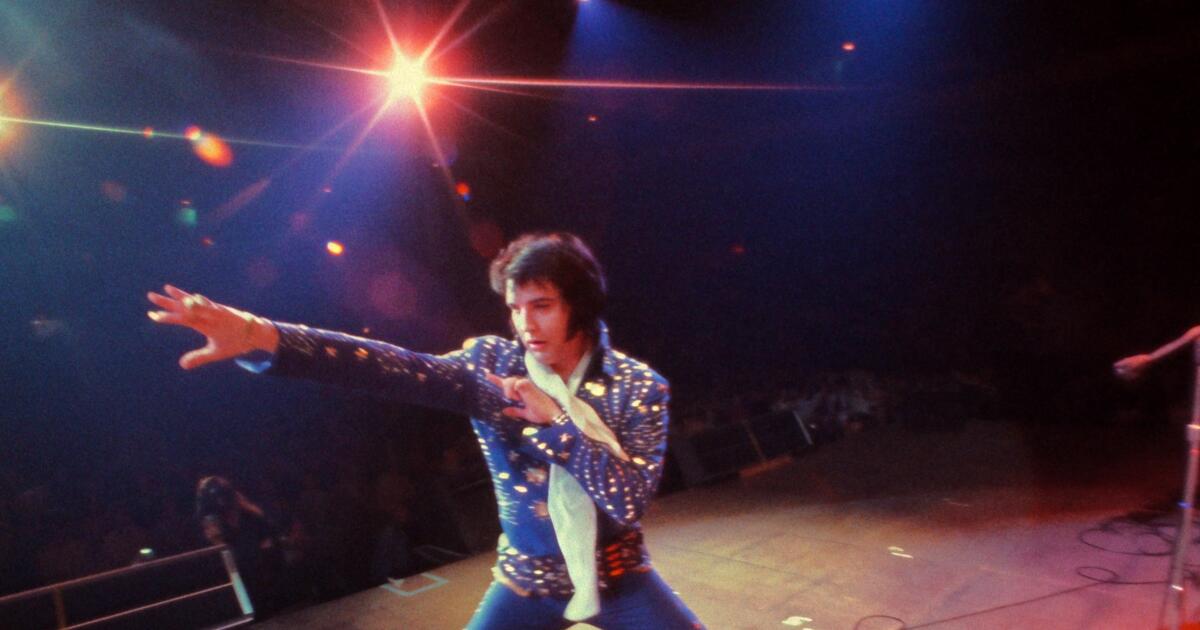
The first hour of “EPiC: Elvis Presley in Concert” convinces you that the King is the greatest entertainer who ever lived. By the end of it, he’s a god. Director Baz Luhrmann claims he made this Imax documentary so that any poor souls who never got to see the King live can worship him in action. Really, I think Luhrmann is praying that in a thousand years, some alien civilization will discover this footage and build a whole religion around the thrall Elvis’ hip thrusts had over a crowd.
If that future comes to pass, then Luhrmann himself will be elevated as a key disciple. He’s so devoted to Elvis that this is his second tribute in four years, the other being, of course, his 2022 biopic “Elvis,” starring Austin Butler, who was good in the role if not quite iconic. That more traditional film hewed to the genre’s standard rise-and-fall narrative and was dinged mostly because the King’s life represents so many things to so many people — race, class, controlling relationships — that it’s impossible to please everyone or for any actor to fill his blue suede shoes.
“EPiC” sticks to the surer footing of documentary footage: the man himself performing over two dozen tunes — including “That’s All Right,” “Burning Love” and “In the Ghetto” — plus twice that number on the background soundtrack. (I’m not into his gospel hits, but they suit the mood.) A dream concert that’s longer and larger than what fans could have seen in reality, the movie is stitched together primarily from Elvis’ Las Vegas appearances in 1970 and 1972. You can tell which year it is by the amount of rhinestones on his costumes, which become increasingly maximalist.
When Elvis retook the stage in 1969, he hadn’t performed before a live audience in nine years and he’d gotten a little uncool. Beatlemania had dinged his appeal so perilously that editor Jonathan Redmond splices its arrival with images of car crashes and missile attacks. Reporters at that comeback show noted that most of his fans were now — horrors! — over 30, with the exception of a 25-year-old who said he attended out of nostalgia.
Luhrmann quickly sets up the essential framework, then Luhrmann picks up a year after Elvis proved he was still a smash. No longer constrained by moral panic, the Army draft or the decade he spent trapped within the Hollywood industrial complex, this is the King at arguably the high point of his career, right in that sweet spot before his 1973 divorce from Priscilla Presley, after which his mood and health started to flag.
This Elvis comes across confident, breezy, comfortable and funny. In one scene, he jokes about the difficulty of lunging to the ground in a tight jumpsuit (an outfit he adopted because he was nervous of ripping his pants). Later, he switches up the lyrics to “Are You Lonesome Tonight?” to croon, “Do you gaze at your forehead and wish you had hair?”
The camera often seems to be right under his chin, gazing as the sweat on his cheeks and lashes shimmers under the Vegas lights like diamonds. His spell over the crowd feels at once intimate and volcanic. You get the best look at his charisma when Elvis targets his energy at an unsuspecting back-up singer in the middle of “Suspicious Minds.” Slowly striding toward the girl, he hypnotizes her as skillfully as a snake charmer and then, as a punchline, lunges in her direction. She jumps and giggles.
While we become familiar with the faces of his band members, the film doesn’t bother to mention any of their names, not even in the credits. They deserve better, but the film is about how the concert felt, not how it came to fruition. Still, once you get over the contact high of Elvis’ psychedelic neon pink paisley shirt in the rehearsal studio, it’s delightful to see that he gives as much of himself when performing in a small setting as he does in a massive one. He loses himself in thrall to the beat, gyrating his pelvis so fast it resembles a machine gun.
Naturally, there’s a montage of the women in the audience overwhelmed by joy, from a sobbing little girl who won’t let go of his arm to a glamazon in a dangerously low-cut minidress who scoots under the curtain before it closes. The ladies tug on his scarves and toss bras at him, one of which he wears on his head. Surprisingly to modern eyes, when his female fans grab and kiss him, Elvis smooches them back, even after he wades into a sea of his admirers and emerges with the chains on his jumpsuit torn off. If you happen to spot your mother or grandmother in the crowd, well, good for her.
In lieu of mentioning Elvis’ off-stage reality, Luhrmann deepens a song’s effect by cutting to personal photographs that are a little out of context. As Elvis wails the line, “And I miss her,” from his cover ballad about a bad husband, we see a shot of Elvis’ dead mother, Gladys. “Always on My Mind” becomes a brisk yet moving acknowledgment of Priscilla and his infant daughter Lisa Marie. Otherwise, Lurhmann only wants to celebrate the good stuff. There’s no tragedy here. It’s ecstasy minus the agony.
If Elvis was ever cranky, that’s been stripped out. Though we hear him get hound-dogged by nosy questions from the press, the closest Elvis comes to snark is when he sits on a stool to play “Little Sister.” He sings the chorus, then cranks up the tempo a notch and suddenly starts belting the Beatles’ “Get Back,” before smoothly transitioning once more into his own song. Point made: Don’t give those Brits too much credit for revolutionizing rock ‘n’ roll.
Lurhmann’s got his own score to settle. In the Butler version of “Elvis,” he made the case that, as big an artist as Elvis was, he should have been bigger. Colonel Parker, Elvis’s manager, kept his cash cow on a leash, tethering him first to middling B-pictures, then to casinos. The Beatles invaded his country; he never played a single gig in theirs. We never got to find out who Elvis, with his magpie love for all music, might have become if he’d traveled the world and gotten to pick up an ashram sitar.
And while that argument got a little drowned out in the biopic by Tom Hanks’ double-phony put-on accent as Parker, this rapturous salute to the King’s majesty wants to make sure we don’t miss it now. Lurhmann even scores his footage of the Colonel to “The Devil in Disguise.” Hey, every religion needs a heel.
‘EPiC: Elvis Presley in Concert’
Rated: Rated PG-13, for smoking and some language
Running time: 1 hour, 37 minutes
Playing: In limited release Thursday, Feb. 19