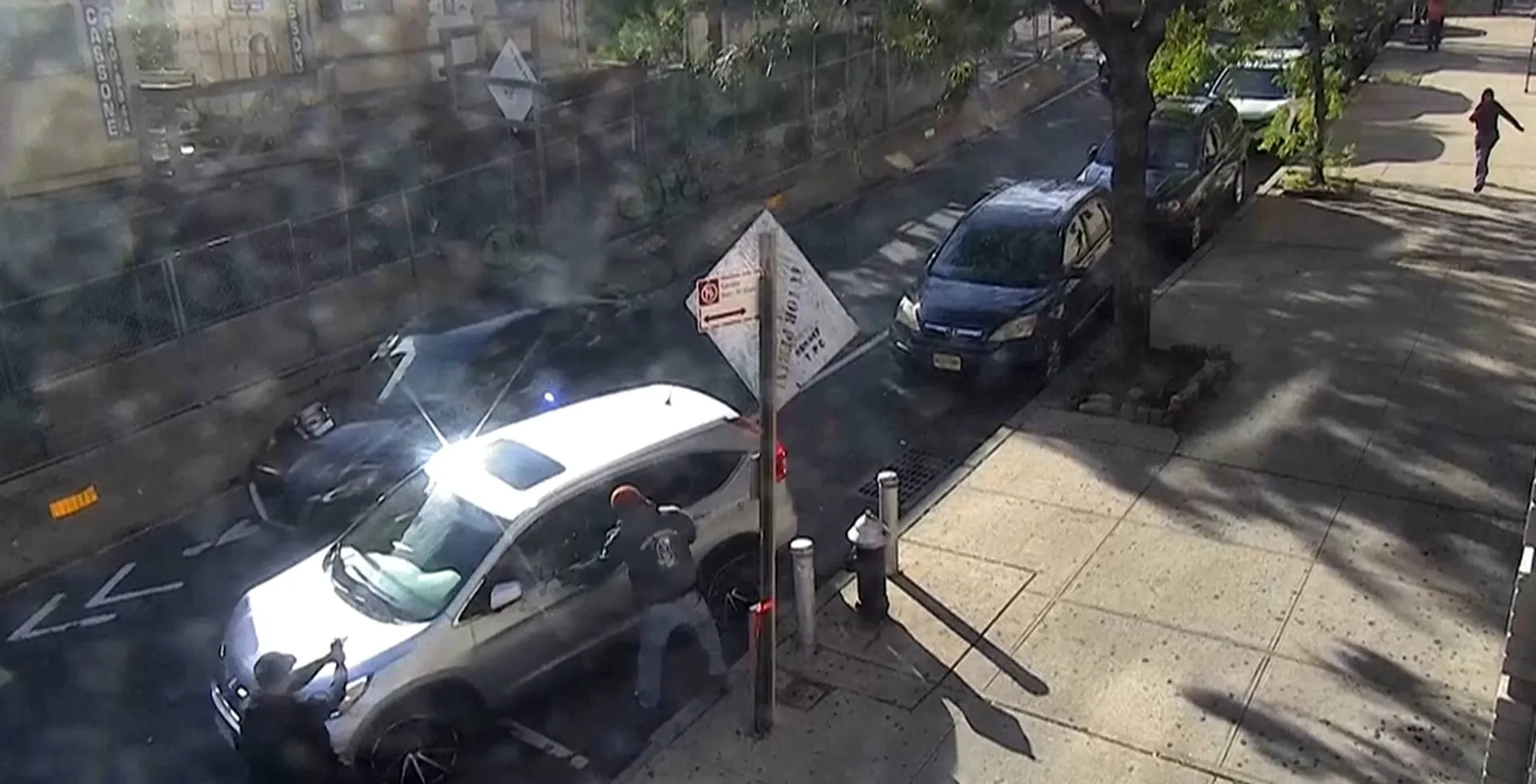
footage

ICE will release body camera video only when in its ‘best interests’

Immigration and Customs Enforcement is moving to equip officers with body cameras in the next two months, but the agency’s policy gives it broad control over what footage will be made public by specifying any releases must be in its “best interests.”

After years of delays, ICE said its field officers nationwide will have body-worn cameras by the end of September. The rollout comes after recent fatal shootings by officers enforcing President Trump’s immigration crackdown have intensified pressure for accountability that the cameras could provide.

But the agency’s policy could mean taxpayers who are pitching in tens of millions of dollars to pay for the cameras may be kept in the dark about some high-profile confrontations — at least in their immediate aftermath.

The policy says ICE will promptly release video of shootings and other encounters in which its agents cause death or serious injury only after determining “it is in the best interests of the agency” to do so. That gives its director discretion to release recordings that reflect well on the agency’s image while working to keep others secret, experts on body camera policies said.

Such selective releases are routine in some law enforcement agencies but usually not stated so clearly in policy, according to Christopher Schneider, a professor at Brandon University in Canada and a co-author of the book “Police Body-Worn Cameras: Media and the New Discourse of Police Reform.”

“In some ways, ICE is saying the quiet part out loud,” he said. “Body-worn cameras are being used as contemporary image-work tools to present the police to the public in the most favorable way possible.”

The policy requires officers to activate cameras during routine enforcement activities, including while making arrests, executing search warrants and responding to emergencies.

After shootings or other serious confrontations, a committee that includes top ICE officials and lawyers will review footage and recommend whether to release it promptly, according to the body camera policy issued in February 2025.

If the answer is yes, the recording could be released within 72 hours. But if the ICE director finds that “specific and compelling circumstances” justify withholding the video, they have the authority to block or indefinitely delay the release, the policy says.

The policy does not elaborate on such circumstances, and ICE did not respond to a question about how it would make such decisions.

Practices vary widely in the U.S. In Chicago, a police watchdog agency routinely releases body camera video of shootings and other serious use-of-force incidents within 60 days. In Philadelphia, the police department very rarely uses its discretion to release video of specific incidents and has no policy for when to do so.

Even when footage is released, ICE’s policy will require the redaction of all officers’ identifying features such as their faces, names and badge numbers to preserve their privacy.

Schneider, who has studied body cameras since their use began spreading a decade ago, said he does not expect ICE to release footage of fatal shootings like those last month in Houston and Maine.

He noted ICE’s sister agency, Customs and Border Protection, has not released footage of the January shooting of Alex Pretti in Minneapolis even though it was captured on agents’ cameras. CBP Commissioner Rodney Scott told lawmakers in February that the video and other materials were under investigation and would be made public “when it’s appropriate.”

ICE spent $30.9 million in July to purchase body camera equipment from Axon, the Arizona-based company that also manufactures Tasers, according to federal spending records.

The spending began one day after the fatal shooting of a 25-year-old motorist in Maine by an ICE officer with a history of violent behavior. Days earlier, another ICE officer shot and killed a home-builder in Houston who was driving to work.

Neither shooting was recorded with body cameras. That news angered members of Congress, who had given ICE $20 million to purchase body cameras in a bill passed to end a partial government shutdown April 30.

ICE said body cameras have been sent to more than half its field officers and the rest will receive them by the end of September. That timeline pushes back estimates from earlier public statements. Maine Republican Sen. Susan Collins, who backed funding for cameras, said last month that the agency informed her they would be deployed by the end of August. ICE had said earlier that they would be issued by mid-September.

ICE officers working in the Houston area, where the agency sent more than 800 cameras, are among those who have started training, according to Rep. Henry Cuellar, a Texas Democrat and member of the House Appropriations Committee.

At least one member of every arrest team will be required to have a camera, the agency said.

“I think the American people need to see what that officer sees and hears,” said White House border czar Tom Homan on July 19 on CBS News’ “Face the Nation.” “And if you look at the data, body cameras actually exonerate agents more than they, you know, provide evidence of wrongdoing.”

ICE began testing body cameras in 2021 during the Biden administration and distributed 1,400 devices three years later, saying use would expand as funding became available.

After returning to office in 2025, President Trump rescinded a Biden order that required federal law enforcement agencies to use body cameras.

ICE did not buy body cameras even after it received a historic $75-billion infusion in Trump’s signature policy bill in 2025 and began hiring thousands of new officers. The two July purchases from Axon were made through an existing government contract that began in 2023, records show.

“This is not hard to deploy, but they’ve slow-rolled it,” said Jason Houser, who was ICE chief of staff under President Biden and helped implement the agency’s pilot program.

Houser said the Trump administration should have equipped officers with body cameras when it expanded mass arrests and traffic stops. Doing so only after several shootings and pressure from Congress “is clearly a political response” that will not make officers or the public safer, he said.

“This doesn’t fix the problem of putting officers in a place where they’re not trained or equipped to carry out the style of operations that the administration is asking them to do,” he said.

Foley writes for the Associated Press. AP reporter Valerie Gonzalez contributed to this report.

Source link

Chilling video footage on killer’s phone reveals violent ‘torture’ spree

Murder 24/7 returns tonight with another harrowing episode as detectives race against the clock for justice

Chilling video footage recovered from a killer’s phone has been exposed, showing a violent spree across “two days of torture”.

Murder 24/7 has returned this week with a harrowing two-part special titled Natural Born Killer. Returning for its third series earlier this month, the true crime documentary takes viewers right into the heart of murder investigations across the UK.

Following West Mercia Police, the show, which sees detectives racing against the clock to ensure justice is done, has been dubbed better than Channel 4’s 24 Hours in Police Custody.

Last night (August 4), viewers were horrified after a harrowing episode delved into the murder of 54-year-old Jamie Gawler who was brutally killed and found by officers dead in an armchair with a towel thrown over his head.

Tonight (August 5), the second episode will air at 9pm on BBC One, as detectives continue their investigation into suspect Matthew Jonathan. A synopsis reads: “In Hereford, detectives continue to build their case against Matthew Jonathan for the murder of 54-year-old Jamie Gawler.

“The suspect maintains a ‘no comment’ stance in interviews, so the team is relying on digital and physical forensics to piece together the final days of Jamie’s life.”

It adds: “A critical forensic breakthrough comes when analysts match an incomplete, bloody footprint from the scene to Jonathan’s rare boots via a national database. Soon after, investigators recover a series of phone videos that reveal the true extent of the assault.”

In the episode, officers can be seen analysing a mobile phone recovered, believed to be Matthew’s, before discovering harrowing video footage on it which appears to show him assaulting Jamie.

The clips were played out as detectives watched on in horror. In the video footage, Matthew can be heard laughing and saying: “Don’t give me that broken face b******.”

He later instructs his victim: “Lift your head up,” before levelling abuse at him. He then adds: “I’ll do 30 years for this, I don’t care.”

The episode then sees officers showing Matthew the footage as one detective can be heard saying: “This is now two days into what I would describe as torture.”

Matthew Jonathan was eventually charged with murder as the episode explains three months later, he pleaded guilty to the charge. At sentencing, Matthew received a life sentence with a minimum of 32 years.

With all episodes available to stream on BBC iPlayer, viewers were horrified after watching the latest instalments this week. Taking to TikTok, one true crime fan admitted their “jaw was on the floor watching this show.”

In the video, they added: “Wow. Absolutely brutal…. I couldn’t believe them episodes, they were brutal.” Another replied: “I love watching this programme but those two were brutal.”

Murder 24/7 can be streamed on BBC iPlayer

Source link

George Michael’s ex-best friend in legal row with late star’s estate over secret album after he released unseen footage

POP superstar George Michael’s estate is suing his former best pal over footage from the recording of a lost album.

Andros Georgiou, 63, faces court for charging fans to watch scenes which he recorded of the ex-Wham! star.

Secret footage of ex-Wham! star George Michael in the studio for an unreleased album Credit: Unknown
Andros Georgiou is being taken to court by the Wham! star’s lawyers, after he released almost 90 minutes of unseen footage shot in 1992 and 1993 Credit: Kevin Dunnett – The Sun

George’s former best friend said he would be “turning in his grave” after the pop singer’s estate sued him over video footage of a secret unreleased album.

The Wham! star’s lawyers are taking Andros to court after he released almost 90 minutes of unseen footage shot in 1992 and 1993.

Andros launched a website last month charging fans to watch the film Trojan Souls — The Greatest Album That Was Never Made.

The record was to feature Elton John, Stevie Wonder, Janet Jackson, Aretha Franklin, Bryan Ferry, Seal and Sade.

NAGA QUITS

Bullying row & crude jokes – Naga’s Munchetty’s downfall as she quits BBC


wild ROMANCE

Princess Andre can’t keep up with ‘extreme’ mum Katie Price’s marriage to Lee

But the legal team from George’s estate has now lodged a case against him at London’s Intellectual Property and Enterprise Court, claiming its rights have been breached.

Furious Andros, 63, said the legal claim was “a case of sheer greed”.

On George, he said: “Yes, we fell out, but we loved and cared for each other deeply, and I find the baseless claims and the constant attempts to erase me from history both disrespectful and, frankly, a bit desperate.

“The film belongs to me.

“Trojan Souls belongs to me.

“They’ve opened Pandora’s Box.

“They won’t want me on the stand.

“I know way too much.

“Bring it on.”

Andros’s film shows the making of tracks for Trojan Souls: The Voice of Reason, a collaboration album with global superstars.

Pop fans are being asked to pay £4.99 for 48 hours of access to the 90-minute video online.

Tribe Media is also selling £19.99 VIP tiers, promising access to never-before-heard recordings of George’s unreleased songs from the record.

Andros shot the video using a camcorder given to him by Sony while they were in Japan on George’s Faith tour.

Andros said: “First and foremost — my brother in arms, my best friend, George Michael to you, Yog to me — would turn in his grave knowing what Russells (the estate’s lawyers) are attempting — and spending his money to do it.”

Andros and George were estranged before the star’s death on Christmas Day, 2016, but had been planning to reconcile
The pair had a close friendship for decades after their fathers moved to the UK from Cyprus together in 1953 Credit: Getty

He went on: “It is well known Yog and I were working on Trojan Souls through my record label, Hardback Records.

“The film I have released was shot by me, with Yog’s full approval.

“This was a home video leaked over 30 years ago.

“It kept resurfacing on YouTube.

“So I decided, if you can’t beat them, put the film out myself, since others were already profiting from my home video.”

The legal case lists Andros and Tribe Media, the production house distributing the film.

The claimants are Robobuild Limited and Big Geoff Overseas Limited, the holding companies George used to manage royalties and world tours.

Andros and George were estranged before the star’s death on Christmas Day, 2016, but had been planning to reconcile.

They fell out after George’s arrest in an LA public toilet in 1998.

But Andros had spoken to his pal on the phone in the final weeks of his life.

The pair had a close friendship for decades after their fathers moved to the UK from Cyprus together in 1953.

Most of the one-hour 24-minute film shows George playing the piano, performing vocals with backing singers, grabbing a bass and talking to producers about his track list in an LA studio.

George lost interest in the album when his then-partner Anselmo Feleppa’s health declined.

Anselmo, who suffered from Aids, died in March 1993.

George never completed the album.

It can take up to two years for a case at the court to reach trial.

Lawyers for George Michael’s estate were asked to comment.

Source link

US releases footage of ninth consecutive night of strikes on Iran | US-Israel war on Iran

NewsFeed

The US military carried out its ninth consecutive night of strikes on Iran, targeting military command centres, air defence systems and coastal surveillance facilities, according to CENTCOM. The US military said it hit maritime capabilities, missile and drone launch sites, and communications networks.

Source link

Extraordinary Footage From Moscow Under Heavy Ukrainian Aerial Attack

In what is reportedly the biggest air raid on the Russian capital in two years, multiple Ukrainian drones and cruise missiles hit several locations across Moscow early today. With heavy bombardment occurring during daylight hours, residents of the city have captured and shared dozens of videos showing dramatic impacts and interception attempts. The attack may signal a new phase of Ukraine’s long-range air war against Russian interests.

Most remarkable, perhaps, are the scenes from a key oil refinery in the Kapotno area, in the southeast of Moscow. Videos from the attacks here show multiple fireballs and plumes of black smoke rising from the refinery, which is run by a subsidiary of the state-owned Gazprom. At one point, we can see the disc-shaped roof of one of the storage tanks being thrown into the air, before cartwheeling down. This incredible detonation appears to have been caused by an errant Russian missile, not a Ukrainian weapon.

The refinery appears to have been at least one of the primary targets of the raid, continuing Kyiv’s long-running campaign directed against Russian energy infrastructure. It is notable that at least some of the videos reveal efforts to protect the refinery in the form of anti-drone netting, which seems to have little to no effect against heavier weapons. More substantial cage-type protection for refineries is something we have seen come out of Ukraine’s offensive against Russian oil infrastructure earlier in the war and subsequently appeared during the conflict in the Middle East earlier this year, to help defend against Iranian drone attacks.

This particular refinery is one of the most critical in Moscow, supplying up to 40 percent of the capital’s petrol and about 50 percent of its diesel fuel. The strike was the second in two days on the facility. The previous one was described by Ukrainian President Volodymyr Zelensky as “a just response to Russian strikes.” Reportedly, the strike on Tuesday had already halted operations at the refinery.

In the wake of today’s Ukrainian attacks, Zelensky framed this as a response to Russia’s striking of a historic Kyiv monastery earlier this week.

On Monday, five people were killed in Kyiv, and the Dormition Cathedral in the Pechersk Lavra monastery complex, a UNESCO World Heritage Site and one of Ukraine’s most significant religious and cultural sites, was badly damaged.

The Russian media outlet RIA Novosti said the overnight attack on energy facilities in Moscow was the biggest in two years.

According to reports, the Ukrainian strikes caught many of the city’s residents off guard, leading to panicked messages on social media.

The Russian Ministry of Defense claims that its air defenses intercepted and ⁠destroyed 555 Ukrainian drones over ⁠multiple regions overnight. The number actually shot down could not be independently confirmed.

The mayor of Moscow, Sergei Sobyanin, said: “Air defense forces are continuing to repel a large-scale attack,” but admitted that several drones had reached the oil refinery and that the Sadovod shopping center, also in the south-eastern part of the city, was damaged. Sobyanin claimed ‌that about 180 drones heading for the capital had ‌been downed.

Elsewhere in the city, air traffic was disrupted at Vnukovo, Sheremetyevo, and Zhukovsky airports. Sheremetyevo seems to have been especially affected, with reports of evacuations and people seeking refuge in the parking area. Meanwhile, traffic was halted ​on Moscow’s ring road near ⁠the refinery, according to the ​interior ministry. A high-rise building in Zhukovsky district, not far from the refinery, also seems to have been struck.

Andrei Vorobyov, the governor of the Moscow region, said that a high-rise residential building, an industrial facility, and a number of private houses had been damaged in the wider area around the capital. One video shows an attack drone smashing into a construction crane on its way to its target. Vorobyov said ​that 16 people ⁠had ​been injured in ​the attack.

Clearly, a significant number of drones and cruise missiles did manage to get through, or otherwise efforts to intercept them caused damage through falling debris, as seen in the video below, or stray air defense missiles.

Videos show both propeller-driven and jet-propelled long-range one-way attack drones in the skies over the Russian capital.

Among them appear to be examples of the Bars, part of a growing family of so-called “drone-missiles,” which combine the features of cruise missiles and uncrewed aerial vehicles (UAVs). Previously, these had been considered as medium-range strike systems, with a maximum range of around 500 miles. Their presence over Moscow would indicate that their range is greater, perhaps evidence that they have been further adapted or reworked.

Bars missiles. (Ukraine Government)

As far as Russian air defenses are concerned, videos from Moscow painted a desperate picture, including at least one likely missile interceptor from a Pantsir short-range air defense system streaking past a Ukrainian drone before making a sharp turn in the opposite direction. In the past, we have seen examples of the Pantsir installed on top of buildings in Moscow, and last month footage appeared showing the counter-drone-optimized SMD-E variant being lifted onto the top of a skyscraper by helicopter.

Additional footage shows soldiers or security forces using rifle-caliber weapons and man-portable air defense systems (MANPADS) in an effort to bring down drones at very short range.

One video apparently even shows an individual taking aim at a Ukrainian drone using a 9mm Makarov pistol.

For Russian President Vladimir Putin, the very public nature of the attacks on Moscow is especially embarrassing.

The Russian leader had previously warned of impending “systemic strikes” on Ukraine, but Kyiv’s continued ability to hit back at scale, and to target the Russian capital in particular, is now combined with the biting effects of fuel shortages across the country.

In an unusual move, Russia, which is the world’s third-biggest oil producer, is to import fuel by sea this month as it confronts shortages caused by relentless Ukrainian drone attacks on its refineries.

Andrey Gurulyov, a retired lieutenant general and deputy of the state duma (the lower house of the Russian Federal Assembly), called for Russia to “strike the enemy mercilessly” in response to the attack. “We need to strengthen our air defense system, but most importantly, we need to hit the enemy,” he told the RTVI news outlet. “Hit the enemy mercilessly, without overthinking it.”

Just before the latest Ukrainian air attack, President Zelensky said he had held “an important coordination call” with U.S. President Donald Trump and French President Emmanuel Macron that may “bring about significant change.”

Yesterday, Zelensky said he had won key pledges of further support from world leaders attending the G7 Summit in France. “These last few days were very important for Ukraine because it is the reunification of the G7 around Ukraine,” Macron told reporters as he and Trump left the Palace of Versailles near Paris.

In the meantime, with little progress being made by either side on the battlefield, the conflict has increasingly settled into tit-for-tat air assaults on key infrastructure and cities.

Kyiv was this week hit by a major barrage of ballistic missiles and drones, and these, together with the heavy attacks on the Russian capital in the last couple of days, signal a further escalation of the air war between Moscow and Kyiv. Beyond that, this latest barrage on Moscow signals what could be a new, far more aggressive phase of Ukrainian long-range strike operations targeting the economic heart of Russia and its seat of power.

Contact the author: thomas@thewarzone.com

Thomas Newdick is a staff writer at TWZ, where he covers military aviation, defense technology, weapons systems, and international security. Based in Berlin, Germany, he reports on conflicts, military modernization efforts, and emerging aerospace technologies around the world, with a particular interest in airpower and its role in contemporary warfare. His reporting is informed by deep expertise in modern and historical airpower, particularly in Europe, with a focus on military aviation, air campaigns, and aerospace developments across the continent and beyond.


Source link

Bahrain releases footage of damage caused by intercepted Iranian drones | Newsfeed

NewsFeed

Bahrain released video of damage in Manama after debris from intercepted Iranian drones fell in populated areas, damaging homes, burning vehicles and scattering wreckage. Officials said an 11-year-old girl sustained minor injuries in the incident.

Source link