WHAT luck! We admire the northern royal albatross – his jet-black wings spanning more than three metres as he circles above our little tour boat.
“They love gliding on this south-westerly breeze,” says Rachel, captain of the Sootychaser.
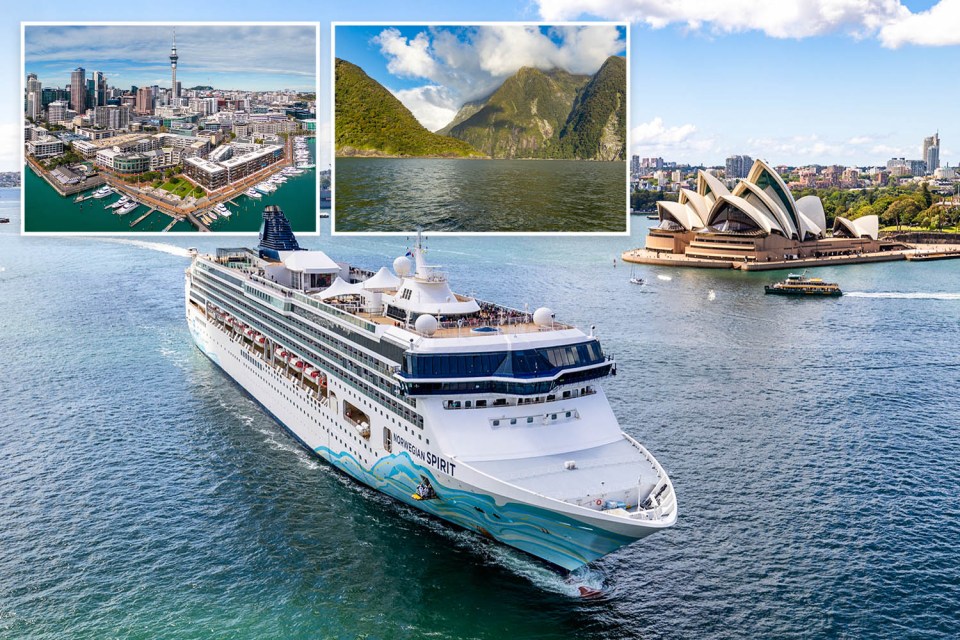
Norwegian Cruise Line offers an 11-day journey setting sail from Sydney, Australia and ending up in New ZealandCredit: SuppliedNew Zealand’s capital city of Auckland is the final stop on a truly epic cruise down underCredit: Getty
But within seconds our attention switches as Rachel spots some adorable blue penguins — the smallest in the world — on the other side of the boat.
With fur seals, oyster catchers, black swans and sooty shearwaters also ticked, this boat trip around Port Chalmers harbour in New Zealand’s South Island has turned into a wildlife adventure that keeps on giving.
Sign up for the Travel newsletter
Thank you!
Lady luck has been with me since I set out on a 12-night cruise from Sydney.
It was a bucket-list departure as we sailed past the Opera House on our way to Auckland on Norwegian Cruise Line’s ship, Norwegian Spirit.
The Tasman Sea was unusually calm as Captain Nordin navigated Spirit into Milford Sound, a deep fjord with steep cliffs and gushing waterfalls, the low mist clearing to reveal a cloudless blue sky.
Cruising New Zealand’s scenic fiordlands, a vast, wild area at the bottom of the South Island, always promised to be a highlight of the trip and didn’t disappoint.
It was spectacular. From Milford we sailed past the softer scenery in Doubtful Sound — so-named because when Captain Cook was passing in 1770 he didn’t think his ship would get into it.
Last up was Dusky Sound, named by Cook as he first saw it as the sun set. Port Chalmers is the nearest that most cruise ships can get to Dunedin, the Gaelic word for Edinburgh. “Scottish settlers travelled thousands of miles to this unknown land, but at least the weather was very familiar,” our guide Robert says with a laugh.
UNESCO world heritage site Milford Sound in Fjordland national park, New ZealandCredit: GettyA little blue penguin – the smallest in the world – are among the unique wildlife you can spot on the cruiseCredit: AFP
He’s not joking. We’re here in New Zealand’s summer, but the sky is grey and it is drizzling.
Things didn’t improve next day, when strong winds prevented Spirit getting into Lyttelton, the port for Christchurch.
Instead there was a day at sea with fabulous views as we sailed past snowy peaks.
I also worked up a sweat in Spirit’s thermal suite and followed up with an altogether different spirit — a margarita in Magnum’s, my favourite bar.
Built in 1998 and with room for just under 2,000 passengers, Spirit is NCL’s oldest and smallest ship, but looking very spruce after a £89million refurb in 2020.
They doubled the size of the spa, updated cabins, turned a waterpark at the back of Deck 10 into an adults-only area and added so many more places to eat and drink that it took me a week to try them all.
As NCL is the king of cruising casual, I booked whichever restaurant I fancied instead of being told when or where to eat, or what to wear. Jeans in the restaurant at dinner? No problem.
Steaks in Cagney’s, noodles in Silk, pasta in Onda by Scarpetta, stir-fry straight off the griddle in the fun Teppanyaki, and a superb Coq au Vin in the Bistro — I munched my way through the lot of them.
They were all really good (top marks went to the Bistro) and usually cost extra, but I paid nothing, thanks to NCL’s generous Free At Sea package.
It includes free meals in up to four speciality restaurants on cruises over nine nights (fewer nights nets fewer restaurants) as well as covering drinks and wifi and giving USD$50 (around £38) off the cost of shore excursions.
There were plenty of included places to eat as well.
Taste, one of two main dining rooms, was good, and I liked the outdoor seating at the Garden Cafe (a posh name for the buffet), but The Local was my favourite, for its salads, burgers, fish and chips and chicken wings.
Outside, the weather was getting better and better, with sunshine and blue skies as we explored New Zealand’s North Island. Wellington, the capital, stole my heart with its relaxed feel, clean streets and waterfront bars.
I rode a cable car to the top of the botanic gardens and wandered back to town, admiring the exotic plants and trees along the way.
In Napier the next day, I joined a hike and wine tour up the lofty Te Mata Peak with guides Helen and Anne.
“We’ve learned from experience it’s good to do the wine after the walk,” says Helen.
Wise words. What started as an easy path from the car park got steeper as we climbed — one foot wrong and you would be tumbling down the grassy bank.
Panting with exertion, it was a joy to finally dive into four tipples, including a cheery sweet rosé aptly named Fleurty.
Tauranga was different again — a beautiful beach resort, with miles of soft sand and stylish apartments that would look right at home on the French Riviera (but were a lot cheaper).
The next day, in Auckland, it was time to say goodbye to Spirit and New Zealand — but I’m not dis-Spirited because, with Lady Luck on my side, I’ll be back.
GO: NEW ZEALAND CRUISE
SAILING THERE: Norwegian Cruise Line offers an 11-day Melbourne, Milford Sound and Eden cruise from Sydney to Auckland departing on February 16, 2027, from £2,030pp for an ocean-view cabin.
Price includes Free At Sea package of drinks, four speciality restaurants, 150 minutes of wifi for one device at a time and USD$50 off shore excursions.
An ‘epic moment’ has reportedly caught Celebrity Traitors bosses off guard and forced them to scrap huge plans they had for the series. The change will reportedly “make great TV”
Bosses have been forced to scrap a cliffhanger but what has replaces it “will make great TV”
The Celebrity Traitors bosses have been forced to scrap a cliffhanger but what has replaces it “will make great TV” according to sources.
The show sees twenty-one famous faces head to The Traitors castle, ready to play the ultimate game of deception and betrayal in the hope of winning a cash prize of up to £100,000 for a charity of their choice.
Fans quickly become invested in the show and to keep viewers hooked it has become known for it’s cliffhangers.
Tonight, viewers will tune in to watch the result of last Friday’s cliffhanger. The all-star line-up will be casting their votes on who to banish from Ardross Castle after the Withnail and I actor battled to convince them he was a faithful.
Actor Richard E. Grant was chosen by host Claudia Winkleman to be a Traitor alongside presenter Maya Jama. However, just minutes into the game, comedian Joe Lycett casually asked him what role he had been given, to which Grant immediately replied, “Traitor!”
He then spent the rest of the premiere manically back-pedaling to convince his fellow contestants that he was actually a Faithful who had simply made a bad joke.
A source told The Sun: “Cliffhangers on The Traitors have become legendary so bosses never want to disappoint and hope to have the nation on tenterhooks all week, waiting for Thursdays to come around – that’s part of the reason the format being fed out twice a week works.
“So they plot out likely moments in gameplay that will be the Friday cliffs. But during filming, something so unbelievable happened even execs didn’t see it coming.
“It forced them to throw plans out the window to accommodate the epic moment – which should make great TV.”
Production firm Studio Lambert decide what elements of the show would make good teasers during pre-production.
Speaking at the launch of the series, executive producer Sarah Fay said: “We always have an idea before going into pre-production what might be cliffhangers but we have to be so reactive because who knows what the story is going to be.
“Last year we went to deadlock [at the Round Table] when it was down to David [Olusoga] and Mark [Bonner] where it was a tie. We never knew that that was going to happen until obviously, it was happening right before our eyes.
“I think the beauty of this game as well is every episode we’ve probably got about three options of what the cliffhanger could be because it’s so nail-biting.”
The Mirror has contacted the BBC press office for comment.
The Celebrity Traitors returns tonight at 8pm on BBC One.
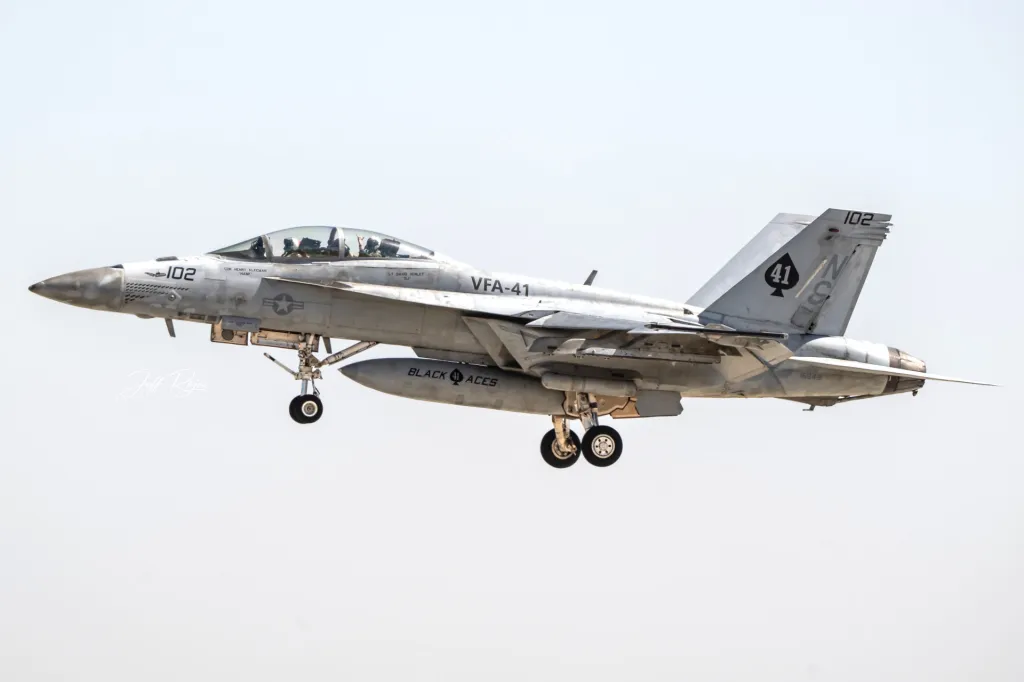
The volume of munitions expended in the course of U.S. operations against Iran this year has been and continues to be a hot topic of discussion, and there has been relatively little official data provided on this front. However, now we know that the F/A-18F Super Hornets of the U.S. Navy’s Strike Fighter Squadron 41 (VFA-41), the “Black Aces,” launched 421 missiles and bombs during their time supporting Operation Epic Fury.
This new insight into VFA-41’s role in the conflict with Iran comes from a photo of a large board listing the squadron’s weapons expenditures during Epic Fury, via Jeff Rojas, who goes by the handle @jro_photography on Instagram. Rojas also shared pictures recently taken of VFA-41’s Super Hornets. The Black Aces were one of the squadrons assigned to the Nimitz class aircraft carrier USS Abraham Lincoln, which has been on a marathon deploymentsince last year. The carrier only left the Middle East region last month and is now set to formally return home to San Diego, California, within days. Per the Pentagon’s official timeline, Operation Epic Fury began on February 28 and concluded on May 5, though U.S. forces have continued to conduct strikes on Iran, on and off, since then.
One of VFA-41’s F/A-18F Super Hornets spotted recently. Jeff Rojas Jeffrey Rojas
The complete tally of munitions employed as shown on the board, broken down by type, from greatest to fewest, is as follows:
The total cost of all of these munitions, using available data from U.S. military budget documents, is very roughly $43,646,000, at least. Unit costs fluctuate regularly due to a variety of factors. Furthermore, the exact price tag for different JDAMs can be somewhat difficult to calculate given how the individual components are budgeted.
The JDAM is really a family of kits that turn standard unguided ‘iron bombs,’ which can vary significantly in the kinds of effects they are designed to produce, into warheads for precision-guided munitions. This is exemplified by the (V)2 and (V)4 subvariants of the GBU-31/B mentioned here, which are built using standard high-explosive and bunker-buster bombs, respectively. No specific subvariants of the GBU-32, GBU-38, or GBU-54 were mentioned in the information provided. Standard JDAMs can also only be employed against static target coordinates. The LJDAM kits add a laser guidance component (akin to what is found on Paveway-series bombs) that enables strikes against moving targets.
A JDAM, as well as a pair of AIM-9Xs, seen under the wing of a VFA-41 Super Hornet in August. NAVCENT
No specific version of AGM-154 is mentioned, either, but the C and C-1 types, which have multi-stage bunker-busting warheads, are the only ones understood to be in service today. Remaining A variants, which were loaded with 145 small bomblets, were removed from U.S. service in 2008 as a result of new guidelines on cluster munitions issued under President George W. Bush. A planned AGM-154B, which would have contained six “smart” Sensor Fuzed Munition bomblets, was never produced. You can read more about the full JSOW family here.
We do not know exactly what targets any of these munitions were employed against. However, a picture that Jeff Rojas grabbed of one of VFA-41’s Super Hornets, seen toward the top of this story and in part below, shows a very interesting broken submarine kill marking, with the added text “Sub Buster.” The jet also has a number of more typical bomb-shaped kill marks.
A close-up look at the broken submarine and other kill marks on one of VFA-41’s Super Hornets. Jeff Rojas Jeffrey Rojas
The video montage in the social media post below includes a clip, starting at 0:13 in the runtime, of a Hellfire missile hitting what looks to be a Ghadir class diesel-electric midget submarine in port.
U.S. forces are degrading the Iranian regime’s ability to project power at sea and harass international shipping. For years, Iranian forces have threatened freedom of navigation in waters essential to American, regional and global security and prosperity. pic.twitter.com/gIBN02mowh
It is extremely likely that the AIM-9Xs and AIM-120s were fired at Iranian drones, though they could have been launched at incoming cruise missiles, as well. At the time of writing, there are no known or reported instances of U.S. military jets engaging crewed Iranian aircraft in the course of the conflict to date. In 2024, the Navy carried out a crash program that increased the total number of AIM-9Xs that F/A-18E/Fs could carry per sortie, specifically in response to Houthi drone threats. Super Hornets loaded with nine air-to-air missiles are now referred to as “Murder Hornets.”
It is also important to remember that this is a discussion of the munitions expended by just one Navy strike fighter squadron. Lincoln‘s air wing includes four strike squadrons, three with Super Hornets and one with F-35Cs, as well as units flying other types of aircraft and helicopters. The carrier was just one part of a much larger array of air, naval, and ground forces that participated in Operation Epic Fury and subsequent operations against Iran. For additional context, consider that the entire Eisenhower Carrier Strike Group, including its entire air wing and escorting ships, fired off 770 munitions in total, by the official count, during very active combat operations in and around the Red Sea between November 2023 and June 2024.
VFA-41 Super Hornets seen flying together recently. Jeff Rojas
As such, the tally of munitions launched from VFA-41 Super Hornets offers a very interesting view into that squadron’s contributions to Operation Epic Fury, as well as the full scale and scope of the conflict with Iran.
Special thanks again to Jeff Rojas for sharing the details about VFA-41’s participation in Operation Epic Fury and his pictures with us.
A EUROPEAN theme park that is a great Disney alternative has revealed it is opening a grand new hotel in just months.
Park Asterix in France, which is cheaper than Disneyland Paris and is under 19miles from the centre of Paris, is opening a themed hotel for up to 750 guests in March.
Parc Asterix has unveiled a new hotel it is opening next yearCredit: PARC ASTERIX
Opening on March 26, The Odyssey will be the park’s fourth hotel and boast 301 rooms across four themed sections.
The hotel will have a more “mineral theme”, designed around Asterix’s travels to the Orient.
Sign up for the Travel newsletter
Thank you!
The hotel will be inspired by caravanserais – typical fortified buildings used as a lodging by merchants and their animals in the likes of Egypt.
The hotel will have four facades surrounding a central courtyard with a number of common areas on the ground floor and bedrooms then on the upper floors.
In the courtyard, there will be four areas around a central oasis.
Each will be a garden with a different theme including Persian, Phoenician, Egyptian, and Mesopotamian.
And then the interior of each facade will correspond with one of the four themes.
In the Mesopotamia area, for example, there will be different artisans.
The hotel will have four themed areasCredit: PARC ASTERIX
Then in the Phoenicia area, the theme will centre around welcoming merchants.
And finally the Egyptian section will transport guests to the banks of the River Nile.
The entire roof of the hotel will then also feature lots of plants.
When it comes to the bedrooms, each will have a double bed that can be separated into two single beds if needed and an alcove with a bunk bed in.
Rooms will be able to host between three and six people.
And if you fancy something a little more lavish, there will be four suites and large terrace on the second floor as well.
The four-star hotel will be twice the size of the other three hotels at the park.
When it comes to dining options, there will be two all-you-can-eat restaurants – La Table des Rois (The Kings’ Table) and La Table Gourmande (The Gourmet Table).
A bar is also in the plans, at the centre of the gardens.
It comes as the park is also set to open a Greek land next year and a London-themed area in 2028Credit: PARC ASTERIXIt will be the fourth hotel at the park and the largestCredit: Parc Asterix
The new hotel was first announced in October last year when the park was also revealed to be the second most visited theme park in France.
And the hotel is part of a wider €250million (£212.6million) investment project to expand the park by 2030.
This year, the park transformed its Egypt area including the re-theming of the Oxygénarium attraction to become The Descent of the Nile.
Les Chaises Volantes then also became The Flight of Ibis and the Le Cirque restaurant became Le Comptoir d’Epidemaïs.
In 2027, the park will also open a new Greek zone with two family attractions, a playground and a restaurant.
And in 2028, there will be a Londinium Zone which will be an indoor area inspired by Asterix in Britain comic books.
Veronica Lorraine, Gardening Editor and Associate Head of Features, who recently visited the park, said: “With more than 50 attractions, there really is a ride for everyone, regardless of age, or fear factor — you definitely need more than one day if you want to get round all of them.
“Disney certainly has the monopoly on world-renowned characters and a blow-out budget to create that real wow factor, all of which seems impossible to compete with — yet somehow Parc Asterix does.
“The tickets are cheaper, the food is better, the shows are spectacular and the rides are a total revelation.
“Add in a sprawling protected countryside backdrop just 30km outside Paris, with three separate hotels within the grounds at very reasonable prices, and you’ve got yourself a winner.
“It’s pure escapism, based all around the cherished world of Asterix — the man who, in famous French comics, protected France from the Romans.”
Halloween season is arguably the most festive time of year in Los Angeles. Is it any wonder that a city that favors make-believe would take to a holiday that inspires elaborate set dressings and creative costumes, the latter a chance to take on a role other than ourselves?
Likely not, and whether you lean spooky or playful, the days and weeks leading up to Oct. 31 are filled with events, often with no costume necessary. Consider October an excuse to throw a massive, fall-related bash.
This season there are returning staples, such as “Carved” at Descanso Gardens and Universal Studios Hollywood’s Halloween Horror Nights, but also opportunities to explore Halloween’s campier side. Our penchant for the theatrical is well represented, and even newer Los Angeles institutions such as the Academy Museum are getting in on the autumnal fun.
Whether you’re seeking an event to charm or to inspire frights, there’s plenty our region has to offer.
DRAMATIC Alaskan landscapes, a medieval city on Spain’s north coast and surf beaches in Morocco are among THE places to visit in 2027, according to Lonely Planet.
The experts’ latest book – Best In Travel 2027 – recommends exploring a treasure trove of places off the beaten track.
Sibenik’s vibrant Old Town and harbourCredit: ShutterstockExplore the height of history at Leon CathedralCredit: Shutterstock
Lisa Minot picks her favourite destinations and experiences from the list.
Sign up for the Travel newsletter
Thank you!
BEST EXPERIENCES
Explore marine treasures on a deep dive in Greece
GO FLIGHTSEEING ALASKA: With just 20 per cent of Alaska accessible by road, taking to the skies in a small plane is one of the best ways to experience its vast wilderness.
DIVE THE AEGEAN: Once heavily restricted to protect underwater antiquities from pillaging, you can now discover Poseidon’s underwater world as new legislation and the opening of underwater archaeological sites allows you to explore marine treasures.
It sank in the 5th century, carrying more than 4,000 wine amphorae (clay jars).
Or visit the Fourni Archipelago, known as the ancient shipwreck capital of the world.
SAIL THE AEOLIAN ISLANDS, ITALY: Island hopping isn’t the reserve of the Greeks.
Sail between these lesser-known islands to discover rugged coastlines, clear waters and Italian traditions.
Set sail from Sicily on the fast ferries that visit all seven islands, but book ahead in summer.
Or join a skippered sailing holiday through UK operators such as Sunsail or Dream Yacht Charter.
EXPLORE KILLARY FJORD, IRELAND: Tucked along Ireland’s Wild Atlantic Way, the Killary Fjord in Co Galway cuts its way ten miles inland towards the village of Leenaun, past steep peaks that change dramatically with the seasons. It’s some of the most dramatic scenery in the country.
BEST PLACES
Take a plane over Alaskan glaciers
SWEDISH RIVIERA: After this year’s heatwaves, travellers may be looking for cooler destinations.
The twin towns of Skanor and Falsterbo are connected by a bridge and home to colourful cottages, gardens and an endless coastline.
SIBENIK, CROATIA: This small but lively Adriatic city has colourful festivals and gastronomic delights from fresh Adriatic seafood to truffle pastas.
Explore a labyrinth of steep stone alleyways, hidden plazas and Venetian-era architecture.
The city sits between the coastal towns of Split and Zadar and there are plenty of low-cost flights into both from the UK.
LEON, SPAIN: Northern Spain is having its moment in 2027.
Known for its many bars offering free tapas, Leon combines centuries of history with a lively contemporary spirit.
When you order a wine, cider or beer, expect a substantial plate of local cured beef, cheese and spicy blood sausage.
RABAT, MOROCCO: Think all the exotic excitement of Marrakech but without the crowds.
Rabat on Morocco’s coast boasts royal palaces, coastal breezes and clean, palm-lined avenues.
The country’s imperial city still has a great Medina — for haggling over leather goods, spices and rugs — as well as miles of wide, sandy beaches.
There are direct flights from Gatwick and Stansted.
PRINCE EDWARD ISLAND, CANADA: Known as Canada’s food island, the country’s smallest province is known for mussels, oysters and roadside lobster rolls served straight off the fishing boats.
Expect lush hills, white sand beaches and red sandstone cliffs dotted with lighthouses.
Author LM Montgomery set her novel Anne Of Green Gables here, and Netflix’s adaptation, Anne With An E, filmed in the province.
THE weather might be about to turn in the UK but in Europe there’s still time to enjoy the sunshine.
So for affordable yet full-of-activity stays, we’ve rounded up 10 best Eurocamp resorts from Croatia to Italy where temperatures are still about 20C in autumn – and stays can be as cheap as £6 per night.
There are plenty of Eurpcamps where temperatures will still be over 20C in autumnCredit: Jaume DevesaEurocamp in Tuscany has six swimming pools and waterslidesCredit: Paul-N. Dubuisson
hu Park Albatros Village, Tuscany, Italy
Tuscany still has temperatures of up to 22C during the autumn, so families can make great use of its six swimming pools, waterslides.
Make sure to try out its treetop adventure course and mini golf too.
Sign up for the Travel newsletter
Thank you!
The new entertainment complex overlooks the beach – it also has a restaurant, pizzeria, ice cream kiosk and there’s a free kids’ club for ages 4-17.
Seven nights from September 28 staying in a Comfort three bedroom holiday home that sleeps up to six guests starts from £236.20 per party – or £35.62pppn.
Holacamp Albufeira has a stretching sandy beach five minutes awayCredit: Unknown
Holacamp Albufeira is perfect for those wanting to blend beach and camping.
As the stretching sandy beach is five-minute drive away and with highs of 22C you can enjoy it well into autumn.
On-site are three swimming pools to splash about in, along with space to sunbathe and don’t forget to try out some watersports or a friendly game of padel.
Alannia Costa Blanca has a beautiful palm-tree lined swimming poolCredit: Jaume Devesa
Just a few hours away in on the Costa Blanca, this Eurocamp has enormous palm-tree lined swimming pools.
There’s also a splash zone for little kids and a spa with sauna and steam room.
When it comes to activities try out tennis, archery, padel tennis, mini golf and there’s a soft play area for the little ones too.
Seven nights from September 28 staying in a Premium two bedroom holiday home that sleeps up to five guests starts from £642.17 per party – or £18.34pppn.
Camping Fabulous Village, Rome, Italy
This Eurocamp is a 30-minute drive outside of central RomeCredit: Paul-N. Dubuisson
When in Rome, head to Camping Fabulous Village – kids will love the swimming pools.
Make sure to head to the on-site restaurant for classic Italian dishes.
The park is a 30-minute drive from Rome too so it’s easy to go sightseeing and book excursions to Ostia Antica, Tivoli, Pompeii and Naples through the parc.
Seven nights from September 28 staying in a Classic two bedroom holiday home that sleeps up to six guests starts from £200.85 per party – or £6.78pppn.
Saint-Aygulf Plage, Riviera, France
For a huge waterplay tower and lots of sports, head to Saint-Aygulf PlageCredit: Eurocamp
Along the French Riviera is this impressive Eurocamp with views across the water. It also has a lagoon-style pool.
The towering waterplay area with tipping buckets and slides actually looks over the Mediterranean Sea.
There are plenty of sporting activities to try out like basketball, volleyball, archery and football – not to mention there’s direct access to the beach where guests can try kayaking and high-octane jet skiing.
Seven nights from September 28 staying in a Comfort two bedroom holiday home that sleeps up to four guests starts from £274.10 per party – or £9.78pppn.
Camping Village Simuni, Dalmatia, Croatia
On the Dalmatian Coast this Eurocamp is by six beaches – one has a huge inflatableCredit: Paul-N. Dubuisson
The Dalmatian Coast can bask in temperatures between 22C and 25C between September and October.
So it’s easy to take advantage of the fact that Camping Village Simuni has access to six beaches – one even has an inflatable obstacle course.
It has four restaurants including Pescaria which serves fresh seafood and Mali Raj where traditional Croatian dishes are cooked right in front of you.
Seven nights from September 28 staying in a Classic three bedroom holiday home that sleeps up to six guests starts from £350 per party – or £8.33pppn.
La Masseria, Puglia, Italy
On the Puglia coastline, La Masseria has an outdoor pool, paddling pool and two JacuzzisCredit: Eurocamp
This Eurocamp is on the Puglia coast – it has a huge swimming complex with an impressive an outdoor pool, paddling pool.
There are also two Jacuzzis, diving boards and the private beach is minutes away on foot.
There are three restaurants on-site and adults can try out wine tours and tastings at the on-parc vineyard.
Seven nights from September 28 staying in a Comfort three bedroom holiday home that sleeps up to six guests starts from £229.30 per party – or £5.45pppn.
El Garrofer, Costa Dorada, Spain
The centre of Barcelona is only a 40-minute drive away from El GarroferCredit: Paul-N. Dubuisson
Described as having an “air of quiet” this resort is much quieter than other Eurocamp sitse.
But it still has swimming pools, waterslides, kids’ clubs and plenty of sport activities to try out.
If you want to see the sights of Barcelona, the city is only a 40-minute drive away so it’s perfect distance for a daytrip.
Seven nights from September 28 staying in a Comfort three bedroom holiday home that sleeps up to five guests starts from £449.95 per party – or £12.85pppn.
Les Dunes, Roussillon, France
Les Dunes has plenty of waterslides and activities throughout autumn for kidsCredit: Paul-N. Dubuisson
This Eurocamp has all you need from a holiday – swimming pools, watersides, restaurants, snack bars all just metres from the beach.
If you visit during September, the parc will be hosting new activities for babies and toddlers.
During October, there will be ‘Day of the Dead’ themed activities like mask-making, games and mini-discos.
Seven nights from September 28 staying in a Classic two bedroom holiday home that sleeps up to four guests starts from £223.23 per party – or £7.97pppn.
Bella Italia, Lake Garda, Italy
If you fancy a visit to Lake Garda had to Eurocamp Bella ItaliaCredit: Paul-N. Dubuisson
On the very tip of Lake Garda is the Bella Italia Eurocamp which has access to the lakeside beach where guests can try out parasailing, para-flying and banana-boat riding.
The resort has four swimming pools with features like waterslides and mushroom fountains.
Not to mention it’s a 10-minute drive away from family-friendly theme park, Gardaland.
Seven nights from September 28, staying in a Classic two bedroom holiday home that sleeps up to six guests starts from £318.07 per party – or £7.57pppn.
At 69, I had never hiked with a backpack and I had no idea what land art was. Nonetheless, when my friend Jackie, a nature documentary film-maker, invited me to join her and her friends Wendy and Sasha on a hiking trip to Refuges d’Artin the mountainous countryside of Haute-Provence, I said a resounding “yes”. We would be sleeping alongside sculptures by the renowned land artist Andy Goldsworthy.
First, I watch Rivers and Tides, a documentary on Goldsworthy’s work, and discover he has built exquisite ice sculptures and stone cairns in my own country, Canada. His work seems to speak to an older part of the soul. Then, I start walking up hills, gradually adding weights to my backpack until I can comfortably carry 9kg (20lb).
We meet in Digne-les-Bains, a bustling mountain town in the centre of the Unesco geopark of Haute-Provence, and the starting point for a 10-day, 150km (93-mile) hiking route that includes the possibility of staying overnight at seven reservable but free off-grid sleeping cabins. Goldsworthy worked alongside local teams to restore the abandoned shepherd huts, farmhouses, chapel and stone shelters, and created a site-specific artwork for each one. Over four days, we will visit three of these refuges and hike about 45km (28 miles).
Our first stop in Digne-les-Bains is Maison Alexandra David-Neél, a museum dedicated to the adventurous, peripatetic life of a woman who, in 1924, disguised herself as a beggar to become the first western woman to enter the Forbidden City of Lhasa in Tibet. The keys to the refuges are kept here, no doubt, to inspire hikers for the adventures that lie ahead.
On the first day, we encounter one of three sentinels that sit like giant mysterious eggs watching over the route. These 2 to 3-metre tall cairns were made by Goldsworthy without mortar or cement and rely on fitting the right shapes and weights of the stones.
La Forest by Andy Goldsworthy, illuminated by natural light. Photograph: Hemis/Alamy
Jackie has told us the trail is mostly flat and indeed, we start on even gravel, chatting and laughing, getting used to the weight of our packs. After 5km, she says we should look for a path leading up the hill on our right. She checks her satnav and points to a goat path going straight up the rocks. I panic. My backpack suddenly feels extremely heavy. In desperation, I check further down the road and, to everyone’s relief, find a path marked with white and red horizontal lines signifying a granderandonnée, a trail certified by the French government.
We begin our ascent, pausing to photograph curlicued and wispy plants right out of Dr Seuss, yellow, scarlet and blue wildflowers, an orange moth sitting on purple brush. Spanish broom perfumes the air. We lift our gaze and see multiple valleys and unique geological formations. It’s easy to imagine our ice-age ancestors walking these trails 15,000 years ago and it’s gratifying to be travelling under our own steam, as they did.
We arrive at the first refuge, La Forest, as the sun is setting. The key unlocks the door. Inside, the air is cold. Our eyes adjust to the dark. A table and benches stand in front of us. To the left, a stairway leads to sleeping platforms. To the right, a doorway into a dark, empty room. From its depths glows a cylindrical obelisk, light falling on one large stone where someone could sit. It’s concave, constructed of light grey stone ending in a porthole to the sky. It’s illuminated by natural light and changes with the time, the weather, the season. This art is living and feels sacred.
That evening, we eat freeze-dried mushroom risotto in the flickering candlelight, play cards, eat chocolate, laugh and share stories. Sasha, who works in film in Germany, teaches us two words: der salzlose – someone who is bland and without flavour; and extrawurst – someone who always demands more. Neither apply to our group. The camaraderie and conviviality bring pure pleasure.
We climb the stairs to the sleeping platforms. Wendy and Sasha have brought sturdy sleeping mats on Jackie’s recommendation. We lay them out and say goodnight. The quiet is complete. Then, a tidal wave of sound erupts. Wendy and Sasha have rolled over. The friction on the technical fabric of their sleeping mats is deafening. The price of comfort has been revealed; they must lie like mummies.
Claudia and friends Jackie and Sasha (left to right) in Le Vieil Esclangon art refuge. Photograph: Wendy Reeves
The next day, we descend, picnic by a river on crackers, avocados and cheese, then start climbing again. Sasha and I subversively agree that it’s psychologically better to be told something is going to be hard and then it turns out easier. I console myself that climbing with a backpack is good for bone density and way less boring than lifting weights.
The next refuge, Le Vieil Esclangon, is in a mountain-top meadow. A majestic fan of lifted rock shines across the wide valley. Everywhere we turn there are more mountains and valleys. The first floor of the refuge is a large dark room split in two by a massive fireplace. Upstairs, the sleeping platforms look out on to a sunlit verge. Across from the fireplace, a tall serpentine shape made of dried mud loops back and forth like a meandering river, ending at the top in the source.
The wind picks up and the temperature drops. We gather wood and light a fire. In the flickering orange light, the sculpture comes to life, looking like one of Plato’s eternal forms. We eat our freeze-dried pad thai, the art and the hikers transient and temporary but together in this warm and cosy moment.
Later, we sleep to the sound of wind and rain, woken only by a mouse rave in the middle of the night.
La Ferme Belon, where ‘huge interlinked semicircular stone arches look like a dragon’s body swimming through earth’. Photograph: B Warluzel
We arrive at the third refuge, La Ferme Belon, in time for a late lunch. In the basement, huge interlinked semicircular stone arches look like a dragon’s body swimming through earth. Upstairs, the sleeping platforms are lovely except for one small detail. A colony of bats hang above. I can feign nonchalance because I know Wendy, who is quietly uber-capable, will find us a delightful B&B for the night. Over pizza and cold rosé, Sasha and I confess to Jackie that we would have rather known how challenging the hikes were going to be. “But you wouldn’t have come if I’d told you,” she answers with a twinkle in her eye.
Andy Goldsworthy said: “To me there is a tremendous difference between works of art that we observe in a museum just for a few minutes and works of art in which we live for a short while, in which we sleep. To sleep in a sculpture is a wonderful idea.”
In Digne-les-Bains we return the keys and soak our stronger bodies in the town’s hot springs. We’ve already said yes to Jackie’s next adventure, sight unseen.
Claudia Casper’s novelThe Mercy Journals won the Philip K Dick award for distinguished science fiction in 2017(Arsenal Pulp Press)
The 31st Marine Expeditionary Unit’s (31st MEU) recent deployment to the Middle East marked the first time the United States Marine Corps (USMC) used its Expeditionary Advanced Base Operations (EABO) concept in a combat setting, the service confirmed to TWZ on Thursday. At its core, EABO involves relatively small groups of Marines quickly establishing bases of operation in forward areas, often within the enemy’s weapons range. During operations in the fight against Iran, Marines refueled and rearmed their own aircraft, as well as those from the joint force, at these austere locales. They also set up remote sensing locations, among other actions from the EABO playbook.
This employment of EABO for Epic Fury is a highly significant development. After years of progressively evolving the EABO playbook, it was no longer an experimental exercise. This meant that Marines were forward deployed in a contested area in a region where established bases were taking heavy fire from Iranian missile and drone barrages. Troops were killed in some of these attacks and U.S. aircraft, buildings and equipment were damaged and destroyed across the Middle East. Pushing aircraft from the MEU, as well as the joint force, to FARPs (forward arming and refueling point) would have been a relevant asset preservation tactic as well as one that would help accelerate combat operations, and it’s exactly what EABO is meant to do.
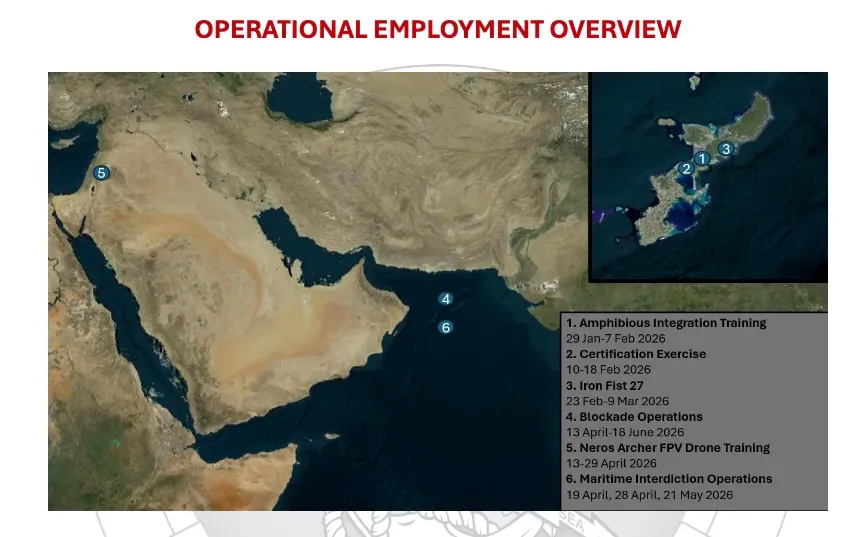
The 31st MEU’s six-month deployment began in January in the Pacific, before the unit was ordered to the Middle East in March, returning to Okinawa, Japan, in July. That’s where it is stationed as the USMC’s only continuously forward-based MEU.
A map of the 31st MEU’s deployment. (31st MEU)
“This was the first time we were able to implement EABO in combat operations since the concept was created for the force,” Capt. Steven J. Keenan, a USMC spokesperson, told us. “We have practiced it many times, but this was a first for supporting a Joint Force named operation with forward FARPs and forward bases that supported joint ops and combat power sustainment.”
EABO was first introduced in 2020 by then-Commandant Gen. David Berger in his Force Design 2030 plan for the future of the Corps. It was created with a fight against China in mind, especially utilizing small Pacific islands. The idea is to have highly mobile, low-signature forces deployed forward in austere, contested or potentially contested maritime locations. The mission is to “support sea control operation, conduct sea denial operations within the littorals, contribute to maritime domain awareness, provide forward command, control, communications, computers, combat systems, intelligence, surveillance, reconnaissance, targeting, and counter-targeting capability and forward sustainment,” according to the Marines.
A Marine holding a Stinger missile launcher stands in front of a Combat Rubber Raiding Craft on Ukibaru Island off the coast of Okinawa during Exercise Hagatna Fury 21. (USMC) A Marine holding a Stinger missile launcher stands in front of a Combat Rubber Raiding Craft on Ukibaru Island off the coast of Okinawa during Exercise Hagatna Fury 21. USMC
The news of the first activation of the EABO concept in combat came Wednesday during a media roundtable with Col. Chris P. Niedziocha, who commanded the 31st MEU during its deployment to the Middle East in support of Operation Epic Fury. Now director of the USMC Expeditionary Warfare School, Niedziocha discussed EABO and a range of other operations during that deployment, including boarding vessels during the blockade of Iranian ports.
The 31st MEU was embarked aboard the Tripoli Amphibious Ready Group (ARG), which consisted of the America class amphibious assault ship USS Tripoli, San Antonio class amphibious transport dock ship USS New Orleans, and Whidbey Island class dock landing ship USS Rushmore. You can read more about the ARG/MEU and its assets in our initial story about the deployment to the Middle East here.
USS Tripoli. (Staff Sgt. Samuel Ruiz)
“You’re starting to see this has been validated,” the colonel said of the EABO concept during the roundtable TWZ attended virtually. “It’s still nascent, but we actually, for the first time, demonstrated what we thought we were able to do, which I think is pretty exciting. And then things like forward arming and refueling to extend the operational reach of aircraft and expeditionary reloading, and then the ever-present logistic challenge of doing something like that. So that’s pretty significant.”
“We successfully implemented critical Expeditionary Advanced Base Operations (EABO), establishing sensor expeditionary advanced bases and forward arming and refueling points (FARPs) where none existed,” the colonel added. “Through our forward logistic elements, we proved that an agile Marine Air-Ground Task Force can sustain itself and generate ready, lethal power in contested maritime environments, directly setting the theater for follow-on joint forces.”
“There was all manner of tankers all the time, but the FARP is to extend the operational reach, and if you can do it, you reduce the load on that,” Niedziocha noted. “Because there’s some aircraft that are basically for expeditionary austere operations, especially the F-35B,” the Marine Corps’ variant of the aircraft designed for short take off and vertical landing.
“There are some trade-offs associated with the Bravo,” Niedziocha pointed out, using a slang for the jets. “There’s less internal fuel, but you have the lift [system], which gives you the option to do these kinds of things. So, the goal there was to walk that fine line between providing the full sortie over wherever you needed it, and keeping the ships far enough away to make them as survivable as possible.”
An F-35B Lightning II aircraft taxis to a forward arming and refueling point in the U.S. Central Command area of responsibility, May 26, 2026. (U.S. Marine Corps photo by Cpl. Maksim Masloboev) Cpl. Maksim Masloboev
In addition to the F-35Bs and other aircraft organic to the 31st MEU, the FARPs were also used by Army helicopters, Keenan told us. Imagery posted on the Pentagon’s image distribution site also showed U.S. Army Gray Eagle drones and Marine MV-22B Osprey tiltrotor aircraft were included.
A Gray Eagle drone lands at a forward arming and refueling point in the U.S. Central Command area of responsibility, May 26, 2026. (U.S. Marine Corps photo by Cpl. Maksim Masloboev) Cpl. Maksim MasloboevU.S. Marines with the 31st Marine Expeditionary Unit transport AIM-120 AMRAAMs to a forward arming and refueling point in the U.S. Central Command area of responsibility, May 26, 2026. (U.S. Marine Corps photo by Cpl. Maksim Masloboev) Cpl. Maksim Masloboev
Niedziocha did not provide details about where the FARPs were set up, but a U.S. defense official told us they were “disaggregated throughout the Middle East.” The official declined to provide further information, citing operational security concerns since they are still being used.
“Throughout the deployment, the Tripoli ARG and 31st MEU successfully conducted over 1,600 mishap-free flight hours of combat aviation missions, including precision strikes, transporting 800,000 pounds of cargo, and moving 5,000 personnel,” a 31st MEU overview of the deployment explained. “The units also provided sustained combat support to joint force operations by delivering critical intelligence and refueling over 300 aircraft ashore and underway.”
The colonel also didn’t provide details about the sensor expeditionary advanced bases. According to the Marines, “a sensing expeditionary advanced base (SEAB) brings together coastal surveillance radars, electronic sensors, and Marines ashore to extend maritime domain awareness, complementing the radars and sensors already at work aboard naval ships off the coast.”
“When SEAB systems identify surface vessels in nearby sea lanes, small unmanned aircraft system (sUAS) operators launch their platforms to visually identify and track the contacts,” the Marines added. “Sensor data and imagery are transmitted in real time across the blue-green command network to decision-makers.”
U.S. Marines with 12th Marine Regiment, 3rd Marine Division, prepare to set up a Ground/Air Task Oriented Radar (G/ATOR) system during a routine unit level training exercise on Iejima, Okinawa, Japan, July 15, 2023. (U.S. Marine Corps photo by Staff Sgt. Manuel A. Serrano) Gunnery Sgt. Manuel Serrano
This capability could have been used to track Iran’s remaining fleet of small boats that it has used to harass shipping and mine the Strait of Hormuz, as well as larger vessels trying to transport oil. Other sensors, like radars and counter-drone systems, could also help identify incoming threats and provide general situational awareness. The EABO concept was employed as part of the 31st MEU’s larger role in supporting the blockade and mine clearance efforts.
The 31st MEU interdicted four vessels during the deployment, three of which led to boardings. On April 19, Marines boarded the MV Touska; on April 28, the MV Blue Star III; and on May 19, the MT Celestial Sea.
The Touska was boarded after USS Spruance fired multiple 5-inch rounds, targeting the engine room and disabling the vessel’s propulsion. The crew of the vessel was retained for about two weeks before being repatriated.
Niedziocha told us that none of the crews offered any resistance.
“At two in the morning, when 30 Force Reconnaissance Marines fast rope onto your vessel, [you are] just compliant with a capital C. They did exactly what they were directed to do. The overmatch that you put onto that vessel is pretty surprising. And then there’s overwatch provided by UAS and manned aircraft, so you create this bubble around the vessel. So yeah, they complied.”
You can see the Touska being boarded in the following video.
The U.S. just released a video of its forces boarding and seizing the Iranian container ship M/V Touska near the Hormuz Strait after it tried to break the U.S. naval blockade pic.twitter.com/FpB2obb3jY
Two years ago, as the EABO concept was maturing, TWZ was invited to get an exclusive look at how an advanced EABO concept would be put into action, including how squadrons operated the F-35B out of an austere combat environment while generating combat sorties. It was an unprecedented and exclusive peek into the EABO playbook and what a real fight in the Pacific with the USMC’s most advanced fighter aircraft could actually look like. You can read about that in our story here. It appears the operations in the Middle East mirrored this exercise closely.
James Deboer
Now back in Japan, the ARG/MEU is getting ready for a new deployment, said the colonel.
“We got back to Okinawa, I think July 22nd, and they had already begun their workup cycle in earnest to be on the water in early January to go out and do another Iron Fist [training exercise] with the Japanese, and then long periods of a crisis response,” said Niedziocha, who relinquished command in August before moving on to his new role. “Just being there, present in the First Island Chain to partner with your allies, demonstrates the resolve and commitment to deter whatever needs deterring.”
As noted earlier in this story, the EABO concept was designed with a Pacific fight in mind. Its first combat employment in the Middle East clearly offers lessons that can now be adapted to enhance EABO operations globally.