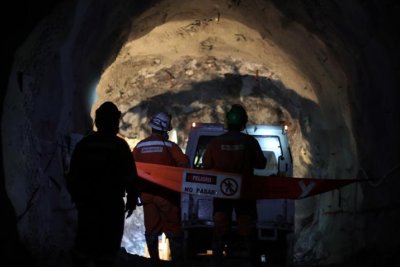

A new International Monetary Funds report says higher copper production and prices support Chile’s growth expectations, but warned of risks that include the crisis in the Middle East, rising oil prices and loss of domestic competitiveness tied to the sharp public spending cuts. File Photo by Mario Ruiz/EPA
SANTIAGO, Chile, May 8 (UPI) — An economic reform plan Chilean President José Antonio Kast announced to revive the country’s economy is drawing criticism over its potential short- and medium-term fiscal impact, as the International Monetary Fund lowered its growth projections for Chile.
The IMF’s World Economic Outlook report had estimated in mid-April that Chile’s gross domestic product would grow 2.4% in 2026 and 2.6% in 2027. However, the organization said this week it revised those projections to 2.2% this year and 2.5% in 2027 if external conditions and the country’s fiscal situation improve.
“Economic activity, driven by investment and exports in 2025, faces a period of heightened uncertainty,” the IMF said.
The report said higher copper production and prices support growth expectations, but warned of risks that include the crisis in the Middle East, rising oil prices and loss of domestic competitiveness tied to the sharp public spending cuts promoted by Kast.
The Chilean president’s plan includes proposals to reduce corporate taxes and cut bureaucracy in an effort to stimulate private investment. Congress is discussing tha proposal.
“Amid persistently high inequality, social discontent also remains a risk,” the IMF report said.
The IMF is not the only institution warning about the risks associated with the government’s National Reconstruction Plan.
Chile’s Autonomous Fiscal Council, an independent public agency tasked with monitoring the sustainability of fiscal policy, warned about the proposal’s possible impact on the country’s fiscal balance and public debt.
“The project commits fiscal spending with a high degree of certainty in the short term and reduces permanent revenue, while the positive effects depend on more uncertain future income associated with growth, which could lead to a deterioration in the fiscal balance if growth does not materialize at the estimated magnitude and speed,” the council said.
Jaime Bastías, director of the auditing school at Finis Terrae University, told UPI the IMF’s downgrade was “absolutely” expected because Chile’s central bank had already made a similar adjustment, while debate over financing the government’s proposal continues to intensify.
“The government’s plan can be an engine that helps us face the storm we are going through, but that is heavily conditioned on the state maintaining orderly public finances. The IMF says that if the proposed tax cuts are not offset through other channels, the country’s debt will grow too much, and that will create another problem,” Bastías warned.
Carlos Smith, a researcher at the Center for Business and Society Research at Universidad del Desarrollo, told UPI the IMF report shows that both external and domestic factors are likely to weaken household income and affect consumer spending.
“Consumption is one of the main drivers of Chile’s GDP. The IMF expects it to contract and that is already beginning to show, along with a very weak labor market. Chile is in a much weaker condition,” he said.
Smith said that although the IMF lowered its growth forecasts, the organization still appears optimistic about the long-term positive impact of the government’s proposed reforms.
“The impact will materialize more slowly than the finance minister expects. Therefore, the IMF is suggesting more efficient alternatives such as lower costs or more limited subsidies to create new jobs,” Smith said.
He added that while Ciles should adjust some aspects of the reform, he believes the plan is still moving in the right direction.
“I agree with the IMF that the proposal needs refinement and should focus on removing obstacles to investment projects without lowering the standards of our legislation or environmental protections. If that is achieved, I believe there is a possibility of reaching 3% growth by the end of the decade,” he said.
Bastías agreed, saying Chile could grow at 3% by 2030 if copper prices remain high, production increases and more private investment arrives.
“It is an optimistic scenario where we need to focus on stimulating those three factors. If that favorable future does not materialize, we will all pay the costs,” he said.