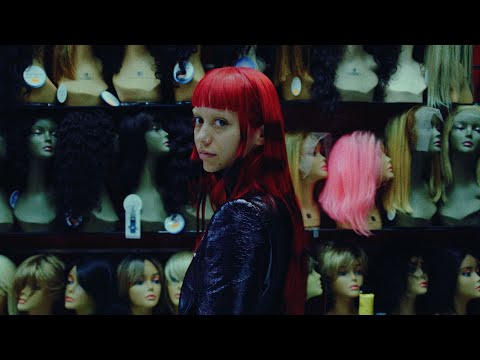
Earlier this summer, Akriila flew to Los Angeles and played two nights at the Roxy in West Hollywood. At 22, the Chilean singer-songwriter, most identifiable by her fire engine red tresses, is one of the most visionary newcomers in the latest wave of post-urbano Latin artists.
Fittingly, Akriila kick-started her career with a trap mixtape. The most-streamed tracks on her debut, 2024’s dazzling “Epistolares,” favor a progressive reggaeton vein. She also collaborated with Milo J on “Llora Llora” — a folksy lullaby off the Argentine rapper’s masterpiece “La Vida Era Más Corta.”
“Hot gays listen to Akriila” became a celebrated slogan on social media.
Turns out she was just getting started. Released Sept. 3, her latest album, “Lucy Miró al Mundo y Notó Que Está Girando” — its title a delicious riff on Beatles lore — eschews reggaeton altogether, in favor of a hallucinogenic collage of shoegaze, electronic glitch pop and South American roots sounds.
A guidepost of Chilean hyper-pop, it is also a heart-wrenching mash of tenderness and distortion. The lyrics describe the trauma of a recent transition, after she left her father’s home and ventured to live on her own — and though she’s now an established artist signed to Atlantic Records, her music is still aching and vulnerable.
“She is a reference point for all of us in contemporary music,” says producer Diego Raposo, a Dominican tastemaker who featured Akriila on his 2023 debut album. “I believe we’re witnessing something that we’ll probably never see again. Her music reminds me of Björk, Aphex Twin, even Shakira — but it’s also incredibly fresh and original.”
A few days before traveling to London for her inaugural European tour, Akriila spoke to De Los about the seduction of second verses, her obsession with ’90s dream pop and the growing pains of living alone.
This is such a dreamlike record. Was that intentional?
I wanted it to feel not necessarily ethereal, but hazy, like you’re inside a bubble. I love the way my voice is processed, sharing the space with so many layers. It’s really cool when the vocals are part of a track instead of lying there in the center of the mix.
I was your age in the ’90s, and this album has a very strange emotional effect on me: It reminds me of what it felt like to be in my 20s, listening to dream pop for the first time.
That makes perfect sense, and it connects with a favorite exercise of mine: Every week — ideally, every day — I listen to a full album from beginning to end. I started with new releases, but then set my sights on the classics.
The Sundays’ [1990 masterpiece] “Reading, Writing and Arithmetic” was the album that opened up the space mentally for what I wanted to do. I always say that I make alternative pop. I start with something that’s catchy and easily digestible, and then mix it with sounds that feel uncomfortable. As I was starting to work on this album, I listened to the Sundays, the Cardigans, and every single record that Prince ever made.
I can definitely feel the ’90s vibe in the closing track, “Lucy.” It’s gorgeous.
That’s inspired by the Sundays’ “Gone,” and the drums sound like Cocteau Twins. I love the art of collage — stealing from different artists, but doing it my way. There are samples of PJ Harvey, Patti Smith, but also Rosalía. When I make videos, I’m always thinking of something that MTV would have played back in the day.
I keep thinking of this record as a concept album, even though the actual concept is more of a feeling than anything else.
I totally get you. It’s not an album like the Who’s “Tommy” — an actual musical that takes the conceptual deal to another level. I feel we’ve forgotten the art of making albums now that we’re so focused on playlists and TikTok. I invest a lot of effort in making my albums conceptual, since I’m not into records that are random collections of tracks. “Epistolares” was all about sending letters and dedications. The deluxe version was more sentimental. This one is a concept album for sure. I could outline in detail why every moment of the record happens when it does.
The bridge on “Abrázame” is incredibly romantic.
That bit really freaked me out in a good way. It was shorter at first, but then I asked [producer] Vinco to make it longer. Those guitars on the bridge are the most beautiful thing he’s ever done. The contradiction of “Abrázame” is that everyone kept telling me that it should continue going up and explode at the end, but I had already overused that device on “Epistolares.” So I did the opposite and gave it a happy ending. That ethereal, ambient thing at the end kills me.
Talking about songwriting devices, here’s a trademark Akriila move: A song may be moving forward, and suddenly there’s a fracture — everything breaks and decomposes. Why?
I think I have ADHD and need things to be constantly changing. I’ve tried to make songs that are plain, but I just can’t do it. My favorite part of songwriting is working on the second verse. You’ve already presented the main idea and shown what the chorus is like. On the second verse you can change the beat or the lyrics, and do anything you like. [Producer] Clemente is just like me in that respect. Sometimes we take things to the limit, and then step back. It’s one of the great things about my creative team: We’re not married to the demos. We may do five versions of the same tune until it sounds right.
Your Chilean roots shine through on “Partedemipartedeti.” I listened to those folk bits and thought: Here’s someone who grew up listening to Los Jaivas and Inti-Illimani.
When I first started obsessing about music, the stuff that I liked was all in Spanish. I listened to tons of records from Chile, Argentina and Mexico. “Carta a Mi Papá” is like a traditional balada from Chile. I stole those chords from “Quizás, Porque” by [Argentine supergroup] Sui Generis. I listened to a lot of Pescado Rabioso when I was a teen. My partner has a cassette deck in her car, and she’s always playing [Charly García’s] “Piano Bar.” I don’t identify only with Chilean music. It’s more of a música latinoamericana thing. I don’t think gringos are that good in the lyric writing department. Artists like Bandalos Chinos, Alex Anwandter and Zoé are really great composers.
Do you think you’re an old soul?
People always tell me that [smiles]. We’re a team of three; I think Clemente is a really young soul. Vinco and I are the old ones.
Before making this record, you stopped living with your dad, moved to a place of your own, and experienced a time of profound loneliness. What does your father think of the finished album?
He loves it. He is a musician himself, and it must have been hard for him when we started living apart. It was also difficult for me to get home and feel so lonely because there was no one waiting for me anymore. My dad still comes to my place once a week; he doesn’t want to bother me, so he leaves food in the reception area. It’s his way of making sure that I’m doing fine.