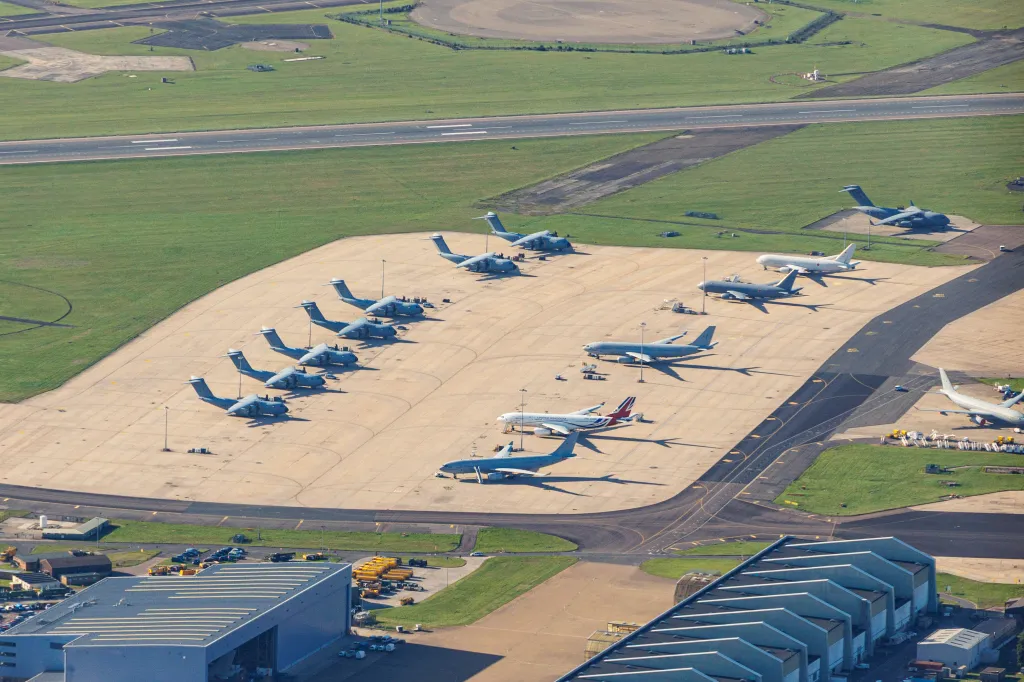
Faced with increasing threats from drones, the Royal Air Force (RAF) is reportedly increasing passive defensive measures to protect its aircraft. The service is setting up protective netting for planes that cannot be placed in hangars or hardened aircraft shelters, according to two British media accounts. The move follows Iranian threats to bases in England that resulted in increased base security measures and the evacuation of U.S. aircraft, first reported by TWZ. There are also real fears across Europe that Russia could go kinetic with its drone capabilities, especially after constant mysterious drone incursions over airfields and one case in which an attempt was made to destroy an aircraft at a German airfield.
TWZ has long highlighted the lack of hardened infrastructure at American military facilities abroad and at home, as well as how the U.S. is beginning to embrace these passive defenses, like netting, to protect aircraft, albeit at an alarmingly slow pace.
“Troops have… been tasked with setting up Kevlar anti-drone nets, like those used in Ukraine, for planes that remain outside on the runway or elsewhere, unprotected at military bases in the UK,” in reaction to drone threats, The Times reported on Wednesday.
Neither The Times, nor Sky News, which also reported about the increased passive defensive measures, stated the nature or the origination of the drone threat.

Both publications also reported that RAF aircraft were being placed into hangars and hardened shelters at night because of the drone threat.

However, that was standard practice well before these events, retired RAF Air Marshal Greg Bagwell noted on X.
“No need for panic, our smaller fighter aircraft have always been placed under cover at night – much of it hardened,” Bagwell explained. “It’s more challenging for larger aircraft, for which we don’t have enough hangarage, so other measures are necessary. But we are clearly in different times.”
“We take the security of our bases, equipment and personnel very seriously and are always adapting to counter any potential threats,” the British Defense Ministry told us Wednesday morning in response to our questions about the reported new passive defense measures at RAF bases. “This includes investing an additional £470 million to strengthen security at military sites, including better physical protection, surveillance and counter-drone capabilities. We have already invested £15 million in drone and counter-drone technology and introduced restricted airspace over 44 critical Defense sites.”
Effect On U.S. Air Force In England Unclear
We don’t know if the U.S. Air Force is taking similar measures to increase passive defenses at the RAF bases hosting its aircraft and also see frequent transiting flights.
As we noted at the top of this story, there were already urgent concerns about threats. Earlier this month, RAF Lakenheath and RAF Mildenhall had their security increased to Force Protection Condition (FPCON) Charlie, the second-highest military security level, reportedly in response to Iranian threats. As the security levels were boosted, Mildenhall saw the evacuation of a large number of its KC-135 aerial refueling tankers as well as its three CV-22 Osprey tiltrotor aircraft.

In addition, on Nov. 13, a suspected drone incursion over Lakenheath triggered a security response. However, a civilian pilot later suggested he and some friends may have set that off by flying near the installation in a three-ship formation of light aircraft.
There is also an ongoing investigation into a security incident at RAF Fairford in September that reportedly prompted the hasty departure of B-1 Lancer bombers. British authorities suspect Iran is behind the incident while a U.S. federal indictment handed up earlier this month said the plot against Fairford was partly coordinated from an American jail by a dual Iranian-Iraqi national.

On Wednesday, two U.S. Air Force officials, citing operational security concerns, declined to tell us whether the service was increasing passive defensive measures, like installing protective netting, in reaction to concerns about drones and ongoing threats.
“For operational security reasons we will not discuss specific force protection measures; however, we want to make clear that our Security Forces throughout the European Theater, in cooperation with our host nation partners, take a proactive integrated and layered approach to base defense and are ready to address potential threats,” one of those Air Force officials told us. “We continue to work very closely with Allies and partners to ensure the safety and security of our U.S. service members, U.S. and host nation civilians, contractors, families, and greater communities. We encourage everyone in our communities to remain vigilant and report any suspicious activity immediately to local authorities.”
RAF bases have hardened infrastructure from the Cold War. These structures are for tactical jets and allow aircraft to be placed out of harm’s way when not in use. These shelters are more than capable of defeating drone threats, but this leaves many other kinds of aircraft at risk and it does not help when the jets are placed outside on a flight line during normal operations.

Retired Air Force Col. Troy Pananon, who served as the Mildenhall installation commander between 2019 and 2021, told us that while moving aircraft into shelters at “fighter bases is pretty typical, generally they don’t have that [capability] for big aircraft” like tankers.
“Kevlar canopies… would be interesting,” he added. “I don’t think that’s the only solution. I would assume layering of defenses. When I think defense I think yes on passive defense all the way through kinetic, intel, and protection (like canopy in this concept).”
RAF Leader Calls For New Aircraft Dispersal Training
Details about the new aircraft defensive measures at RAF bases “emerged as Air Chief Marshal Sir Harv Smyth said the air force needed to practice dispersing aircraft across the country in preparation for possible conflict so that multiple jets could not be taken out in one blow,” The Times reported.
Smyth, speaking on Tuesday night at the Freeman Air and Space Institute, “said that aircraft had been dispersed across the UK over recent months as a result of a new runway being built at RAF Brize Norton — the main hub for the RAF’s strategic and tactical air transport,” the publication added. “However, the air force is likely to rehearse the fast dispersal of aircraft again, he explained.”

“As a service, we have proved that if we need to, we can take what people would have called ‘eggs in one basket’ and spread it across the length of the United Kingdom and keep operating,” Smyth added, according to Sky News.
“That was a big test for us and frankly the team nailed it,” Smyth explained. “We need to do more of that, this idea of just being as ready as we can with all of the tools that we have optimized for what we think the fight might be.”
In the days leading up to Russia’s all-out invasion, the Ukrainian Air Force (UAF) dispersed aircraft and radars across the country to prevent them from being wiped out in an initial attack. In addition to installing the aforementioned protective netting, the UAF has received a fleet of new vehicles to help it operate and maintain its Western-supplied F-16 Viper fighters at dispersed locations around the country. All these efforts over the past nearly five years have enabled the UAF to survive and continue fighting to this day under constant attack.

The U.S. military is also developing measures to operate forward, within the enemy’s weapons engagement capabilities and survive by moving rapidly from one place to another to stay outside of their foe’s targeting cycle. These efforts are additionally designed to get large forces to far-flung locales relatively quickly. This includes the Air Force’s Agile Combat Employment (ACE) doctrine, a term that currently refers to a set of concepts for distributed and disaggregated operations centered heavily on pushing small groups of combat aircraft forward, often to remote, austere, or otherwise non-traditional locales. These meansures
The other branches of the U.S. military, especially the U.S. Marine Corps, have been developing similar new concepts of operations.
America’s Changing Passive Defense Posture
As we pointed out earlier in this story, TWZ has frequently sounded the alarm about how a lack of passive defenses like hardened shelters and protective netting has created worrisome vulnerabilities, especially in any future fight against China.
In particular, we have raised concerns about threats posed by drones, small and large, to aircraft sitting out in the open for more than a decade now. Ukraine’s unprecedented Operation Spiderweb attack last year thrust these threats fully into the public consciousness. Spiderweb involved coordinated, localized covert attacks on airbases across Russia using large waves of weaponized quadcopter drones. At least 10 Russian bombers, as well as a variety of other aircraft, all sitting on open flightlines, were destroyed.
The following video screencap shows one of those Operation Spiderweb attacks underway.

Worries about aircraft parked in the open were further stoked by Iranian missile and drone barrages that killed and wounded U.S. personnel and destroyed and damaged aircraft, radars and other equipment during Operation Epic Fury.
The following images show a U.S. Air Force E-3 Sentry jet destroyed after an Iranian attack on Prince Sultan Air Base in Saudi Arabia in March.
Despite these events, there remains pushback against hardened shelters at the highest levels of the U.S. military.
“There is value in some light protection against small, unmanned threats,” Air Force Chief of Staff Gen. Kenneth Wilsbach told Breaking Defense in July. “Some of them — just nets that are up that keep a small, few-$100 drone from getting next to a $2 billion aircraft. That actually works, [and is] really cheap.”
Otherwise, “I think that I don’t want to spend a lot of money on hardening shelters. Unless you’re going to send something 100 feet or more underground, we can blow it up, and so can they,” Wilsbach said in the same interview. “So, the economics of building a shelter that is impervious to a strike doesn’t work.”
As we have explained in the past, hardened shelters are not meant to protect aircraft from every conceivable form of attack. They can guard against submunitions, shrapnel and smaller drones. Ballistic missiles hit at very high speed and can piece hardened structures. Even some glide bombs and cruise missiles feature specialized penetrating warheads that can punch through hardened shelters. Still, these shelters would force an enemy like China to expend more munitions that use powerful unitary warhead to destroy each aircraft, and they would not even know what shelters have aircraft inside them. Basically, it hardens the target and makes it so $100M fighters can be destroyed by $30,000 drones en masse.
Still, all these experiences in Ukraine, the Middle East, Europe and elsewhere are pushing the American military to finally take action.
Even before Operation Spiderweb was launched, the U.S. Air Force at least considered installing nets or other physical barriers to help blunt drone attacks on parked aircraft at Langley Air Force Base in Virginia and Seymour Johnson Air Force Base in North Carolina.
Last January, the Pentagon, by way of Joint Interagency Task Force 401 (JIATF-401), notably issued new guidance for protecting critical infrastructure against drone attacks that explicitly called for increased use of netting, along with cables and other kinds of passive physical defenses. JIATF-401 was established in August 2025 to serve as a focal point for counter-drone efforts across the U.S. military, as well as other branches of government, and to help accelerate the fielding of new capabilities.
Then, earlier this month, the U.S. Air Force began looking for contractors who could install netting at Tyndall Air Force Base in Florida to help protect F-35 Joint Strike Fighters from drone attacks. The netting plan, which has yet to be finalized, reflects growing support for increased physical hardening of bases within the U.S. military, especially against uncrewed aerial threats.

The need to passive hardening of airfields is undeniable at this point and we will likely begin to see real movement in the West to put at least simpler measures in place, like netting, that can at least help reduce some of the risk, while not incurring large costs or resulting in major operational impacts.
Contact the author: howard@twz.com