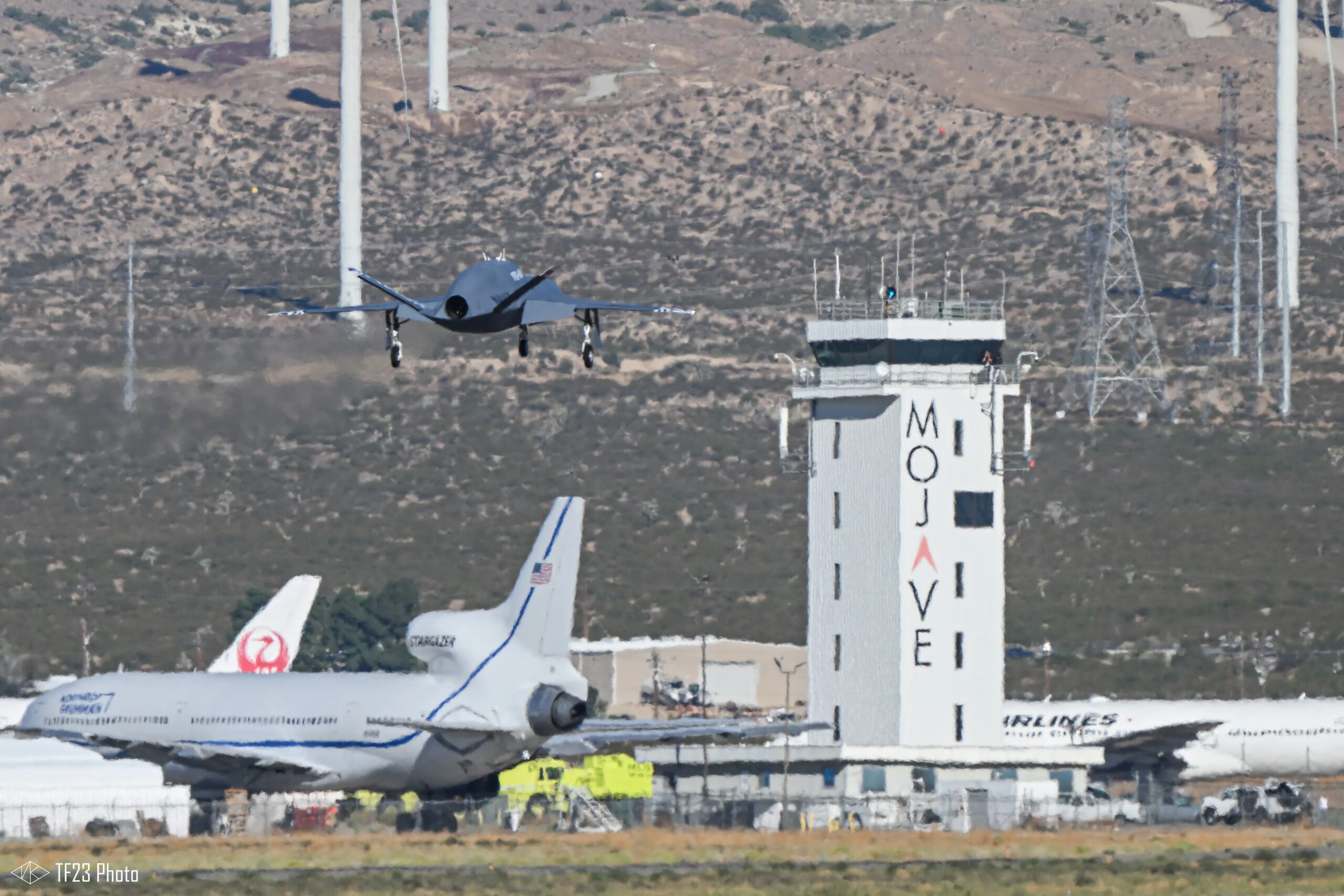
A hybrid-electric uncrewed aircraft designed and built by Northrop Grumman (NOC) has begun flight testing at Edwards Air Force Base in California, the company said Wednesday. The aircraft, designated XRQ-73, was developed under the Defense Advanced Research Projects Agency’s Series Hybrid Electric Propulsion
Weekly insights and analysis on the latest developments in military technology, strategy, and foreign policy.
The U.S. Air Force said its new interim Air Force One jet, dubbed the VC-25B Bridge aircraft, has officially completed modifications and flight testing and is being painted in the red, white and blue livery sought by President Donald Trump. The extremely lavish 747-8i Boeing Business Jet (BBJ) – donated by Qatar to the U.S. last year for use by Trump – is set to serve in the Air Force One role while the White House awaits the delayed delivery from Boeing of two fully-outfitted VC-25B Air Force One aircraft. There are no plans to retire the VC-25As that currently serve as Air Force One until both full-up VC-25Bs are operational.
The Air Force said the VC-25B Bridge aircraft is on schedule to roll out in its new paint scheme and be delivered to the Presidential Airlift Group this summer. It is not clear when it will start flying Trump. The White House referred us to the Air Force for additional information.
A VC-25B Bridge aircraft takes off for flight testing at Greenville, Texas. The aircraft recently completed modification and flight-testing phases, entering maintenance to be painted in red, white, gold and blue livery. The program remains on schedule to deliver the Bridge aircraft to the Presidential Airlift Group no later than summer 2026. (Courtesy photo)
The Qatari-donated 747-8i jet envisioned as a presidential airlifter, had a recent test flight. (TT-33 operator photo)(TT-33 operator)
The USAF now says that with the Boeing VC-25B deliveries delayed far past its initial 2024 target and VC-25A heavy maintenance cycles being extended, an interim capability became “an absolute imperative.” How accurate this claim actually is isn’t clear. Trump has been talking about an interim Air Force One aircraft for some time since deliveries of the new VC-25Bs were pushed back beyond his second term. We heard of no actual requirements originating for this capability from within the USAF prior to the new administration or far in advance of Trump’s deal with the Qataris to source the jet. Very early in the new administration, Elon Musk was even working to find out how to get Trump a new Air Force One as fast as possible, for instance.
The Air Force claimed that in February 2025, a dedicated task force launched a “full-court press” on the VC-25B Bridge program while simultaneously working to accelerate Boeing’s long-term VC-25B production.
A rendering of a future US Air Force VC-25B Air Force One jet in the red, white and blue livery desired by President Donald Trump. (Boeing) Boeing
Though questions were swirling about the legality and ethics of receiving the gifted plane, the Pentagon last May took delivery of the aircraft and said it would rapidly undertake the required modifications.
It’s one thing to have a donated ultra-luxury jet, but turning it into one safe and connected enough to carry a president is another story.
As TWZ has previously noted, converting any aircraft into one that is secure enough to transport the president is a complex undertaking. The aircraft needs to provide constant, secure communications, including what is needed to order a nuclear strike under extreme conditions. Historically, it also needs to be physically hardened both inside and out to withstand myriad threats, from the electromagnetic pulse of a nuclear weapon going off to incoming surface-to-air missiles to enemy intelligence-gathering efforts. To do this requires significant modifications right down to the aircraft’s outer structure. It is very unlikely, if not impossible, that this aircraft was hardened against EMPs in the timeframe required for fielding it.
In previous coverage, we noted that at the very least, “this aircraft will haveto feature somekind of DIRCM setup to repel shoulder-fired heat-seeking missiles, and modular units are available that can be attached in a canoe to the bottom of the aircraft. These systems, such as Elbit’s C-MUSIC or Northrop Grumman’s Guardian, are in service with foreign VVIP 747s, as well as commercial aircraft, including those flying for Israeli airline El Al. You can read all about these systems here. Still, while they offer far less defensive capacity compared to what is seen under the belly of a VC-25A, they would offer a significant layer of protection.” We still don’t see any evidence of the aircraft being modified with defensive countermeasures.
Northrop Grumman’s Guardian pod is a self-contained DIRCM (includes missile approach and warning sensors and laser pointer) solution for airliner-type aircraft. (Northrop Grumman)
L3Harris, known for its communications systems and aircraft alterations, was selected to undertake the “complex modification of the bridge aircraft,” the Air Force explained. The company already delivers “secure, reliable and resilient communications” for VC-25A and the executive airlift fleet “but has extensive experience with self-protection and customization of VIP aircraft,” the Air Force added. “The accelerated timeline was further made possible by a mission-focused partnership with Boeing, who provided the necessary engineering data to support the required structural modifications.”
In addition, “elite specialists from multiple government agencies developed advanced protocols to detect and – if necessary – neutralize potential technical hazards on previously owned aircraft,” according to the Air Force. “Their rigorous approach on the Bridge aircraft has literally ‘written the book’ and set the benchmark for integrating used airframes into the secure military inventory.”
In response to our question about what modifications the jet received, the Air Force told us the following:
“Safety and security were at the forefront of this program. We deliberately minimized interior aesthetic modifications to focus on modifications for safety, security and mission execution. We assessed which requirements were necessary for an interim capability. We had greater flexibility in developing our mission requirements.
After safety and security, we focused on the mission communications systems.
We have made deliberate decisions such as the reduction of the number of airstairs, less chiller space, and exclusion of the Golden Eagle mission [to fly the remains of former presidents] to minimize structural modifications, while prioritizing modifications focused on safety, security and secure communications.”
We also asked whether this jet will be able to fly overseas and into higher-risk areas, but have not gotten a response. At this point, based on the limited info we have at this time, that seems unlikely. But if this is the case, the question then can be raised why the USAF is spending billions on two full-up Air Force One aircraft if standards have been so relaxed that this simpler aircraft can do all their missions? We will update this story with any pertinent details the USAF provides.
A Qatari Boeing 747 sits on the tarmac of Palm Beach International airport after US President Donald Trump toured the aircraft on February 15, 2025. (Photo by ROBERTO SCHMIDT / AFP) ROBERTO SCHMIDT
To help speed up the delivery process of this interim Air Force One jet, the Air Force said it “constructed an at-scale mockup of the interior, complete with virtual reality views, to enable early commissioning activities for White House staff.”
“Our commitment to providing the president with a secure, resilient and reliable airborne command post is unwavering,” said Chief of Staff of the Air Force Gen. Ken Wilsbach. “The VC-25B Bridge program is a testament to the Air Force’s ability to innovate and rapidly evolve to ensure the continuity of our government under any conditions.”
The Air Force said the estimated delivery of Boeing’s VC-25Bs is now expected in 2028. If that holds up, then this ‘bridge’ aircraft will have served at most around two years until the first full-up VC-25B is delivered.
We will continue to follow developments in this program and provide updates when warranted.
As tensions ramp up amid fragile truce, US military says it ‘redirected’ 34 vessels as part of blockade on Iran’s ports.
Published On 24 Apr 202624 Apr 2026
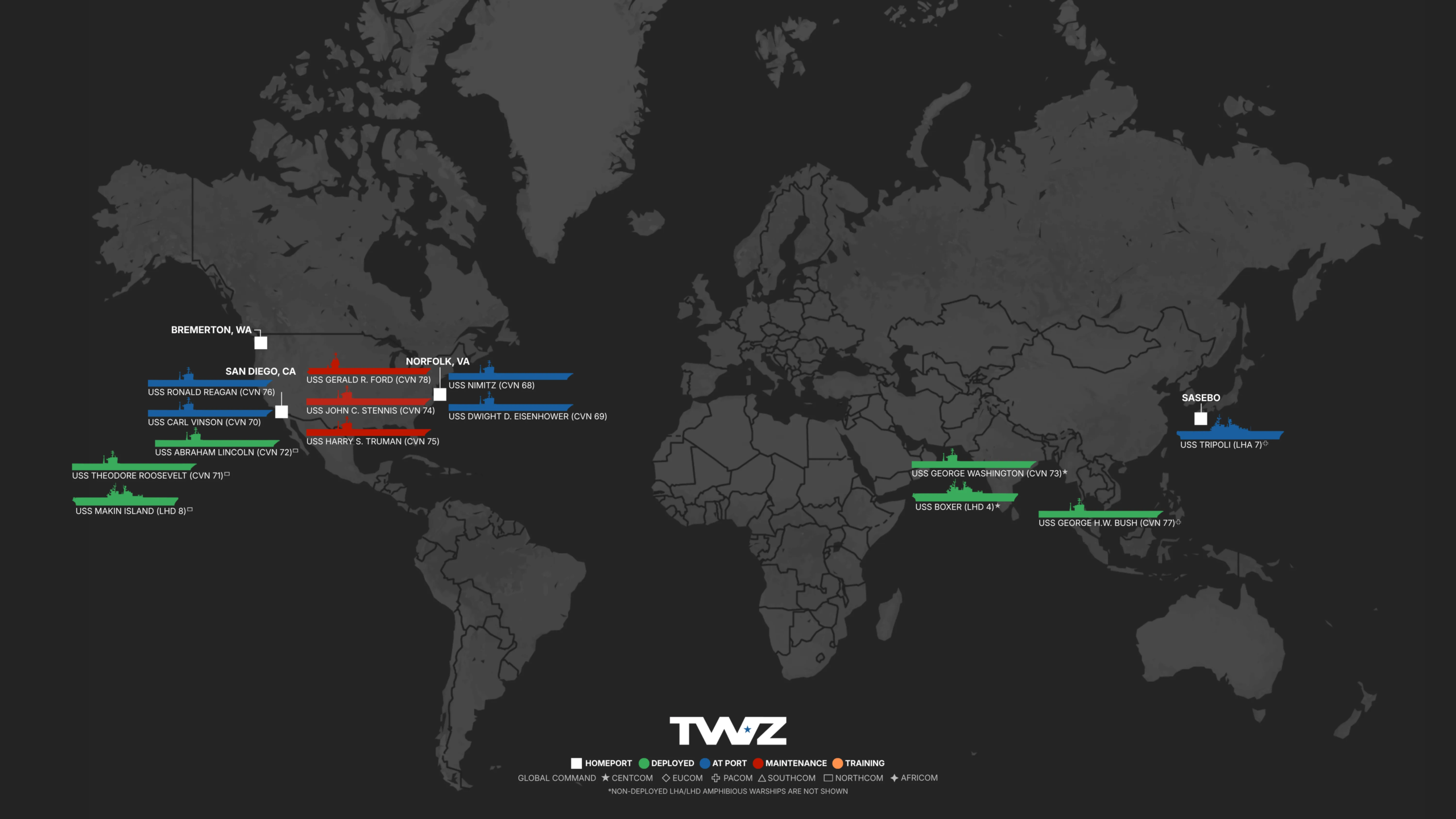
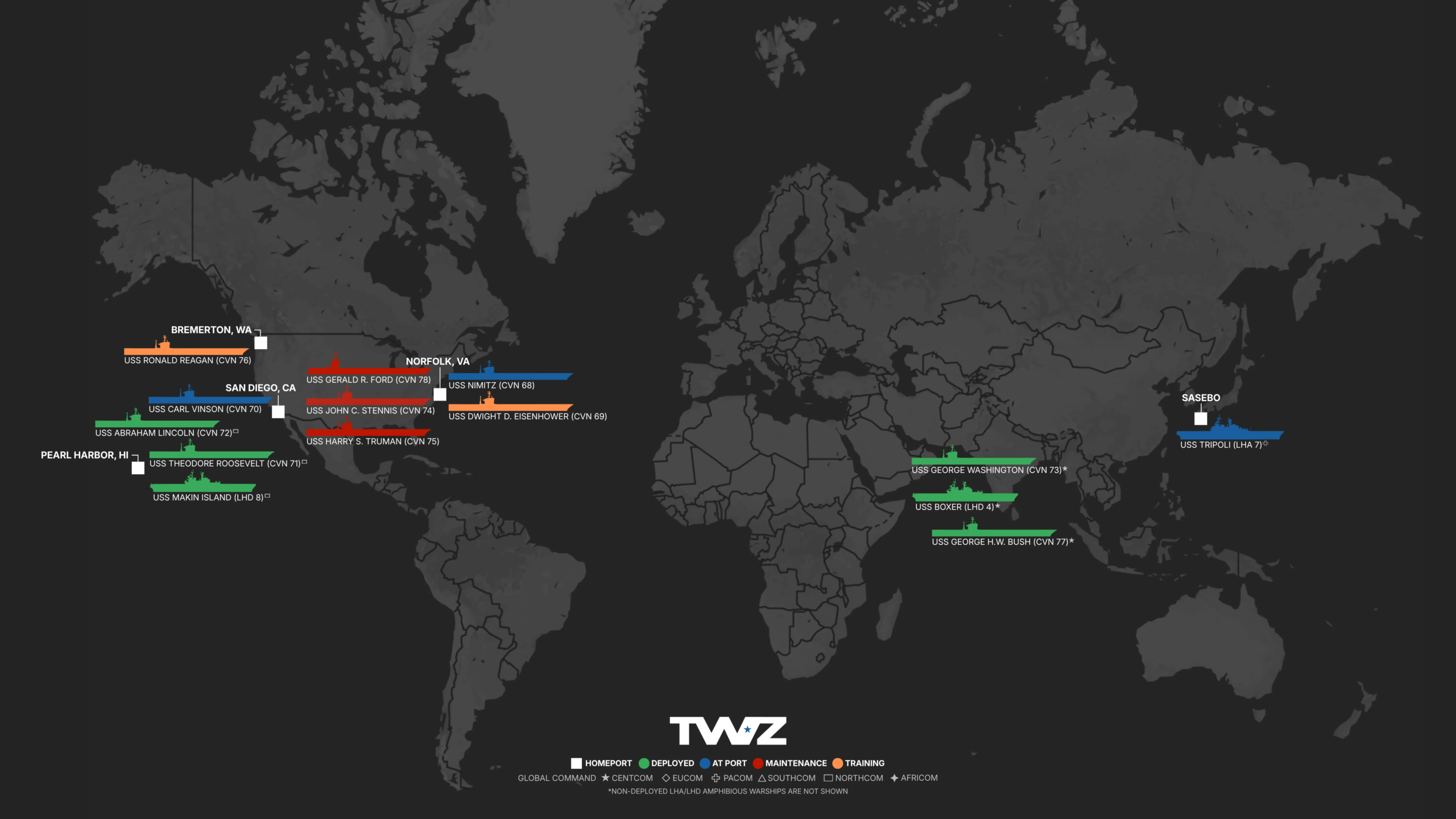
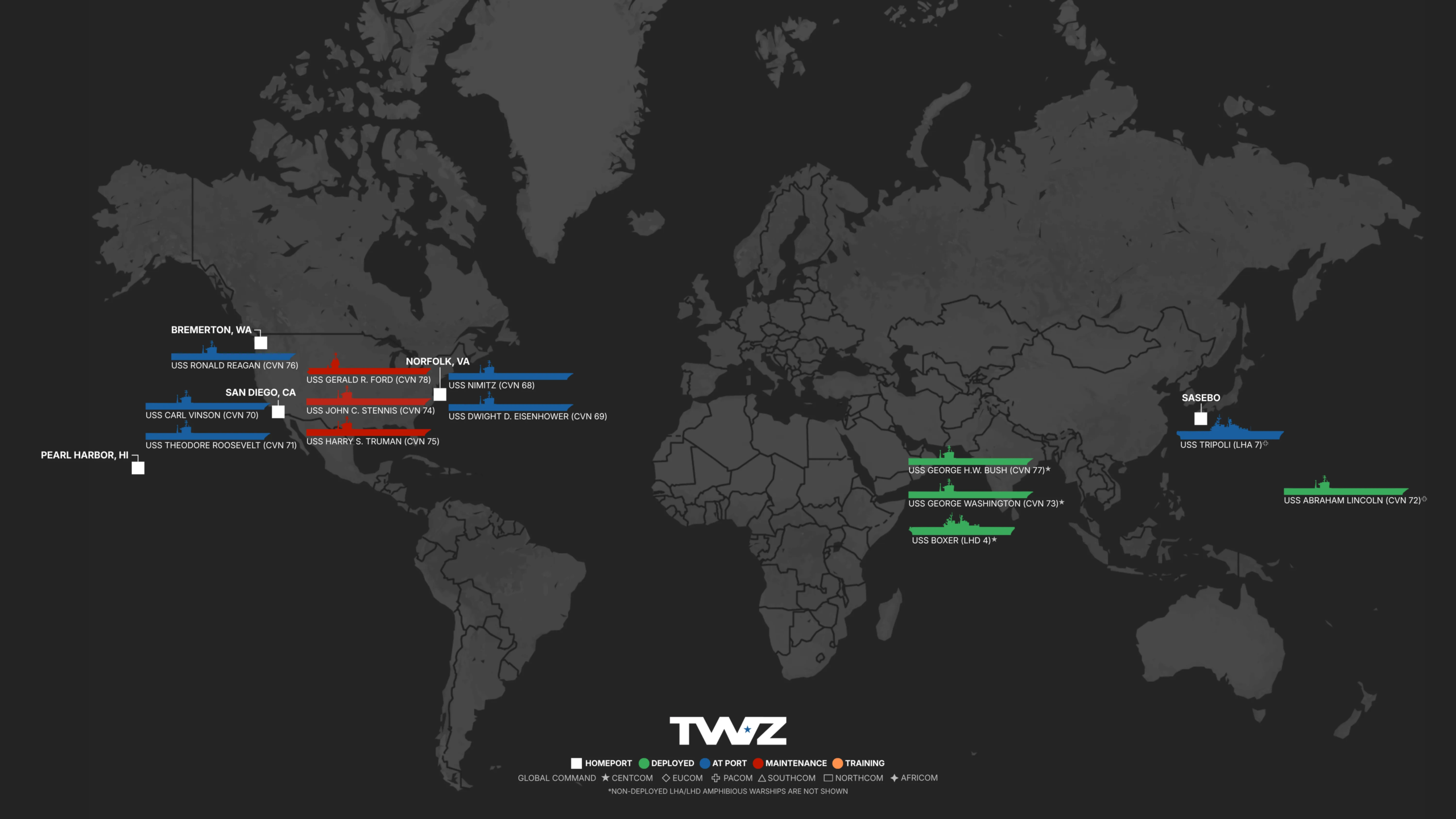
The United States has three aircraft carriers in the Middle East for the first time in 23 years with the arrival of the USS George HW Bush, the US military has said, amid a fragile ceasefire with Iran.
The Middle East-based Central Command (CENTCOM) of the US military said on Friday that the carriers include 12 accompanying ships, more than 200 aircraft, and 15,000 soldiers.
Recommended Stories
list of 3 itemsend of list
“For the first time in decades, three aircraft carriers are operating in the Middle East at the same time,” CENTCOM said.
The last time the US amassed that amount of military assets in the region’s waters was in the lead up to the US-led invasion of Iraq in 2003.
The other two US aircraft carriers in the region are USS Abraham Lincoln and USS Gerald R Ford, which is the largest in the world.
The show of force signals that the US is preparing to return to fighting should the fragile ceasefire between the US, Israel and Iran unravel.
Diplomacy between the two countries has been in limbo, with Iran setting the lifting of the US naval blockade against its ports as a condition for resuming the talks.
US President Donald Trump announced extending the truce on Wednesday, but he said the naval siege would persist.
For its part, Iran has reblocked the Strait of Hormuz in response to the US blockade after declaring the waterway completely open last week when the regional ceasefire was extended to Lebanon.
Trump has not set a deadline for the extended ceasefire and suggested that he is comfortable with the status quo, which he argues is depleting the Iranian economy at a low cost for the US.
“I have all the time in the World, but Iran doesn’t,” he wrote in a social media post on Thursday.
The US president was later asked how long he would be willing to wait before receiving a proposed deal from Iran. He said: “Don’t rush me.”
Iran has described the blockade – which has seen US forces seize at least two Iranian oil ships – as an “act of war”.
Iranian forces have also captured foreign commercial ships in the Hormuz Strait, accusing them of violating maritime regulations.
With negotiations on hold, Trump has shown no signs of willingness to lift the siege in order to facilitate talks.
On Friday, the US military said it has “redirected” 34 vessels in the region. “The blockade against ships entering or exiting Iranian ports continues,” CENTCOM said.
Trump has previously threatened to destroy Iran’s civilian infrastructure, including bridges, power and water stations.
Israeli Defense Minister Israel Katz said on Thursday that his country is awaiting the green light from Trump to return Iran to the “age of darkness”.
“Israel is prepared to renew the war against Iran. The [Israeli military] is ready in defence and offence, and the targets are marked,” Katz said, according to The Times of Israel newspaper.
Weekly insights and analysis on the latest developments in military technology, strategy, and foreign policy.
As the dust settles following more than five weeks of sustained U.S. combat operations against Iran, we now have the clearest picture yet of the toll taken on American aircraft during Epic Fury. After flying more than 13,000 sorties, the United States lost 39 aircraft throughout the 39-day operation, with another 10 damaged to various degrees, according to TWZ’s internal tracking. The actual number is likely higher, as we only confirm losses via open sources.
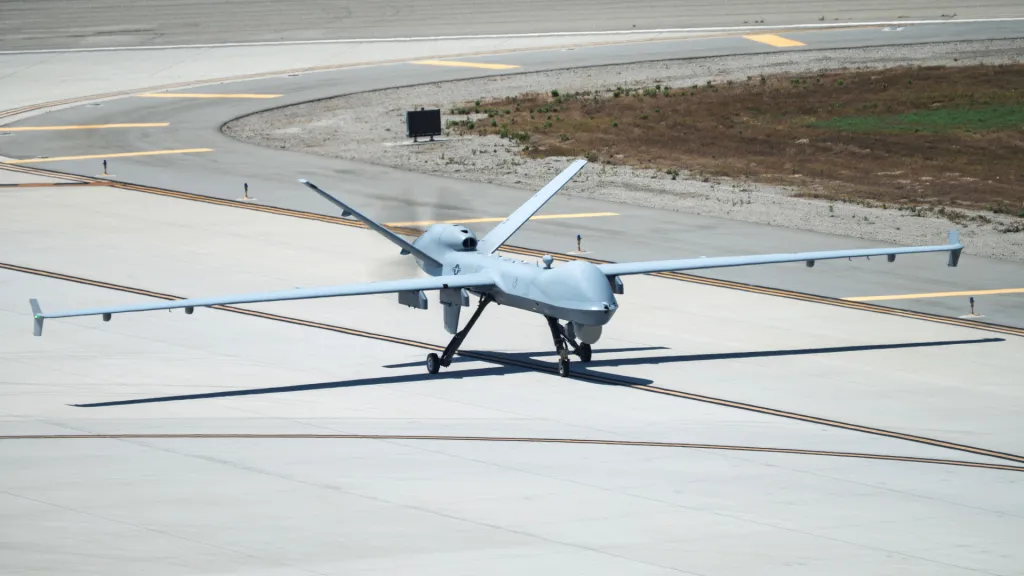
America’s drone fleet absorbed the heaviest losses, accounting for more than 60% of total combat attrition. Up to 24 USAF MQ-9 Reaper drones were destroyed, according to the latest reporting from Jim LaPorta and CBS. Five fighters were downed while in the air, four F-15E Strike Eagles and one A-10 Warthog. An F-35A was hit over Iranian airspace, marking the first known combat damage to a 5th-generation fighter, but the pilot made an emergency landing safely. 20% of attrition was due to friendly fire, including three F-15Es shot down over Kuwait, or the deliberate destruction of assets to prevent capture during a combat search and rescue mission in Iranian territory. Some losses, however, will be felt more than others, such as the prized E-3G Sentry that was totally destroyed.
For the latest on Operation Epic Fury, read our rolling coverage here and check TWZ daily for live updates.
WASHINGTON — The United States relied on dozens of aircraft, hundreds of personnel, secret CIA technology and a dose of subterfuge to rescue a two-man F-15E fighter jet crew downed deep inside Iran, a risky mission that President Trump and his top defense aides detailed Monday.
U.S. forces rescued the pilot within hours of the jet going down late Thursday, surging helicopters, midair refuelers and fighter aircraft deep into Iran after confirming his location, Trump said in a valedictory news conference at the White House, describing the military operation in an unusual level of detail.
The second aviator aboard the aircraft — the weapons systems officer — was rescued nearly two days later.
An A-10 Warthog, which was the attack aircraft primarily responsible for keeping in contact with the downed pilot on the ground, was hit by enemy fire while engaging Iranian forces, said Gen. Dan Caine, chairman of the Joint Chiefs of Staff.
The A-10 was “not landable,” Caine told reporters, but the pilot continued fighting before flying to a friendly country and ejecting. He was quickly rescued and is doing fine, Caine said.
The rescue of the F-15 pilot occurred before the Iranians could marshal a comprehensive search of their own, but finding and bringing home the weapon systems officer was an even more complicated endeavor.
The officer, who rode in the backseat of the F-15 flying under the call sign Dude-44 Bravo, was injured but followed his training to get as far from the crash site as possible. He managed to climb mountainous terrain and hide inside a cave or crevice. He contacted U.S. forces Saturday.
When a plane crashes in hostile territory, “they all head right to that site, you want to be as far away as you can,” Trump said.
CIA Director John Ratcliffe said the spy agency used “exquisite technologies that no other intelligence service” possesses to locate the aviator. At the same time, the CIA mounted a deception operation to mislead Iranians who also were trying to find him.
Ratcliffe said the search and rescue operation was “comparable to hunting for a single grain of sand in the middle of a desert.”
The CIA declined to respond to questions Monday about the kind of technology used to locate the airman.
Protected by an “air armada” of drones, strike aircraft and more, rescuers moved in on Sunday to pick up the weapons officer and bring him home.
Many of the dozens of aircraft that were part of the operation were there for deception, Trump said.
“We were bringing them all over, and a lot of it was subterfuge,” Trump said. “We wanted to have them think he was in a different location.”
Back in Washington, national security officials coordinated on a call, keeping the phone line open for nearly two days straight.
“From the moment our pilots went down, our mission was unblinking,” Defense Secretary Pete Hegseth said. “The call never dropped. The meeting never stopped, the planning never ceased.”
Cooper, Toropin and Amiri write for the Associated Press. Cooper reported from Phoenix and Amiri from New York. AP writer Josh Boak contributed to this report.
April 6 (UPI) — The United States and South Korea began a joint investigation Monday to locate the wreckage of at least three U.S. aircraft that crashed off South Korea’s northeastern coast during the Korean War, officials said.
The four-week survey of the Gangneung and Yangyang areas of northeastern Gangwon Province seeks to trace the wreckage of a fighter plane and two transport aircraft, ahead of underwater investigations scheduled for August, South Korea’s Ministry of Defense said in a statement.
The joint survey is being conducted by the Pentagon’s POW/MIA Accounting Agency and South Korea’s Ministry of National Defense Agency for KIA Recovery and Identification, which will collect materials, including information from local residents, as well as confirm the availability of medical decompression chamber facilities essential for underwater operations.
“Since 2024, I have been coming to Korea for three years to work with MAKRI to find traces of the heroes who fought in the war,” U.S. Marine Staff Sgt. Jordyn King, deputy team leader of the Pentagon’s DPAA investigation team in South Korea, said in a statement.
“During the one month given to us, we will carefully gather materials so that we can achieve good results in the future underwater investigation.”
Seoul said the survey covers three aircraft crash sites, including that of a transport plane that crashed on Nov. 15, 1952, after departing Gangneung Air Base for Pohang with nine people, including a South Korean service member, on board.
The plane suffered engine trouble mid-flight and crashed into the sea.
A second site is waters near Yangyang County, where a U.S. aircraft crashed on Feb. 21, 1952. The third is in waters near Gangneung, where a transport plane with 17 people on board crashed on Oct. 16 of that same year after suffering a mechanical problem.
“Just as we recover the remains of South Korean troops killed in action, we will spare no support in helping to find the war dead and missing of the U.S. military who helped us,” Lt. Col. Kim Seong-hwan, acting head of MAKRI, said in a statement.
The announcement comes months after the two agencies signed a memorandum of understanding in Arlington, Va., committing to the recovery and identification of remains of soldiers who were classified as missing during the Korean War of 1950-1953, which ended with an armistice.
According to a DPAA release announcing the signing in August, the agreement enhances cooperation and collaboration between the two agencies, while streamlining efforts to locate, excavate and identify the remains of fallen service members.
More than 1.8 million Americans served in the Korean War of 1950-1953, about 37,000 of whom were killed, more than 92,000 wounded and roughly 8,000 were listed as missing, according to Pentagon statistics.
Passengers arrive to discover their posessions have been left behind as days of walkouts start at sites – full list
12:17, 31 Mar 2026Updated 12:17, 31 Mar 2026
Trolleys to transport suitcases in Terminal T4 of Adolfo Suarez Madrid-Barajas Airport, this Easter, as two ground handling strikes at Groundforce and Menzies airlines hit(Image: Getty Images)
Passengers flying from 13 Spanish airports hit by strike action have landed to discover all their luggage has been left behind, local media has reported. Canarias said the first day of the strike by Groundforce workers, the ground handling operator that services Air Europa flights, resulted in continuous delays across all the airline’s flights and passengers arriving at Canary Island airports without their luggage, having had to leave it behind at their point of origin.
Alternating work stoppages are taking place between 5 and 7 am, 11 am and 5pm, and 10 pm and midnight, the first day of the strike affected 13 Spanish airports, three of them on the islands of Gran Canaria, Lanzarote, and Fuerteventura, where delays occurred throughout the day. These delays did not originate at the island airports but rather on flights arriving primarily from Madrid, Barcelona, and Bilbao, with delays approaching an hour.
Airports impacted are Barcelona-El Prat, Madrid-Barajas, Ibiza, Palma de Mallorca, Gran Canaria, Tenerife, Fuerteventura, Bilbao, Lanzarote, Alicante, Valencia and Malaga. The Groundforce strike is scheduled for this Wednesday (April 1) and Good Friday (April 3), with the possibility of becoming indefinite.
Because the aircraft operate on a network, delays accumulated throughout the day, causing significant disruptions to flights departing from the three affected airports in the archipelago. At major airports on the Iberian Peninsula, such as Madrid, Barcelona, and Bilbao, planes departed without luggage in their holds throughout Monday, leaving many passengers arriving at their destinations without their belongings.
It’s worth remembering that the most affected route is Madrid-Gran Canaria, on which Air Europa operates seven flights daily. According to Orlando Robledano, secretary of the aviation sector at the UGT union, the strike’s impact on Canary Island airports has been reduced due to the minimum services imposed by Groundforce on all Lanzarote Airport employees. Even members of the works council received this notification requiring them to comply with these minimum services, making it impossible to achieve the level of participation required for a strike of this nature.
This, coupled with the fact that domestic flights at Canary Island airports are protected and must be serviced regardless of delays, meant that the problems were less severe at the islands’ airports than at those on the mainland. Other affected airports include Alicante, Valencia, Palma de Mallorca, Ibiza, and Málaga.
Hosteltur reported that strikes at Canary Island airports during the peak days of Holy Week, between Maundy Thursday (April 2) and Easter Monday (April 6) may be called off as workers at Menzies—who provide check-in, boarding, and baggage services to airlines such as Norwegian, EasyJet, and British Airways—along with the works council and their union representatives from UGT, are close to reaching an agreement to call off the strike that was set to affect nearly 3,000 of the group’s employees in Spain, 600 of them in the Canary Islands.
At least six planes took off from Madrid-Barajas Airport on Monday without their passengers’ luggage due to an indefinite strike by the ground handling company Groundforce. On this first day of the strike, disruptions are being reported at all airports, although the most significant impacts are felt in Madrid and Barcelona, according to union sources, Telecinco reported.
Passengers report long queues and checked baggage left on the tarmac during the first day of the strike The indefinite strike by Groundforce ground staff began this Monday at Barcelona Airport, with protests taking place at three different times. The affected services are all those related to ground handling.
Long queues were reported at Barcelona’s El Prat Airport, where Alberto García said: “There have been some delays, and some planes have even departed with very little luggage. It was the protesters themselves who informed passengers that their bags would not arrive on time.
“The unions continue fighting for their objective and are demanding that the company comply with the wage agreements stipulated in the collective bargaining agreement.” At this time, many people have seen their flights significantly delayed or have had their luggage left behind.
In Madrid, people have had to wait for extended periods to check their luggage. Some report waiting for “four or five hours.”
Many planes, especially those arriving from Madrid, “are arriving without luggage, and the problems are spreading,” a UGT spokesperson told Europa Press, adding that “there is no guarantee that luggage will arrive.” The delays “affect not only direct flights but also many connecting flights, since passengers arrive without their luggage and therefore miss their next flight.”
March 23 (UPI) — A Colombian Air Force C-130 Hercules aircraft crashed Monday in the southern department of Putumayo while transporting military personnel, with the number of casualties still unknown, authorities said.
Defense Minister Pedro Sánchez confirmed the accident and said the cause remains under investigation. Initial reports indicate the aircraft was carrying about 100 people, including members of Colombia’s armed forces and National Police.
“Military units are already at the scene; however, the number of victims and the causes of the accident have not yet been precisely determined,” Sánchez said on X.
Con profundo dolor informo que un avión Hércules de nuestra @FuerzaAereaCol sufrió un trágico accidente mientras despegaba de Puerto Leguízamo (Putumayo), cuando transportaba tropas de nuestra Fuerza Pública.
Unidades militares ya se encuentran en el lugar de los hechos; sin…— Pedro Arnulfo Sanchez S. Orgullosamente Colombiano (@PedroSanchezCol) March 23, 2026
Gen. Carlos Silva, commander of the Colombian Aerospace Force, said the aircraft was carrying “114 passengers on board and 11 crew members.” He also said that “48 injured people have already been rescued,” though he cautioned that the figure is preliminary, France24 reported.
A witness at the crash site told local radio station La FM that several injured people had been evacuated.
“We are in a rural area where the plane went down and we are collecting the injured. About 10 to 15 people have been taken out. We are transporting them in police vehicles and local residents are helping move people on motorcycles,” the witness said.
Pobladores de la zona aseguraron que hay, al menos, una decena de heridos, que están siendo evacuados con ayuda del Ejército, la FAC y la Policía. pic.twitter.com/PONeOtZLgg— La FM (@lafm) March 23, 2026
Early reports indicate the aircraft may have experienced difficulties during takeoff and failed to gain proper altitude, according to Noticias Caracol.
The aircraft, identified as FAC 1016, was carrying troops from the Army’s 27th Jungle Brigade. The personnel were traveling from Puerto Leguízamo to Puerto Asís as part of a troop rotation, and the plane was expected to return to Bogotá.
President Gustavo Petro addressed the incident on X, expressing concern over possible casualties.
“I hope we do not have deaths in this horrific accident that should not have happened,” Petro said.
He added that his administration has sought to modernize the military’s equipment but has faced bureaucratic obstacles.
“If civilian or military administrative officials are not up to this challenge, they must be removed,” he said.
Petro also said his government has worked to modernize the country’s strategic air fleet and has requested the immediate purchase of helicopters and transport aircraft to expand troop mobility, particularly in regions affected by the grounding of Russian-made helicopters.
He said, contrary to some media reports, the military has been losing operational capacity for more than 15 years and that his administration is committed to fully modernizing its equipment.
Weekly insights and analysis on the latest developments in military technology, strategy, and foreign policy.
The latest addition to the Japan Air Self-Defense Force (JASDF) is, without question, one of the ugliest military aircraft to grace an apron today. With its enormous, bulged nose and other awkward protuberances, the Kawasaki EC-2 is, nevertheless, an important addition to the JASDF at a time when it faces increasing challenges from various sophisticated threats. The aircraft, which has generated much interest, took to the air for the first time today at Gifu Air Base, in the prefecture of the same name.
Derived from Japan’s indigenous C-2 twin-jet transport, the EC-2 is a standoff electronic warfare aircraft, the development of which began in 2021. Its primary role is to interfere with an opponent’s operations on the electromagnetic spectrum, from outside the range of air defense threats.
Specifically, the EC-2 is based on serial 68-1203, which was the third C-2 transport completed, before being modified for its specialist role.
As for the C-2, this military airlifter sits somewhere between a C-17 and a C-130 in terms of size and capabilities. In fact, it is probably closest in most regards to the four-turboprop Airbus A400M, but is powered by a pair of General Electric CF6 high-bypass turbofans — similar to those on many 747s and 767s, for instance.
A standard Japan Air Self-Defense Force C-2 transport aircraft. Australian Department of Defense SGT Pete Gammie
Returning to the EC-2, this aircraft is the successor to the JASDF’s one-off and now-retired Kawasaki EC-1, which was converted from an existing C-1 transport airframe and was for many years operated by the Electronic Warfare Operations Group (Denshi Sakusengun) at Iruma Air Base, in Japan’s Saitama prefecture.
A series of photos shows the now-retired Kawasaki EC-1:
Gifu is home to the JASDF’s Aviation Development and Testing Group, which will put the EC-2 through its paces before it is approved for operational service.
Before its first flight, the EC-2 became a peculiar object of interest for spotters and locals alike, with photographers taking numerous shots of the aircraft as it underwent taxi trials at Gifu.
Prior to that, the EC-2’s appearance had only been publicly known thanks to a rendering released by the Japan Ministry of Defense.
Schematic rendering of the EC-2. Japan Ministry of Defense
Back in 2022, a spokesperson from the Japan Ministry of Defense’s Acquisition, Technology & Logistics Agency (ATLA) told Janes that the C-2 was selected as the platform due to its ability to carry a significant amount of equipment to enable it to conduct “effective jamming” from outside of the opponent’s threat envelope.
“[The] C-2 transport aircraft has been selected as the base platform after considering such factors as its flight performance, maximum payload, and cost,” the ATLA spokesperson said at the time.
“By choosing the C-2 as the base platform, we make use of the existing infrastructure of the C-2 and thus effectively and efficiently operate the new C-2-based standoff EW aircraft,” the spokesperson added.
Compared to the C-1, the C-2 has a significantly higher payload capacity. The new transport can carry a payload of nearly 80,000 pounds for a maximum takeoff weight of 310,000 pounds, as opposed to a payload of around 26,000 pounds and a maximum takeoff weight of 100,000 pounds for the older C-1. You can look at a very direct visual comparison of the C-1 and the C-2 here.
A Japan Air Self-Defense Force C-1 transport aircraft in 2017. The last examples of these aircraft were retired in March 2025. KAZUHIRO NOGI/AFP via Getty Images AFP Contributor
Reportedly, however, at least some of the equipment previously used in the EC-1 — including the J/ALQ-5 electronic countermeasures system — has been ported over to the new EC-2.
Like its predecessor, the EC-2 has a huge bulbous nose, but it also adds two large, bulged fairings in tandem on the top of the fuselage. Meanwhile, there are two other prominent fairings mounted on either side of the rear fuselage.
Very few details of other specific equipment have been released, but imagery of the aircraft confirms that missile approach warning sensors (MAWS) are installed around the fuselage as part of its self-defense suite.
In an operational context, the EC-2 would use its powerful jamming systems to disrupt enemy sensors — especially those belonging to air defense systems and communications — on the ground and in the air, from a long distance.
The details that have been released relating to the EC-2 refer to program costs. Namely, the FY2025 Budget Request notes that around $260 million was allocated to the development of the aircraft. This is part of a total of around $3.2 billion that is being spent to upgrade intelligence collection and analysis capabilities.
Reflecting the increased emphasis on electromagnetic spectrum operations, Japan plans to buy four EC-2s, compared to having just one EC-1 in the past.
The EC-2 is the second specialized variant of the C-2, after the RC-2 signals intelligence (SIGINT) platform, first flown in 2018 and now active with the Electronic Warfare Operations Group. This aircraft was converted from the second C-2, serial 18-1202, and was officially handed over to the JASDF in 2020.
The RC-2 also has fairings on top and on the sides of the fuselage, and atop the tail. The nose radome is enlarged, and there is an extensive under-fuselage antenna ‘farm.’
According to statements from the Japan Ministry of Defense, it seems the EC-2 and RC-2 will likely work in concert. Specifically, the RC-2 is part of a wider effort to “improve capabilities to gather electromagnetic information necessary for electronic jamming and electronic protection.” This suggests that the RC-2 will conduct regular peacetime missions to gather data on locations and types of threat emitters, as part of generating an electronic order of battle, with this information then being used to ensure the EC-2 is able to target specific emitters.
As part of its fiscal 2023 budget, the Japan Ministry of Defense received a little over $25 million to explore the missile-toting C-2 concept, with a plan to continue technical research until fiscal 2024. If judged successful, full-scale development would then follow. The current status of that effort is unclear.
One factor that has stood in the way of additional procurement is the very high cost of the C-2, with around $2.3 billion plowed into the development effort and each airframe priced at approximately $176 million, as of 2017. This means Japan has been buying these aircraft at a slow rate, with the aim of fielding a frontline fleet of 16. The high cost has also contributed to a failure to win any export orders, which, if secured, would have helped to bring down the price.
The EC-2 seen on its first flight earlier today, accompanied by a Mitsubishi F-2B chase plane:
However, there is clearly a need for the EC-2, and it seems likely that the program will yield further examples of the standoff jammer.
In the past, Japanese defense officials have described the regional environment as “severe” and increasingly complex.
After all, Japan faces an increasingly challenging security environment, with the key threats provided by Chinese, North Korean, and Russian military activity. China has intensified its air and naval operations in the East China Sea and the wider Western Pacific, including deploying aircraft carriers and conducting frequent patrols near Japan’s southwestern islands. North Korea continues to test ballistic missiles capable of reaching Japan, while Russian aviation activity around Japanese airspace has also increased, including joint patrols with the Chinese military.
Outside of Japan, this type of platform is of growing interest, with a number of significant active procurement programs. In the past, we have looked in detail at the U.S. Air Force’s EA-37B Compass Call, as well as its derivative for Australia, the MC-55A Peregrine.
The second MC-55A Peregrine for the Royal Australian Air Force arrived at RAAF Base Edinburgh, South Australia, last week. Dsperandio dean sperandio
While its bizarre appearance might be the most obvious feature of Japan’s new EC-2, this ungainly machine will play an important role in the modernization of the Japan Air Self-Defense Force, as it increasingly looks at how to dominate the electromagnetic domain.
Weekly insights and analysis on the latest developments in military technology, strategy, and foreign policy.
A perfect storm involving three U.S. Navy aircraft carriers highlights the strain on the fleet amid an ongoing war in the Middle East and tensions in Asia. One of the carriers was damaged by a fire, another just saw its service life extended for the second time, while a third had its delivery pushed back until 2027. Though a Navy official told The War Zone there is no connection between the fire and service life extension, taken in concert these events show how difficult it is to build, operate and maintain the huge and expensive nuclear warships, especially when their deployments or service lives are pushed past anticipated timelines.
On March 12, a fire broke out in the laundry area of the USS Gerald R. Ford while underway in the Middle East, injuring two sailors. Though officials initially said the damage was minor, the vessel is now heading to Souda Bay in Crete for repairs, according to USNI, taking it out of war against Iran. On Monday, The New York Times reported that the fire took more than 30 hours to extinguish and left more than 600 sailors “bunking down on floors and tables.”
The aircraft carrier USS Gerald R. Ford was damaged by a fire in its laundry area. (Seaman Apprentice Nathan Sears photo) (Seaman Apprentice Nathan Sears photo)
It is unclear how long the Ford’s repairs will take, but it leaves only one carrier, the USS Abraham Lincoln, on station as the war drags into its 18th day with no immediate end in sight.
The fire was the latest of the Ford’s woes during what has become a 10-month-long deployment that has twice been extended and would set a post-Vietnam War record by mid-April unless it is sent out of theater. The previous record, at 294 days, was set by the USS Abraham Lincoln in 2020. However, a military official told the Times that the Pentagon recognizes that the Ford is reaching the limits of its deployment length. He added that the USS George H.W. Bush is preparing to deploy to the Middle East and will probably relieve the Ford. CENTCOM declined to comment when we asked for additional details.
The Nimitz class aircraft carrier USS George H.W. Bush (CVN 77) transits the Atlantic Ocean, Feb. 15, 2026. (U.S. Navy photo by Mass Communication Specialist 2nd Class Mitchell Mason) Petty Officer 2nd Class Mitchell Mason
As we previously reported, the Ford experienced sewage issues prior to deploying to the Middle East from the Caribbean, the latter of which is where it played a big role in the capture of Venezuelan dictator Nicolas Maduro. Even before that, Adm. Daryl Caudle, the Chief of Naval Operations, was so concerned in January about the condition of the ship and its crew and the scheduled repairs it would miss that he said he would “push back” on any order to extend its deployment.
Typical carrier deployments last about six to eight months, a period designed to ensure the ships can maintain readiness and the crews do not get worn out. When that doesn’t happen, it creates a cascading series of problems that affect not just the ships and crews, but the facilities that have scheduled repairs and lined up workers to make them happen.
The USS Dwight D. Eisenhower, the last carrier to make an extended deployment, has seen its planned maintenance extended for a half year and counting as a result of the additional strain of being away from its home port for so long. The Navy’s Fiscal Year 2026 budget shows that work on the ship was supposed to have been completed last July, but it is still unfinished. The lack of availability reverberates across the rest of the fleet. That in turn limits the options commanders have when planning or preparing for contingencies and puts the overall carrier availability plan out of whack.
The Ford already was going to require an extended refurbishment before the fire, now that could be extended much longer. You can read much more about the problems created by deferred carrier maintenance via extended deployments in our deep dive into the issue here.
Meanwhile, the aircraft USS Nimitz, the Navy’s oldest operational carrier, has seen its service life extended for the second time.
“USS Nimitz‘ (CVN 68) service life has since been extended to March 2027,” the Navy said in a statement. “Accordingly, the U.S. Navy plans to inactivate the ship in 2027.”
On March 13, the Navy signed a $95.7 million contract with Huntington Ingalls Inc. “for advance planning and long-lead-time material procurement to prepare and make ready for the accomplishment of the inactivation and defueling of USS Nimitz (CVN 68). Work will be performed in Newport News, Virginia, and is expected to be completed by March 2027.”
The news of the extension broke after the carrier departed Naval Base Kitsap in Bremerton, Washington on March 7 to head to Naval Station Norfolk in Virginia as part of a scheduled homeport shift prior to decommissioning, according to Breaking Defense, the first to report the change in the Nimitz’s plans. The Nimitz was initially scheduled to be taken out of service in April of 2025, but that was extended to May of 2026.
The Nimitz class aircraft carrier USS Nimitz (CVN 68) transits Puget Sound during the ship’s final departure from Naval Base Kitsap-Bremerton, Washington, March 7, 2026. (U.S. Navy photo by Mass Communication Specialist Seaman Kimberli Ibarra Ruiz) Seaman Kimberli Ibarra Ruiz
It is unclear if the Nimitz will deploy before it will be finally inactivated, but it is no longer assigned an air wing.
However, the decision to keep the ship in service until 2027 coincides with the delivery of the future USS John F. Kennedy, the second Ford class carrier, being pushed back until then.
The Kennedy’s “delivery date shifted from July 2025 to March 2027 (preliminary acceptance TBD) to support completion of Advanced Arresting Gear (AAG) certification and continued Advanced Weapons,” a Navy official told us in December.
Federal law requires the Navy to keep at least 11 carriers in the fleet. We’ve asked the Navy if there is a connection between the Nimitz extension and the Kennedy’s delivery delay and will update this story wtih any pertinent information provided.
The Navy announced that the Kennedy completed Builder’s Sea Trials (BST) at Newport News Shipbuilding (NNS), a division of HII, in Newport News, Virginia, Feb. 4. BSTs provide an opportunity to test ship systems and components at sea for the first time, and make required adjustments prior to additional underway testing.
The future USS John F. Kennedy undergoing Builder’s Sea Trials. (Photo By: Ricky Thompson/HII) ASHLEY COWAN
The current status of the Ford, Nimitz and Kennedy shows the jenga-like nature of trying to meet the needs of commanders while maintaining the condition of ships and crews and adhering to federal law. All of this, of course, is in flux. Given that America is in a new war with an uncertain future, there could be further shockwaves to the Navy’s plans for its carrier fleet.
Weekly insights and analysis on the latest developments in military technology, strategy, and foreign policy.
The latest addition to the legendary X-plane family is Bell Textron’s demonstrator for the Speed and Runway Independent Technologies (SPRINT) program. The chosen X-76 designation (for the year 1776) is intended to reflect the 250th anniversary of the United States.
“Bell is honored to receive the X-76 designation and continue the spirit of American innovation, honoring the founding of the United States in 1776,” said Jason Hurst, Bell SVP, Engineering, in a company media release. “This is an important milestone as the Bell and DARPA team advances to a historic first in aviation history and fulfills our mission of developing next-generation vertical-lift aircraft.”
A DARPA artist’s concept for the X-76. The latest DARPA renderings likely incorporate a degree of artist’s license but make an interesting comparison with Bell renderings. DARPA
SPRINT, which we have discussed in the past, is a Defense Advanced Research Projects Agency (DARPA) effort that is being run in conjunction with the U.S. Special Operations Command. Last year, DARPA selected Bell in favor of Boeing subsidiary Aurora Flight Sciences to move to the next phase of SPRINT — an experimental flying demonstrator. It should also be noted that SPRINT is paired with the High-Speed Vertical Takeoff and Landing (HSVTOL) program, something that Bell has discussed with TWZ in depth in the past.
The core goal of SPRINT is to demonstrate a concept for a vertical takeoff and landing (VTOL) aircraft that can cruise at speeds between 400 and 450 knots. In the words of DARPA, the aim is to “[eliminate] one of the battlefield’s most difficult choices — between the high speed of an aircraft that needs a runway and the go-anywhere flexibility of a slower helicopter.”
Bell’s X-76 design centers on wingtip proprotors with blades that fold away after the transition from hover to level flight, as you can read more about here. The company calls this the Stop/Fold rotor system.
At its most basic, the Stop/Fold concept is intended to offer vertical takeoff and landing capability, as well as the ability to hover, but with a tilting rotor system that can be stowed in a lower-drag configuration to allow for higher-speed level flight. A separate traditional jet propulsion system provides forward thrust in the latter mode.
A wind tunnel model of one of Bell’s fold-away rotor design concepts. Bell
DARPA announced today that the X-76 had successfully completed its critical design review (CDR) and has now entered production. CDR followed Bell’s selection in May 2025, after which SPRINT entered Phase 2 of the program.
Once built, the X-76 demonstrator is planned to mature technologies necessary for the following capabilities:
Achieve cruise at speeds exceeding 400 knots
Hover in austere environments
Operate in and out of unprepared surfaces
“For too long, the runway has been both an enabler and a tether, granting speed but creating a critical vulnerability,” said Cmdr. Ian Higgins, U.S. Navy, program manager for DARPA SPRINT. “With SPRINT, we’re not just building an X-plane; we’re building options. We’re working to deliver the option of surprise, the option of rapid reinforcement, and the option of life-saving speed, anywhere on the globe, without needing any runway.”
Eventually, Phase 2 will be followed by a flight-test program, known as Phase 3, which is planned for early 2028.
In its announcement today, DARPA also released a rendering showing the X-76, apparently uncrewed. It was presented together with a rendering showing a potential production aircraft (seen below) based on the X-76/SPRINT, this time optionally crewed.
A DARPA artist’s concept for a future operational aircraft based on the X-76. This operational platform is described as optionally piloted. DARPA
These renderings are broadly similar to those (crewed and uncrewed) that Bell released in 2024 and which we discussed at the time.
Crewed and uncrewed design concepts utilizing fold-away proprotor technology that Bell unveiled in 2024 as part of its work on DARPA’s SPRINT program. Bell
While it’s not immediately clear how the crewed and uncrewed aircraft in the latest renderings differ in size, it’s worth noting that Bell previously showed two different sizes of crewed Stop/Fold rotor concepts, plus one uncrewed.
An earlier (2021) Bell rendering showing three related design concepts with fold-away rotor blades. Bell
Beyond the aspiration to demonstrate cruising speeds in excess of 400 knots, DARPA’s press release does not include any other details about expected flight performance or other capabilities. Previously, Bell has said the technology is scalable, so it could apply to designs with gross weights ranging from 4,000 to 100,000 pounds. In contrast, Air Force Special Operations Command’s (AFSOC) CV-22B version of the Osprey tiltrotor has a maximum gross weight of 60,500 pounds and a top speed of 280 knots.
A CV-22B Osprey receives fuel off the coast of Greenland from an MC-130H Combat Talon II. U.S. Air Force/Senior Airman Laura Yahemiak
Other missions could include combat search and rescue (CSAR), intelligence, surveillance, and reconnaissance (ISR), air-to-air combat, and air-to-surface strike.
Of these, CSAR is currently of particular relevance, with growing questions about how this highly demanding mission will be conducted going forward, especially when it comes to high-end conflicts against adversaries with more capable air defense networks. An X-76-derived platform could be a suitable basis for a future CSAR aircraft.
More generally, the U.S. military is looking at ways to advance its runway-independent capabilities. Runway-independent aircraft, as well as platforms with more limited runway requirements, both crewed and/or uncrewed, are increasingly seen as critical to being able to take on China in a future high-end conflict in the Indo-Pacific region. In Europe and the Middle East, too, where traditional runways can also be targeted by a growing range of threats, the kinds of technologies that the X-76 will explore could also be highly relevant.
A computer-generated image of a Bell future tiltrotor carrying out a personnel recovery mission over the sea. This was schemed under the HSVTOL project, which is closely related to SPRINT. Bell
Regardless of theater or mission, VTOL is a central part of the X-76 and SPRINT. The ability to operate from a greater number of locations, including austere ones close to the battle, would help reduce vulnerability and increase overall flexibility, as well.
As well as freedom from conventional runways and infrastructure, the high speed of the X-76 would bring considerable benefits in terms of being able to rapidly deploy over longer distances, improved response time, and enhanced survivability, which is always a major factor for conventional rotorcraft.
While Bell is confident in the potential of its Stop/Fold rotor system, and DARPA has identified it as a concept worth exploring with a demonstrator aircraft, it is not the only option on the table when it comes to meeting growing demands for new VTOL-capable special operations airlift and other runway-independent capabilities.
Beyond the technical hurdles that lie ahead of the X-76 in particular, and new-generation VTOL concepts in general, it should also be recalled that, despite decades of interest and multiple research efforts, the U.S. military has, as far as we know, so far only fielded one tiltrotor platform. While multiple efforts to develop a truly high-speed VTOL platform in this class have so far failed to yield an operational aircraft, the X-76 should, at the very least, demonstrate whether the Stop/Fold rotor system could be one answer to this requirement.