netting

Marines Used Anti-Drone Netting During Recent Logistics Exercise

Faced with the ubiquitous threat from small attack drones, military forces around the world are resorting to the use of large amounts of mesh netting for protection, something TWZ was among the first to highlight. Now it appears the U.S. Marine Corps may be employing this defensive measure as well.

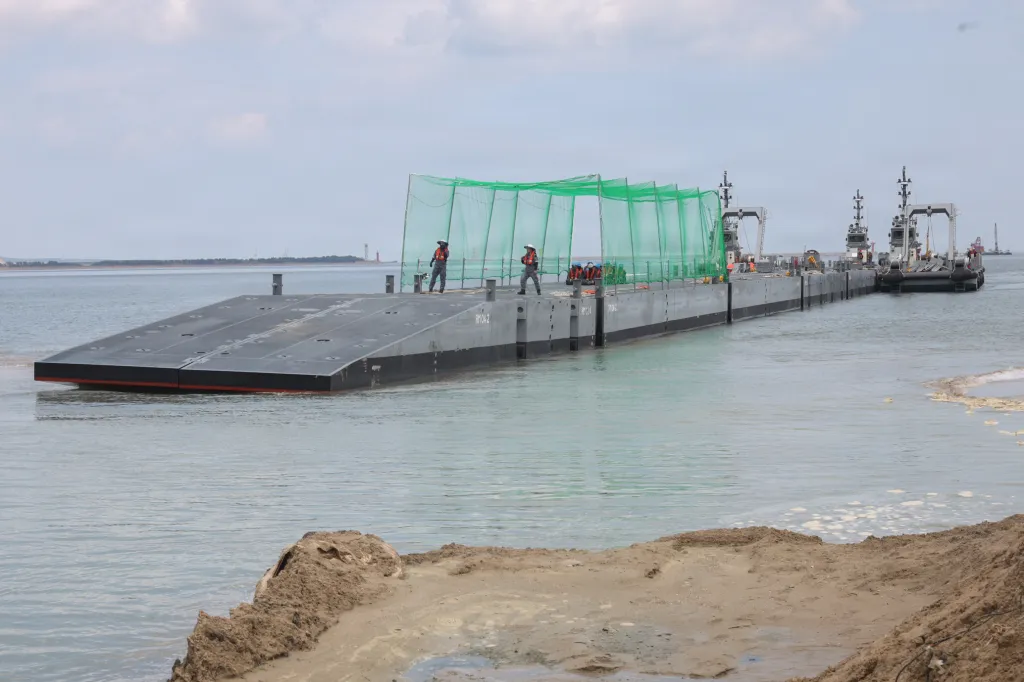
After a recent logistics training exercise in South Korea, photographs were posted on the Pentagon’s image distribution site showing what appears to be anti-drone netting on a ship-to-shore floating platform used for moving cargo and troops. While it’s possible that it could be for some other purpose, the netting appears to be in line with other examples of drone defensive measures seen in Ukraine and many other places, including recent usage by Dutch forces. We’ve reached out to the Marines for more details.

Republic of Korea service members aboard an Improved Navy Lighterage System conduct a beach stabbing of the platform during Combined Joint Logistics Over-the-Shore 26 at Dogu Beach, Pohang, South Korea, July 9, 2026. The offload was a Maritime Prepositioning Force exercise where 3rd Marine Logistics Group distributes equipment from a created port of entry and provides support to III Marine Expeditionary Force units training throughout South Korea, testing and validating 3rd MLG’s ability to conduct integrated logistics operations in complex environments. CJLOTS 26 is a combined exercise designed to integrate U.S. and Republic of Korea lighterage and ship-to-shore connector capabilities, improve combined readiness, strengthen the Republic of Korea-U.S. alliance, and expand combined maritime sustainment capacity during logistics operations. (U.S. Marine Corps photo by Lance Cpl. Matthew Borruso)
Republic of Korea service members aboard an Improved Navy Lighterage System conduct a beach stabbing of the platform during Combined Joint Logistics Over-the-Shore 26 at Dogu Beach, Pohang, South Korea, July 9, 2026. (U.S. Marine Corps photo by Lance Cpl. Matthew Borruso) Lance Cpl. Matthew Borruso
Republic of Korea service members aboard an Improved Navy Lighterage System conduct a beach stabbing of the platform during Combined Joint Logistics Over-the-Shore 26 at Dogu Beach, Pohang, South Korea, July 9, 2026. The offload was a Maritime Prepositioning Force exercise where 3rd Marine Logistics Group distributes equipment from a created port of entry and provides support to III Marine Expeditionary Force units training throughout South Korea, testing and validating 3rd MLG’s ability to conduct integrated logistics operations in complex environments. CJLOTS 26 is a combined exercise designed to integrate U.S. and Republic of Korea lighterage and ship-to-shore connector capabilities, improve combined readiness, strengthen the Republic of Korea-U.S. alliance, and expand combined maritime sustainment capacity during logistics operations. (U.S. Marine Corps photo by Lance Cpl. Matthew Borruso)
Republic of Korea service members aboard an Improved Navy Lighterage System conduct a beach stabbing of the platform during Combined Joint Logistics Over-the-Shore 26 at Dogu Beach, Pohang, South Korea, July 9, 2026. (U.S. Marine Corps photo by Lance Cpl. Matthew Borruso) Lance Cpl. Matthew Borruso

The idea behind the netting, as we have reported in the past, is that drones will get caught up in the nylon or mesh metal nets and become disabled, or the nets will help keep the drones far enough from personnel before exploding to keep them from being killed. How protective the netting set up by the Marines would be against highly maneuverable first-person view (FPV) drones is questionable, given how open it is on both ends, though it could provide some protection from lighter munitions dropped by so-called bomber drones. Beyond that, the netting only covers one section of the floating platform, presumably where the cargo or a vehicle will go, leaving the rest of it, as well as the ship and its wheelhouse, fully exposed.

The images were taken during Combined Joint Logistics Over-the-Shore 26 (CJLOTS 26) at Dogu Beach, Pohang, South Korea on July 9. The goal of CJLOTS 26 was to allow the Marines and partners from the Republic of Korea’s military to deliver supplies from a vessel stationed offshore without requiring existing infrastructure like a pier.

“The offload was a Maritime Prepositioning Force exercise where 3rd Marine Logistics Group (MLG) distributes equipment from a created port of entry and provides support to III Marine Expeditionary Force units training throughout South Korea, testing and validating 3rd MLG’s ability to conduct integrated logistics operations in complex environments,” the Marines noted. “CJLOTS 26 is a combined exercise designed to integrate U.S. and Republic of Korea lighterage and ship-to-shore connector capabilities, improve combined readiness, strengthen the Republic of Korea-U.S. alliance, and expand combined maritime sustainment capacity during logistics operations.”

U.S. service members transfer a MK36 Medium Tactical Replacement Vehicle Wrecker onto an Improved Navy Lighterage System to conduct a cargo offload during Combined Joint Logistics Over-the-Shore 26 at Dogu Beach, Pohang, South Korea, July 9, 2026. The offload was a Maritime Prepositioning Force exercise where 3rd Marine Logistics Group distributes equipment from a created port of entry and provides support to III Marine Expeditionary Force units training throughout South Korea, testing and validating 3rd MLG’s ability to conduct integrated logistics operations in complex environments. CJLOTS 26 is a combined exercise designed to integrate U.S. and Republic of Korea lighterage and ship-to-shore connector capabilities, improve combined readiness, strengthen the Republic of Korea-U.S. alliance, and expand combined maritime sustainment capacity during logistics operations. (U.S. Marine Corps photo by Lance Cpl. Matthew Borruso)
U.S. service members transfer an MK36 Medium Tactical Replacement Vehicle Wrecker onto an Improved Navy Lighterage System to conduct a cargo offload during Combined Joint Logistics Over-the-Shore 26 at Dogu Beach, Pohang, South Korea, July 9, 2026. (U.S. Marine Corps photo by Lance Cpl. Matthew Borruso) Lance Cpl. Matthew Borruso

The images show Republic of Korea service members aboard an Improved Navy Lighterage System (INLS), “a sea state three (SS3) capable causeway system that resembles a floating pier comprised of interchangeable modules and is used to transfer cargo from Military Sealift Command (MSC) ships to shore areas where conventional port facilities are unavailable or inadequate,” according to the Navy.

The troops were conducting what is called a “beach stabbing,” where the module is attached to the beach so that vehicles and troops can come ashore.

You can see another example of the INLS system in the following photograph taken in 2022.

Improved Navy Lighterage System (INLS) craft, attached to Amphibious Construction Battalion 1 (ACB 1), connect to the offloading ramp of a Military Sealift Command ship in support of Joint Logistics Over-The-Shore (JLOTS) training operations in waters off Virginia, Aug. 4, 2022. (U.S. Navy photo by Chief Boatswain’s Mate Justin Wahl) Improved Navy Lighterage System (INLS) craft, attached to Amphibious Construction Battalion 1 (ACB 1), is connected to the offloading ramp of a Military Sealift Command ship in support of Joint Logistics Over-The-Shore (JLOTS) training operations in waters off of Virginia, Aug. 4, 2022. (U.S. Navy photo by Chief Boatswain’s Mate Justin Wahl)

While the Marines don’t specifically mention drone defense in photos, U.S. Forces Korea/Combined Forces Command did explain it was part of a large-scale training exercise designed with the drone threat in mind.

“To enhance full-domain operational sustainment capabilities, the exercise integrated five types of ground, maritime and air sustainment assets,” according to U.S. Forces Korea/Combined Forces Command. “Reflecting evolving battlefield conditions, the training also strengthened protection measures for sustainment nodes against threats such as hostile drone attacks.”

There’s good reason for counter-drone efforts to be baked into logistics operations. The war in Ukraine has shown that drone attacks have made resupplying front line troops such a deadly endeavor that there is an increasing use of ground robots to carry out these missions.

Ukraine's ‘Khartia’ brigade turns to land drones to survive the drone-saturated frontline thumbnail

Ukraine’s ‘Khartia’ brigade turns to land drones to survive the drone-saturated frontline


Any fight against China or North Korea would almost assuredly see large numbers of drones descending on U.S. and allied forces. Both countries have developed large arsenals of these weapons and the technology to use them at scale. North Korea, as we have reported in the past, has gotten assistance from Russia on drone technology as well as direct experiencing fighting Ukraine. The regime has invested significant resources into evolving its drone capabilities across all tiers.

Amphibious operations are especially vulnerable to short-range drone attacks. Approaching over the horizon in open water to a controlled beach means commanders can assume their assets will be attacked by FPV and other short-range drone types, and likely at scale.

The extent and effectiveness of netting that would be deployed as a passive defensive measure in future battles is an open question; however, U.S. military doctrine is starting to acknowledge the need. Newly released guidance from the Pentagon suggests using such systems as part of a layered defense against small drones.

“Two proven ways to disrupt drones are shaping their physical environment and interfering with their signals,” according to a new handbook published by the Pentagon’s Joint Interagency Task Force 401. “Obstacles such as fencing, netting, or over-head structures can alter flight paths, block common avenues of approach, and push drones into visible or unfavorable routes while also degrading control links, GPS (Global Positioning Systems), or navigation timing.”

The Pentagon established JIATF 401 last August to coordinate counter-drone efforts across the department and help accelerate the fielding of new capabilities. The guidance in the handbook follows a call in February by the task force for the increased use of netting, cables, and other kinds of passive physical defenses to protect critical infrastructure. It is part of an evolving trend by the U.S. toward acceptance of these measures, something we discussed in great detail here

The section on hardening from the Pentagon’s counter-drone guidance issued in February. (Pentagon)

In addition, as we reported two years ago, U.S. Air Force officials at Langley Air Force Base in Virginia were looking at installing anti-drone nets to help protect F-22 Raptor stealth fighters on the flightline. That came nearly a year after the base was subjected to waves of still-mysterious drone incursions, which The War Zone was first to report

Still, despite JIATF 401’s suggestions about netting and the Air Force’s interest in installing it to protect prized aircraft, there is scant evidence of widespread use by the U.S. military, leaving it lagging as these measures proliferate around the globe.

As we noted earlier in this piece, TWZ has showcased examples of netting use beyond Ukraine. The most recent instances emerged in Lebanon, where Israeli troops began using netting to protect against increasing attacks from Hezbollah FPV drones. The netting was erected after Israeli military leaders were heavily criticized for not doing enough to protect their troops from drone attacks. In fact, some Israeli troops were so desperate to get netting they reached out to fisherman.

The following video shows one example of Israel’s use of anti-drone netting.

Elsewhere, we reported that Taiwan is using anti-drone netting to protect its air defense systems. There are also reports published in the Netherlands that Dutch troops trained using anti-drone “net tunnels” – similar to those used by Russia and Ukraine – during an exercise in Germany last month called “Fighter Lion.”

Whether the netting seen in the logistics training exercise in South Korea represents a trend, or a one-off experiment, is currently unknown. However, one thing is clear. Netting, while certainly no panacea, is increasingly viewed as a critical countermeasure for militaries across the globe.

Contact the author: howard@twz.com

Howard is a Senior Staff Writer for TWZ. He writes frequently about conflict, focusing heavily on the Middle East and Ukraine, and interviews with military and intelligence officials and industry leaders from around the globe. He lives near Tampa, Florida, home of U.S. Central Command, U.S. Special Operations Command.


Source link

Israel Now Using Netting To Protect Combat Vehicles Against Scourge Of Hezbollah Drones

Over the course of a nearly two-month old war with Israel, Hezbollah has been increasing its use of fiber-optic controlled first-person view (FPV) drones against Israeli troops and vehicles, something we were among the first to note. Now, it appears that Israel is resorting to the use of anti-drone netting on its vehicles to help protect them from the one-way attack drones. These attacks are occurring even amid an ongoing, though extremely fragile, ceasefire.

A video emerged Wednesday on social media showing an Israeli vehicle festooned with the netting, draped like a soccer goal from metal arms extending out and above. The idea, as we have reported in the past, is that drones will get caught up in the nylon or mesh metal nets and become disabled, or the nets will help keep the drones far enough from the occupants before exploding to keep them from being killed. The latter is a far more limited scenario and depends on the vehicle type and the warhead on the drone. Based on the video we are seeing, the level of protection netting can provide passengers in the open-top Israeli vehicle if a trapped drone’s warhead were to detonate is likely very little.

Israeli Defense Forces testing a folded anti-drone net installed on a Humvee.

The video emerged amid a surge of Hezbollah strikes with FPV drones against the IDF in Lebanon. pic.twitter.com/PwIyuJQVs4

— Status-6 (War & Military News) (@Archer83Able) April 29, 2026

The video began to circulate amid growing controversy in Israel over what is perceived as the IDF’s inability to counter the Hezbollah FPV drone threat. The frustration reached a new level over the weekend, after an Israeli soldier was killed and six were wounded by a Hezbollah drone. A followup attack was launched while the IDF was medevacing the wounded, narrowly missing the helicopter.

You can see the drone narrowly miss the helicopter in the following video. 

“The attack laid bare a growing vulnerability: the Israel Defense Forces’ lack of preparedness for first-person view (FPV) drones in Lebanon, which have been an increasingly prominent weapon in Hezbollah’s arsenal during the current fighting,” the Times of Israel reported on Monday. “The Israel Defense Forces has reported dozens of drone-related injuries in recent weeks, though most were minor. Sunday’s attack marked the first fatal FPV drone strike on Israeli forces.”

“Yet the emergence of fiber optic-guided drones should not have come as a surprise,” the paper highlighted. The reason is what we noted in our previous story about this issue. The militant Lebanese group has used FPV drones against Israel since 2024 and they have been widely used by both sides in the Ukraine war for several years, as well as in other conflicts zones around the globe.

These strikes have become more prevalent the deeper Israel went into southern Lebanon. Videos of these recent attacks have been showing up on social media.

Hezbollah conducted more fiber-optic FPV strikes on Israeli vehicles in Lebanon, including two ‘Merkava’ Mk.4 tanks, a D9 Caterpillar armored bulldozer, and what appears to be a rare ‘Namer’ heavy IFV equipped with a turret mounting a 30 mm Bushmaster Mk 2 cannon.
1/ https://t.co/ms2nagNHrD pic.twitter.com/WDs6M3SpwW

— Roy🇨🇦 (@GrandpaRoy2) April 5, 2026

Moreover, Israeli Merkava tanks began sporting metal additions on top of vehicles meant to deflect top-down attacks from drones during the conflict in Gaza two years ago, which you can read more about here. Some of those tanks that have come under attack recently have been observed with them as well. So Israel has been working to deal with the evolving FPV drone threat, on some level, for some time and it is not alone in struggling with it. Most militaries in the world face the possibility of this same vexing threat with no clear blanket countermeasure to deal with it.

Israeli military officials acknowledge that the IDF still lacks an effective counter to fiber-optic-guided drones, the Times of Israel noted, for reasons we have frequently reported. Fiber optic cables mitigate the effect of electronic warfare efforts to jam radio signals as well as some of the limitations imposed by geographical features that can impede the line-of-sight radio connection between drone and operator.

“The IDF initially assessed that Hezbollah’s fiber optic drones could only operate over a few kilometers,” the outlet stated. “Later, the military discovered launches occurring from distances of up to 15 kilometers (nine miles).”

“The gap was underscored on April 11, when the Defense Ministry’s Directorate of Defense Research and Development issued a public call for solutions to the threat — nearly two years after such systems first surfaced in Ukraine, and weeks into the current conflict with Hezbollah,” according to the Times of Israel. “The Defense Ministry is seeking additional capabilities to address this threat. The purpose of this request is to identify innovative and mature technologies.”

⚡️🇮🇱🇱🇧Times of Israel: Sunday’s Hezbollah drone attack in Taybeh, which killed Sgt. Idan Fooks and wounded six others, has exposed the IDF’s lack of preparedness for first‑person view (FPV) drones, particularly those guided by fibre‑optic cables which are immune to electronic…

— War Monitor (@monitor11616) April 28, 2026

It’s unclear how widespread the use of netting is currently by the IDF in southern Lebanon.

“The issue of drones carrying fiber-optic cables is currently a threat without a clear solution,” a high-ranking IDF official, who just returned from Lebanon, told us. “What’s been shown in the video seems more like an experimental concept rather than something that is already operational in the field.”

“In practice, forces are using various improvised solutions—fishing nets, camouflage nets, even soccer nets, along with drills involving small-arms fire at drones,” he added. “However, I personally haven’t seen the specific net system mentioned being used on the ground yet.”

The official said someone from the IDF’s ground forces research and development team told him that the conclusion in the military is that “this solution is highly problematic. It allows the lower parts of the vehicle to remain exposed, areas that the net doesn’t cover. The likely next step for the adversary would be to detonate the drone at a distance from the net, causing shrapnel to disperse toward the forces.”

IDF troops claim they recently captured a cache of Hezbollah weapons in southern Lebanon, including first-person view (FPV) drones. (IDF)

In a post on X Tuesday, Israeli military journalist Doron Kadosh said the issue of how to deal with Hezbollah FPV drones “took up significant volume in [Monday]’s discussion at the IDF’s senior command forum at Ramat David. The commander of the 282nd Artillery Brigade, which is currently fighting in Lebanon, Col. G., told the commanders: ‘The drone threat is a significant operational challenge that we’re dealing with. We need to think about how to organize better against this threat.’”

IDF combat unit commanders fighting in Lebanon “now express great frustration with the drone threat and the few tools the IDF has to counter them,” Kadosh added. “‘There’s not much you can do about it,’ says a commander currently fighting in Lebanon. The briefing the forces receive boils down to— ‘Stay alert, and if you spot a drone—shoot at it.’”

Some IDF units “have already begun developing independent responses to the threat—for example, nets deployed over positions, houses, and windows—so that the drone gets caught in the net and doesn’t hit its target,” Kadosh continued. “This is an improvised response; we’ve started deploying it with some of the forces, but it’s far from sufficient,” an officer currently fighting in Lebanon told the reporter. This would follow exactly what we saw in Ukraine, as both sides looked to improvised forms of protection from incoming drones, leading to rapid experimentation and many dead ends.

הבוקר אצל @efitriger:

איום רחפני הנפץ שמאתגר את כוחות צה״ל בדרום לבנון בשורת התקפות יומיומיות של חזבאללה:

הסוגיה תפסה נפח משמעותי גם בדיון פורום הפיקוד הבכיר של צה״ל אתמול ברמת דוד. מפקד חטיבת התותחנים 282 שנלחמת כעת בלבנון, אל״ם ע׳, אמר למפקדים: ״איום הרחפנים הוא אתגר מבצעי… pic.twitter.com/jiSGrSEBGH

— דורון קדוש | Doron Kadosh (@Doron_Kadosh) April 28, 2026

Despite the limitations, this netting has become fairly common in Ukraine, with both sides using netting over vehicles, buildings and miles and miles of roadway to provide safer corridors of travel.

About anti-FPV road net tunnels:

“Thousands of kilometers of equipped anti-drone corridors block the main logistical routes all the way to the forward positions
The goal is to ensure security up to a depth of 100 km from the contact line.”
6/ https://t.co/Avipifv6Fr pic.twitter.com/ES7gq20lln

— Roy🇨🇦 (@GrandpaRoy2) April 29, 2026

As we noted in our last piece on the growing FPV threat to Israeli forces, active protection systems (APS) on armored vehicles are being adapted to provide hard-kill counter-drone protection. These systems use sensors to detect incoming rocket-propelled grenades, missiles, and other projectiles, and fire projectiles to hit them before they strike the vehicle. Israel is a major pioneer in the APS space, with systems being deployed for decades, but just how soon it can upgrade existing systems, such as Iron Fist, for this application isn’t clear. Also, this doesn’t help many lighter vehicles that do not have APS capabilities. Still, it is one bright spot of hope of creating a defense against fiber optic FPVs, at least for lower volume attacks, although these are also very costly systems.

Iron Fist APS | Active Protection System for Armored Vehicles thumbnail

Iron Fist APS | Active Protection System for Armored Vehicles


Regardless, we are likely to see more Israeli vehicles equipped with nets and other forms of passive protection in the coming days, and likely more advanced countermeasures if the war grinds on for a prolonged period.

Contact the author: howard@thewarzone.com

Howard is a Senior Staff Writer for The War Zone, and a former Senior Managing Editor for Military Times. Prior to this, he covered military affairs for the Tampa Bay Times as a Senior Writer. Howard’s work has appeared in various publications including Yahoo News, RealClearDefense, and Air Force Times.


Source link