Hi, and welcome to another edition of Dodgers Dugout. My name is Houston Mitchell. There are only 34 games left in the regular season for the Dodgers. How is that possible?
Well, nothing cures a team’s woes more than playing Colorado. But was it a cure or a placebo?
At which positions are the Dodgers excelling or struggling compared with the rest of MLB this season? One way we can tell is by looking at Wins Above Average at each position. WAA measures how many wins a player gives their team compared with an average major league player. A score of zero means the player is average, a positive score means they are better than average, and a negative score means they are below average.
Let’s look at the top five teams at each position, where the Dodgers rank if not in the top five, and at the last-place team. The number includes all players who played at that position this season.
Catcher
1. Detroit, 1.9
2. Arizona, 1.5
3. Minnesota, 1.2
4. Miami, 1.1
5. Athletics, 1.0
14. Dodgers, -0.1
30. Chicago White Sox, -2.5
As you can see, the loss of Will Smith has been huge. He is a steadying influence in the lineup and behind the plate.
First base
1. Boston, 2.6
2. Atlanta, 2.5
3. Chicago White Sox, 1.7
3. Athletics, 1.7
5. Dodgers, 1.6
30. Arizona, -1.8
Speaking of steadying influences: Freddie Freeman.
Second base
1. Milwaukee, 3.5
2. St. Louis, 2.6
3. Seattle, 2.1
4. Pittsburgh, 1.7
5. San Francisco, 1.6
11. Dodgers, 0.5
30. NY Mets, -2.1
Third base
1. Tampa Bay, 2.7
2. Dodgers, 2.2
2. Boston, 2.2
4. Chicago Cubs, 2.0
5. Chicago White Sox, 1.6
30. Philadelphia, -2.0
Shortstop
1. Kansas City, 4.2
2. Miami, 3.3
3. Washington, 2.8
4. Houston, 2.3
5. Arizona, 2.2
13. Dodgers, 0.8
30. Colorado, -2.3
Left field
1. Seattle, 1.9
2. NY Yankees, 0.9
3. Pittsburgh, 0.8
4. Miami, 0.7
5. Milwaukee, 0.6
20. Dodgers, -0.7
30. Arizona, -1.7
This is mostly Teoscar Hernández, with contributions from Alex Call, Tommy Edman and Ryan Ward.
Center field
1. Chicago Cubs, 5.9
2. Dodgers, 3.8
3. Boston, 3.7
4. Atlanta, 2.1
5. Angels, 1.4
30. Detroit, -1.8
If someone had told you after his miserable 2025 postseason that Andy Pages would be the second-best center fielder in baseball this year, would you have believed them? And the Angels make their only appearance here thanks to Mike Trout.
Right field
1. Boston, 3.6
2. Arizona, 2.7
3. St. Louis, 1.7
3. Chicago Cubs, 1.7
5. Washington, 1.3
22. Dodgers, -1.5
30. Cincinnati, -3.1
The corner outfielders are killing the Dodgers.
DH
1. Houston, 3.1
2. Dodgers, 2.2
3. Tampa Bay, 1.2
4. Philadelphia, 1.1
5. Chicago Cubs, 0.6
30. NY Mets, -1.9
Houston’s (no relation) designated hitter is Yordan Alvarez, traded by the Dodgers as a prospect in 2016 for reliever Josh Fields in probably the worst trade of the Andrew Friedman era.
Starting pitchers
1. Philadelphia, 9.9
2. Detroit, 7.4
3. NY Yankees, 6.9
4. Milwaukee, 5.6
5. Dodgers, 5.1
30. Chicago Cubs, -4.7
Relief pitchers
1. San Diego, 3.9
2. NY Yankees, 2.6
3. Philadelphia, 1.9
4. Chicago White Sox, 1.6
5. Atlanta, 1.0
5. Toronto, 1.0
23. Dodgers, -2.5
30. Kansas City, -7.9
So, relief pitching and the corner outfielders are the gaping hole in the equation. But keep in mind, because I fall prey to this also: Every team has problems. We tend to focus on the Dodgers and don’t think about it this way. Every team has holes they are trying to solve before the postseason (or next season) begins. Some teams, like the Angels and Rockies, have holes almost everywhere. But even the best team isn’t perfect. And, yes, I will repeat it again, anything can happen in the postseason.
Remember last season? The Dodgers were 29th in relief pitching at -6.4. They were 29th in left field at -2.4. But they pulled it together and won. No reason they can’t do it again this year. And there’s no reason they can’t get swept in the first round.
Dodgers’ record at this point the last three seasons:
2026
77-51, first place by nine games
2025
73-55, first place by one game
2024
76-52, first place by four games
Dave Roberts on Kyle Tucker
Here is Roberts’ viewpoint on Tucker, after Tuesday’s win over Colorado:
“When you start to struggle and you internalize … you find yourself going dark, and that’s a lonely place,” Roberts said Tuesday, before the Dodgers’ 7-6 win against the Rockies. “So I think that for me, trying to proactively pull conversations out of him, talk about life, talk about baseball, it just kind of opens things up, and I think that it’s freeing.
“He’s a cerebral guy by nature, internalizes a lot. But still, for me, he’s with a new ballclub, he’s scuffling, so I want to get that out of him.”
Tucker dropped a relatively easy fly ball during that game, and Roberts said:
“There’s indecision, and catching a baseball at your ankles kind of speaks to where his head is at right now. It’s not from lack of effort, or care. It’s just right now, I think he’s kind of fighting. So we’ve got to keep supporting him.”
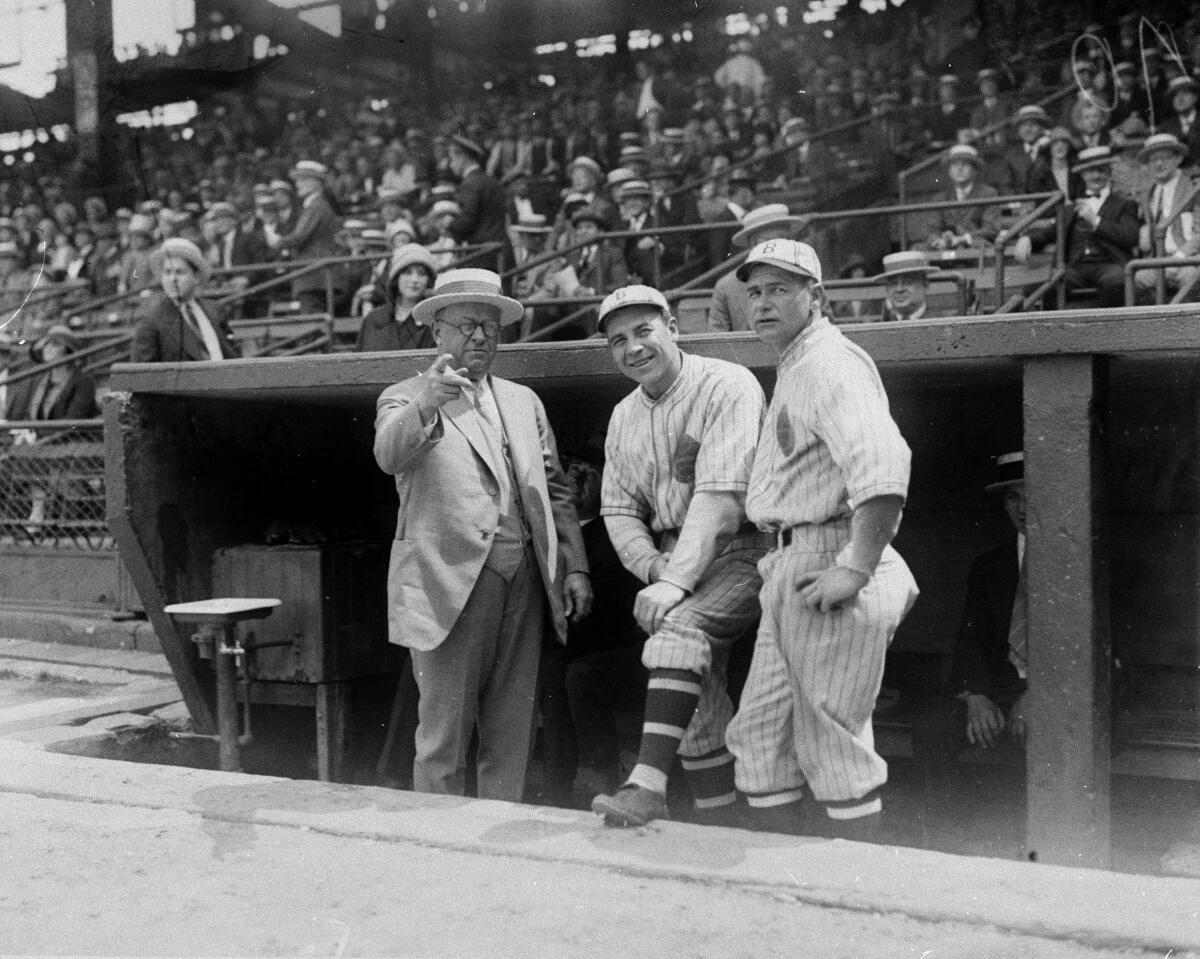
Forgotten Dodger: Zack Wheat

Dodgers manager Wilbert Robinson, first baseman Jack Fournier and outfielder Zack Wheat in the dugout in 1921.
(Associated Press)
One of the things the Dodgers don’t do very well is celebrate their rich and diverse history, especially if something happened before 1947. With that in mind, this is the first in an occasional series of items looking at Dodgers that often get overlooked.
Zack Wheat played for the Dodgers from 1909 to 1926 and was inducted into the Hall of Fame in 1959. He is still the all-time Dodgers leader in games played (2,322), hits (2,804), doubles (464), triples (171) and total bases (4,003).
He has yet to make the Dodgers Dugout Dodgers Hall of Fame. Of course, there aren’t a lot of people alive who saw Wheat play, probably hurting him in the voting. Many voters tell me that they can’t judge someone they never saw, but I don’t need to have seen Babe Ruth, Lou Gehrig, Tris Speaker or Al Simmons to know they were all-time greats.
Wheat’s best season might have been 1918, when he led the league with a .335 batting average. Or it might have been 1916, when he hit 32 doubles and 13 triples and led the league in slugging. Or it might have been 1922, when he hit .335 with 29 doubles, 12 triples, 16 homers and 112 RBIs. Or it might have been any number of other seasons. He finished with a .317 career batting average.
And don’t think he was only a hitting machine. He was a great defensive outfielder.
Baseball Magazine in 1918: “What Napoloen Lajoie was to infielders, Zack Wheat is to outfielders, the finest mechanical craftsman of them all. He is the easiest, most graceful of outfielders with no close rivals.”
Wheat got married during the 1912 season and his new wife, Daisy, became his agent. In the same Baseball Magazine story, she said, “I made him hold out each year for seven years and each time he got a raise.”
Other things of note about Wheat:
—He has an OPS+ of 130. Among Dodgers with 5,000 plate appearances (Wheat had almost 10,000), that is third all time, behind Duke Snider and Jackie Robinson.
—He is fourth in career WAR among batters, behind Snider, Robinson and Pee Wee Reese.
—To make money during the offseason, Wheat raised mules and sold them to the Army, which used them as pack animals during World War I. It was because of the money he made doing this that he was able to hold out for a better contract each offseason. The most money he earned in one season as a player was $16,000.
—Wheat recommended the Dodgers sign his longtime friend, Casey Stengel. It’s unlikely any other team would have signed him, so Wheat is basically responsible for Stengel’s career.
—Wheat and manager Wilbert Robinson never got along. Longtime Dodgers owner and team president Charles Ebbets died in 1925 and was replaced as team president by Ed McKeever, who named Wheat the manager of the team, making Robinson a front-office executive. McKeever died two weeks later, and, with no team president, the Dodgers’ board of directors named Robinson manager again.
—No longer needing Wheat and thinking he was getting too old, the Dodgers released him before the 1927 season so he could negotiate with any club he wanted to, instead of trading him to a team he didn’t wish to play for. Wheat signed with the Philadelphia A’s and hit .324 in 88 games.
—Wheat was listed as 5-10, 170 pounds, but many thought he was smaller than that. He wore a size 5 shoe and suffered from ankle problems throughout his career. A bruised heel brought an end to his career.
—Wheat didn’t stay in baseball when he retired. When asked why years later, he said, “Nobody asked me to.”
—Wheat was 10th all-time in hits when he retired, with 2,884.
—Wheat became a farmer after retiring, then became a police officer in Kansas City after the Depression caused him to sell his farm.
—While on a police call in 1936, Wheat crashed his car and suffered a fractured skull, broken wrist and 15 broken ribs. He spent five months in the hospital and retired as a police officer. He moved with his family to a lakeside house in Sunrise Beach, Mo., and opened a 46-acre hunting and fishing resort.
—Wheat was voted into the Hall of Fame by the Veterans Committee in 1957. Unfortunately, he wasn’t eligible to be voted in by the Veterans Committee because he hadn’t been retired long enough. So they elected him again in 1959.
—When told he was finally elected for real, Wheat, 70, said, “That makes me feel mighty proud. I feel a little younger, too.”
—In 1971, Wheat was asked if he had any advice for boys who wanted to become major leaguers. “Yes,” he said. “Tell them to learn to chew tobacco.”
—Wheat was once asked his secret for playing so well for so long. He said: “I smoke as much as I want and chew tobacco a good deal of the time. I don’t pay any attention to the rules for keeping in physical condition. I think they are a lot of bunk. The less you worry about the effect of tea and coffee on the lining of your stomach, the longer you will live and the happier you will be.”
—Wheat died of a heart attack in Missouri on March 11, 1972. He was 83 years old.
You can see Wheat’s career stats here.
You can read much more about Wheat in this excellent bio by Eric Enders as part of the SABR bio project.
Up next
Friday: Pittsburgh (Bubba Chandler, 6-8, 4.23 ERA) at Dodgers (Yoshinobu Yamamoto, 12-7, 2.60 ERA), 7:10 p.m., SportsNet LA, AM 570, KTNQ 1020
Saturday: Pittsburgh (Jared Jones, 2-5, 4.78 ERA) at Dodgers (*Tarik Skubal, 7-7, 2.85 ERA [0-2, 3.18 ERA with Dodgers]), 4:15 p.m., Fox, AM 570, KTNQ 1020
Sunday: Pittsburgh (TBD) at Dodgers (*Blake Snell, 1-1, 3.60 ERA), 1:10 p.m., SportsNet LA, AM 570, KTNQ 1020
All times Pacific
*-left-handed
In case you missed it
The Dodgers are Mark Walter’s crown jewel. Can he hold on to it amid federal probe?
Cox customers can finally watch the Dodgers on SportsNet LA
Dodgers Debate: Never a dull moment with the Dodgers
Dodgers closer Edwin Díaz heads back to injured list because of neck inflammation
And finally
Michael Kay interviews Vin Scully in 2013. Watch and listen here.
Until next time …
Have a comment or something you’d like to see in a future Dodgers newsletter? Email me at houston.mitchell@latimes.com. To get this newsletter in your inbox, click here.