SAN DIEGO — This is where it all started for Jim Harbaugh, this idyllic hilltop University of San Diego campus with its sweeping views of the city and ocean, Spanish Renaissance architecture and courtyards lined with palm trees.
Harbaugh had been an assistant coach elsewhere, learning the ropes as an offensive consultant at Western Kentucky and quarterbacks coach for the Oakland Raiders, but this was his first chance to be a head coach. It launched a second career for the longtime NFL quarterback, taking him to Stanford, the San Francisco 49ers — where his team fell just short of a Lombardi Trophy — to a national championship at Michigan, and now to the Chargers, with whom he’s beginning his third season.
The Chargers have moved training camp to USD for Tuesday and Wednesday this week, reuniting Harbaugh with a place legendary Raiders owner Al Davis advised him not to come.
“Awww, Jimmy, Jimmy, I thought you wanted to be a pro coach,” Davis, voice dripping with disappointment, told him in 2004 when he learned Harbaugh was leaving his Raiders gig.
“But Mr. Davis, you coached college football,” Harbaugh countered.
“Yeah,” Davis said, “but that was at USC, not U-S-D.”
Harbaugh knows he made the right decision, and never doubted it, even when he and defensive coordinator Dave Adolph — another NFL fixture — had to roll up their sleeves and scrub down the cramped and filthy USD locker room themselves; even when he and his assistant coaches routinely made hundreds of PB&J sandwiches to provide late-night snacks for their players, who don’t receive scholarships at the NCAA Division I FCS level; and even when he pushed himself so hard at practice — he was the head coach, mind you — that he got sick all over himself.
“He was very demanding of us,” recalled former Toreros linebacker Matt Gabbard, “but it wasn’t something he didn’t demand of himself.”
They still call it Harbaugh Hill, a steep dirt road overlooking the practice fields on campus. Football players would plod up it as part of their training camp, and Harbaugh would run with them and urge them along. It bothered him that nobody could keep pace with receiver Nick Garton, who also excelled in soccer and track in high school, and could breeze up the grade like it was nothing.
“Isn’t anybody going to challenge this guy?” Harbaugh said. “Finally, I said, ‘I’ll do it.’”

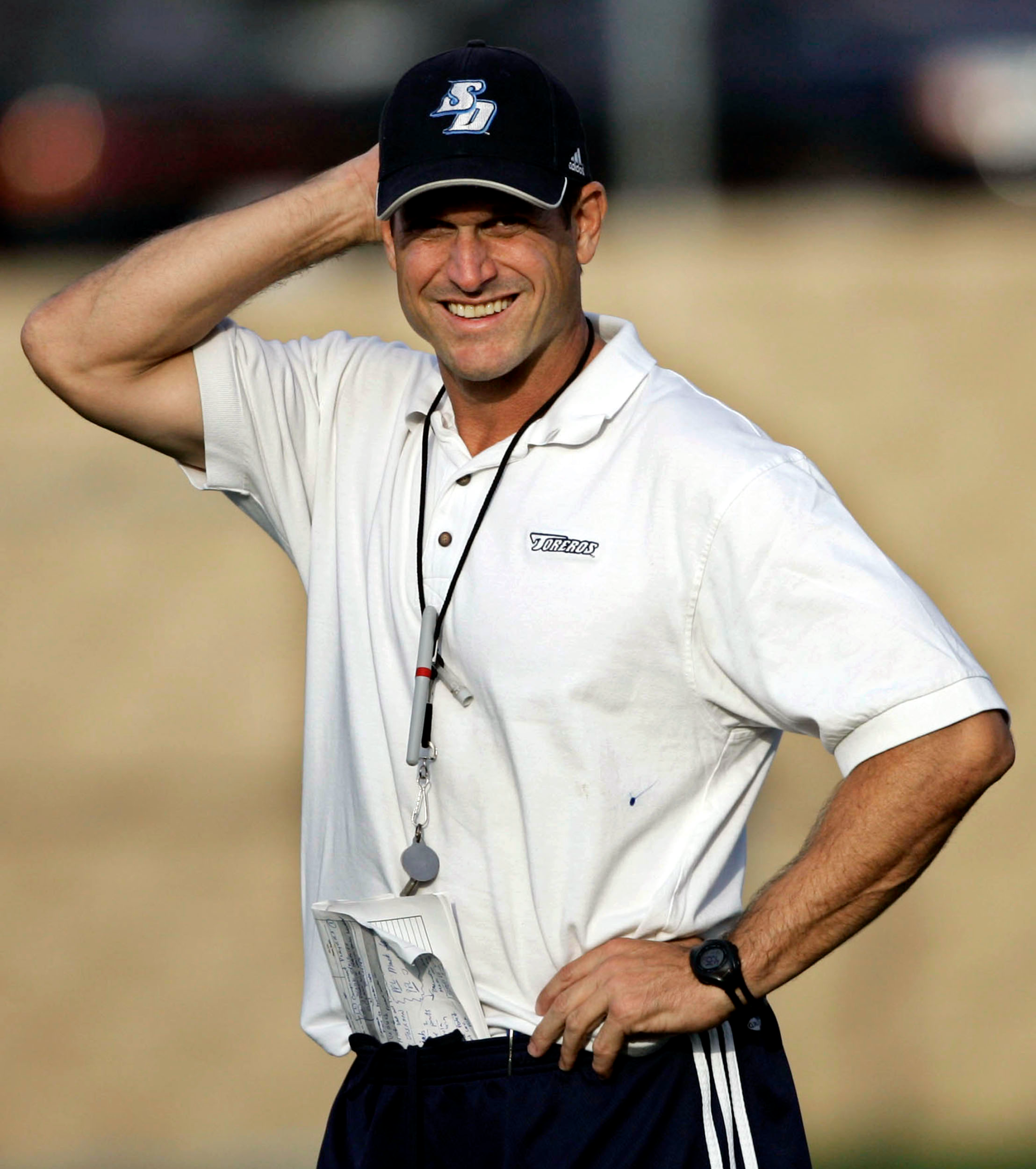
Jim Harbaugh smiles during a practice with the University of San Diego in November 2005.
(Lenny Ignelzi / Associated Press)
So he did, matching Garton stride for stride before losing his breakfast all over himself. The coach didn’t stop running, though.
“I finished second,” he said, recalling the episode after Chargers practice this week and clearly still proud of his accomplishment.
Harbaugh coached at USD for three seasons, starting in 2004, and was three years removed from his playing career. He was 40 when he took the job and still had thoughts of putting the pads back on. He even looked into playing arena football and entertained the idea of playing for the Los Angeles Avengers, but that thought only lasted a day or so. He really wanted to be a coach, and brought along his dad, Jack Harbaugh, to oversee the running backs in that first season.
Jim and Jack would carpool to campus every day from their Coronado homes, father and son talking plays, personnel, family and life.
“What I saw was passion,” said Jack Harbaugh, who spent six decades coaching high school and college football. “If I could use one word, it’s Jim’s passion for the game. He would coach as if that was maybe the last job he’d ever had.”
That resonated with the players.
“When we saw coach Harbaugh come in and have that next-level intensity, you kind of get chills running down your spine,” defensive back Phil Bretsch said. “Like, ‘Oh boy, this is going to be different.’ But you’re ready for it, right? We’re not there for any other reason other than we love football.”
The turnaround was abrupt. Harbaugh inherited a historically mediocre program and coached his team to a 29-6 record in three seasons. The 2006 team went 11-1, won the Pioneer League, and Harbaugh was a finalist for the Eddie Robinson Award, presented to the top coach in the FCS.
One of his biggest accomplishments was luring Adolph out of retirement. The defensive specialist was almost 70 and was a turnaround artist with all sorts of NFL franchises — Cleveland, Kansas City, Raiders and Chargers — but in his later years was the primary caregiver for his ailing wife. Harbaugh asked and asked and asked, and finally got a yes when he helped arrange for in-home care for the Adolphs for several hours a day.
Coaching at this level was about making sacrifices for the love of the game. There was no school money to feed the hungry players after their team meetings, so Harbaugh and the other coaches — essentially volunteers — shelled out for tubs of peanut butter, vats of jelly and dozens of loaves of bread every night.
“We were always on the hunt for calories,” Bretsch said. “I think I stayed alive off Carl’s Jr. 99-cent chicken sandwiches for about six months throughout my career. We always joked, ‘What if we would have had the training table the big programs had? What would we have been like?’”
But those teams had something different. They had Harbaugh.
“We had a competitive advantage from a coaching standpoint every game we went into,” said running back J.T. Rogan, who went on to work with Harbaugh at Stanford and Michigan. “I would refer to him as my father in football, but that would probably be diminishing the impact he’s had on my life.”
It wasn’t just about Harbaugh’s football mind or unwavering intensity and enthusiasm. He had connections. When he took his team up to play Menlo College, he had Jerry Rice deliver the pregame talk. Steve Mariucci spoke to the team as well. So did longtime college basketball coach Tom Crean, Harbaugh’s brother-in-law.

Jim Harbaugh huddles with his teammates during a game between the San Diego Chargers and Denver Broncos in October 2000.
(Stephen Dunn / Getty Images)
When the Toreros needed cold-weather clothing for a game at Dayton, Harbaugh cajoled the Chargers, with whom he spent part of his playing career, into donating some of their mothballed gear.
“We got turtlenecks with the Chargers insignia on them,” Rogan recalled. “We’d have these jackets with a big Chargers lightning bolt, the dark-blue stuff before the baby-blue stuff was en vogue.”
For Harbaugh, the job was part-coaching and part “Let’s Make a Deal.”
When Saint Mary’s dropped its football program, he called the East Bay school not only to recruit players but to round up equipment that would otherwise go unused. He wound up buying virtually everything the program had, writing a $10,000 check out of his personal account.
“I got all the practice pants, the helmets, the thigh boards, everything,” he said.
He rented a U-Haul and drove to Moraga to collect the stuff. When Harbaugh was about to head out, the Saint Mary’s coach asked one more question:
“You need goalposts?”
Harbaugh was all ears.
“He showed me these year-old goalposts,” he said. “They were beautiful. I put them in the U-Haul and took them too.”

Chargers coach Jim Harbaugh watches training camp at the University of San Diego on Tuesday.
(Gregory Bull / Associated Press)
With the truck loaded and as he was preparing to pull out, Harbaugh got a call on his cell. It was an unheralded USD quarterback recruit from Oakland named Josh Johnson. He was supposed to be at freshman orientation but didn’t have a way to get from the Bay Area down to San Diego.
Harbaugh was quick on his feet.
“He said, ‘My parents are working and can’t take me down there,’” Harbaugh said. “I said, ‘Tell you what, can you be ready in an hour?’ He said he could be, so I drove the U-Haul over to his place and picked him up an hour later.”
The two spent the next seven hours together, driving to USD. Even now, Harbaugh made clear he wasn’t bending the rules.
“It wasn’t an extra benefit for Josh Johnson,” he said. “I put him to work. He unloaded the whole truck.”
In his first practice, Johnson went from seventh on the quarterback depth chart to second. He would go on to become one of the greatest players in the history of the program, leading the Toreros to back-to-back Pioneer League championships. He set many school records, including his 2007 season in which he threw 42 touchdown passes with one interception.
Johnson, now playing for the Cincinnati Bengals, has played for 14 NFL franchises, some more than once. That’s the most in league history for a quarterback. It’s an astounding rise from a tiny, non-scholarship university in San Diego. An odyssey of an ascent.
Harbaugh, for one, can relate.