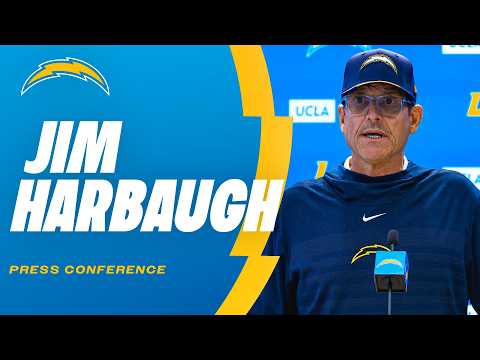
Jim

Chargers and Jim Harbaugh reconnect to their San Diego origins

This is where it all started for Jim Harbaugh, this idyllic hilltop University of San Diego campus with its sweeping views of the city and ocean, Spanish Renaissance architecture and courtyards lined with palm trees.

Harbaugh had been an assistant coach elsewhere, learning the ropes as an offensive consultant at Western Kentucky and quarterbacks coach for the Oakland Raiders, but this was his first chance to be a head coach. It launched a second career for the longtime NFL quarterback, taking him to Stanford, the San Francisco 49ers — where his team fell just short of a Lombardi Trophy — to a national championship at Michigan, and now to the Chargers, with whom he’s beginning his third season.

The Chargers have moved training camp to USD for Tuesday and Wednesday this week, reuniting Harbaugh with a place legendary Raiders owner Al Davis advised him not to come.

“Awww, Jimmy, Jimmy, I thought you wanted to be a pro coach,” Davis, voice dripping with disappointment, told him in 2004 when he learned Harbaugh was leaving his Raiders gig.

“But Mr. Davis, you coached college football,” Harbaugh countered.

“Yeah,” Davis said, “but that was at USC, not U-S-D.”

Harbaugh knows he made the right decision, and never doubted it, even when he and defensive coordinator Dave Adolph — another NFL fixture — had to roll up their sleeves and scrub down the cramped and filthy USD locker room themselves; even when he and his assistant coaches routinely made hundreds of PB&J sandwiches to provide late-night snacks for their players, who don’t receive scholarships at the NCAA Division I FCS level; and even when he pushed himself so hard at practice — he was the head coach, mind you — that he got sick all over himself.

“He was very demanding of us,” recalled former Toreros linebacker Matt Gabbard, “but it wasn’t something he didn’t demand of himself.”

They still call it Harbaugh Hill, a steep dirt road overlooking the practice fields on campus. Football players would plod up it as part of their training camp, and Harbaugh would run with them and urge them along. It bothered him that nobody could keep pace with receiver Nick Garton, who also excelled in soccer and track in high school, and could breeze up the grade like it was nothing.

“Isn’t anybody going to challenge this guy?” Harbaugh said. “Finally, I said, ‘I’ll do it.’”

Jim Harbaugh smiles during a practice with the University of San Diego in November 2005.

Jim Harbaugh smiles during a practice with the University of San Diego in November 2005.

(Lenny Ignelzi / Associated Press)

So he did, matching Garton stride for stride before losing his breakfast all over himself. The coach didn’t stop running, though.

“I finished second,” he said, recalling the episode after Chargers practice this week and clearly still proud of his accomplishment.

Harbaugh coached at USD for three seasons, starting in 2004, and was three years removed from his playing career. He was 40 when he took the job and still had thoughts of putting the pads back on. He even looked into playing arena football and entertained the idea of playing for the Los Angeles Avengers, but that thought only lasted a day or so. He really wanted to be a coach, and brought along his dad, Jack Harbaugh, to oversee the running backs in that first season.

Jim and Jack would carpool to campus every day from their Coronado homes, father and son talking plays, personnel, family and life.

“What I saw was passion,” said Jack Harbaugh, who spent six decades coaching high school and college football. “If I could use one word, it’s Jim’s passion for the game. He would coach as if that was maybe the last job he’d ever had.”

That resonated with the players.

“When we saw coach Harbaugh come in and have that next-level intensity, you kind of get chills running down your spine,” defensive back Phil Bretsch said. “Like, ‘Oh boy, this is going to be different.’ But you’re ready for it, right? We’re not there for any other reason other than we love football.”

The turnaround was abrupt. Harbaugh inherited a historically mediocre program and coached his team to a 29-6 record in three seasons. The 2006 team went 11-1, won the Pioneer League, and Harbaugh was a finalist for the Eddie Robinson Award, presented to the top coach in the FCS.

One of his biggest accomplishments was luring Adolph out of retirement. The defensive specialist was almost 70 and was a turnaround artist with all sorts of NFL franchises — Cleveland, Kansas City, Raiders and Chargers — but in his later years was the primary caregiver for his ailing wife. Harbaugh asked and asked and asked, and finally got a yes when he helped arrange for in-home care for the Adolphs for several hours a day.

Coaching at this level was about making sacrifices for the love of the game. There was no school money to feed the hungry players after their team meetings, so Harbaugh and the other coaches — essentially volunteers — shelled out for tubs of peanut butter, vats of jelly and dozens of loaves of bread every night.

“We were always on the hunt for calories,” Bretsch said. “I think I stayed alive off Carl’s Jr. 99-cent chicken sandwiches for about six months throughout my career. We always joked, ‘What if we would have had the training table the big programs had? What would we have been like?’”

But those teams had something different. They had Harbaugh.

“We had a competitive advantage from a coaching standpoint every game we went into,” said running back J.T. Rogan, who went on to work with Harbaugh at Stanford and Michigan. “I would refer to him as my father in football, but that would probably be diminishing the impact he’s had on my life.”

It wasn’t just about Harbaugh’s football mind or unwavering intensity and enthusiasm. He had connections. When he took his team up to play Menlo College, he had Jerry Rice deliver the pregame talk. Steve Mariucci spoke to the team as well. So did longtime college basketball coach Tom Crean, Harbaugh’s brother-in-law.

Jim Harbaugh #4, Quarterback for the San Diego Chargers talks to his offensive line.

Jim Harbaugh huddles with his teammates during a game between the San Diego Chargers and Denver Broncos in October 2000.

(Stephen Dunn / Getty Images)

When the Toreros needed cold-weather clothing for a game at Dayton, Harbaugh cajoled the Chargers, with whom he spent part of his playing career, into donating some of their mothballed gear.

“We got turtlenecks with the Chargers insignia on them,” Rogan recalled. “We’d have these jackets with a big Chargers lightning bolt, the dark-blue stuff before the baby-blue stuff was en vogue.”

For Harbaugh, the job was part-coaching and part “Let’s Make a Deal.”

When Saint Mary’s dropped its football program, he called the East Bay school not only to recruit players but to round up equipment that would otherwise go unused. He wound up buying virtually everything the program had, writing a $10,000 check out of his personal account.

“I got all the practice pants, the helmets, the thigh boards, everything,” he said.

He rented a U-Haul and drove to Moraga to collect the stuff. When Harbaugh was about to head out, the Saint Mary’s coach asked one more question:

“You need goalposts?”

Harbaugh was all ears.

“He showed me these year-old goalposts,” he said. “They were beautiful. I put them in the U-Haul and took them too.”

Chargers coach Jim Harbaugh looks on during training camp at the University of San Diego.

Chargers coach Jim Harbaugh watches training camp at the University of San Diego on Tuesday.

(Gregory Bull / Associated Press)

With the truck loaded and as he was preparing to pull out, Harbaugh got a call on his cell. It was an unheralded USD quarterback recruit from Oakland named Josh Johnson. He was supposed to be at freshman orientation but didn’t have a way to get from the Bay Area down to San Diego.

Harbaugh was quick on his feet.

“He said, ‘My parents are working and can’t take me down there,’” Harbaugh said. “I said, ‘Tell you what, can you be ready in an hour?’ He said he could be, so I drove the U-Haul over to his place and picked him up an hour later.”

The two spent the next seven hours together, driving to USD. Even now, Harbaugh made clear he wasn’t bending the rules.

“It wasn’t an extra benefit for Josh Johnson,” he said. “I put him to work. He unloaded the whole truck.”

In his first practice, Johnson went from seventh on the quarterback depth chart to second. He would go on to become one of the greatest players in the history of the program, leading the Toreros to back-to-back Pioneer League championships. He set many school records, including his 2007 season in which he threw 42 touchdown passes with one interception.

Johnson, now playing for the Cincinnati Bengals, has played for 14 NFL franchises, some more than once. That’s the most in league history for a quarterback. It’s an astounding rise from a tiny, non-scholarship university in San Diego. An odyssey of an ascent.

Harbaugh, for one, can relate.

Source link

Jim Ovia, Nigeria’s Banking Godfather, Retires

Jim Ovia steps down as Zenith Bank chairman after 36 years, passing the torch to CEO Adaora Umeoji.

When Jim Ovia founded Zenith Bank in July 1990 at age 38, with NGN 20 million (then about $2.5 million) in capital, Nigeria already had a rich history of indigenous banking institutions. National Bank of Nigeria (1933), African Continental Bank (1937), and Agbonmagbe Bank (1945), later renamed Wema Bank, were among the major banks. 

In May, nearly 36 years after Zenith’s founding, Ovia retired as chairman after completing the maximum 12-year tenure permitted under the Central Bank of Nigeria’s (CBN) corporate governance code. Known as the godfather of Nigerian banking, Ovia leaves Zenith as Nigeria’s most valuable listed bank, with more than NGN 30 trillion (about $19.5 billion) in assets and NGN 1 trillion in after-tax profit in 2025.

Zenith was among the institutions that emerged stronger from Nigeria’s landmark 2004–05 banking consolidation, during which the CBN raised minimum capital requirements from NGN 2 billion to NGN 25 billion, reducing the number of the nation’s commercial banks from 89 to 25. 

Building an African Banking Empire

The lender has since expanded beyond Nigeria, with subsidiaries in Ghana, Sierra Leone, and Gambia; branches in London, Paris, and Dubai; a representative office in China; and a growing East African presence following the acquisition of Paramount Bank Kenya. Last year, Zenith became the first Nigerian lender to exceed NGN 5 trillion in market capitalization.

Prominent Nigerian banking executive in formal suit and glasses.
Nigerian banking industry leader retiring, symbolizing leadership transition in finance sector.

The leadership transition follows years of internal succession planning. Adaora Umeoji, who joined Zenith in 1998, became the bank’s first female group managing director and CEO in 2024, after a 28-year career at the institution. Under her leadership, Zenith completed an NGN 350.46 billion capital raise, 160% subscribed, comfortably exceeding Nigeria’s new regulatory capital requirements while maintaining record profitability.

Ovia strengthened his financial commitment before stepping down as chairman. In December, five months before retiring, he acquired an additional NGN 14.8 billion in Zenith Bank shares, increasing his holding to 16.2% and cementing his position as the bank’s largest individual shareholder.

Ovia’s leadership laid “the foundation for what has become one of Africa’s most respected and globally recognized financial institutions,” according to the Nigerian Education Loan Fund. Shareholder advocate Boniface Okezie, national coordinator of the Progressive Shareholders Association of Nigeria, terms Zenith “one of the strongest banks in the country because of the solid foundation [Ovia] laid,” and expresses confidence that the lender’s governance framework will remain strong without its founder.

Charles Wachira is a contributing writer based in Kenya.

Source link

Chad Tracy’s record Red Sox win streak mirrors dad Jim’s Rockies run

Winning streaks bring a life of their own to a clubhouse, each day presenting another opportunity to extend the joy and methodically build a feeling of invincibility.

Inevitably the streak ends and everyone sighs, reflects and returns to work. The Boston Red Sox lost the second game of a doubleheader Wednesday to end a win streak that tied an 80-year-old club record when it reached 15 in the opener.

Boston interim manager Chad Tracy stepped into the clubhouse to say a few words afterward but saw veteran players Willson Contreras and Sonny Gray speaking to the team and allowed them the moment.

“We just won 15 games in a row, and I think all of us knew it was going to end at some point,” Tracy said.

Call it the “Tracy Turnaround” redux.

Tracy had never managed, coached or played at the major league level before replacing Alex Cora on April 25, but he was well-versed in experiencing the glorious ride of a winning streak and its abrupt end. His father, Jim Tracy, managed the Dodgers, Pittsburgh Pirates and Colorado Rockies from 2001-2012.

Like his son, Jim Tracy was given an interim manager title when he replaced Clint Hurdle in May 2009 after Colorado’s poor start. It took only a few weeks before the Rockies won 11 games in a row, 17 of 18 and finished 74-42 to make the playoffs.

This year’s Red Sox can only hope their U-turn under Chad Tracy mirrors his dad’s. Boston was 32-46 before winning 20 of 23, including the 15-game win streak.

No surprise that father and son discussed the similarities. Chad was a double-A first baseman with the Texas Rangers in 2009 and closely followed his dad’s fortunes.

“I remember the [Rockies’] run,” Chad said. “You know, we talk very basically about just, he’s excited [about the Red Sox]. He’s a baseball fan. He’s watching constantly, and he’s fired up for it. So, like, we haven’t done a whole lot of comparing to that, but he’s just — he’s a Boston Red Sox fan.”

Jim was rewarded by becoming the second interim manager in MLB history to win the Manager of the Year award. Chad could be in the running to be the third, especially if the Red Sox make the playoffs.

They already are only the sixth father-son combo to manage in the major leagues, following Bob and Aaron Boone, George and Dick Sisler, Bob and Joel Skinner, Buddy and David Bell, and Felipe Alou and Luis Rojas.

The achievement isn’t lost on Jim Tracy, who became so emotional upon learning his son was named interim Red Sox manager he pulled his car to the side of the road. He attended Chad’s first game, a victory over the Baltimore Orioles, on the top step of the dugout.

“One thing that jumped out at me,” Jim Tracy said, “was that when he was presented to the media, his body language in the dugout…. he was not overwhelmed or fazed with anything that was going on. He was ready to do whatever was asked of him.”

That Chad replaced Cora, who led the Red Sox to the 2018 World Series title in his first season, elicited mixed feelings. Cora played with the Dodgers from 1998-2004, including four seasons under Jim.

“It’s a wonderful day, but in some respects, it’s bittersweet,” Jim said the day of Chad’s managerial debut. “I’m proud of [Chad], but the Tracy family loves and respects Alex Cora.

“You have to go back with some special years I had in Los Angeles and Alex was very much a part of that. Bittersweet is the right word because Alex was so good to my son and took such good care of him. But it was reciprocated.”

Source link

Moment sozzled Jim Davidson, 72, is helped up by drinking buddies after collapsing outside pub following all day session

COMEDIAN Jim Davidson admitted “I found out what legless means” after collapsing outside a pub and being helped up by drinking buddies.

The star downed two ­bottles of wine, tequila, vodka, six pints of ­Guinness and two whiskies on an all-day session, saying: “I think it must have been that last scotch that did it.”

Jim Davidson admitted ‘I found out what legless means’ after collapsing outside a pub and being helped up by drinking buddies
Jim downed two ­bottles of wine, tequila, vodka, six pints of ­Guinness and two whiskies on an all-day session, saying: ‘I think it must have been that last scotch that did it’ Credit: News Group Newspapers Ltd

Ex-Big Break and Generation Game host Jim, 72, had sailed to the Isle of Wight on his £350,000 yacht Lady Natasha — named after his fiancée.

The pair dined at The Hut in Colwell Bay before Natasha, 49, called it a night and Jim ­carried on drinking with some yachtsmen.

He said: “It was boys stuff. I found out what the term legless means.

“My quote is ‘must take more water with it’.

FUNNY BUSINESS

The Apprentice star sparks rumours she’s dating co-star after show scandal


tatt’s a lot

Katie Price dons bikini to show tattoo collection but ditches wedding ring

“We had a smashing meal at The Hut, which is the best ­restaurant in the country, then I decided to go on the p***.

“It was a bit of a harmless fun, no one died.”

Jim, who has five ex-wives, detailed his mammoth booze-up, which ended with him collapsing outside Salty’s pub in Yarmouth.

He said: “Most people leave Salty’s like that. First I had a couple of bottles of wine that made me a bit dizzy.

Jim, who has five ex-wives, detailed his mammoth booze-up, which ended with him collapsing outside Salty’s pub in Yarmouth Credit: Alamy
Jim admitted being a binge drinker and said: ‘I can do that when I’m not working. I can’t when I’m working’ Credit: AFP

“I thought I better have some tequila to sober me up. After the tequilas made me feel worse, I thought vodka will kill the tequila.

“And after that six pints of Guinness. I thought well I need a wee, I’ll go into this pub and use their toilet and while I’m here I’ll have a couple of scotches.

“I think it must have been that last scotch that did it.”

Jim admitted being a binge drinker and said: “I can do that when I’m not working. I can’t when I’m working.

“Today I’ve got to drive five hours to Blackpool, do a show in the club and then five hours back tomorrow. This is the reality of showbiz. Then back to the studio to film my weekly satire show.

“When you’ve got a picture of me coming off stage in a theatre like that, then I’m in trouble.”

Source link

Seth Doane and Jim Axelrod among contenders for ’60 Minutes’ roles

With the 2026-27 season premiere of “60 Minutes” just two months away, CBS News leadership is getting closer to deciding who will fill the recent departures of longtime correspondents Scott Pelley, Sharon Alfonsi, Cecilia Vega and Anderson Cooper.

Seth Doane, a longtime correspondent based in Italy who is often seen on “CBS Sunday Morning,” is under consideration, along with chief investigative correspondent Jim Axelrod, who currently has a lead role in the “Eye On America” series featured on the “CBS Evening News with Tony Dokoupil.”

Trevor Phillips, a British journalist and former politician who recently joined CBS News as senior global affairs correspondent, is expected to have a role on the program, according to people briefed on the plan. Phillips had a long career in the U.K., producing and writing documentaries and most recently hosted the Sky News program “Sunday Morning with Trevor Phillips.”

Phillips received a knighthood in 2022 for his service to equality and human rights for the U.K. But he also generated controversy over his career for comments about the British Muslim community, which led to a yearlong suspension from the Labor Party in 2020.

A CBS News representative declined comment beyond saying the division is looking at a number of internal and external candidates.

Dokoupil is expected to deliver four “60 Minutes” pieces a season. Major Garrett, the network’s chief Washington correspondent, will also have a contributor role.

Matt Gutman, hired from ABC News last year as national correspondent, is under strong consideration. He is being put in front of test audiences, according to several people at the network.

Holly Williams, a foreign correspondent working out of Istanbul for CBS News since 2012, and Mariana van Zeller, a journalist for National Geographic Channel, are both said to remain in contention.

The newcomers will join Bill Whitaker, Lesley Stahl, Jon Wertheim and Norah O’Donnell, who are all returning as correspondents. O’Donnell will also continue in her role as senior correspondent for the network, occasionally anchoring specials.

The rebuild of the talent lineup comes after the upheaval at the program that has occurred since Bari Weiss joined CBS News as editor in chief in October.

Pelley was fired last month after confronting management about the May 28 dismissal of his colleagues Alfonsi and Vega along with the program’s executive producer Tanya Simon and her second-in-command Draggan Mihailovich.

In February, Cooper decided not to sign a new deal as a “60 Minutes” contributor, as the CNN anchor cited a desire to spend more time with his family. But Cooper has reportedly told colleagues that he does not want to work for Weiss.

The internal disruption at “60 Minutes” followed a highly successful season. In its 57th season, “60 Minutes” was the most watched news program on television with an average of 9.1 million viewers a week, according to Nielsen data. The program bucked the overall decline in traditional TV viewing by growing 9% over the previous season.

After the dismissal of his “60 Minutes” colleagues, Pelley accused Weiss of trying to “murder” the program and claimed she was putting “her thumb on the scale” for more favorable coverage of the Trump administration. He was fired with cause after confronting management at a June 1 meeting.

Weiss came to CBS when parent company Paramount acquired her digital website The Free Press, known for its criticism of progressive policies and its strong support of Israel.

Weiss was hired by Paramount Chief Executive David Ellison with a mandate to move the news division to the political center. The pronouncement has created the perception that CBS News is looking to placate the Trump administration as Paramount sought regulatory approval for its $111-billion acquisition of Warner Bros. Discovery, which will also give the company ownership of CNN.

The noise surrounding Weiss has hurt CBS News despite strong reporting that is often far from being pro-MAGA. This past weekend’s “CBS Sunday Morning” featured a segment from national security correspondent David Martin about the Department of Defense interfering with the editorial independence of Stars & Stripes, the military newspaper.

Trump complained vehemently about his last interview with O’Donnell on “60 Minutes,” — conducted the day after a gunman tried to enter the White House Correspondents Assn. dinner in Washington on April 25.

Source link