As the Palisades fire raged, then-Los Angeles Fire Department Chief Kristin Crowley went on a television blitz, calling out city leadership for systematically underfunding her agency.
The LAFD, she said, didn’t have enough firefighters, based at enough fire stations, to quench the wind-driven flames that were tearing through the hills.
“We need more. This is no longer sustainable,” she said in one interview Jan. 10.
Nearly a year after the fire destroyed much of the Palisades, LAFD officials continue to highlight financial concerns, with Crowley’s successor requesting a 15% budget increase and the firefighters union proposing a sales tax that could bring in an extra $300 million per year.

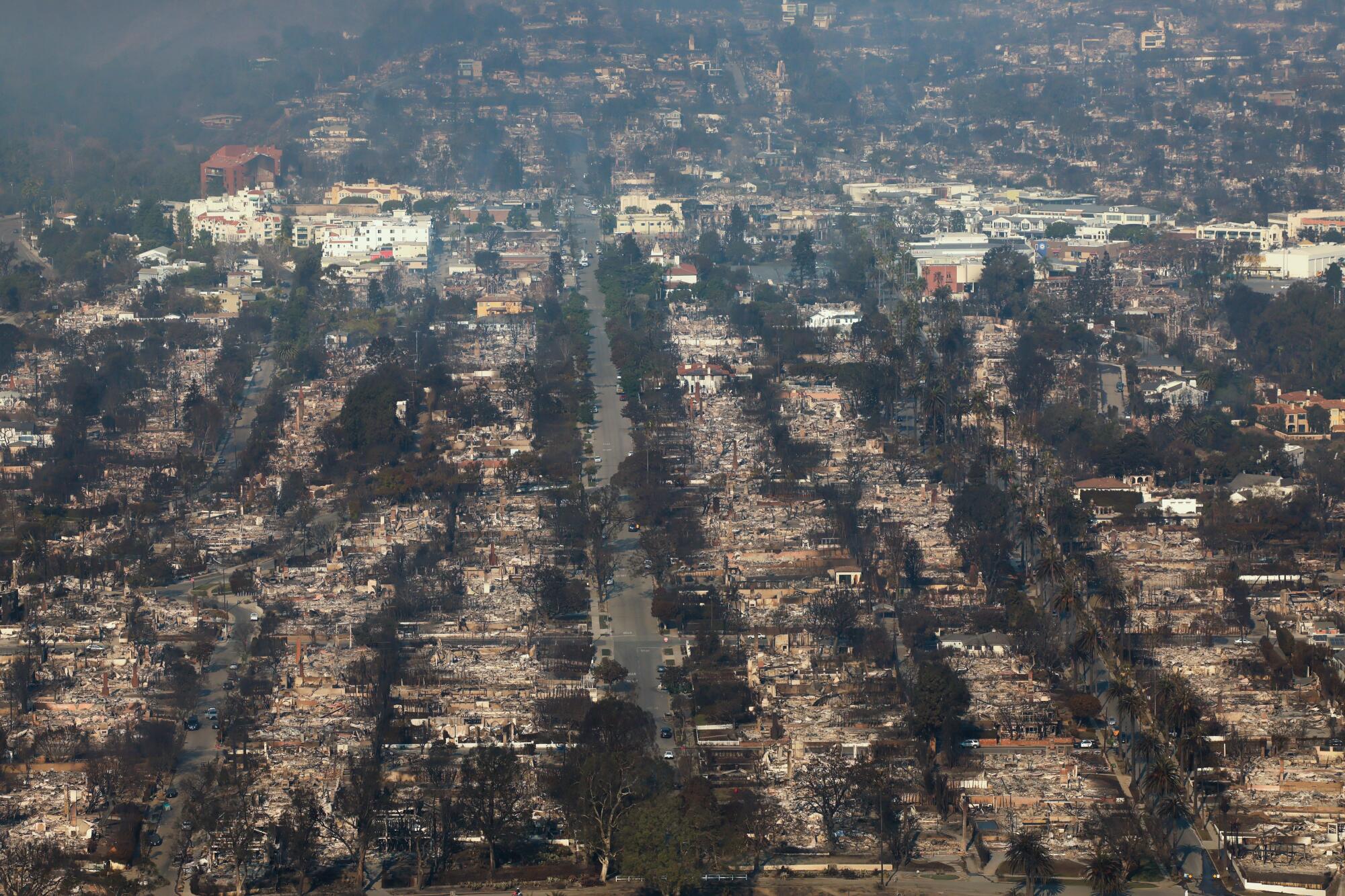
A Jan. 9 aerial view of neighborhoods destroyed by the Palisades fire.
(Robert Gauthier / Los Angeles Times)
But the LAFD’s hyper-focus on money obscures its leaders’ failures in managing the resources they had, beginning with a decision to leave the scene of a New Year’s Day fire despite signs it hadn’t been fully extinguished.
Days later, that fire reignited into the Palisades fire, which killed 12 people and destroyed thousands of homes. Despite forecasts of catastrophically high winds, LAFD officials didn’t pre-deploy engines in the area or increase manpower by ordering a previous shift of firefighters to stay on duty.
As the flames spread, the firefighting response was disorganized and chaotic, with the LAFD’s own after-action report describing major failures by high-ranking commanders in communication, staffing and basic wildland firefighting knowledge.
City leaders have highlighted changes they have made since the fire, including appointing 30-year LAFD veteran Jaime Moore as chief and drafting new protocols for staffing on high hazard weather days.
But the question remains: Is Los Angeles prepared for the next major wildfire? Some city officials and fire experts don’t think so, pointing to an LAFD that hasn’t evolved with the times and an incomplete review of how the Palisades fire started.
Moore, who was appointed chief last month, declined to comment.
Mayor Karen Bass said in an interview earlier this month that the city is “on the path to be completely ready” for a major wildfire, with the LAFD now taking a more proactive approach to weather warnings.
“The Fire Department has been way more aggressive, has done pre-deployment, has been very visible, alerts going out early, trying to be very, very aggressive,” she said.
But Genethia Hudley Hayes, president of the Board of Fire Commissioners, said that the LAFD is still unprepared and that there hasn’t been enough time to make the necessary changes. She cited the LAFD’s technology, which she said is about two decades behind.
“I am not confident there would be a different result” if a similar disaster strikes, she said.
City Councilmember Traci Park, whose district includes Pacific Palisades and who has advocated for more Fire Department funding, agreed with Hudley Hayes.
Some essential changes have been made, such as requiring firefighters to stay for an additional shift during red flag warnings, Park said. But she said that too many fire engines are out of service, there are not enough mechanics, and most important, questions about the origin of the Palisades fire remain unanswered.
In October, after federal prosecutors charged a former Palisades resident with deliberately setting the Jan. 1 Lachman fire, The Times reported that a battalion chief ordered firefighters to roll up their hoses and leave the burn area on Jan. 2, even though they had complained that the ground was still smoldering and rocks remained hot to the touch. The Times reviewed text messages among firefighters and a third party, sent in the weeks and months after the fire, describing the crew’s concerns.
The LAFD’s after-action report, released in October, only briefly mentioned the Lachman fire. Critics have flagged this as a crucial lapse in the report, which prevents the department from figuring out what went wrong and avoiding the same mistakes.
After the Times report, Bass ordered an investigation into the LAFD’s handling of the Lachman fire.

Mayor Karen Bass, right, and then-Fire Chief Kristin Crowley speak during a news conference in January. Bass ousted Crowley less than two months after the Palisades fire.
(Allen J. Schaben / Los Angeles Times)
Bass had ousted Crowley less than two months after the Palisades fire, citing the LAFD’s failure to properly deploy resources ahead of the winds and potentially have a chance to extinguish the fire before it exploded out of control, an issue that was exposed by a series of reports in The Times.
Bass also countered Crowley’s financial complaints, saying that the budget did not affect the department’s ability to fight the fire. The LAFD’s 2024-25 budget had actually increased 7% from the previous year, due in part to generous firefighter raises.
More money won’t solve bad decision-making by top officials, said Marc Eckstein, an emergency physician who served as LAFD’s medical director and commander of its emergency medical services bureau until he retired in 2021.
He said that without transparency and accountability, “the fallback is always going to be what it has been: We need more of everything — more people, more money, more fire trucks, more fire stations.”
A modern fire agency needs the flexibility to surge its staff during a disaster, he said, while also addressing day-to-day needs. Most 911 calls are for medical problems, he said, yet the LAFD functions more or less the same as it did decades ago, when structure fires were more common.
He said a panel of outside experts should have been given access to the LAFD’s records to offer an unbiased look at how the department performed leading up to and during the Palisades fire.
“And it’s a playbook. OK, how do we prevent this from happening again?” he said. “And the fact that didn’t happen is a disgrace.”
How much the department transforms after the Palisades disaster will depend, in large part, on its new chief. Moore, who joined the LAFD in 1995 and most recently was deputy chief of the Operations Valley Bureau, was chosen by Bass to lead the department over a fire chief from a major city outside California.
At stations around L.A., firefighters told Bass that they wanted an insider for the job, which she said factored into her decision.
“Given that the Fire Department was under such scrutiny, such a difficult time, morale is in the toilet, infighting that’s going on, the last thing in the world they needed, in my opinion, was somebody from the outside,” Bass told The Times.
Moore had signaled before his appointment was confirmed last month that he was troubled by the LAFD’s missteps with the Lachman fire and was going to bring in an outside organization to investigate.
But the following week, he appeared to change course, alleging that the media was trying to “smear” firefighters while saying he still planned to investigate the Lachman fire.
Moore will be in charge of implementing the 42 recommendations in the after-action report, which range from establishing better communication channels to how to defend homes where hidden embers could ignite.
The report drew the conclusion that top LAFD commanders had startlingly little knowledge about combating wildfires, including “basic suppression techniques.” It suggested that all LAFD members undergo training on key skills such as structure defense and how to draw water from swimming pools when hydrants don’t work.
In an interview with ABC7, Moore said that the LAFD has adopted about three-quarters of the recommendations and is considering creating a division specializing in wildland fires.

Members of Crew 4, the department’s new full-time wildland hand crew, practice cutting fire lines near Green Verdugo Fire Road in Sunland.
(Myung J. Chun / Los Angeles Times)
Since the Palisades fire, the LAFD has hired a 26-member wildland hand crew that uses chainsaws and other tools to chop paths through brush to stop a fire from spreading. When they aren’t battling fires, they do brush clearance throughout the city.
Earlier this month, as hand crew members practiced cutting fire lines through the brush in Sunland, the crew’s leader, Supt. Travis Humpherys, declined to say whether they would have changed the outcome of the Palisades fire.

Travis Humpherys is the Crew 4 superintendent.
(Myung J. Chun / Los Angeles Times)
But they have already “made a dramatic impact” with brush clearance and fighting wildfires, including a 20-acre fire in Burbank in June, Humpherys said.
Moore’s requested budget of more than $1 billion for the coming year — a 15% increase over this year’s budget — includes money for a second wildland hand crew, as well as nearly 200 additional firefighter recruits and helitanker services to attack fires from the air. That amount could be pared down during the months-long city budgeting process, as the City Council and the mayor find ways to balance the overall budget amid financial headwinds.
Meanwhile, United Firefighters of Los Angeles City Local 112 is charting an ambitious course to reduce the department’s dependency on the city budget, pushing for a ballot measure that, if approved by voters in November 2026, would raise nearly $10 billion by 2050 through a half-cent sales tax. But after the LAFD’s failures in the Palisades fire, some voters may be reluctant to entrust its leaders with more money.
“It’s hard to believe that we are fully prepared for the next major emergency,” Doug Coates, the union’s acting president, said in a statement. “We desperately need more firefighters and paramedics, more trucks, engines, and ambulances and more wildfire resources and neighborhood fire stations.”
E. Randol Schoenberg, whose family lost four homes in the fire, including his in Malibu — along with documents that belonged to his grandfather, the composer Arnold Schoenberg — said he would be happy to pay more taxes for more services.
But Schoenberg, an attorney who is representing Palisades fire victims in a lawsuit against the city and the state, said he expects the LAFD to honestly examine its mistakes.
“If they don’t really grapple with the issues of how this happened, then no matter how much money we throw at it, it’s going to happen again,” he said.
Times staff writer David Zahniser contributed to this report.