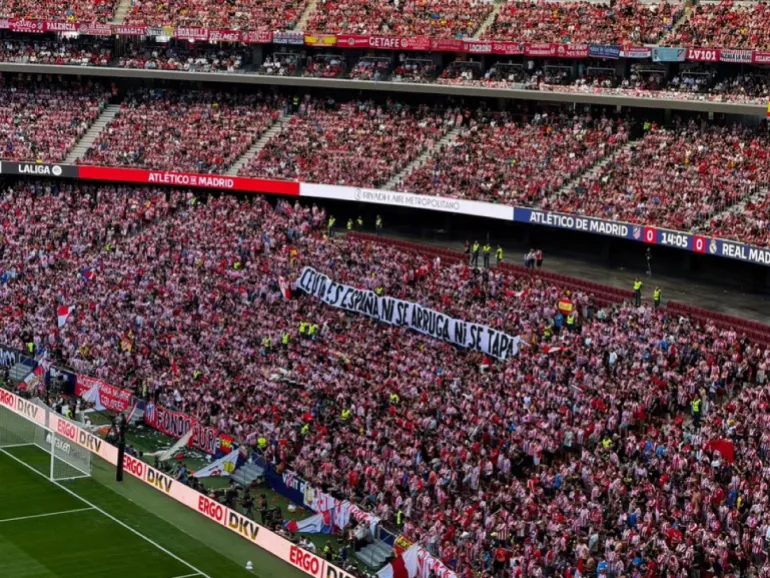
Madrid, Spain – Thirteen minutes into La Liga’s Madrid derby on Sunday, a banner was unfurled in the Metropolitano Stadium’s south stand stating: “Ceuta es Espana. Ni se arruga, ni se tapa.” (Ceuta is Spain. It is neither rolled up, nor covered.)
It was a reference to the controversy involving Real Madrid players Kylian Mbappe, Vinicius Junior and Ibrahima Konate, who in a previous football match against Elche had rolled-up shirts carrying a solidarity message linked to Ceuta, the Spanish enclave at the centre of growing political tensions between Spain and Morocco over the influx of migrants and refugees.
Recommended Stories
list of 4 itemsend of list
A record 72,000 migrants crossed from Morocco to Ceuta over the course of two days in late July, overwhelming local resources and creating a humanitarian crisis. The Spanish NGO Caminando Fronteras documented 141 deaths across both sides of the border in the immediate aftermath.
Mbappe and Konate have strong ties to the African continent. Konate was born and raised in Paris by parents who migrated from Mali, while France captain Mbappe grew up in Bondy, outside Paris, to parents who came from Cameroon and Algeria.
Mbappe said his gesture did not reflect a lack of support for Ceuta.
“I also wanted to think about all the people who are suffering, because in the end I am human and I don’t want to prioritise the suffering of one group over another,” he said.
He also said he wanted to acknowledge migrants who had suffered or lost their lives during the crisis.
Real Madrid later said it respected each player’s freedom to participate in the initiative. A day earlier, Barcelona had chosen not to wear the shirts before their La Liga game against Levante.
La Liga president Javier Tebas, meanwhile, criticised the three Real Madrid players and said he did not regard the campaign as political. David Aganzo, president of Spanish footballers’ union AFE, said players instead needed to be properly informed about what they were being asked to wear and why.
While the debate over Spanish football’s support for Ceuta followed Real into their derby against fierce rivals Atletico Madrid on Sunday, it also united supporters from both sides for two minutes as they joined in chants of “Ceuta no se vende, Ceuta se defiende” (Ceuta is not for sale, Ceuta must be defended) before the usual hostility of the derby resumed.
Mbappe and Vinicius were also the target of whistles from both sets of fans when Real’s starting XI was announced prior to kickoff.
Jorge Garcia, a 32-year-old Atletico Madrid supporter, believed they deserved the jeering.
Speaking to Al Jazeera after the match, Garcia termed the players’ move “disrespectful” to both Ceuta and Spain.
![Fans hold a banner during the Atletico Madrid vs Real Madrid match in the Spanish La Liga at the Metropolitano Stadium in Madrid on Sunday, September 20, 2026 [Leyla Hamed/Al Jazeera]](https://i0.wp.com/occasionaldigest.com/wp-content/uploads/2026/09/Ceuta-banner-Atletico-Madrid-vs-Real-Madrid-Leyla-Hamed-1789993641.jpeg?w=640&ssl=1)
The campaign was launched on September 11 by Asociacion Valenciana de Empresarios (AVE), a non-profit business association, which described the move as an expression of solidarity with Ceuta’s residents and businesses amid an influx of migrants and a message of “territorial and social cohesion in Spain”.
AVE is chaired by businessman Vicente Boluda, a former interim Real Madrid president whose maritime group also operates in Ceuta.
Spain coach Luis de la Fuente travelled to Ceuta with the World Cup trophy, declaring: “This is Spain, this is Ceuta.” Real Madrid president Florentino Perez later visited and said the trip had been organised weeks earlier and was not a response to the controversy involving his players.
Youssef Temsamani, a Spain-based Moroccan journalist, believes the players found themselves in a difficult position: wearing the shirt could be interpreted as taking a political position, but declining to do so could be portrayed as showing a lack of solidarity.
Temsamani said migrants should also form part of discussions about solidarity with Ceuta, and criticised descriptions of the crossings in parts of Spain’s political and media debate as an “invasion” or “occupation”.
Luhay Hamido, president of AD Ceuta football club, defended the right of individual players to make their own decisions and said he respected those who wore it and those who did not.
“We cannot force anyone to identify with a cause they do not understand,” he told Al Jazeera, suggesting footballers are sometimes simply told to put on a shirt in the tunnel without having received a full explanation.
The scale of the crisis that prompted the solidarity campaign remains difficult to quantify precisely. Spain’s Interior Ministry put the number of people who irregularly crossed into Ceuta on July 30 and 31 at 72,000, saying more than 70,000 initially returned to Morocco.
Seven weeks later, the government estimated that 9,000 to 10,000 migrants remained in Ceuta. RTVE reported on September 20 that around 8,300 people were being accommodated in different facilities while more than 4,000 remained on the streets, reflecting discrepancies between estimates compiled at different stages of the crisis. The new temporary centre at the port reached its capacity of 1,700 people within hours of opening.
Hamido said the crisis had also directly affected AD Ceuta, with several advanced signings collapsing because players and their families were worried by what they had seen on television. The club began paying for prospective signings to visit the city before making their decision.
At the same time, he described the support from Spanish football as “pure fuel for us”, giving Ceuta “strength, hope and energy”, and said AD Ceuta could act as an “amplifier” so the city was not forgotten.
Away from the stadiums and political arguments, football is also played in the neighbourhoods in Ceuta, where migrants had gathered in the largest numbers.
There, children could be seen playing barefoot in the street, marking out makeshift goals against walls and turning whatever space they could find into a football pitch. Some wore shirts bearing the names of Yamal, Hakimi or Mbappe – players whose own family histories stretch across borders.
For Hamido, ordinary people caught in the crisis should not be castigated.
“[These] people, in the end, are not to blame,” he told Al Jazeera.