Moroccan migrants are protesting in Ceuta, demanding asylum two weeks after more than a massive migrant surge into the Spanish enclave. Thousands are in limbo, sheltering on beaches as Spanish authorities debate asylum claims.
Thousands of people attempted to cross into Ceuta last month, overwhelming local authorities. On Saturday, Moroccan officials said they detained 111 attempting to cross. Photo by Jalal Morchidi/EPA
Aug. 15 (UPI) — Dozens of migrants were detained in Morocco on Saturday as they attempted to cross into the Spanish territory of Ceuta.
Moroccan officials said they intercepted some 111 people near the town of Fnideq, about 2 miles from the border, BBC reported.
Local police chartered buses to return them to other parts of the country, El Pais reported.
The attempted crossings come weeks after more than 60,000 people crossed the border into Ceuta, overwhelming the small territory.
Moroccan authorities intercepted dozens of migrants seeking to cross into the Spanish North African exclave of Ceuta on Saturday, reports say.
More than 100 people were blocked trying to make their way to the border on the outskirts of the town of Fnideq, according to Moroccan security sources cited by Spanish media and the Reuters news agency.
It comes a fortnight after roughly 78,000 migrants arrived in the exclave by sea in a matter of hours – 100 of whom died, according to the city’s mayor, who also said the vast majority of arrivals had returned to Morocco.
Security had been stepped up in the area after the influx and amid suggestions on social media of a second mass crossing attempt this weekend.
The security sources said 111 people had been detained in or around Fnideq – known in Spanish as Castillejos – about 3km (1.8 miles) from the border, the majority of whom were from sub-Saharan Africa.
Moroccan police – including some in riot gear – reportedly used tear gas to disperse groups of migrants gathered on nearby hills.
Earlier this week, Rabat said it was monitoring “the circulation of social media posts and messages of unknown origin” calling for a mass crossing Saturday, warning it would prosecute organisers and participants.
Thousands of migrants entered the Spanish city of Ceuta from neighbouring Morocco on July 31, bringing renewed attention to one of Europe’s most unusual borders.
Although Ceuta lies on the northern coast of Africa and is surrounded by Moroccan territory, it is administered by Spain and forms part of the European Union. Together with nearby Melilla, it forms the EU’s only land border with Africa, making both cities recurring flashpoints for migration and diplomatic tensions between Madrid and Rabat.
The latest crossing has once again highlighted border security and irregular migration, but it has also drawn attention to a broader question: why do these small Spanish territories on the African continent continue to generate recurring political crises between Spain and Morocco?
Understanding the latest tensions requires looking at three connected issues: migration pressures, the cities’ legal status, and Morocco’s long-standing claim over their sovereignty.
Why has the crisis resurfaced now?
The latest crossing reflects continued pressure along one of Europe’s most sensitive migration routes. Because Ceuta and Melilla are Spanish territory, entering either city means entering the European Union.
For some migrants travelling through North Africa, the two cities are among the few places where EU territory can be reached by land, making them recurring focal points during periods of increased migration towards Europe.
The timing of the latest surge has also been linked to a recent ruling by Spain’s Supreme Court on the treatment of migrants attempting to reach Ceuta and Melilla by sea. The court ruled that Spain’s “hot return” procedure, which allows certain immediate returns at the border, could not be applied to migrants intercepted at sea while attempting to swim into the enclaves. The judges found that the procedure applies to people who cross physical border barriers, such as fences, rather than those intercepted at sea.
The ruling did not create an automatic right to remain in Spain or legalise irregular entry. However, it was interpreted by some migrants as making immediate return more difficult if they reached Spanish territory by sea. Spanish and Moroccan officials pointed to the ruling as one factor that may have influenced the latest surge, while migration experts also cited broader migration pressures and misinformation circulating among migrants and smuggling networks.
The episode showed how legal decisions affecting border procedures can quickly influence perceptions on one of Europe’s most heavily monitored frontiers.
Migration cooperation has long been closely linked to the wider relationship between Spain and Morocco. Madrid relies heavily on cooperation with Rabat to manage migration routes, while Morocco’s role in controlling movement towards Europe has made border management an important element of its relationship with both Spain and the EU.
That dynamic became particularly clear in 2021, when thousands of migrants entered Ceuta during a period of heightened tensions after Spain allowed Brahim Ghali, the leader of the Polisario Front, to receive medical treatment in Spain.
The Polisario Front seeks independence for Western Sahara, which Morocco considers part of its territory and which has its final status unresolved under a United Nations-led political process. Rabat viewed Spain’s decision to host Ghali as a diplomatic setback, while Madrid said the decision was based on humanitarian grounds.
Spain accused Morocco of easing border controls during the crisis, while Moroccan officials rejected the suggestion that Morocco should act as Europe’s border guard. The episode demonstrated how migration cooperation can become entangled with broader political disputes between the two countries.
What is the legal status of Ceuta and Melilla?
Under the current international legal framework, Ceuta and Melilla are Spanish territories under Spain’s sovereignty. Spain exercises full administrative and governmental authority over the two cities, and they are represented in Spain’s political system and form part of the EU.
They are not listed by the UN as Non-Self-Governing Territories, a category that applies to territories whose people have not yet exercised the right to self-determination through decolonisation. Because Ceuta and Melilla are not on that list, they are not part of a UN decolonisation process.
There has also been no international court ruling or UN decision determining sovereignty over Ceuta and Melilla. The dispute remains a political disagreement between Spain and Morocco rather than a sovereignty dispute currently being adjudicated through an international legal process.
This is one of the key differences between Ceuta and Melilla and Western Sahara. Western Sahara remains on the UN list of Non-Self-Governing Territories and is the subject of a separate UN-backed political process over its future status, while Ceuta and Melilla are treated internationally as territories under Spanish sovereignty.
This is the basis of Madrid’s position that the sovereignty question is settled. Spain argues that the two cities are not colonial possessions but fully integrated parts of the Spanish state, governed under Spanish law and protected as Spanish territory.
Morocco disputes that interpretation, arguing that the cities’ location on the African continent and their historical connection to North Africa mean they should be viewed differently from other Spanish cities.
Why does Morocco continue to claim the two cities?
The dispute is rooted in the long history of the western Mediterranean.
The Strait of Gibraltar has historically connected Europe and Africa rather than separating them. Armies, merchants, cultures and religions moved across it for centuries.
During the medieval period, Muslim dynasties based in present-day Morocco, including the Almoravids and Almohads, ruled large parts of the Iberian Peninsula. Their influence remains visible today in Spain’s architecture, language and cultural heritage.
Later, Portugal and Spain established footholds along the North African coast as European powers expanded their influence overseas.
Portugal captured Ceuta in 1415. After the Iberian Union between Spain and Portugal ended in 1640, Ceuta remained under Spanish rule. Spain has administered the city ever since.
A view of the border fence separating the Spanish enclave of Melilla from Morocco in North Africa [File: AP Photo]
Melilla has been under Spanish control since 1497.
Spain points to this long history of administration, together with citizenship and constitutional integration, as evidence that the two cities are fully part of Spain.
Morocco views the same history through a different lens, arguing that European-controlled territories on the African mainland remain a historical legacy of European expansion.
Why do the cities matter beyond Spain and Morocco?
The importance of Ceuta and Melilla extends far beyond their size.
For Spain, the cities are sovereign territory and a direct extension of the Spanish state into North Africa.
For the European Union, they represent its only land borders with Africa and are therefore central to debates over migration, border security and cooperation with neighbouring countries.
For Morocco, the cities remain linked to a broader question of territorial sovereignty, even as Rabat maintains close cooperation with Spain on migration, trade and security.
This combination of interests means that developments in Ceuta and Melilla can quickly become issues of regional significance.
Could the dispute be resolved?
There is little indication that either Spain or Morocco is seeking to reopen formal negotiations over sovereignty.
Spain maintains that Ceuta and Melilla are integral parts of the country and that their status is not negotiable.
Morocco continues to maintain its claim, but in recent years has generally prioritised practical cooperation with Spain over direct confrontation on the issue.
As a result, the dispute tends to reappear indirectly during periods of political tension, diplomatic disagreements or increased migration pressure.
What does the latest crossing reveal?
The immediate challenge remains humanitarian: managing migration while protecting the rights and safety of people attempting to reach Europe.
But the events in Ceuta also show why the city repeatedly returns to international headlines. Migration may trigger the immediate crisis, but the response is shaped by border policy, Spain-Morocco relations, legal developments and a sovereignty dispute that continues to influence relations between the two countries.
Ceuta and Melilla remain unusual because they are geographically part of Africa but politically part of Europe. As long as migration pressures and sovereignty disputes persist, they are likely to remain among the Mediterranean’s most sensitive border flashpoints.
More than 72 migrants died trying to reach Ceuta, but within hours the tragedy had become a political flashpoint.
Al Jazeera’s Ava Warriner examines the biggest claims about the crossings, what we know, and why analysts say the fallout could extend far beyond Spain.
Spanish Prime Minister Pedro Sanchez is facing growing criticism from some European leaders as European Union interior ministers meet to discuss last week’s mass crossing into the Spanish territory of Ceuta, an episode that has reignited debate over migration across the bloc.
Human rights groups and activists, meanwhile, have accused far-right politicians of exploiting the crisis to advance anti-immigration narratives.
Recommended Stories
list of 4 itemsend of list
More than 60,000 people crossed into the North African enclave on Thursday and Friday, triggering a humanitarian emergency and prompting Spain to deploy additional military and police forces.
More than 80 migrants died, according to Spanish and Moroccan authorities, including some who drowned or were crushed while attempting to cross a breakwater barrier.
Most of those who entered have since returned to Morocco. By Saturday, “almost all” had left and the situation in Ceuta had largely returned to normal, Spanish Interior Minister Fernando Grande-Marlaska said.
Ireland, which holds the rotating presidency of the Council of the European Union, convened an emergency video meeting of EU interior ministers after 22 of the bloc’s 27 member states called for “coordinated action and the strengthening of external borders”.
Political fault lines
The events in Ceuta have once again exposed divisions within the EU over migration policy, with several governments calling for a tougher approach while others have urged adherence to humanitarian and international legal obligations.
Italian Prime Minister Giorgia Meloni was among Sanchez’s sharpest critics, announcing that Italy would introduce temporary air and sea border controls with Spain while questioning Madrid’s handling of the situation.
Sanchez rejected the criticism, saying Italy’s position was “contrary to European law, humanitarian law, and the principles of solidarity that bind us together”.
In a post on X, he also noted that Italy had received significantly more migrants than Spain since 2021, saying Italy had recorded about 478,000 arrivals compared with Spain’s 234,000.
The political debate has unfolded despite a broader decline in irregular migration to the EU. According to the EU’s border agency Frontex, irregular border crossings peaked at 1.8 million in 2015. During the first half of 2026, crossings fell by 37 percent compared with the same period last year to about 49,000.
The scenes in Ceuta have nevertheless become a focal point in wider political debates over migration, despite the EU already introducing stricter migration and asylum rules that expand member states’ powers to detain migrants and return them to designated “safe countries” or facilities outside the bloc.
Human rights organisations have criticised the measures, warning they could leave asylum seekers stranded for prolonged periods in offshore detention centres, while illegal police pushbacks at borders still regularly occur in both the EU and North Africa.
Spain defends its response
The Spanish government has rejected accusations that it mishandled the crisis, saying the situation was brought under control quickly in close coordination with Morocco despite limited assistance from other European countries.
Officials have also said that a recent ruling by Spain’s Supreme Court, which found that migrants arriving by sea cannot be summarily returned without due process, was deliberately misrepresented by smuggling networks to encourage people to attempt the crossing.
A senior Moroccan official, speaking anonymously to the AFP news agency, said Rabat had raised concerns with Spanish authorities after discussions on social media about the court ruling began in late July.
“We discussed this ruling and its impact. We explained that this ruling was going to create a problem. And it did create a problem,” the official said.
He rejected suggestions that the mass movement into Ceuta reflected a failure by Morocco’s security forces.
“It’s simplistic to say that Morocco should just have used force to stop them. That is to completely misunderstand this phenomenon,” he said.
Migrants rushed to receive water and beverages in Ceuta, Spain, where many have spent days on a beach holding signs seeking asylum. Hungry and thirsty, they remain in the tiny Spanish territory as authorities struggle to manage thousands after a mass border rush.
Migrant children in Ceuta suffer loss, hunger in hope of a safer life in mainland Europe.
Published On 3 Aug 20263 Aug 2026
Hundreds of unaccompanied minors are stranded in Ceuta in North Africa, following the massive surge of migrants who swam around the border fence with Morocco to reach the Spanish territory.
Some of the children are traumatised after witnessing family members drown in the Mediterranean Sea, as tens of thousands left Morocco in search of better opportunities.
Recommended Stories
list of 3 itemsend of list
An estimated 3,000 to 5,000 migrants, of the roughly 60,000 who arrived in Ceuta on Thursday, have avoided expulsion.
More than 800 unaccompanied minors are among the remaining migrants and face an uncertain future.
A 17-year-old girl from Tangier told the Associated Press she saw Spanish police pulling the body of her eight-year-old brother from the sea when she made it to shore. She was also separated from her mother during the journey.
“I saw people stepping on the dead,” she said through a translator. “Now we are children begging on the street.”
After finding a government facility for youths in need full, she is now relying on locals for food and shelter.
Minors must be cared for under Spanish law
Spanish law says adult migrants can apply for asylum, but the bar is normally set very high for Moroccans to be granted humanitarian protection. If rejected, they will face expulsion procedures.
Article 35 of Spain’s 2000 law on foreigners’ rights states that when police identify young children and teenage migrants who are unaccompanied by adults, the minors must be granted protection and receive “immediate attention’ from Spanish child protection services.
An AP journalist saw Spanish soldiers escorting an unaccompanied Moroccan boy who was crying and begging not to be sent back. Due to pressure from local residents who insisted he was a minor, the boy was transferred to the Spanish Civil Guard instead of being repatriated.
Most of the Moroccan adults who arrived last week have either voluntarily gone home or were pushed back by Spanish police. Among the remaining in Ceuta are significant numbers of people from other countries, including Sudanese fleeing their war-torn country, Palestinians from Gaza, Afghans and people from several African nations.
The city’s migrant centre is full — it has a capacity for 600 people. Food is scarce among the migrants, according to reporting by AP and AFP.
Many are sleeping outside or resting on the beach or on the hills surrounding Ceuta. In the hazy distance, mainland Europe, their ultimate goal, lies across the sea.
For the past couple of days, I have commuted to work between Europe and Africa. When an estimated 60,000 migrants arrived in Ceuta, Spain’s autonomous outpost on the northern tip of Africa, from Morocco this week, businesses shut their doors and all available beds quickly disappeared.
So, we have been staying in the mainland Spanish port city of Algeciras, taking the one-hour ferry to and from Ceuta.
A fellow commuter is Isabel Hossein, a port police officer in Algeciras whose home is Ceuta. “I have documents, so it’s easy for me,” she says. “Sometimes I cross the border to Morocco just for lunch. Why not? The food is good.”
Isabel says the mass influx of migrants on Wednesday and Thursday was overwhelming for the residents of Ceuta. “People were afraid; there were so many young men everywhere,” she said.
“I am half Christian, half Muslim, as many in Ceuta are. We live peacefully together. But the numbers this time were scary.”
It has got me thinking about the journeys we take. At Algeciras, hundreds of cars line up daily for the ferry to Tangier. Moroccans from all over Spain, and elsewhere in Europe, depart here to go home for the summer holidays.
I am told that on motorways in Spain up to 1,000km away, the word “Algeciras” appears in Arabic to ensure people find their way here. They, of course, have documents.
In Ceuta, on Saturday, I saw hundreds of young men making their way back to Morocco on foot, under the watchful, occasionally threatening, eye of the Spanish military.
The undocumented ones
Exhausted by the heat, 48 hours earlier, the men swam to the shores of Ceuta.
“For the good life, humanity, safety, and all the things you need,” Abdelmajid said.
There was none of that available when they arrived in Ceuta, just extreme heat, thirst and a very hostile reception.
Of the estimated 60,000 Moroccans who arrived in little more than 24 hours, 90 percent had returned to Morocco by Saturday night.
Several indicated by rotating their wrists they would simply try again. “They were told to come. I saw it on Instagram, ‘Go to Spain and get money, jobs,’” she said. “It’s all a game.”
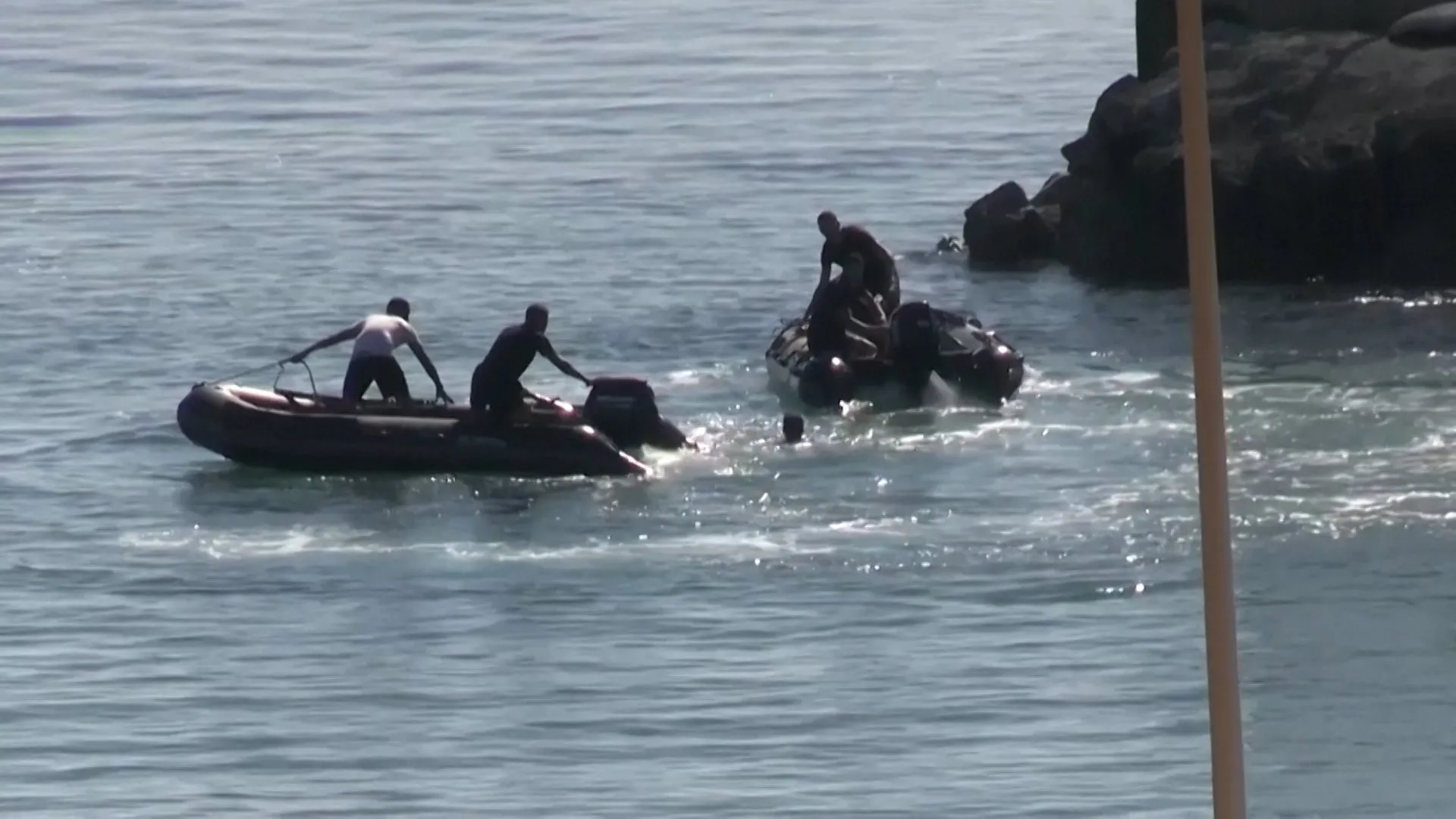
Dozens died in the attempt to reach Ceuta, and on Saturday evening, police divers were still recovering bodies from the surrounding waters.
Alvise Perez, a far-right influencer and member of the European Parliament representing the Se Acabo la Fiesta party, leaves the city centre under police protection [Adri Salido/Getty Images]
The Spanish government blames criminal gangs and traffickers. Opposition politicians blame the left-wing Spanish government’s immigration policies for the weekend’s events, some describing it as “an invasion”.
Zia Yusuf, a senior figure in the anti-immigration Reform UK party, turned up in Ceuta to join those from the right and far right trying to set their narrative for the events.
A long way to come for a bit of social media, but this was powerful stuff: in a crisp white shirt and surrounded by muscled minders, I watched Yusuf extract a few words from young men who spoke little English.
On his X account, he told his nearly 150,000 followers: “I am in Ceuta, the scene of the 60,000 strong invasion. Spain has effectively militarised its border. Already spoken to Moroccan men here who say they are trying to get to Britain. More to come.”
No one I spoke to said they were heading for Britain. Though I’ve no doubt if you posed the question to someone with a passing idea of what you were asking – “Would you like to go to Britain?” – the answer would likely be, “yes”.
For some, it no doubt is a game. But here in Ceuta, amid the detritus of flippers and rubber floating devices that litter the beaches this weekend, a game with tragic consequences.
Hundreds of residents in Spain’s North African enclave of Ceuta gathered to oppose a planned far-right anti-migrant rally, forcing organisers to cancel the event amid heightened tensions following a temporary influx of migrants crossing from Morocco.
Spain says the crisis in its North African enclave Ceuta is back under control, with most of the more than 50,000 migrants who stormed across its borders over recent days choosing to voluntarily go back to Morocco.
Tens of thousands of people crossed into Ceuta on Thursday and continued arriving overnight into Friday.
Recommended Stories
list of 4 itemsend of list
Most came by sea, swimming or in small boats, to get around the border fence. Some rushed border crossing points in such numbers that the guards were overwhelmed. Others tried to climb the breakwater that holds the border fence. At least 67 people died trying to reach Ceuta.
Many questions remain about what caused such a huge number of people to abruptly seek to illegally enter Spanish territory. It was clearly not a coincidence they all chose the same day to do so. Was it coordinated and planned in advance, and if so, by whom and for what purpose?
Here’s what we know:
Where is Ceuta and why is it significant?
Ceuta is an autonomous Spanish city on the northern coast of Africa bordering Morocco. Along with Melilla, it is one of the only two land borders between the European Union and Africa.
It first came under Portuguese rule in 1415 before becoming part of Spain in 1580. It remained under Spanish sovereignty after Portugal regained independence in 1640. After the decolonisation of Africa, Ceuta and Melilla are the only remaining European-held territories on the African mainland.
Its location has made it one of the main entry points for migrants and asylum seekers trying to reach Europe. The enclave is protected by high border fences, surveillance systems, and a permanent deployment of Spain’s Civil Guard and National Police.
What caused the sudden massive influx?
Authorities in Ceuta linked the surge in attempted crossings to a Spanish Supreme Court ruling published in July that barred authorities from immediately returning migrants who arrive by sea. The ruling does not apply to migrants who enter Spain by land, including by climbing over the border fence.
But several experts have questioned this theory, saying few migrants would have been aware of the court ruling.
Ignacio Cembrero, a Spanish journalist specialised in migration in North Africa, told the news agency AFP that “without a doubt, the July 8 ruling has played a role… but that doesn’t explain the level of mobilisation.”
Spanish Prime Minister Pedro Sanchez blamed the sudden influx on human trafficking mafias who exaggerated the significance of the court ruling to convince vast numbers of migrants to take part in a mass coordinated surge into Ceuta.
Some believe that Morocco may have had a role in organising and facilitating the sudden mass breach of the border.
Morocco does not recognise Madrid’s sovereignty over the centuries-old Spanish enclaves Ceuta and Melilla, regarding them as occupied territory.
Morocco also stridently asserts its own sovereignty over Western Sahara, a former Spanish colony it annexed in 1975 where the Indigenous inhabitants, represented by the Polisario Front, oppose rule from Rabat and want independence.
In April 2021, Madrid allowed Polisario Front leader Brahim Ghali to be treated in a Spanish hospital for COVID-19, infuriating Morocco, which regards him as a criminal in charge of an outlawed separatist rebellion.
Morocco recalled its ambassador from Madrid, and appeared to loosen its border controls in May, allowing about 10,000 migrants to enter Ceuta as a threat to Spain.
In 2022, Spain restored full diplomatic relations with Morocco after reversing its four-decade policy of supporting self-determination for the Indigenous people of Western Sahara and instead backing Moroccan sovereignty. It was widely assumed that Rabat achieved this goal by leveraging the vulnerability of the Spanish enclaves.
Last month, relations between Madrid and Rabat soured again because Sanchez made an official visit to Algeria – a country Morocco regards as a bitter enemy because of its unwavering support for the Polisario Front.
Some are speculating that the latest events in Ceuta show Morocco once again sending a warning to Spain.
What does this have to do with Israel?
Some observers believe that if Morocco did orchestrate the mayhem, it may have been encouraged by others, pointing at two leaders with a particular grudge against Sanchez – US President Donald Trump and Israeli Prime Minister Benjamin Netanyahu.
Sanchez is one of Europe’s most consistently pro-Palestinian voices. He has explicitly said Israel’s war on Gaza is genocide, has been highly critical of the US-Israel war on Iran, and refused to allow jointly operated US-Spanish military facilities to be used to facilitate that war.
Trump has been scathing about Spain because of its refusal to spend a greater share of gross domestic product to match the NATO target.
Morocco has been far friendlier than Spain to Israel. In 2024, Spain refused to allow a US-flagged cargo ship carrying weapons for Israel to dock at Algeciras, so the vessel redirected to Morocco instead. The same year, Moroccan authorities allowed an Israeli warship to dock at Tangier to refuel and resupply en route from the US to Israel, after Spain had refused the vessel port access.
Many Israelis consider Madrid’s support for Palestine hypocritical when Spain also occupies Arab territory.
In 2019, Netanyahu’s son Yair tweeted a map of Ceuta and Melilla, saying, “Dear Arabs and Muslims. Want to free occupied Arab Islamic lands? Here’s a good start!”
In March this year, an article written by American Enterprise Institute fellow Michael Rubin for the staunchly pro-Israel Middle East Forum urged: “Moroccans should gather, send bulldozers to the border, and then enter Ceuta and Melilla unarmed to raise the flag.”
In April, pro-Israel Moroccan analyst Amine Ayoub wrote an article for Israeli website Ynet News arguing: “US-Spain tensions over NATO, Iran create opening for Morocco to press claims on Ceuta and Melilla, with Israel positioned to back Rabat diplomatically within US-led alliance that increasingly favours cooperative partners over European holdouts.”
On Friday, with Ceuta invaded by tens of thousands of migrants, Israel’s ambassador to the United Nations, Danny Danon, posted a provocative comment on X.
“Spain, which never misses an opportunity to lecture Israel, has declared a state of emergency in Ceuta following the crisis over its immigration policy,” Danon wrote. “Maybe before it continues lecturing us, it’s time it explained to the world why it still maintains colonial enclaves in Africa.”
“Well, it’s all starting to become quite clear,” commented Spain’s transport minister, Oscar Puente, apparently suggesting he thought Israel was involved in what happened in Ceuta.
Pro-Israel sentiment has been steadily on the rise in Morocco, particularly as the country’s diplomatic relationship with both Israel and the United States has been deepening.
Days ago, it was announced that Morocco named a 1,055km (655.5-mile) highway over Western Sahara after Trump.
Experts said the gesture was far from surprising, as Morocco was one of the signatories to the Trump-brokered Abraham Accords, which saw the country normalise relations with Israel in 2020. In return, the Trump administration has provided crucial support to Morocco at the United Nations and through bilateral channels, bringing Rabat closer to securing greater control over Western Sahara.
There is no evidence that Morocco orchestrated events in Ceuta partly on behalf of Israel, just a lot of interesting coincidences.
But whether or not there was any conspiracy, one consequence of the episode is clear – the already frosty relations between the left-wing Spanish government of Sanchez and the far-right Israeli government of Netanyahu are now even chillier.
Spain’s foreign minister maintains ‘the integrity of the Schengen area is absolutely guaranteed’.
Spain says “virtually all” of the estimated 60,000 migrants who stormed its North African enclave of Ceuta by land and sea in recent days have already left again voluntarily.
The number of people who had died trying to enter Ceuta was raised to at least 67 on Saturday, Spanish officials said, adding there could be additional casualties on the Moroccan side of the border. Some of the confirmed dead had drowned, and some were crushed while trying to climb the breakwater that holds the border fence.
Recommended Stories
list of 4 itemsend of list
“Virtually all those who entered Ceuta have now returned to Morocco,” Spain’s Minister of Foreign Affairs, Jose Manuel Albares, wrote on X on Friday night.
The mass influx of migrants had dismayed European Union governments, and particularly those in the Schengen area – 29 countries that have abolished border controls for travel between them.
European Union chief Ursula von der Leyen on Friday described the images from Ceuta as “unacceptable”, while French Interior Minister Laurent Nunez said France would tighten its borders with Spain.
In Italy, Prime Minister Giorgia Meloni threatened to suspend Italy’s open-border Schengen agreement with Spain “to defend our borders and ensure the safety of our citizens”, though Italy does not share a border with Spain.
Spain’s Interior Ministry said about 50,000 people had crossed the border since Thursday morning, and estimated that 48,300 had returned by 6pm (16:00 GMT) on Friday. Juan Jesus Vivas, head of Ceuta’s local government, said as many as 60,000 people had pushed across over the past couple of days.
Spain announced it was installing a containment barrier along the breakwater fence into the sea.
Moroccan police in riot gear used tear gas and water cannon trucks at the enclave’s border on Friday night to disperse people gathered near the fences and push them back.
“Honestly, I don’t even know why I came, and now I’m going back,” a young Moroccan man, who said he was from Tangier, told Reuters. “I haven’t eaten since lunch yesterday, even though I brought some money with me … What we’re doing is neither good nor enjoyable.”
Ceuta, together with Melilla – another autonomous Spanish city in North Africa – represents the European Union’s only land border with Africa. Both cities often experience surges in attempted crossings by people seeking to migrate to Europe.
To reach Ceuta, migrants often swim from the Moroccan town of Fnideq, covering about 5km (3 miles) to reach Spanish territory. Others attempt the crossing from the nearby town of Belyounech, where the distance is shorter.
Ceuta authorities linked the surge in attempted crossings to a Spanish Supreme Court ruling earlier this month that prevented authorities from immediately returning migrants who arrive by sea. The ruling does not apply to migrants who enter Spain by land, including by climbing over the border fence.
Sanchez said on Friday that the influx of migrants was caused by mafias spreading rumours about this court ruling. But activists in Morocco expressed doubt that the ruling was behind the surge, arguing most migrants would have been unaware of such legal decisions.
Although the crossing appeared blocked later on Friday, many migrants still moved along the coast, seeking routes around the fence.
“I was late,” said Brahim, 32, who had arrived from Tangier hoping to cross through the gate, but found it effectively shut.
Spain has condemned the “selfish, polarising and unlawful” reaction of some EU countries to the influx of about 60,000 migrants from Morocco to Ceuta.
Officials say almost all those who reached the enclave on 30 July have returned, while Spain’s Interior Minister Fernando Grande-Marlaska said on Saturday that the death toll had risen to at least 67.
It comes after Italy temporarily suspended the EU’s border-free Schengen arrangement with Spain, as Prime Minister Giorgia Meloni called the scenes “shocking”.
Finland and Denmark backed Italy’s move, while Czech Prime Minister Andrej Babiš urged a temporary suspension of Spain’s Schengen membership.
In a letter to European Commission President Ursula von der Leyen, Spanish Prime Minister Pedro Sánchez said he had “serious concerns” about some European governments.
He said the Spanish government had fully restored control over the border and prevented any “unauthorised onward movement towards continental Europe” in less than 48 hours.
While most had shown “support and solidarity”, Sanchez said other European governments had chosen to attack Spain, “driven by prejudice, fake news, ignorance, or political interest”, and pointed out that Ceuta was not part of the Schengen area.
“The European Union cannot afford this kind of selfish, polarising and unlawful reaction,” he said.
The Spanish leader called for an urgent meeting with EU interior ministers to “reaffirm that the security of our external borders is a shared responsibility of all Member States”.
Meanwhile, 22 of the EU’s 27 countries also called for emergency talks in an open letter, citing “serious concerns” regarding the developments in Ceuta.
The nations “welcome that Spain and Morocco are cooperating closely to ensure the swift return of migrants”, but said a video conference of EU interior ministers would help reach agreement on mobilising EU instruments and support for Spain to restore “effective control” of the border and prevent further uncontrolled crossings.
British Prime Minister Andy Burnham said he had spoken to Sanchez and the UK was “providing what help we can”.
Spain says 50,000 migrants who entered its North African enclave of Ceuta have returned to Morocco. There are allegations they were actively encouraged to make the crossing, even as poverty and inequality drives people to seek opportunities in Europe.
Spain announced Friday that it was deploying troops to Ceuta, a tiny Spanish territory on the coast of North Africa, to deal with an influx of tens of thousands of migrants who entered from Morocco illegally, overwhelming border security by their sheer numbers. File photo by Jalal Morchidi/EPA
July 31 (UPI) — Spain said Friday that it was deploying troops to Ceuta, an autonomous Spanish principality on the coast of North Africa, to deal with an influx of tens of thousands of migrants who illegally crossed from Morocco.
Authorities requested assistance from Madrid after the security situation descended into chaos on Thursday with border integrity completely overwhelmed and at least 15 people drowned after attempting to swim to Ceuta.
“The armed forces will reinforce the Civil Guard in the exercise of its powers and any others that may be necessary to maintain security in the city of Ceuta,” said Spain’s Interior Ministry.
It added that it was coordinating with Morocco to address the flow of migrants and that both governments were committed to coming up with and implementing measures for the swift return “of all people who have entered illegally.“
Spanish Prime Minister Pedro Sanchez was due to hold emergency talks with officials in Ceuta on Friday.
In a post on X, he reassured Ceuta President Juan Jesus Vivas that his administration was deploying all necessary resources and partnering with Moroccan and international authorities to “restore normalcy as soon as possible.”
Separated from the Spanish mainland by the Gibraltar Strait, just 10 miles wide, Ceuta is a key staging post in the journeys of migrants trying to reach Europe, with the influx apparently triggered by a recent Spanish Supreme Court ruling that people intercepted en route to Ceuta cannot be returned to Morocco.
The interior ministry blamed organized human traffickers using the decision to “encourage the flow of undocumented migrants.”
Implications for the other European countries, due to so-called Schengen free travel area that, once on the soil of any member nation, allows people to move around the continent passport-free, prompted France to tighten its border with Spain.
“In response to the situation observed in the Ceuta enclave, I gave instructions as of last night to immediately strengthen the controls at the Spanish border. Furthermore, I am activating the Rapid Intervention Border Force for in-depth checks,” Interior Minister Laurent Nunez announced on X on Friday morning.
Ceuta, on Morocco’s northern coast, is separated from mainland Spain by the Strait of Gibraltar and has long been a focal point for migrants attempting to reach Europe.
Local officials had appealed to Madrid for help after a recent rise in attempted crossings, but there were chaotic scenes on Thursday as border controls apparently broke down.
The astonishing estimation by Spanish officials suggests the number of migrants who entered into Ceuta in the last day or so could be more than half of the population of the city – which sits at around 83,600, according to the latest local figures.
Spain later deployed its armed forces to bolster security in Ceuta and at its sister city of Melilla, where between 300 to 400 crossings were also reported overnight.
Coveted by Morocco, both cities have long been a flashpoint in diplomatic relations with Spain. Madrid asserts that both territories are integral parts of Spain and have the same status as the semi-autonomous regions on its mainland.
They form the European Union’s only land borders with Africa.
Spain has deployed its military to Ceuta after thousands of migrants overwhelmed police barricades. At least nine people are reported dead, and Italy says it supports temporarily tightening immigration controls for all travellers from Spain.
More than 1,500 migrants have reached Spain’s North African enclave of Ceuta by sea over the past week, many swimming from Morocco using wetsuits and inflatables. Local authorities say reception centres are overwhelmed and have called for an emergency response.
Estimates of up to 2,000 migrants have entered Spain’s territory of Ceuta in recent days in attempts to reach Europe.
Published On 30 Jul 202630 Jul 2026
Authorities in Ceuta have raised the alarm after thousands of migrants breached the border to the North African Spanish enclave from neighbouring Morocco in recent days.
The government of Ceuta said on Thursday that between 1,500 and 2,000 people had entered in the last 10 days. Hundreds more were estimated to have arrived on Thursday, prompting regional President Jesus Vivas to declare an “absolute humanitarian and social emergency” and call on Madrid to send troops to reassert control of the border.
Recommended Stories
list of 4 itemsend of list
Spain’s Interior Ministry rejected calls to declare a national emergency, saying such a measure does not cover migration crises, but promised additional resources.
Footage showed some of the migrants shouting “Viva Espana!” as they entered the territory, many of them having travelled by water from the Moroccan side on inflatable devices.
Crowds were shown walking around the breakwaters onto local roads, reported The Associated Press news agency. State news agency EFE said others had crossed by the border by land, scaling fences.
Migrant rights activist Zakaria Zarroqui told the Reuters news agency that the surge in migrant numbers was similar to one that occurred in May 2021, when some 10,000 Moroccan and sub-Saharan youths entered the enclave within days.
“The situation remains out of control as we speak,” Zarroqui said, adding that people were still flocking to the Moroccan city of Fnideq in an attempt to cross the border.
Ceuta, together with Melilla — another autonomous Spanish city in North Africa — represents the European Union’s only land border with Africa. Both cities often experience surges in attempted crossings by people seeking to migrate to Europe.
Earlier this month, Spain’s Supreme Court ruled that migrants intercepted at sea while attempting to reach Ceuta or Melilla cannot be returned to Morocco.
“It has been a slow trickle since the Supreme Court’s ruling, but today has been an explosion,” a Guardia Civil spokesperson told Reuters.
Spain’s Interior Ministry said it was working closely with Morocco to address the surge in irregular arrivals, blaming people-smuggling networks for exploiting the Supreme Court’s ruling and encouraging undocumented migration.
Interior Minister Fernando Grande-Marlaska is expected to visit Ceuta on Friday to evaluate the situation.