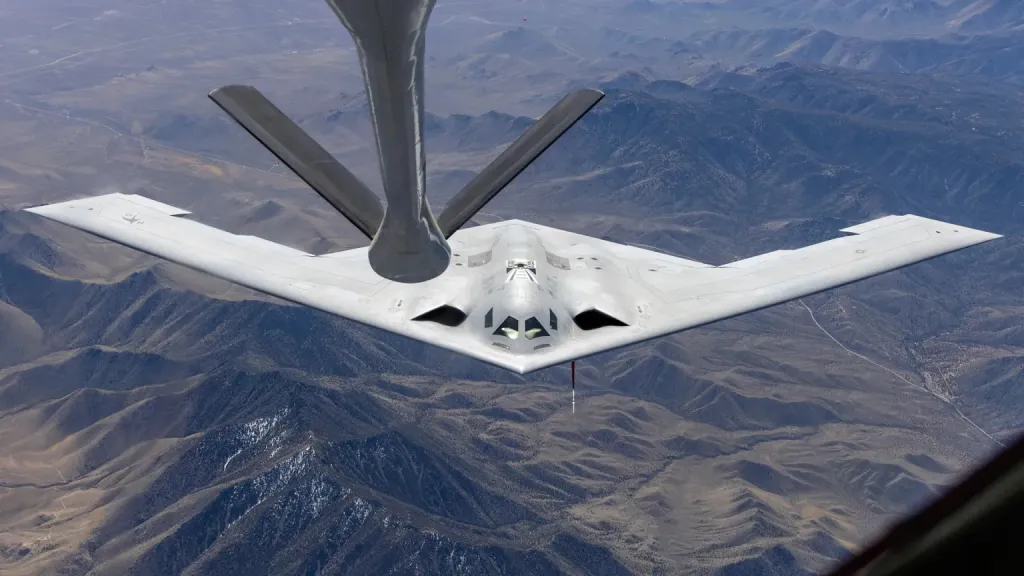
An agreement to ramp up production of the B-21 Raider was indeed structured to at least open the door to orders for more of the bombers, according to prime contractor Northrop Grumman. When the deal was announced back in February, the U.S. Air Force described it as a tool primarily intended to simply help accelerate fielding of the B-21. The service also said that long-stated plans for a fleet of 100 aircraft remained unchanged. Since then, it has separately confirmed that it is reassessing the objective Raider fleet size.
Northrop Grumman CEO Kathy Warden was asked about the prospect of orders for more than 100 B-21s during a quarterly earnings call earlier this week.
“The agreement we reached with the Air Force does allow them to consider accelerating production into a larger program of record, and we are working with them in that analysis,” Warden said. “They are undertaking it now. I expect that by year-end they will come to a conclusion on that, and we’ll certainly keep you updated.”

The deal, as it was announced earlier this year, centers on a 25 percent boost in annual B-21 production capacity. Raider production rate details have been and remain classified, but past reports have said that Northrop Grumman is understood to be able to churn out up to eight of the bombers a year.
As noted, emphasis was placed at the time on production acceleration to support fielding of the first operational B-21s next year. Any possibility of a larger total fleet size was downplayed.
U.S. officials have increasingly voiced support for a fleet of more than 100 B-21s for years now. Just in April, Secretary Pete Hegseth told members of the Senate Armed Services Committee that he saw a need for “a lot more” B-21s. However, the Air Force has repeatedly said there has been no change in the official acquisition plan.

The first sign of actual change being on the horizon came in May. That month, Air Force Lt. Gen. David Tabor, Deputy Chief of Staff for Plans and Programs, made clear that the planned Raider fleet size, or so-called program of record, was at least under formal review at a hearing before the House Armed Services Committee.
“We’re in the process of sharpening our pencils, really getting down to exactly what that [revised program of record] is,” Tabor said at that time, according to Air & Space Forces Magazine. “I think here in the next year, by the time we get to the ’28 [Fiscal Year 2028] budget, we’ll be able to give you a better answer, much more precise answer, and show you our homework.”
The Pentagon’s annual proposed budget for the upcoming fiscal year is typically released sometime in the spring. During the earnings call this week, Northrop Grumman CEO Warden indicated that the final decision on a new B-21 fleet size target is actually expected to come months before then, which makes sense in the context of the lengthy budget planning process.
What that new B-21 fleet number might be remains to be seen, and it is not clear whether it will even be publicly disclosed. In February, an Air Force official told TWZ that any revised figure is expected to be classified. Cost, schedule, and other details about the Raider program continue to be shrouded in heavy secrecy even as the aircraft has moved into increasingly public testing ahead of its planned fielding next year.
In terms of overall progress, the Air Force and members of Congress have repeatedly described the B-21 as a model acquisition effort that has been able to stay within cost and schedule targets despite at least a few hurdles during development.
On “B-21, there’s been good execution throughout the years,” John Greene, Northrop Grumman’s CFO, also said on the earnings call this week. “So, that’s been an enabler to ensure the overall program profitability remains on a direction that’s headed north.”
Air Force officials have also been open about their excitement for what the B-21 will bring operationally, as well as the added capacity that will come from having even 100 of these bombers. The B-21 is notably smaller than the B-2, but it will offer extreme range and other substantially improved capabilities compared to its predecessor. There are also only 19 B-2s still in service, and those aircraft, though highly capable, are very much a ‘silver bullet’ force.

B-21 Takeoff and Landing
The Raiders will replace the Air Force’s aging B-1B swing-wing bombers, as well. There is no clear replacement plan for the B-52 bomber yet, with those aircraft set to continue flying through at least 2050. To ensure their relevance for decades to come, the B-52s are in the process of receiving an extensive array of upgrades, including new engines and radars, but there have been delays. How those efforts continue to unfold might also have implications for the B-21 even though the two aircraft fill very different roles.
By all indications, the B-21 remains on track to begin fielding next year. The Air Force just recently made an announcement about the operational crew complement for the bombers, which will be two pilots. You can read more about this decision and its significance here.
It will still be some time before the B-21 force reaches a true operational capability even after initial fielding begins. Raider deliveries are also set to continue for years, especially if the total planned fleet rises well above 100 aircraft.
Contact the author: joe@twz.com