Pathway

Court ruling narrows pathway to citizenship for DACA recipients

The Trump administration has largely ended a pathway to citizenship for DACA recipients who marry U.S. citizens.

President Trump tried, unsuccessfully, to end DACA during his first term. This week’s action reflects his administration’s ongoing focus on the Obama-era program that shields from deportation hundreds of thousands of immigrants, often referred to as Dreamers, who were brought to the U.S. as children.

“It was inevitable that what Trump was going to do in office this time was to embark on a massive delegalization mission,” said Karen Tumlin, director of the Justice Action Center in Los Angeles. “That’s what this is.”

Tumlin was referring to a ruling by an administrative immigration court that was published Thursday.

The ruling concerns a travel provision afforded to recipients of Deferred Action for Childhood Arrivals, the program created in 2012. The provision allowed DACA recipients to travel in ways other people without legal status cannot.

DACA isn’t technically a form of legal status, though its recipients are granted work permits.

For immigrants who entered the U.S. illegally, leaving the country or being deported triggers a penalty — many are banned from coming back into the U.S. for a decade.

Most people who qualify for legal residency, or a green card, have to serve that 10-year ban before they can apply for a green card, which can lead to citizenship.

But DACA recipients, under the travel provision called advance parole, could leave the U.S. for school, work or humanitarian reasons. When they returned through an airport or border, the stain of their original unlawful entry was erased.

With the penalty wiped away, a DACA recipient married to a U.S. citizen or who had another way to obtain legal residency could start that process for a green card without delay.

Thursday’s ruling by the Board of Immigration Appeals does away with that benefit.

U.S. Citizenship and Immigration Services spokesman Zach Kahler said the decision confirms a “straightforward principle” that departing the U.S. has meaning.

“The immigration laws enacted by Congress impose consequences when someone who has accrued unlawful presence, leaves the country and later seeks admission, including when that departure occurs under advance parole,” he said. “U.S. Citizenship and Immigration Services will ensure that immigration filings are decided based on the laws, regulations, and binding legal precedent that govern each case.”

Immigration attorneys and other advocates quickly convened Thursday to determine how the ruling will affect immigrants.

Tumlin said some DACA recipients can still safely travel with advance parole, while for others — particularly those with deportation orders — it would be too risky to leave. She said DACA recipients should consult with an immigration attorney before traveling.

“For over a decade, I could reassure my clients that traveling on Advance Parole was a safe option,” Shilpa Malik, an immigration lawyer in Florida wrote Thursday on X. “What was once a vital protection is now gone.”

Under the ruling, having the travel document may no longer protect certain DACA recipients when they return from their trips abroad, because leaving could expose them to the years-long ban.

The decision also makes obtaining green cards more difficult. Tumlin said some DACA recipients could qualify for waivers that allow them to avoid the years-long reentry ban, but the waivers are granted under limited circumstances.

The latest federal data show there are 455,000 DACA recipients in the U.S. as of March, with about 126,000 in California.

According to the nonpartisan Congressional Research Service, 45,447 DACA recipients were approved for advance parole as of Aug. 21, 2017.

About 76,000 DACA recipients had become legal residents as of July 31, 2019, most after marrying a U.S. citizen, according to the research service. It’s unclear how many DACA recipients have obtained advance parole or green cards since then.

Path2Papers, a project at Cornell Law School, analyzed 1,600 consults and estimated that around 60% of DACA recipients would be subject to the 10-year ban.

Republicans have viewed advance parole as an abuse of the immigration system.

The office of Sen. Chuck Grassley (R-Iowa) blasted the provision, saying in 2017 that “the Obama administration allowed thousands of DACA recipients to exploit an immigration law loophole to obtain green cards.”

Last year, Grassley introduced a bill to guarantee that it would no longer be used by immigrants seeking to adjust their legal status. This week’s ruling essentially accomplishes that goal.

The immigration appeals board’s decision applies to future travel. People who previously traveled and returned to the U.S. won’t be affected and could still adjust their immigration status.

Tumlin said Thursday’s decision is yet another effort to change the goalposts for DACA recipients by an administration that has resorted to ending the program “through death by a thousand cuts.”

The Department of Homeland Security has arrested hundreds of immigrants with DACA, and in a February letter to U.S. senators, then-Homeland Security Secretary Kristi Noem said the agency had deported 86 DACA recipients between Jan. 1 and Nov. 19, 2025.

One of those was Maria de Jesus Estrada Juarez, a Sacramento mother who was deported a day after her green card interview. A federal judge later ordered the agency to bring her back to the U.S.


Source link

Pathway To Larger B-21 Raider Fleet Was Baked Into Production Ramp-Up Deal

An agreement to ramp up production of the B-21 Raider was indeed structured to at least open the door to orders for more of the bombers, according to prime contractor Northrop Grumman. When the deal was announced back in February, the U.S. Air Force described it as a tool primarily intended to simply help accelerate fielding of the B-21. The service also said that long-stated plans for a fleet of 100 aircraft remained unchanged. Since then, it has separately confirmed that it is reassessing the objective Raider fleet size.

Northrop Grumman CEO Kathy Warden was asked about the prospect of orders for more than 100 B-21s during a quarterly earnings call earlier this week.

“The agreement we reached with the Air Force does allow them to consider accelerating production into a larger program of record, and we are working with them in that analysis,” Warden said. “They are undertaking it now. I expect that by year-end they will come to a conclusion on that, and we’ll certainly keep you updated.”

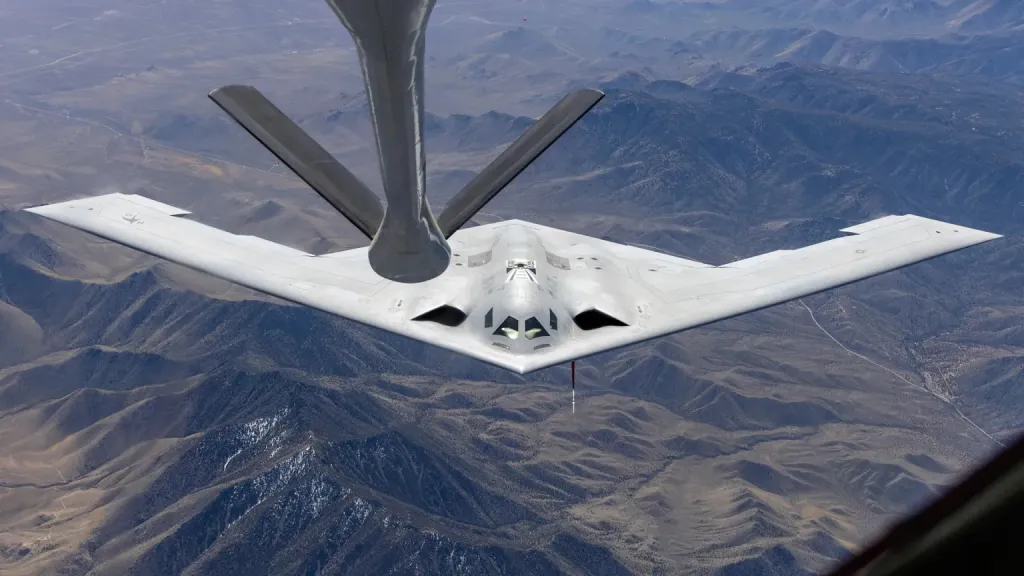
A pre-production B-21 Raider seen during in-flight refueling testing. USAF

The deal, as it was announced earlier this year, centers on a 25 percent boost in annual B-21 production capacity. Raider production rate details have been and remain classified, but past reports have said that Northrop Grumman is understood to be able to churn out up to eight of the bombers a year.

As noted, emphasis was placed at the time on production acceleration to support fielding of the first operational B-21s next year. Any possibility of a larger total fleet size was downplayed.

U.S. officials have increasingly voiced support for a fleet of more than 100 B-21s for years now. Just in April, Secretary Pete Hegseth told members of the Senate Armed Services Committee that he saw a need for “a lot more” B-21s. However, the Air Force has repeatedly said there has been no change in the official acquisition plan.

A pre-production B-21 Raider seen during a flight test. USAF

The first sign of actual change being on the horizon came in May. That month, Air Force Lt. Gen. David Tabor, Deputy Chief of Staff for Plans and Programs, made clear that the planned Raider fleet size, or so-called program of record, was at least under formal review at a hearing before the House Armed Services Committee.

“We’re in the process of sharpening our pencils, really getting down to exactly what that [revised program of record] is,” Tabor said at that time, according to Air & Space Forces Magazine. “I think here in the next year, by the time we get to the ’28 [Fiscal Year 2028] budget, we’ll be able to give you a better answer, much more precise answer, and show you our homework.”

The Pentagon’s annual proposed budget for the upcoming fiscal year is typically released sometime in the spring. During the earnings call this week, Northrop Grumman CEO Warden indicated that the final decision on a new B-21 fleet size target is actually expected to come months before then, which makes sense in the context of the lengthy budget planning process.

What that new B-21 fleet number might be remains to be seen, and it is not clear whether it will even be publicly disclosed. In February, an Air Force official told TWZ that any revised figure is expected to be classified. Cost, schedule, and other details about the Raider program continue to be shrouded in heavy secrecy even as the aircraft has moved into increasingly public testing ahead of its planned fielding next year.

In terms of overall progress, the Air Force and members of Congress have repeatedly described the B-21 as a model acquisition effort that has been able to stay within cost and schedule targets despite at least a few hurdles during development.

On “B-21, there’s been good execution throughout the years,” John Greene, Northrop Grumman’s CFO, also said on the earnings call this week. “So, that’s been an enabler to ensure the overall program profitability remains on a direction that’s headed north.”

Air Force officials have also been open about their excitement for what the B-21 will bring operationally, as well as the added capacity that will come from having even 100 of these bombers. The B-21 is notably smaller than the B-2, but it will offer extreme range and other substantially improved capabilities compared to its predecessor. There are also only 19 B-2s still in service, and those aircraft, though highly capable, are very much a ‘silver bullet’ force.

B-21 Takeoff and Landing thumbnail

B-21 Takeoff and Landing


The Raiders will replace the Air Force’s aging B-1B swing-wing bombers, as well. There is no clear replacement plan for the B-52 bomber yet, with those aircraft set to continue flying through at least 2050. To ensure their relevance for decades to come, the B-52s are in the process of receiving an extensive array of upgrades, including new engines and radars, but there have been delays. How those efforts continue to unfold might also have implications for the B-21 even though the two aircraft fill very different roles.

By all indications, the B-21 remains on track to begin fielding next year. The Air Force just recently made an announcement about the operational crew complement for the bombers, which will be two pilots. You can read more about this decision and its significance here.

It will still be some time before the B-21 force reaches a true operational capability even after initial fielding begins. Raider deliveries are also set to continue for years, especially if the total planned fleet rises well above 100 aircraft.

Contact the author: joe@twz.com

Joseph is TWZ’s Deputy Editor, helping to oversee the site’s highly experienced and dedicated team, while also writing informative and impactful defense and national security content. He lives right in the thick of it in the Washington, D.C. area.


Source link