One of the memorable moments of Venezuela’s crazy January ‘26 was ExxonMobil Chairman Darren Woods sitting across from President Trump, telling him Venezuela was “uninvestable.” His company is owed billions from Chávez-era expropriations, spent years in arbitration tribunals, and had watched its assets nationalised without fair compensation. Four months later, ExxonMobil’s technical teams were on the ground in Venezuela, evaluating assets including the Cerro Negro project. Woods was telling investors he felt positive about the opportunities.
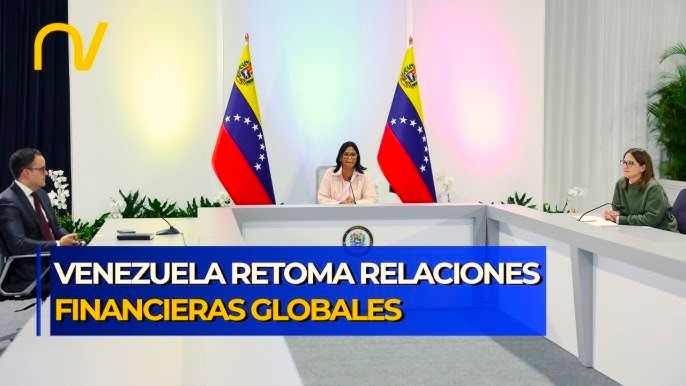
The arc from expropriated creditor to ¿partner? is not happening by accident. In April 2026, the IMF and World Bank resumed dealings with Venezuela for the first time since 2019, opening the path to a formal economic assessment and potentially unlocking $4.9 billion in frozen special drawing rights. In May, the Delcy administration announced a “comprehensive restructuring of its sovereign debt” and PDVSA obligations, appointing Centerview Partners as financial adviser and pledging a macroeconomic framework by June. This did not include a request for a macroeconomic programme established by the Fund, which distanced itself from Venezuela’s announcement shortly after. According to Reuters, Venezuela’s total liabilities could be above $150 billion.
On June 2, Venezuela added Hogan Lovells as legal counsel for the restructuring under a dual mandate that also covers strategic lobbying for the Venezuelan embassy in Washington. The account is led by Norm Coleman, a former Republican senator with deep political connections in the capital. Neither selection has been free of political entanglement. Former Trump official Mauricio Claver-Carone, earmarked by The Washington Post as Venezuela’s unofficial viceroy, has vouched for Centerview. His business partner, Jessica Bedoya, was on the same chartered flight to Caracas as two Centerview executives on February 12, weeks before the firm finalized its contract (Centerview denied Bedoya played any role in their assignment).
Some of the companies that spent a decade winning arbitration awards against Venezuela may now be considering turning those claims into something more useful: an operating agreement, a new oil deal. Whether the game is actually changing, and the extent to which Delcy’s technical cadres can manage the process her government is trying to kickstart, are two of the huge questions for Venezuela’s “transition” observers.
Without the IMF as an anchor, the most aggressive litigants will extract preferential recoveries while others are left with worthless paper.
The shape of how Venezuela got here is also visible in a Delaware courthouse. In December, a judge signed the order transferring Citgo to Amber Energy, an affiliate of Wall Street hedge fund Elliott Management, for 5.9 billion dollars. The gavel came down, but the sale did not close. CITGO is now in legal and political limbo.
The transaction requires approval from OFAC, which has repeatedly extended the freeze on CITGO-related transactions. The State Department is now the main barrier blocking the sale, while Treasury, Commerce, and Energy favour letting it proceed. Ten days ago, OFAC issued General License 5W, extending the freeze on CITGO share transfers to June 19. A World Bank delegation visited Caracas last month. Everything suggests Delcy Rodríguez now feels compelled to show she can find a way to pay them back. That she has a plan.
In the meantime, Amber Energy is pressing daily for access to CITGO’s financial and operational details even though it is not formally in control, while CITGO itself cannot make major investment decisions or hire key personnel. A company valued at $13 billion is being run in slow motion, waiting for Washington to decide what Venezuela’s most valuable foreign asset is actually worth, to whom, and under what terms.
None of this happened overnight. The process was set in motion by Hugo Chávez when he went on a nationalisation spree that expropriated the assets of ConocoPhillips, ExxonMobil, Crystallex, and dozens of other foreign companies across the oil, mining, and manufacturing sectors. Those companies didn’t go home quietly. They went to arbitration. And they won.
The restructuring announcement tries to change the terms of the conversation. Venezuela is no longer being asked whether it will engage with its creditors. It has begun doing so. Centerview Partners is on the ground. A macroeconomic framework is due soon. The creditor committee, which includes GMO, Greylock Capital, Fidelity, and T. Rowe Price has been ready to negotiate since January.
ConocoPhillips has been explicit: recovering the billions owed from past expropriations takes priority over any new drilling.
An IMF programme, if it materialises, could signal credibility. It would serve as the anchor for the entire restructuring process. IMF conditionality establishes a debt sustainability framework that defines how much Venezuela can actually pay, which in turn defines what creditors can realistically expect. It also catalyses coordination. Rather than pursuing individual enforcement actions against Venezuelan assets, creditors have an incentive to wait for an orderly process. Without that anchor, the most aggressive litigants will extract preferential recoveries while others are left with worthless paper.
Delcy Rodríguez announced the restructuring without first securing that anchor. She has stated there are “no plans” to contract an IMF loan. The IMF, for its part, says it is willing to support a programme but requires clarity on economic data and external debt that Caracas has not yet provided. Very soon, we will find out whether Venezuela is building toward an IMF-anchored process or trying to engineer one without it.
Several of the companies owed the largest arbitration awards are well positioned to operate Venezuelan assets: ExxonMobil at Cerro Negro, ConocoPhillips at its former Petrozuata and Hamaca projects. ConocoPhillips has been explicit: recovering the billions owed from past expropriations takes priority over any new drilling. A negotiated settlement that converts arbitration claims into operational stakes, with revenue streams tied to production, would give creditors a return and Venezuela a rebuilt industry. The OFAC licensing architecture already enables this. Since January 2026, OFAC has issued or updated more than eight general licenses expanding authorised activity in Venezuela’s energy and financial sectors. Washington has built the tools, such as General License 58. The question is whether Venezuela can use them.
What this push does not resolve is the harder question: whether Venezuela has the institutional capacity to negotiate on its own terms rather than simply accept whatever is offered. Woods’s shift from “uninvestable” to “positive” in four months signals appetite, not commitment. ExxonMobil wants its assets back or a return on its claims. So does ConocoPhillips. So does every creditor in the queue. The question is whether Venezuela can show up to this negotiation as a party with a strategy, not just a debtor with a problem.
The path forward requires exactly what fifteen years of chavismo didn’t build: legal capacity, a coherent negotiating strategy, and the institutional infrastructure to distinguish between claims that should be settled, claims that should be contested, and claims that might be converted into something more useful than a judgment. The latter could amount to an oil agreement like the one Chevron got in the early 2020s. Venezuela’s reformed Hydrocarbons Law allows international arbitration to resolve disputes in the oil and gas sector. So does the new Mining Law for gold and strategic minerals.
The framework now exists in writing. Whether Venezuela can implement it coherently, and whether it can hold up against the inevitable tension between Venezuelan law as established in the new statutes and US jurisdiction as required by OFAC licenses, are the open questions that will determine whether this moment becomes the start of something durable or another lost opportunity.
None of that sounds like glamorous policymaking. It doesn’t play well in a speech. But the alternative, continuing to treat international arbitration as someone else’s problem, has a documented price tag. It is measured in refineries.