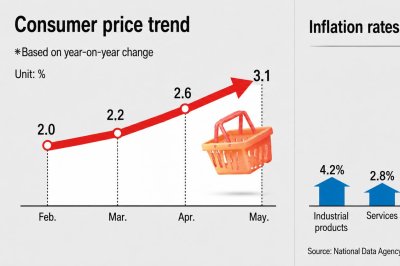

Consumer prices in South Korea rose 3.1% in May from a year earlier, driven by sharp increases in petroleum products, international airfares and overseas group tour fees. Data from National Data Agency. Graphic by Asia Today and translated by UPI
June 2 (Asia Today) — South Korea’s consumer price growth topped 3% in May for the first time in 26 months as a prolonged Middle East war drove up global oil prices, raising concerns that high inflation could continue through the second half of the year.
The consumer price index stood at 119.92 in May, with 2020 set as the base year of 100, up 3.1% from a year earlier, according to consumer price data released Tuesday by the National Data Agency. It was the first increase of 3% or more since March 2024.
Industrial products rose 4.2% from a year earlier, while service prices increased 2.8%. Petroleum prices showed the sharpest increase, jumping 24.2%, the largest gain in three years and 10 months since July 2022, when the Russia-Ukraine war was at its height.
Gasoline prices rose 23.1%, diesel prices climbed 33.3% and kerosene prices increased 21.7%.
Among services, international airfares, which are directly affected by fuel costs, rose 33.5%, while overseas group tour fees increased 26.3%.
The living price index, which tracks frequently purchased items with a high share of household spending, rose 3.3% from a year earlier, showing a worsening burden felt by consumers.
Lee Doo-won, an official in charge of economic trend statistics at the data agency, said petroleum prices rose more sharply because of higher international oil prices caused by the Middle East war.
“International airfares and prices for travel and lodging-related items rose sharply as fuel surcharges linked to global oil prices increased and the number of peak-season days, including holidays, grew,” Lee said.
The government said it will work to reduce price uncertainty by stabilizing petroleum prices.
A Finance Ministry official said the government’s petroleum price cap and fuel tax cut reduced the May consumer price increase by 0.6 percentage point.
“We will make every effort to stabilize prices felt by households through petroleum price stabilization measures and a task force on livelihood prices,” the official said.
Experts said inflation led by higher global oil prices is likely to continue in the second half.
“Although the United States and Iran have announced plans to discuss reopening the Strait of Hormuz, the high oil price trend is likely to continue in the second half even if the war ends, given the destruction of local oil facilities,” said Jeong Se-eun, an economics professor at Chungnam National University.
“For South Korea, which imports all of its oil, oil prices affect overall inflation. There is also concern that abnormal weather forecast for this summer could raise agricultural prices,” Jeong said.
“With no notable downward factor in the second half, inflation is expected to stay around 3%,” she added.
Park Jin, a professor at the Korea Development Institute School of Public Policy and Management, said prices are determined by market supply and demand.
“On the supply side, there are inflation concerns caused by unstable oil prices. On the demand side, there are price-increase factors such as a strong domestic stock market,” Park said. “Preemptive steps, including consideration of an interest rate hike, are needed.”
— Reported by Asia Today; translated by UPI
© Asia Today. Unauthorized reproduction or redistribution prohibited.
Original Korean report: https://www.asiatoday.co.kr/kn/view.php?key=20260602010000704