

Inflation

Vietnam’s gig workers slammed by rising fuel costs amid fallout of Iran war | Business and Economy News

Ho Chi Minh City, Vietnam – After a long day of ferrying passengers to and fro recently, e-hailing driver Nguyen was dejected to find he had spent half of his earnings on fuel.

“I drove for around seven or eight hours, making around 240,000 Vietnamese dong [$9.11] and then I paid 120,000 Vietnamese dong [$4.56] on petrol,” Nguyen, a motorcyclist who connects with passengers via the locally developed super-app Be, told Al Jazeera, asking not to be identified by his real name.

Recommended Stories

list of 4 itemsend of list

“I can’t survive with this amount of money in the city.”

In Vietnam, the ripples of the US-Israel war on Iran are hitting many gig workers hard.

The Southeast Asian country normally sources about 80 percent of its crude oil from Kuwait, but shipments have dried up amid Iran’s effective blockade of the Strait of Hormuz, driving up fuel prices.

Diesel prices have more than doubled, while petrol prices have risen almost 30 percent, making getting from point A to point B an increasingly expensive proposition in cities such as Ho Chi Minh City, home to more than 7 million motorcycles.

“Because the petrol price is so high, so many drivers are turning off the app, going home and just not working,” Nguyen said.

“After today, I will turn off the app and stop working for a few days to see if the price goes down or if the government is helping in any way.”

Govi
A Be driver picks up a passenger at Thu Duc Metro Station in Ho Chi Minh City, Vietnam, on March 30, 2026 [Govi Snell/Al Jazeera]

Vietnam’s government has rolled out a series of emergency measures to cushion the blow for citizens.

Prime Minister Pham Minh Chinh last month announced that an environmental tax on diesel, petrol, and aviation fuel would be suspended until April 15 to help stabilise prices.

Nguyen Khac Giang, a Vietnamese-born visiting fellow at the ISEAS-Yusof Ishak Institute in Singapore, said authorities had been forced to act to stave off rising disgruntlement among citizens.

“There are a lot of complaints and frustrations about rising living costs, because gas prices are everything in Vietnam,” Giang told Al Jazeera.

“It’s not only necessary in terms of making the population feel relief about the rise of gas prices, but at the same time, it will keep the macroeconomic stability intact, given the turbulence outside Vietnam.”

Despite the government sacrificing an estimated $273m in revenue via the tax cut, signs of strain are mounting across the economy.

Public transportation is stretched to capacity in major cities, while domestic carriers such as Vietnam Airlines and Vietjet Air have slashed flights.

“As a very, very open economy, Vietnam is super vulnerable to international shocks,” Giang said.

Gig workers have been particularly exposed due to the double whammy of heavy fuel consumption and minimal labour protections.

“Their income is changeable due to factors beyond their control,” Do Hai Ha, a research fellow at the University of Melbourne who has studied Vietnam’s gig platforms, told Al Jazeera.

“They have no chance to negotiate with the platforms.”

Many drivers have had no choice but to work longer hours as they are “excluded from labour protection, so there’s no guarantee in terms of minimum wages or overtime pay”, Do said.

A commuter refuels at a Ho Chi Minh City petrol station on March 27. Govi Snell _ Al Jazeera_-1775367397
A commuter refuels at a petrol station in  Ho Chi Minh City, Vietnam, on March 27 [Govi Snell/Al Jazeera]

Companies, too, are feeling the crunch.

Anh Dao, who collects fares on Ho Chi Minh City’s bus route 13, said the bus operator has been losing money due to the surge in diesel prices, despite raising ticket prices by 3,000 Vietnamese dong ($0.11).

“As we already signed the contract, we cannot just stop running the buses,” Ahn told Al Jazeera.

For one fisherman in the coastal region of Binh Thuan, about 200km (124 miles) from Ho Chi Minh City, rising fuel costs have prompted a frantic search for cheaper options to power his basket boat.

“Now that fuel prices are rising, it’s having a big impact,” the fisherman told Al Jazeera, asking not to be identified by name. The middlemen he does business with have been citing weak demand to justify offering lower prices for his catch, he said.

“What I was usually able to sell for 800,000 Vietnamese dong [$30] is now only selling for 650,000 Vietnamese dong [$24],” he said.

Families kept apart

For some low-income families, the rising costs are reshaping daily life in other ways.

After a weeklong trip to the Mekong Delta region, Uyen Pham, a communications manager for the Saigon Children’s Charity, said she has seen the strain firsthand.

“Several parents noted that the cost of bottled cooking gas has nearly doubled,” Pham told Al Jazeera.

“Most of our beneficiary families have always relied on wood-fired stoves or a hybrid of wood and gas to save money. With the recent price hike, they are now strictly limiting their gas usage even further, relying almost entirely on wood to cut every possible expense.”

For many parents, the rising fuel costs have also meant less time with family.

“Many parents in remote areas must leave their children with grandparents to work in cities,” Pham said.

“Rising fuel prices directly increase their commuting costs, while manual labour wages remain stagnant. This pinches their take-home pay and, in some cases, reduces how often they can afford to travel home to see their children.”

For the government in Hanoi, the price volatility has intensified the focus on greater energy independence, Giang, the visiting fellow, said.

“The longer-term question this crisis has enacted is a very important question about the strategic autonomy of Vietnam in terms of energy dependencies, especially when we are a net importer of oil,” he said.

Policymakers will need to “more aggressively accelerate Vietnam’s energy independence by building more refineries,” Giang said, “because now we only have two refineries, which is not enough for the Vietnamese market.”

With long-term solutions likely to take years to come to fruition, authorities are scrambling for short-term fixes.

Commuters wait for the train at Thu Duc metro station. Govi Snell_ Al Jazeera. 30_03_-1775367388
Commuters wait for the train at Thu Duc Metro Station, in Ho Chi Minh City, Vietnam, on March 30, 2026 [Govi Snell/Al Jazeera]

Late last month, Vietnam’s prime minister and a delegation from the Ministry of Industry and Trade visited on the Nghi Son Refinery and Petrochemical Complex, the country’s largest refinery, in Thanh Hoa, a coastal city about 1,500km (932 miles) north of Ho Chi Minh City.

During their visit, officials said the refinery, which supplies about 40 percent of Vietnam’s petrol needs, would urgently need to find alternative sources of crude, as current supplies were expected to run out by the end of May.

The war on Iran also appears to be reshaping at least some domestic investment.

Vingroup, Vietnam’s largest conglomerate, last month informed authorities that it wanted to halt plans to build the country’s largest liquefied gas-fired power plant and put the funds towards a renewable energy project instead, according to a letter reported by the Bloomberg and Reuters news agencies.

In the letter, the company cited “the significant risk of high fuel prices for LNG power projects” due to the war.

In the meantime, Duy, who works at a cafe tucked behind a Ho Chi Minh City petrol station, is feeling some relief after the government’s fuel tax cut, which authorities projected would reduce petrol prices by about one-quarter and diesel prices by about 5 percent.

“I usually pay 100,000 Vietnamese dong [$3.80] a week on gas, but at the peak of the high prices a few days ago, it was almost double that,” she told Al Jazeera.

“It affected my income.”

Additional reporting by Nguyen Hao Thanh Thao

Source link

Shoppers rush for half-price deals amid high inflation

1 of 2 | Shoppers crowd the cooking oil section at an E-Mart store in Seoul as daily necessities are sold at half price during the 2026 Landers Shopping Festa. Photo by Asia Today

April 1 (Asia Today) — Large crowds gathered at discount stores across Seoul on Tuesday as consumers rushed to take advantage of steep price cuts, highlighting growing pressure from persistent inflation.

At an E-Mart store in Seoul’s Yongsan district, shoppers lined up before opening, with many heading straight to discounted meat and fresh produce sections as doors opened.

“Prices are so high these days. If not for chances like this, when else would I buy?” said a woman in her 60s, who said she arrived 30 minutes early to secure discounted items.

E-Mart launched its largest discount event of the first half of the year, running through April 12, offering up to 50% discounts on groceries and household essentials. The campaign involves affiliates across Shinsegae Group, including department stores, online platforms and shopping malls.

Fresh food items drew the biggest crowds. Pork belly and pork shoulder were sold at 1,490 won ($1.10) per 100 grams with membership discounts, while whole watermelons were priced at 11,900 won (about $8.80) for the day. Discounted Korean beef also attracted heavy demand, with some shoppers buying multiple packages.

Store employees said traffic during promotional events can be more than triple normal levels, as customers stock up on essentials.

In contrast, snack aisles were relatively quiet, reflecting a shift in consumer behavior toward necessities such as eggs, cooking oil and other basic goods. Analysts say prolonged inflation has led households to prioritize essential spending over discretionary purchases.

The retailer said it prepared its largest-ever promotion focused on everyday items, including discounts on detergents, diapers, batteries and processed foods when purchased in bulk. A special promotion also offers select products for 1,000 won (about $0.70).

The event, first launched in 2021, has grown rapidly, surpassing 1.3 trillion won (about $960 million) in sales last year. Shinsegae Group aims to expand it into a major national shopping festival comparable to global events such as Black Friday in the United States and Singles’ Day in China.

Company officials said this year’s extended promotion period and expanded product lineup are expected to drive record sales.

The surge in turnout underscores how rising prices are reshaping consumer behavior, with discount events becoming key opportunities for households to manage everyday expenses.

— Reported by Asia Today; translated by UPI

© Asia Today. Unauthorized reproduction or redistribution prohibited.

Original Korean report: https://www.asiatoday.co.kr/kn/view.php?key=20260401010000280

Source link

The Dollar Dilemma | Global Finance Magazine

War, tariff volatility, and shifting capital flows challenge the global currency order—even as markets prove resilient.

When Japan’s largest automaker reported 2025 results last May, it said its earnings were hit by $4.6 billion in foreign-exchange losses due to the US dollar’s decline. This month, Toyota has a new concern: the war in Iran that has spread throughout the Persian Gulf. The company sold 325,000 cars to the region in 2025, but the fighting and the closure of shipping lanes through the Strait of Hormuz could further decrease earnings.

Even more damaging, the company is forecasting a roughly $9.6 billion drag on earnings in 2026 due to President Trump’s on-again, off-again tariffs. “The impact of US tariffs,” Toyota CFO Kenta Kon said, “is a significant rise from our initial forecasts.”

 The global economy entered 2026 already on shaky ground. The Trump administration’s sweeping tariff policies weakened the dollar and heightened trade fears, while a Supreme Court decision on those tariffs added fresh uncertainty, even as inflation was slowly easing. Then, on February 28, US and Israeli forces launched strikes on Iran, oil prices surged, and the dollar bounced higher in a flight to safety.

The Strait of Hormuz, which carries about 20% of global oil and LNG exports, effectively closed after Iranian threats and tanker attacks, sending oil prices from about $70 to more than $110 a barrel within days. Oil-import-dependent economies such as Japan, South Korea and China were especially vulnerable to the war’s aftershocks.

Higher oil prices. Uncertainty about tariffs. The dollar boomerang. Corporate finance executives face a new series of challenges: Higher oil prices, etc. However, despite short-term headwinds for business, global analysts remain relatively optimistic about the long-term economic outlook, even with the war’s sudden shadow over markets.

While energy concerns increased as war clouds gathered over the Persian Gulf, analysts largely believed that the global economy would revert to a pattern similar to the pre-war period: a gradually declining dollar, reduced foreign investment in US assets, and inflation that persistently prevents central banks from lowering interest rates. A key sign of market consensus was that, by mid-March, the forward price of oil for October delivery was $79 per barrel, compared to its temporary $110 spike after the war began. But the uncertainty surrounding the objectives and duration of the attacks on Iran by the US and Israel has kept oil prices bouncing around $100 per barrel.

Aside from the currency issue, several factors have contributed to relatively positive economic forecasts despite the fighting in the Gulf. The Trump administration maintains, despite its forecast having been extended, that the disruption to energy supplies will be relatively short-lived. “You’re seeing a little bit of a fear premium in the marketplace, but the world is not short of oil or natural gas,” said Energy Secretary Chris Wright on CNBC in early March. “Worst case is a few weeks, not months.”

As Dollar Falters, China Moves In

The dollar had a tough year in 2025, dropping about 12% against a basket of other major currencies. Although US administrations usually support a strong dollar, President Donald Trump broke that tradition and said it was “great” that the dollar was falling on global markets, which caused it to tumble even more.

The dollar’s decline triggered a significant shift into gold, which increased in value by 60% in 2025, reaching a record price of $5,110 per ounce. European stocks saw their largest inflows ever in February as investors moved away from the United States.

Marc Chandler, Bannockburn Global Forex

Marc Chandler, chief market strategist at Bannockburn Global Forex, said that for much of 2025, foreign investors had been buying US equities while shorting the dollar as a hedge. “Now that US equities are declining, they have to buy back their short-dollar hedge,” Chandler said. “I’m not convinced that what we’re seeing in the dollar is much more than unwinding positions, rather than people flocking to the US as a safe haven.”

Mark Sobel, former head of international finance at the US Treasury, wrote in a March 2025 op-ed for the Financial Times that the dollar’s dominance was slowly eroding. “Like termites eating away at a house’s woodwork, Trump’s dysfunctional policies are eating away at its support and rendering the US currency acutely vulnerable to future shocks,” Sobel said.

A weaker dollar is not just a market story—it is reshaping currency dynamics globally, with China at the center. The Chinese government intervened on February 27 to stop the renminbi’s appreciation against the dollar, which had increased by 7% since last April. The People’s Bank of China (PBOC) announced it would eliminate the 20% reserve requirement on foreign exchange forward contracts and stated it would keep the renminbi’s exchange rate at a “reasonable and balanced level.” The higher value of the renminbi did not hurt Chinese exports—the country recorded a $1.2 trillion trade surplus in 2025.

China’s government has used the weaker dollar to strengthen the renminbi’s role in trade finance and payments, with officials claiming the currency is now the world’s largest trade-finance currency. Chinese companies have been gradually decreasing dollar transactions. The dollar’s share of cross-border transfers has dropped from 80% in 2010 to about 40% in 2025, mainly due to increased renminbi flows. The renminbi’s share of global trade has grown from 2% in 2021 to over 7%, a notable rise but still not enough to threaten the dollar’s dominant position in world trade.

In Japan, as inflation rises, the Bank of Japan is expected to increase interest rates, according to Mitsubishi UFJ Financial Group. While the Federal Reserve in the US has kept rates steady through its mid-March meeting. The BOJ’s move to tighten policy after ending its negative interest rate policy is seen as a factor aiding yen appreciation.

Europe has been significantly affected by the rise of the euro, which appreciated nearly 12% against the dollar in 2025. “I have watched the dollar rate with concern for some time,” German Chancellor Friedrich Merz said. “The dollar course is a considerable extra burden for the German export economy.” Dirk Jandura, head of the BGA, Germany’s wholesale and foreign trade association, said the strength of the euro was causing exporters “great concern.” The dollar’s easing, though, has softened some of that impact.

Economy Shows Resilience

Supporting the Trump administration’s more optimistic oil outlook, the International Energy Agency agreed in early March to release 400 million barrels of oil to address the supply disruption—the largest such action in the organization’s history. The move reinforced officials’ view that any price spike would likely be short-lived, lasting weeks rather than months. The 32 member countries still have about 1.4 billion barrels of emergency reserves that can be tapped if the shortage worsens.

“The rise in crude oil prices to date does not represent a shock of the magnitude seen in earlier episodes,” said J.P. Morgan analysts Bruce Kasman and Nora Szentivanyi. “At [about] $100 a barrel, Brent crude is less than 35% above its two-year trailing average. To deliver a shock similar in size to the Russian invasion, crude oil prices would need to move close to $150 and remain at this elevated level for several months.”

Joe DeLaura, an energy analyst at Rabobank in the Netherlands, urged companies to have a plan in place to make quick decisions involving their energy supplies. “Start assessing your supply chains and your access to capital markets,” DeLuca told a webinar in March. “Are you shoring up relationships? Are you able to have critical redundancy in your supply chains, especially for key inputs like energy? One of the ways to take advantage of this is by looking further out on the curve and take advantage of volatility when it swings in your favor.”

Daniel Moseley, Oxford Economics

Unlike in 1973, when a Middle East oil embargo caused inflation to soar, the United States now exports both petroleum and liquefied natural gas. Therefore, the war is unlikely to significantly impact the US economy in 2026, as it would require a “very severe scenario” for US economic growth to contract, according to Oxford Economics. “We have a view that the US dollar is going to broadly continue to somewhat weaken,” said Daniel Moseley, associate director for scenarios and macro modeling, at Oxford Economics.

Asia Hit Hard

The Iran War most heavily affects Asia. According to the US Energy Information Administration, 84% of crude oil and 83% of LNG travels to the region. I would also say war in Iran. China, India, Japan, and South Korea are the leading destinations for Persian Gulf crude oil, but Thailand and Vietnam also rely heavily on imported energy.

Companies like Toyota have limited options but to cut costs. One strategy is localizing their supply chains. The company announced in February that it plans to invest $10 billion in the US over the next five years to increase production of its most valuable hybrids. It is also reducing production of lower-value models and stated it will implement three price hikes in 2026 to compensate for the “double whammy” of a weaker dollar and US tariffs.

Rajiv Biswas, CEO of Asia-Pacific Economics in Singapore, states that a major concern in Asia is that a prolonged energy shortage could lead to a surge in inflation, prompting central banks to increase interest rates. China’s government, for instance, ordered refiners to halt diesel exports, seemingly worried that supplies could run low during a lengthy conflict.

Biswas stated that the Persian Gulf is also a major shipping route for urea and sulfur used in fertilizer production. This means “the agricultural sectors of many Asian developing countries could also be hit by lack of essential inputs,” as well as the US, right as the Spring planting season begins. Additionally, Brazil, the world’s leading soybean producer, imports most of its urea from Qatar and Iran. India depends on Saudi phosphate exports.

Europe Needs To Urgently Use AI

No European industry was more affected by the dollar’s rise than automobile manufacturing. At luxury carmaker BMW, for instance, revenues fell 5.9%, with half of the decline attributable to the strength of the euro, which created a $670 million headwind. Additionally, US tariffs reduced earnings and imports from China and limited sales to Europe.

“If you take all these elements together, the headwind is bigger than the tailwind, which we’re working on,” BMW CFO Walter Mertl said. He added that the company had cut costs by $2.6 billion to boost profitability. “We are working on all cost elements,” Mertl said, including capital expenditures, research and development spending, and sales and general expenses.

To hedge against a weakened dollar that makes their exports more expensive, European companies need to do more than cut costs. These companies need to invest urgently in cutting-edge technologies, such as artificial intelligence, to make them more competitive in the global marketplace, says Marcello Messori, a professor at the Schuman Centre of the European University Institute in Milan.

“Europe needs to look at artificial intelligence and how it is compatible with the green transition and try to exploit these specific sectors,” Messori says. “Between the current European specialization in mature technologies and the technological frontier, there are a lot of opportunities that you can exploit between those extremes.”

One company leading this approach is Siemens, once known for low-profit industrial machinery. CEO Roland Busch stated that the company has strong growth prospects because it has focused on adopting new technology. “We are in a good place because we are offering what the world needs,” Busch said. “We are positioned along secular growth drivers: automation, digitalization, electrification, sustainability, and artificial intelligence.”

Messori emphasizes that the European Union must speed up efforts to unify financial markets to create a larger pool of venture capital. He notes that Sweden boasts a thriving startup economy. However, established companies often relocate quickly to the US, where capital markets are more accessible.

While the results of wars rarely match initial predictions, the consensus among analysts is that by year’s end, the Iran war may be seen as an economic distraction rather than a strategic turning point. The forces that defined markets before the conflict—moderating inflation, steady demand, and resilient consumer spending—are expected to keep the global economy on track. The dollar, meanwhile, is likely to remain volatile but broadly weaker over time, as structural pressures and shifting capital flows continue to test its dominance.

Source link

South Korea proposes $7.1B relief budget amid inflation, oil shock

Data provided by the Ministry of Economy and Finance. Graphic by Asia Today and translated by UPI

March 31 (Asia Today) — South Korea’s Ministry of the Interior and Safety proposed a 9.52 trillion won ($7.1 billion) supplementary budget on Monday to ease the impact of high oil prices and inflation driven by instability in the Middle East.

The plan includes direct cash payments ranging from 100,000 won to 600,000 won ($75 to $450) per person for low- and middle-income households, along with increased funding for local governments and youth employment programs.

The proposal was approved at a Cabinet meeting and will be submitted to the National Assembly for review.

At the center of the package is a 4.82 trillion won ($3.6 billion) relief program targeting the bottom 70% of income earners. Payments will vary depending on region and socioeconomic status.

Residents in the Seoul metropolitan area would receive 100,000 won ($75), while those outside the capital region would receive 150,000 won ($112). People living in areas facing population decline would receive between 200,000 won and 250,000 won ($150 to $187).

Additional support is aimed at vulnerable groups. Single-parent households and those in the near-poor category would receive 450,000 won ($337), rising to as much as 500,000 won ($375) for those outside the capital region. Recipients of basic livelihood assistance would receive 550,000 won ($412), or up to 600,000 won ($450) with regional adjustments.

The government estimates the program will cover about 32.56 million people in the bottom 70% income bracket, along with 360,000 near-poor and single-parent households and 2.85 million recipients of basic livelihood benefits.

Details such as eligibility criteria, payment timing and methods will be finalized through interagency consultations and announced separately.

The ministry also set aside 19.5 billion won ($14.5 million) for youth work experience programs, focusing on sectors such as caregiving, culture and environmental services. Officials said the initiative is designed to support young people facing increased employment uncertainty amid global economic volatility.

An additional 4.67 trillion won ($3.5 billion) in local government grants is included to help regional authorities respond quickly to local economic conditions and fund projects aimed at stabilizing livelihoods and boosting economic activity.

Interior and Safety Minister Yoon Ho-joong said the relief payments were structured to provide greater support to regions and populations facing deeper economic hardship.

“With growing external uncertainties, including the conflict in the Middle East, we will work closely with the National Assembly to ensure this budget serves as a stabilizing force for people affected by rising fuel costs and inflation,” Yoon said.

— Reported by Asia Today; translated by UPI

© Asia Today. Unauthorized reproduction or redistribution prohibited.

Original Korean report: https://www.asiatoday.co.kr/kn/view.php?key=20260331010009533

Source link

Bond yields surge as Iran war stirs inflation fears almost a month into the conflict

Yields on government debt across European countries and the United States have been rising since the start of the Iran war.


ADVERTISEMENT


ADVERTISEMENT

Investors are demanding higher yields as confidence in the global economy has cratered due to the severe negative impact of the conflict on energy markets, supply chains and Middle Eastern infrastructure.

The 2-year notes, sensitive to near-term rate expectations, have risen faster than their 10-year counterparts in a classic bear-flattening move, while longer-dated yields reflect worries over the economic drag caused by more expensive energy.

Speaking to Euronews, BCA Research’s Chief Fixed Income Strategist, Robert Timper, explained that “the aggressive bear flattening of yield curves reflects a hawkish monetary policy repricing in response to inflation fears stemming from the Iran war”.

“The front-end [2-year yields] is more sensitive to changes in monetary policy and has therefore risen more than the long-end [10-year yields] in response to investors’ anticipation of more hawkish central bank policy,” Timper added.

Historically, this specific curve behaviour often precedes an inverted yield curve, which is a well-recognised indicator of a potential economic recession.

European bonds bear the brunt of the sell-off

The repricing has been most pronounced in Europe, with the UK bond market feeling the biggest pressure.

Since the start of the conflict, the 10-year UK gilt yield has risen from 4.2% to a high of over 5% while the 2-year note yield jumped from 3.5% to a peak of 4.6%.

Timper explained to Euronews that past inflation experience has proved decisive, stating that “rate hikes in the UK are more likely than elsewhere because inflation has been more elevated than elsewhere, and the risk of inflation expectations unanchoring is therefore higher.”

On Wednesday, AJ Bell’s investment director Russ Mould highlighted the UK-specific implications in a detailed press release, noting that the 10-year gilt yield is hovering near 5% for only the third time since 2008 while the 2-year gilt yield comfortably exceeds the Bank of England base rate.

Mould also explained that the gap between the 10-year gilt yield and the FTSE 100 dividend yield has widened to more than one-and-a-half percentage points, making UK equities relatively less attractive.

Elsewhere in Europe, bond yields experienced similar surges.

Germany’s 10-year bund yield increased from 2.65% to around 3%, nearing 15-year highs, while the 2-year note yield climbed from roughly 2% to 2.65%.

In France, the 10-year OAT yield jumped from 3.2% to above 3.7%, approaching 17-year peaks, while the 2-year note yield has risen from 2.1% to over 2.8%.

As for Italy, the 10-year BTP yield was at around 3.3% before the Iran war and has now surpassed 3.9%, approaching two-year highs, while the 2-year note yield has increased from roughly 2.15% to 3%.

In every single one of these bond markets, the yield on the 2-year notes has risen faster than their 10-year counterparts.

The 30 and 20-year bond yields are also all trading higher which denotes deteriorating confidence in the long-term growth prospect of the respective European economies.

US Treasuries face comparable headwinds

Across the Atlantic, US Treasuries have followed a similar trajectory, though the sell-off has been less severe than in the UK for example.

The 10-year note yield has risen from around 3.9% to a peak of 4.4%, reached on Monday, and is currently trading at 4.37%.

Meanwhile, the 2-year note yield increased from 3.35% to a high of over 4%, and it is hovering 3.9% at the time of writing.

The yields on both notes have hit an 8-month high.

Timper’s analysis places US bond performance close to that of the euro area, reflecting broadly comparable inflation histories and policy outlooks. There is scant evidence of investors fleeing European bonds for US Treasuries as a safe-haven trade.

Speaking to Euronews, Timper explained that such shifting flows would be more visible in currency markets as the US dollar benefits from being the predominant denominator for energy exports.

For now the message from bond markets on either side of the Atlantic is consistent, the Middle East conflict has rewritten the near-term outlook for inflation, monetary policy and borrowing costs.

Source link

Brits have just DAYS left to avoid new £100 passport price hike

BRITS are urged to apply for passports now before the price hike.

Holidaymakers have only 21 days before the application fees increase to £102.

A hand with red nail polish holding a black British passport with a gold royal coat of arms.
Passport prices are rising from April 8Credit: Alamy

From April 8, passport fees are set to rise sharply from £94.50 to £102.

It’s the third year in a row prices have gone up, meaning Brits will now pay 24% more for a passport compared to renewing back in January 2024.

And it gets worse if you apply by post, with fees jumping from £107 to £115.50 for adults.

Kids aren’t spared either, with children’s passports rising from £61.50 to £66.50 online, or from £74 to £80 by post.

HOT LIST

Where our travel experts will holiday this year – and how we found the best deals


GROUNDED

Another European airline cancels all flights to Dubai until summer

The Government says the increases are needed to make the system self-funded rather than relying on taxpayers.

Officials insist they’re not making a profit, with fees instead covering processing applications, supporting Brits overseas and managing UK border checks.

Standard applications take on average three weeks to process, which is the exact date when the new price comes into force.

So if you want a passport before the cost shoot up, you can apply for one-day premium service.

And be quick as the premium service will go up from from £222 to £239.50 in April as well.

Source link

Fed holds interest rates steady amid Iran war, poor inflation report

March 18 (UPI) — The Federal Reserve announced that it is leaving its benchmark interest rate untouched Wednesday in its first Federal Open Market Committee statement since the start of the war with Iran.

The Fed’s benchmark interest rate remains at a 3.5% and 3.75% range as the committee held on to its projection of at least one rate cut coming this year.

“Available indicators suggest that economic activity has been expanding at a solid pace,” the FOMC statement said. “Job gains have remained low and the unemployment rate has been little changed in recent months. Inflation remains somewhat elevated.”

As for the war in Iran, the statement said its impact on the U.S. economy is “uncertain.”

The Fed continues to pursue monetary policies it believes will bring the rate of inflation down to 2%. In its statement it said it is “committed to supporting maximum employment,” in pursuit of its target.

Economic reports that inform the Fed’s decision have indicated pressures from inflation remain and economic growth has slowed.

Wednesday’s announcement comes on the heels of a producer price index report earlier in the day that showed the largest increase to the index for final demand goods since August 2023.

Last week, the U.S. Bureau of Labor Statistics reported that nonfarm payrolls fell by 92,000 in February. The unemployment rate increased to 4.4%.

These reports have economists and traders cooling on the potential for interest rate cuts. Eugenio Aleman, chief economist at Raymond James, said in a statement that the wholesale inflation report on Wednesday, “likely reinforces a hold decision.”

Data from the producer price index report predates the beginning of the war with Iran.

President Donald Trump receives a bowl of shamrocks from Irish Taoiseach Micheal Martin to celebrate St. Patrick’s Day at the White House on Tuesday. Photo by Yuri Gripas/UPI | License Photo

Source link

How will the war on Iran impact the US economy? | US-Israel war on Iran News

New York City, United States – Rising prices on the back of US-Israel strikes on Iran are adding to the economic pressure facing US consumers despite efforts by US President Donald Trump to paint the war as a success.

On Wednesday, Trump declared, “We won – in the first hour it was over.”

Recommended Stories

list of 4 itemsend of list

Trump’s declaration comes even as the Strait of Hormuz remains closed, cutting off oil from the Gulf amid warnings from Iran, which continues to strike ships, that oil could reach $200 per barrel.

Oil prices spiked above $100 per barrel on Sunday and again today.

The magnitude of the economic pressure on consumers will depend on how long the war lasts and, crucially, how soon shipping traffic can return to the Gulf.

“If it drags on and especially if it remains at this intensity, prices will be higher, and more volatile for consumers,” said Rachel Ziemba, an adjunct senior fellow at the think tank Center for a New American Security.

“If it ends quickly, and it’s a credible and stable end, then we could see prices fairly quickly normalising”.

If the war lasts more than a few weeks, however, observers say the US economy is more likely to see deepening impacts, like 1970s-style “stagflation” or a recession.

When might we see a recession?

On Thursday, the International Energy Agency said in a report that “the war in the Middle East is creating the largest supply disruption in the history of the global oil market.”

According to Sam Ori, who directs the Energy Policy Institute at the University of Chicago, in the past, when oil prices have reached 4 percent to 5 percent of gross domestic product and stayed elevated, “that’s always triggered a recession.”

The US will not hit that threshold as quickly as it would have in the 1970s, when its economy was more deeply dependent on foreign oil, Ori said, but added he expected a recession if prices remained about $140 a barrel for most of the year.

Alternatively, “the indefinite closure of the Strait of Hormuz would so vastly exceed that number, it would not take a year,” he said.

Ori, who used to run an oil shock war game for US officials, said he would have been “laughed out of the room” if he had proposed a scenario where the strait was closed for six months, because many analysts see it as “too big to fail”.

Ori says that assessment is still likely, but recent developments “are chipping away at that level of certainty”.

The Gulf, which separates the Arabian Peninsula and Iran, provides more than one-fifth of the world’s oil supply via tanker ships through the Strait of Hormuz.

The severity of that threat to the global economy is the “strongest indicator that this is going to get resolved pretty fast, because it’s impossible to fathom what would happen if it didn’t”, Ori said.

He added that the conflict has now entered a phase in which it may be moving out of US control, especially as some countries have turned off the oil wells as they run out of storage.

While those events have now been baked into oil prices, the things that he is on the lookout for include “successful mining of the strait, some kind of structural blockage, or a battlespace development that binds the US into a longer, drawn out conflict”, outcomes that could signal a total loss of the strait for an unknown amount of time and create the “conditions for a complete meltdown”.

Higher prices

The war is already driving petrol prices up for US consumers.

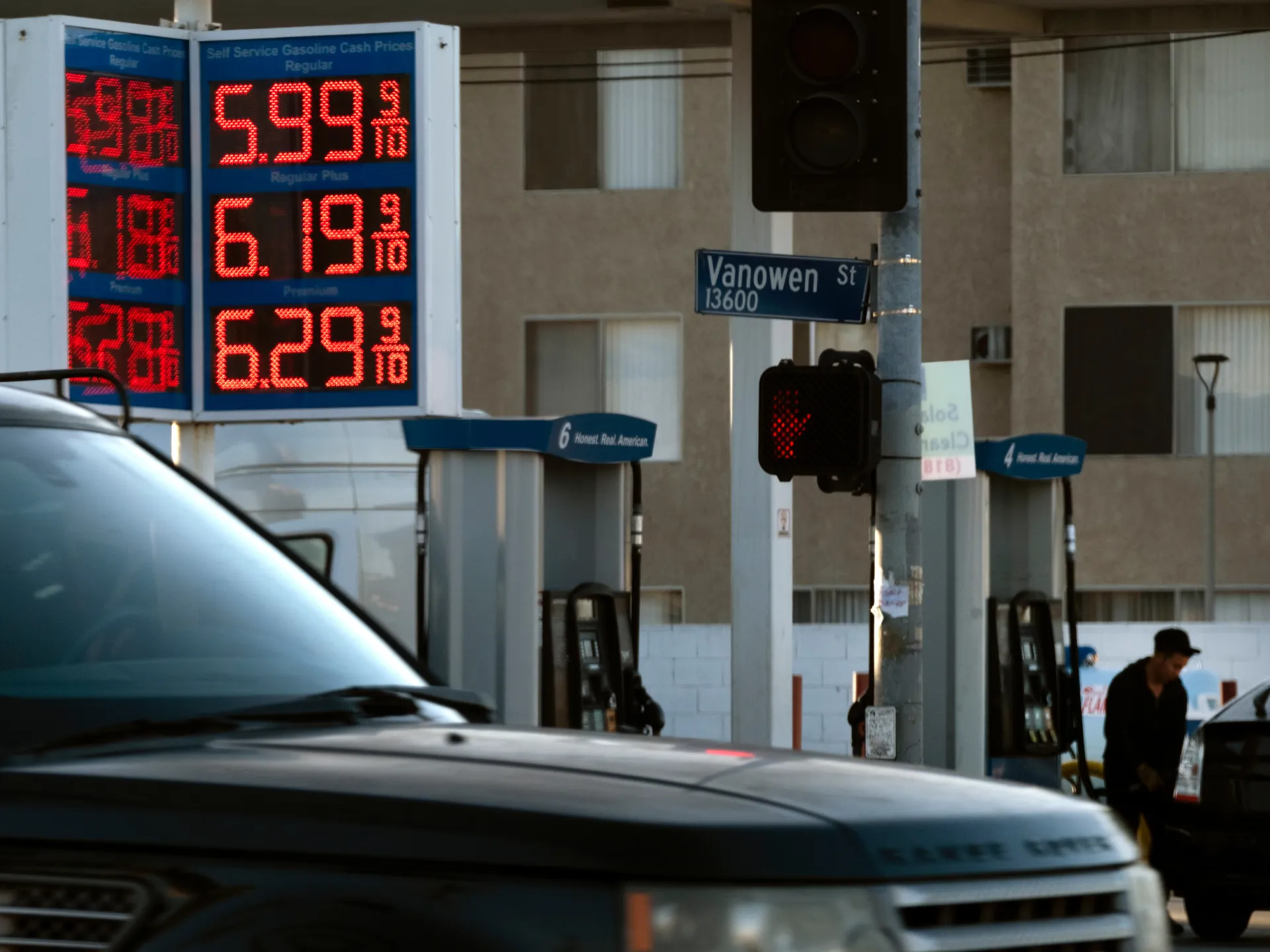
Patrick DeHaan, who leads petroleum analysis for the app GasBuddy, said that the national average as of Wednesday is now $3.59 per gallon ($0.95 per litre) – up 65 cents since February.

The highest increases are near the coasts, where US petrol, diesel and jet fuel supplies are more easily diverted to meet global demand, according to DeHaan.

An end to the conflict could lower petrol prices within weeks, DeHaan said, but “every week that this goes on, we could see another 25 to 40 cent increase”.

Robert Rogowsky, an adjunct professor at Georgetown University’s School of Foreign Service, said lower-income people in particular, “will pay the price for this inflationary burst”.

As the war continues, it will also nudge up prices for consumer goods.

Peter Sand, chief analyst for freight intelligence platform Xeneta, said the backup at the Strait of Hormuz is already causing congestion at ports worldwide.

In the short term, consumers should not feel much of a pinch, Sand said. But if the conflict lasts for a month, some goods will be delayed, “and of course, the price tag on those goods also goes up.”

The war also means that the Red Sea, mostly closed in 2025 due to Houthi attacks, will likely stay closed throughout 2026, Sand said. It was expected to reopen, which could have lowered consumer prices.

Oil and oil byproducts from the Gulf are also used directly in consumer goods, like plastics, pharmaceuticals and fertilisers. Shortages now may mean higher prices later.

Fertilisers from the Gulf, for example, are needed soon for spring planting. Delays could affect crops next year.

A shortage of helium from the Gulf could also impact semiconductor manufacturing, delaying car manufacturing and other industries, Ziemba said.

The spectre of 1970’s-style ‘stagflation’

Higher consumer prices could increase the risk of “stagflation”, when stagnant economic growth occurs alongside high unemployment and high inflation.

That is how the US economy responded to the oil price shocks of the 1970s.

Severin Borenstein, faculty director of the Energy Institute at the University of California, Berkeley’s Haas School of Business, said, “There’s certainly concern about stagflation again.”

That combination of high inflation plus high unemployment, Borenstein said, “is just really tough for the Fed to deal with”.

“They can either juice the economy or slow it down, and the two problems call for opposite solutions”, Borenstein said.

The Fed can lower interest rates to prompt spending and hiring, which can make inflation worse, or it can raise interest rates to lower inflation, which can slow hiring.

Ziemba said higher oil prices likely point to “inflation remaining stickier, which means it’s harder for the Fed to cut interest rates.”

As a result, “mortgage rates and other long-term interest rates might be stuck at their current levels,” Ziemba said. Mortgage rates, which were at 5.99 percent on February 27, are up to 6.29 percent as of March 12.

Even if the war ends tomorrow, it may already be accelerating longer-term shifts.

Rogowsky called US attacks on Iran “an injection of adrenaline” into a realignment already under way, as middle powers seek to reduce their reliance on the US.

That realignment “will affect our terms of trade, which will have a distinct impact on our economy”, Rogowsky said.

Logistics consultant David Coffey said for some businesses, the war is expediting conversations about risk. “They may have been assuming ‘Yes, there’s risk in the Middle East,’ but they may not have been assuming that this would kick off”, Coffee said.

Making supply chains more secure could raise costs for consumers, he said.

Military spending and the US budget

Meanwhile, Heidi Peltier, a senior researcher at Brown University’s Costs of War Project, said war also means long-term expenses around debt payments and veterans’ healthcare.

“We have spent at least $1 trillion in interest on the Iraq and Afghanistan wars – and rising, because it’s not like we’ve paid off any of that principal”, Peltier said.

Military spending, she said, also tends to create fewer jobs than government investment in education or healthcare. “If we’re spending money on this, what are we not spending money on?” Peltier asked.

Source link

Why you should book your summer holiday to Spain and Greece NOW

BRITISH holidaymakers have been caught up in the Iran crisis, with thousands stranded abroad and even more fearing for their upcoming trips.

But if you haven’t booked your holiday yet, should you be doing it now to avoid any price hikes?

Your holiday to Spain and Greece is likely to cost more this summerCredit: Alamy
Airlines are already hiking flight fare prices, and this is likely to continueCredit: Alamy

Due to the ongoing US-Iran conflict, the cost of jet fuel has spiked, with airline fares already spiking in response.

Before the attack, prices were around $90 (£67) per barrel.

However, this has now jumped to as much as $200 (£149) per barrel – the highest prices since Russia invaded Ukraine in 2022.

Jet fuel makes up about a quarter of the cost of airline operations, according to the IATA.

BILLS BLOW

Cost of food shops, fuel & holidays will soar due to Iran war, experts warn


HOL-D ON

Brits are cancelling holidays to Cyprus despite it being on the safe travel list

In response, airlines such as Qantas, Scandinavia’s SAS and Air New Zealand have all raised flight prices already.

Some airlines such as Ryanair, easyJet, British Airways and Virgin Atlantic, are less affected as they have secured some of their fuel at fixed prices for a set amount of time – called hedging.

Ryanair boss Michael O’Leary said the rise in jet fuel “won’t affect our costs and it won’t affect ​our low fares,” something easyJet also echoed.

But flights elsewhere are likely to go up in the next year or so, as the conflict continues.

Most airlines in America do not protect themselves against jet fuel price increases, meaning Brits are likely to see more expensive transatlantic fares.

According to research from Skift this could cost US airlines as much as $24billion in extra fuel costs – working out to 11 per cent increases on flights.

Not only that, but the closure of the Strait of Hormuz – one of the world’s most important shipping routes – is also having a knock-on affect and could lead to shortages.

James Noel-Beswick, head of commodities at market intelligence firm Sparta Commodities, told the BBC that it was very likely” that prices will increase this summer.

He added: “I think we’re weeks away from maybe flight cancellations or delays due to lack of jet fuel, rather than months.”

So, what can Brit holidaymakers do?

Qantas has already said they are raising pricesCredit: EPA

If you were planning on booking a package holiday, many tour operators allow you to lock in a cheap price, and simply pay a deposit, with the full balance coming later.

Jet2 allows you to book a holiday with a £60pp deposit while TUI has a number of £0 deposit schemes.

Loveholidays has deposits from £19pp, as well as a “Best Price Promise” that refunds the difference if your holiday is cheaper within seven days of booking, plus an extra £5 per person.

Destinations like Spain – already one of the most popular holiday destinations for Brits – are likely to see even more demand this year along with Greece due to being seen as ‘safer’ holiday destinations.

This means you might see a jump in price more than usual as well.

Other popular destinations like Cyprus is already seeing some booking cancellations after a drone attack on an RAF base on the island.

Hoteliers have said cancellations are affecting holidays in March and April – this is despite Cyprus remaining on the safe travel list.

Dubai is still on the “only essential travel” list so holidays to the UAE city are currently suspended, along with Jordan also on the travel ban list.

Even destinations like Egypt and Turkey are being affected, with a number of Sun readers concerned about holidays to both.

The Sun’s Head of Travel on which holiday destinations to go to instead this year

The Sun’s Head of Travel Lisa Minot, explains: “There’s no doubt the current crisis in the Middle East is going to have a seismic impact on our holiday habits.

“Reports of travellers stranded in the UAE and across the globe will certainly prompt those looking to travel long haul to look at alternative ways to fly – with direct flights to places like Thailand, the Maldives and Japan sure to be very popular.

“Closer to home, the situation will sadly likely impact destinations like Turkey, Egypt, Cyprus and possibly even Greece.

“And with soaring fuel costs, tour operators will be looking to price alternative destinations competitively. 

“But there are other options – our traditional resorts in places like Spain and Portugal are good, safe bets.

“Comparison giant TravelSupermarket has crunched the numbers for this summer and declared Spain’s Costa Calida one of the best-value destinations for this summer. 

“Dubbed the ‘warm coast’, this region stretching along the south eastern region of Murcia is one of Spain’s most underrated coastlines with 150miles of beaches, crystal clear waters and the unique Mar Menor lagoon, Europe’s largest saltwater lake.

“Also worth exploring arethe likes of Montenegro, Albania and even North Macedonia for cheaper hotel and restaurant costs as well as traditional favourite Bulgaria.

Both countries have not been affected by the Iran crisis and the tourist resorts remain safe to travel to.

Long haul holiday destinations are likely to see a spike in prices too, as Brits try to avoid booking connecting flights that go via Dubai, Doha and Abu Dhabi.

Some popular countries include Thailand, Vietnam, the Maldives and Bali, all of which usually fly via the Middle East.

There are alternative stopover destinations, usually via Turkey, Singapore or Hong Kong – but the soaring demand is likely to see these cost more this year too.

And with longer flight times? More jet fuel, so even more costs being passed on.

DEALS IN GREECE & SPAIN

Keen to book your next holiday ASAP? There are some great packages available to snap up right now.

*If you click on a link we will earn affiliate revenue.

Greece

Little Prince Apartments, Corfu

TUI offer a 7-night self-catering stay from 31 May including return flights from London Gatwick from £246.14pp.

Palm Beach Hotel, Kos

Jet2 Holidays offer a 7-night half board stay from 21 July including return flights from Glasgow from £561pp.

Sylvia, Crete

TUI offer a 7-night stay with breakfast from 30 July including return flights from Cardiff from £772.80pp. This offer includes one free child’s place.

Dedalos Beach Hotel, Crete

Booking.com offer a 5-night half-board stay from 1 June from £394pp, flights not included.

Trianta Hotel Apartments, Rhodes

TUI offer a 7-night self-catering stay from 2 August including return flights from Glasgow from £638pp. This offer includes one free child’s place.

Spain

Inter2, Salou

Jet2 Holidays offer a 5-night all-inclusive stay from 29 May including return flights from London Gatwick from £491pp.

Medplaya Hotel Monterrey, Girona

Booking.com offer a 5-night all-inclusive stay from 8 June from £157.50pp, flights not included.

Tabaiba, Costa Teguise, Lanzarote

TUI offer a 7-night self-catering stay from 13 July including return flights from London Gatwick from £447.12pp.

El Churra, Murcia

Jet2 Holidays offer a 5-night stay with breakfast from 24 May including return flights from Edinburgh from £548pp.

Poseidon La Manga Hotel & Spa, Murcia

Booking.com offer a 5-night half-board stay from 8 June from £231pp, flights not included.

Here are five lesser visited coastal resorts to visit this year.

And here is another lesser known European city that is a bargain weekend trip.

Long haul flights will be hit the hardestCredit: Alamy

Source link