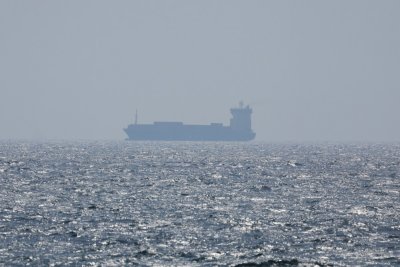

A container ship sails on the Strait of Hormuz, as seen from Ras Al Khaimah, United Arab Emirates, on June 23, 2025. The United Kingdom Maritime Trade Operations Center said a tanker was struck in the strait late Sunday. File Photo by Ali Haider/EPA-EFE
May 4 (UPI) — An oil tanker was struck late Sunday near the Strait of Hormuz, the second attack on a vessel in the Persian Gulf in about eight hours.
The United Kingdom Maritime Trade Operations said in a statement that it received a report of a tanker being hit by unknown projectiles as the vessel was about 78 nautical miles north of Fujairah, United Arab Emirates, near the northern tip of Oman’s Musandam Peninsula by the Strait of Hormuz.
The attack occurred at about 11:40 p.m. local time, it said, adding that all crew were safe and there was no environmental impact from the strike.
The tanker was not identified.
The oil tanker was struck a little more than eight hours after a bulk carrier was attacked by “multiple small craft” in the same region.
The UKMTO said the unidentified bulk carrier was attacked Sunday afternoon about 11 nautical miles west of Sirik, Iran. All crew were reported safe.
The agency is advising vessels to transit the Strait of Hormuz with caution.
The maritime security threat level in the strait remains critical as the United States is enforcing a blockade of Iranian ports in response to Iran restricting which vessels can transit the strait.
The attacks come as U.S. President Donald Trump on Sunday vowed to “free” cargo ships trapped in the Persian Gulf since the U.S.-Israel war against Iran began on Feb. 28.
In his Truth Social post, Trump said Project Freedom would begin Monday with the goal of helping ships sailing under neutral flags navigate the strait. Few specifics on how the operation will work were given.
More than two dozen vessels have reportedly been attacked in the strait since the war began.