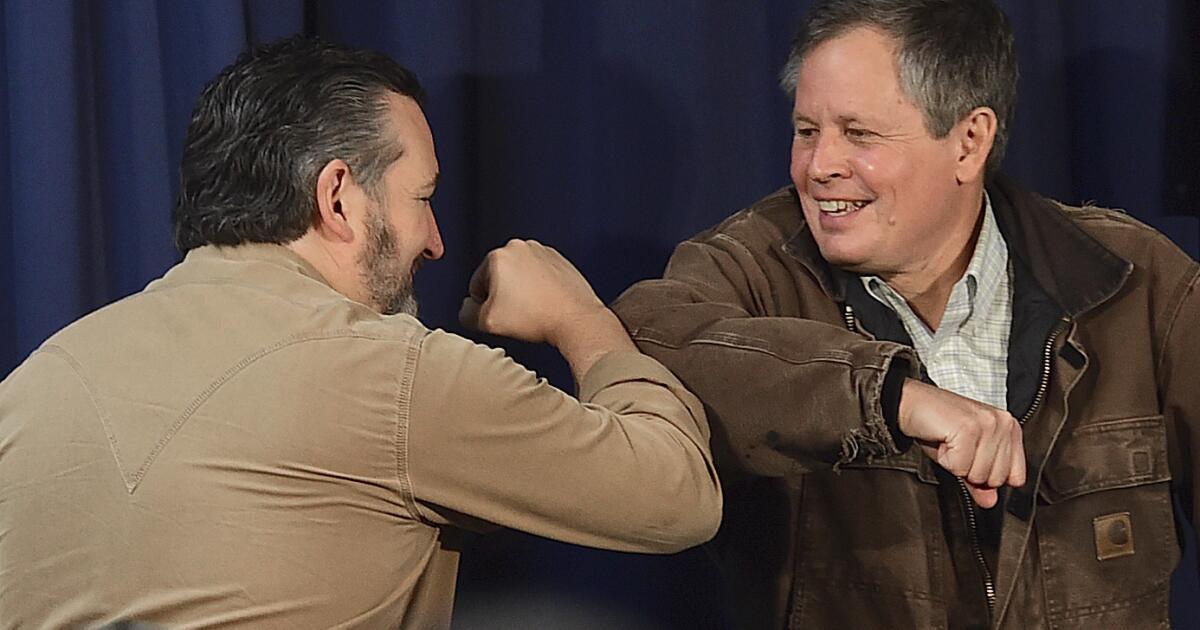
For months, the senior U.S. senator from Montana pondered his political future.
Or so he said.
Wrapping up his second term and facing a glide path to a third, Steve Daines unexpectedly opted this month against seeking reelection, saying in an aw-shucksy video he planned to spend more time back home in Montana and enjoy more cherished moments with his seven grandkids.
Notably, after long “wrestling with this decision,” Daines announced his intent a scant two minutes after the deadline passed for candidates to put their names on the ballot. March 4 at 5:02 p.m local time, to be precise.
More notable still, Daines’ preferred successor, Republican former U.S. Atty. Kurt Alme, jumped into the race at 4:52 p.m. that very same day.
There are relay runners who might learn a thing or two from their timing and coordination.
As part of the seamless handoff, Alme was swiftly endorsed by President Trump, Montana’s Republican governor, Greg Gianforte, and its other Republican senator, Tim Sheehy, for all intents settling the GOP contest and, quite likely, choosing the state’s next member of the U.S. Senate.
Never mind what voters might have wished, or other prospective candidates might have had in mind.
“There are a lot of Republicans in the state, folks with political ambitions, who are extremely peeved right now,” said Kal Munis, a Montana native and political science professor at Auburn University, who closely tracks politics in his home state.
Moreover, Munis said, with enough notice a heavy-hitting Democrat might have entered the contest, instead of the lowly bunch now running hopeless campaigns.
Montana, which has a rich Democratic history, has become a solidly Republican state, though the makeover took some time to complete.
As recently as 2008, Barack Obama made a serious run there, losing to John McCain by less than 3 percentage points. Montana had a Democratic governor until Gianforte was elected in 2020 and a Democratic U.S. senator until Jon Tester was defeated in 2024.
Still, while Daines’ seat hardly appeared at great risk for the GOP, a fight for the party’s nomination might have been a costly distraction, diverting money and attention that could go elsewhere as Republican prospects for the midterm election grow increasingly dim. (An unpopular war and shaky economy that’s been knee-capped by a sudden spike in oil prices will do that.)
Of all people, Daines certainly appreciates the bigger political picture, having led Republicans’ Senate campaign committee during the 2024 cycle. So he and his allies short-circuited the election process by laying hands on Alme, who stepped down as U.S. attorney to sidle into the Senate.
Seth Bodnar was among those who quite rightly criticized Daines for, as Bodnar put it, having “so little respect for Montana Republicans that he withdrew at the last minute to coronate his handpicked successor instead of giving them a voice at the ballot box.”
It just goes to show, Bodnar suggested, “the disgusting arrogance of Washington politicians and their party bosses who trade power back and forth like candy.”
Bodnar, the former president of the University of Montana, is running for Senate as an independent, conspicuously steering clear of the toxic Democratic brand. There is speculation the high-handed behavior of Daines, Trump and other Republicans might be enough to give Bodnar’s steep-odds candidacy a decent shot in November.
Munis, for one, is doubtful.
“There are a number of activist types who are deeply angered by this,” he said. “But when it comes to tallying votes in an election, that’s just a drop in the bucket.”
Unfortunately, Daines’ scheming, stick-it-to-the-voters approach isn’t just a Montana Republican thing.
Democratic Rep. Chuy Garcia of Illinois announced in the fall that he would not seek a fifth term this year. The last-second move — which came after Garcia had earlier filed paperwork to run for reelection — made it so his chief of staff and preferred successor, Patty Garcia (no relation), was the only major Democrat to appear on the ballot, virtually guaranteeing her election in November.
The cynical maneuver so disgusted Rep. Marie Gluesenkamp Perez, a maverick Democrat from rural Washington state, that she defied party leaders and introduced a resolution rebuking Garcia.
His actions were “beneath the dignity of his office and incompatible with the spirit of the Constitution,” said Gluesenkamp Perez, who was jeered and booed by fellow Democrats during the floor debate for having the temerity — heavens to Betsy! — to put principle above knee-jerk partisanship. The measure passed the House, 236 to 183, with only 22 Democrats joining Gluesenkamp Perez in support.
In California, the law prevents incumbents from pulling off the kind of underhanded stunt that Garcia and Daines managed. That’s because the filing deadline is automatically extended for an extra five days whenever a sitting lawmaker opts against seeking another term.
So, for instance, when Rep. Darrell Issa suddenly announced this month he would not run for reelection, he endorsed his favored replacement, San Diego County Supervisor Jim Desmond, but couldn’t grease the process to see to it that Desmond takes his place.
Legislators in other states should pass a law like the one in California to prevent the undemocratic shenanigans that in effect neutered voters in Montana and the Chicago area.
That is, if they truly believe elections matter and voters should have a choice and not stand by powerless as their government representatives are anointed from on high.