


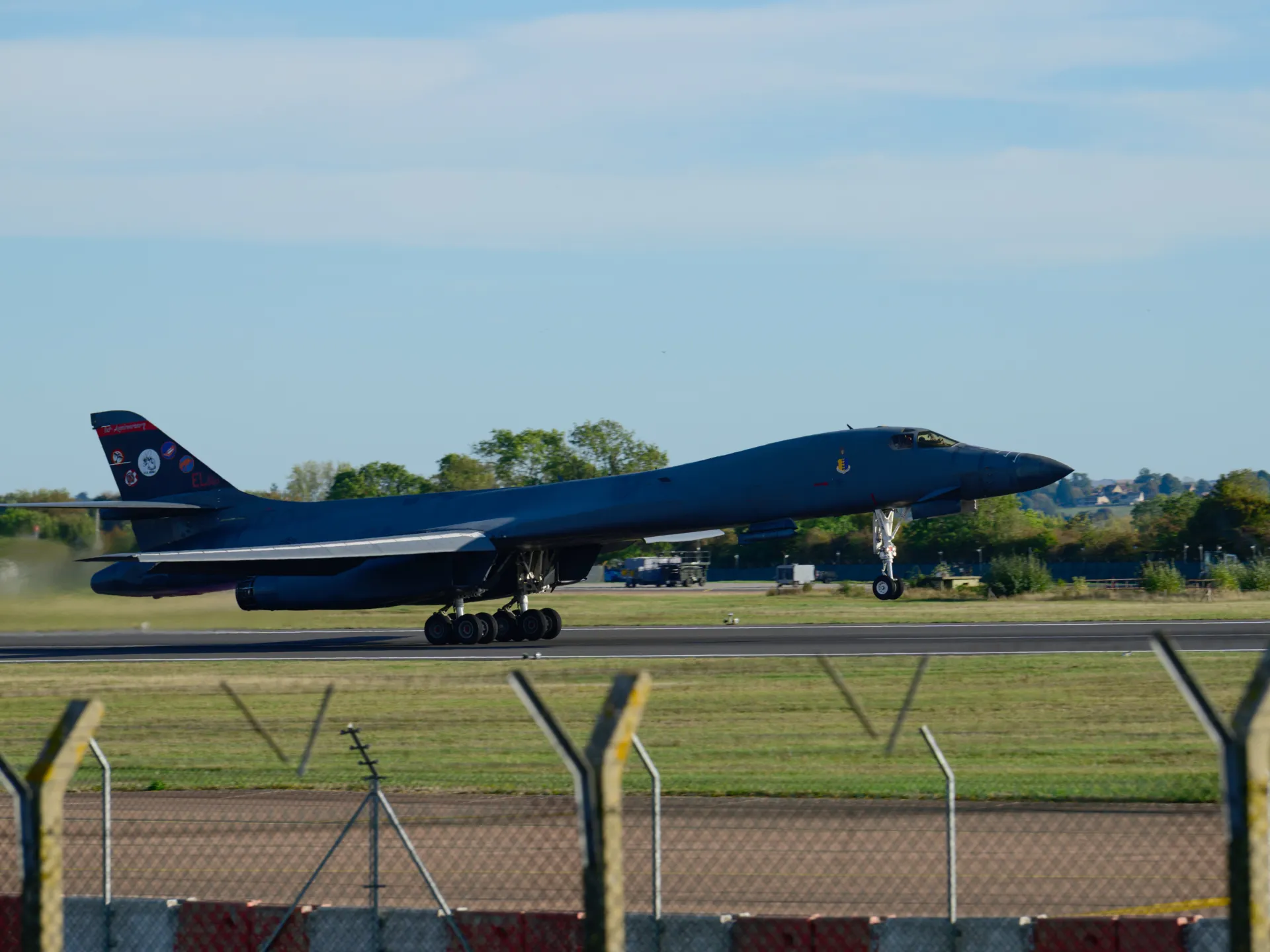

WASHINGTON — The only remaining U.S. aircraft carrier patrolling the Pacific departed Asia through Singapore last week en route to the Middle East, marking the latest step in a steady drawdown of American military assets across the region.
An armada of naval forces, alongside a constellation of air-defense and missile capabilities, has been removed from a theater the Trump administration said just last year would be the battleground of the coming century.
And now, President Trump’s surprise decision this week to curtail military exercises with South Korea has further fueled anxiety across Asia, where Washington’s closest allies fear violent consequences from a vacuum of American power.
Trump said his decision to withdraw U.S. participation from the annual military drills was de-escalatory, claiming they would needlessly provoke North Korea’s dictator, Kim Jong Un, with whom he has recently been in touch.
But he also blamed Seoul for its decision to not take part in his war with Iran.
“I said, ‘Would you like to give us a little hand?’ ” Trump told reporters. “He said, ‘No thanks,’ and I said, ‘Wait a minute — we have 39,000 soldiers over there, guarding you from Kim Jong Un, your next-door neighbor, and you’re not going to help us.’ ”
“That’s strange,” Trump added. “We can’t go around and protect all of these countries, especially when they’re not there to help us.”
South Korea’s president, Lee Jae Myung, responded to Trump’s last-minute decision to pull back from the drills with a degree of alarm.
“From now on, we must prepare measures with even the worst-case scenario in mind,” Lee said, “on the premise that the Middle East situation may be prolonged.”
It was the latest jolt to South Korea’s confidence in an alliance that has formed a cornerstone of Washington’s defense strategy in Asia since the end of World War II.
The Pentagon has kept its THAAD missile-defense batteries on the Korean peninsula. But in March, it moved some of the system’s radars and forward-positioned interceptors toward the Middle East, as the Iran war strained U.S. missile-defense stocks. Analysts estimate the conflict has consumed more than 40% of the Pentagon’s THAAD interceptor inventory.
The diversion was accompanied by the redeployment of dozens of combat and dry-cargo ships, mine countermeasure vessels, and guided-missile destroyers out of the region, ahead of the departure of the strike group centered on the nuclear-powered USS George Washington, which is now on its way to the Middle East.
Other U.S. allies in the region reacted swiftly to Trump’s pullback from the Korean exercises.
The Australian government said it remained “deeply concerned” with North Korea’s nuclear weapons and ballistic missile programs, while Japan’s defense minister, Shinjiro Koizumi, warned of historic stakes.
“As Japan faces the most severe and complicated security environment in the post-war era, the cooperation among Japan, the United States and South Korea is critical to the peace and stability of the region,” Koizumi said in a statement.
And Beijing has been quick to capitalize on the vacuum.
China’s Foreign Ministry mocked that the United States “has become addicted to quitting groups and scrapping treaties,” while its military began installing permanent infrastructure in Taiwan’s exclusive economic zone within days of the George Washington’s departure.
“The current international landscape has once again proven that only by ensuring the effective operation of the multilateral system can we prevent the spread of the law of the jungle,” said Mao Ning, a spokesman for the Chinese Foreign Ministry, “and keep the international order from being dominated by the logic that ‘might makes right and force represents justice.’”
Speaking with journalists in the Oval Office on Monday, Trump said that his communication with Kim was “making things safer” in the region.
He did not offer details on their conversations.
“Kim Jong Un has always treated me with great respect,” Trump said, confirming that the North Korean leader had replied to his overtures.
WASHINGTON — President Trump’s war against Iran is stretching the limits of U.S. aircraft carriers and leaving the western Pacific without one of the key American warships as China shows more signs of aggression.
The USS George Washington is departing the Pacific to relieve the USS Abraham Lincoln in the Middle East, amid growing concerns about mental health and supply issues aboard the long-deployed carrier. The Lincoln has had its time at sea extended from its original May return date to support the war in Iran.
The lack of a U.S. carrier in the Pacific may be short-lived if the Navy deploys another in the next couple of months. But it shows how the open-ended operations with Iran are running some American sailors ragged, analysts say, while the Trump administration further retreats from the Asia-Pacific region and focuses on the Western Hemisphere.
“The administration says that the Pacific is supposed to be the most important behind the Western Hemisphere,” said Greg Poling, director of the Southeast Asia Program at the Center for Strategic and International Studies. Instead, the U.S. is “doing the exact opposite” of its previously expressed goal of pulling out of the Middle East.
American allies in the Pacific are unsettled over the unpredictability of the Trump administration, Poling said, while China “is quite happy with U.S. distraction, with the frustration of U.S. allies and partners.”
China may take advantage
Beijing sees the U.S. military presence in the region as a threat to China’s rise and an obstacle to its ambition to seize Taiwan, the self-governing island it claims as its own. But the United States has argued that the Pacific region is too important economically to lose.
No one expects China to invade Taiwan just because an American aircraft carrier has left the region. But the carrier’s absence gives the Chinese another opportunity to show its strength, said Bryan Clark, a former Navy submariner who is a defense analyst at the Hudson Institute.
“They’re using this as part of the narrative to demonstrate to the Philippines, to Japan, to Indonesia and others that the U.S. is not the big dog in the western Pacific anymore,” Clark said. “They would just prefer that countries in the region decide that China is the bigger power and the U.S. is not able to guarantee their security anymore.”
China conducted naval exercises this week with Indonesia and recently has shown signs of aggression toward Japan and the Philippines, two key U.S. allies that also have territorial disputes with Beijing.
China carried out military drills this month near the Scarborough Shoal in the South China Sea. Both China and the Philippines have claims over the shoal. Last month, a Chinese guided-missile destroyer conducted a live-fire exercise off Japan’s southernmost island of Okinotori.
Adm. Frank Bradley, head of the U.S. Special Operations Command, has been trying to reassure regional allies of Washington’s commitment. He was in Manila on Thursday, telling his Filipino counterparts that U.S. special operations forces are ready to step up joint exercises to strengthen the countries’ alliance. He also is expected to travel to Japan.
Evan Sankey, a policy analyst at the Cato Institute who focuses on U.S. policy toward China, said aircraft carriers provide psychological assurance to U.S. allies. The absence of carriers in the region, he said, “adds to the general sense that the U.S. is distracted by events in the Middle East.”
Trump has relied on aircraft carriers for military actions
Trump has relied heavily on aircraft carriers to support his numerous military operations during his second term. The USS Gerald R. Ford returned home in mid-May after an 11-month deployment, the longest since the Vietnam War, during which it supported the U.S. fight against Iran and the capture of Venezuelan President Nicolás Maduro.
The Ford had experienced a fire in a laundry space that forced the carrier to turn around and return to the Mediterranean Sea for repairs and left hundreds of sailors without places to sleep.
The USS Lincoln has been at sea 268 days as of Saturday, a record deployment without a port visit, as the Ford had. Democratic lawmakers and families of the sailors have been calling for investigations and greater visibility into conditions aboard the ship, which is preparing to return to its home port in San Diego.
Warships and their crews can handle only so much, said Robert Farley, who teaches national security and diplomacy at the University of Kentucky and often writes about aircraft carriers.
“People don’t get enough rest. It’s psychologically exhausting. And R&R is part of keeping the crew healthy,” Farley said. “Sometimes it’s framed as, ‘These people haven’t had a vacation.’ But we are dealing with well-known limits on the capacity of a crew to operate at top efficiency over time. And that just declines.”
Clark, of the Hudson Institute, said the squeeze on the nation’s aircraft carriers stems from the lack of preparation and planning for the Iran war.
“If we were going to mobilize to do this kind of conflict, and we anticipated it might go this long, we might have done some changes to the carrier schedule to make sure more would be available,” Clark said.
Clark said the Navy has 11 aircraft carriers and typically deploys two or three at a time. But it could soon deploy four if the USS Theodore Roosevelt leaves San Diego for the Middle East, allowing the Washington to return to Pacific.
But the massive warships will need maintenance, probably causing a bottleneck at the nation’s only two carrier shipyards.
“We’ll end up with a maintenance debt that needs to be paid for the next few years,” Clark said. “We’ll probably have less carrier presence than we’ve had in the previous years because carriers will be lined up to get into the shipyard.”
Role in modern warfare
Michael Swaine, a senior research fellow in the Quincy Institute’s East Asia Program, questions the future need for aircraft carriers as warfare rapidly changes.
Carriers can be more easily targeted with drones and missiles, particularly by an adversary such as China, Swaine said, while smaller ships and submarines can be as effective in striking targets as the fighter jets that launch off a carrier.
Top Navy officials have indicated a desire to move away from a heavy reliance on carriers. Adm. Daryl Caudle, chief of naval operations, told the Associated Press in February that he wants to convince commanders to use smaller, newer ships and other assets instead of consistently turning to huge aircraft carriers.
ROD Stewart has sparked concern for his health as he pulled out of a second concert in a week over a mystery medical issue.
It’s been revealed 81-year-old rocker has pulled out of his August 9 gig at the Riverbend Music Center in Cincinnati.
Rod Stewart has told fans he has no plans to fully retire from music or performing all togetherCredit: GettyFans have shared their concerns for rocker Rod Stewart’s health on social mediaCredit: Getty
The organisers of the event announced the shocking news yesterday – the day of the gig.
Sign up for the Showbiz newsletter
Thank you!
They confirmed Rod was undergoing an “unforeseen but minor medical procedure.”
The venue shared a statement on social media, which said: “Due to an unforeseen but minor medical procedure that required prompt attention, Rod Stewart’s performance tonight in Cincinnati has been postponed.
Following the sad news, Rod also postponed his concerts at Red Rocks Park and Amphitheatre in Morrison, Colorado in June, citing vocal rest.
He has repeatedly told fans that while he is winding down large-scale global arena touring, he has no intention of fully retiring from music or performing altogether.
Rod Stewart, who is married to TV personality Penny Lancaster, shot to fame in 1971 following the release of his debut album, Every Picture Tells A Story.
His biggest hits include Maggie May, Sailing and Da Ya Think I’m Sexy?
Over his six-decade career, he’s sold over 250 million records worldwide, been inducted into the Rock and Roll Hall of Fame twice, and received a knighthood in 2016.
Iran on Monday denied that any negotiations were taking place with the United States, directly contradicting U.S. President Donald Trump’s claim that talks were scheduled later in the day and exposing fresh uncertainty over Washington’s strategy after months of military confrontation.
The conflicting statements came after Trump once again backed away from threatened military action against Iran, saying he preferred diplomacy over escalation. Tehran, however, insisted that no negotiations were planned and that no meetings with American officials had been arranged.
Iran Rejects Trump’s Claims
Speaking aboard Air Force One on Sunday, Trump said the United States would begin negotiations with Iran on Monday afternoon, describing diplomacy as preferable to launching another round of attacks.
Iran swiftly dismissed the claim.
Stay ahead of the geopolitical week.
MD Briefing delivers expert analysis across five global fronts — the Indo-Pacific, energy, geoeconomics, European security, and the Middle East — every Monday morning. Free.
Foreign Ministry spokesman Esmail Baghaei said there were no negotiations under way with Washington and no plans to host American officials or dispatch Iranian negotiators abroad. He added that, apart from Foreign Minister Abbas Araqchi, who is currently on a religious pilgrimage in Iraq, all Iranian negotiators remain inside the country.
A senior Iranian source also told Reuters that no talks had been scheduled and that Araqchi would remain unavailable until at least the end of the week.
According to Tehran, the only ongoing discussions involve Oman and focus exclusively on managing shipping through the Strait of Hormuz.
A Familiar Cycle of Escalation and Retreat
The latest episode mirrors a pattern that has defined the five month conflict between Washington and Tehran.
Since launching Operation Epic Fury alongside Israel, Trump has repeatedly threatened major military action before stepping back at the last moment, often citing diplomatic efforts as justification.
Iran has consistently rejected direct negotiations since the collapse of a U.S. backed memorandum of understanding in early July, arguing that Washington has failed to uphold previous commitments while continuing military pressure.
The repeated cycle of escalation followed by de escalation has left uncertainty hanging over regional security and global energy markets.
Hormuz Remains the Central Dispute
At the heart of the dispute remains the Strait of Hormuz, the world’s most strategically important oil shipping route.
Washington argues that the failed June agreement required Iran to reopen the waterway to unrestricted international shipping. Tehran maintains that the document explicitly preserved its authority over traffic through the strait, allowing it to retain significant leverage.
The inability of the United States to secure unrestricted access has become one of the most significant unresolved issues of the conflict.
For the Trump administration, failure to reduce Iran’s influence over Hormuz would represent a strategic setback after months of military operations aimed at weakening Tehran’s regional position.
Strategic Goals Remain Unfulfilled
Five months into the conflict, many of Washington’s stated objectives remain largely unmet.
The United States has sought to dismantle Iran’s nuclear programme, reduce its capacity to strike regional rivals, protect commercial shipping, and increase pressure on Iran’s leadership.
Instead, Iran has continued to demonstrate its ability to disrupt regional energy infrastructure and maritime trade while maintaining leverage over one of the world’s most critical energy chokepoints.
Each round of military escalation has been followed by Iranian retaliatory actions targeting shipping, Gulf energy infrastructure, or U.S. interests in the region, complicating Washington’s efforts to establish deterrence.
Despite the diplomatic confusion, financial markets welcomed Trump’s decision not to proceed with further attacks.
Brent crude prices fell more than 4 percent to around 84 dollars per barrel as traders anticipated a reduced immediate risk of supply disruptions in the Gulf.
Nevertheless, tensions remain elevated.
The British maritime security organisation UKMTO reported that a commercial vessel in the Strait of Hormuz detected an explosion in nearby waters overnight, although no injuries or damage were reported.
Diplomatic Uncertainty Persists
The contradictory messages from Washington and Tehran highlight the absence of a clear diplomatic pathway toward ending the crisis.
While Trump continues to present negotiations as an alternative to military action, Iran’s categorical denial suggests that no formal channel currently exists between the two governments.
With the Strait of Hormuz still contested and military incidents continuing across the Gulf, the conflict remains caught between diplomacy and confrontation, leaving regional stability and global energy markets vulnerable to further shocks.
A UK airline has lost its last chance at a rescue deal – more than eight months after entering administration.
The firm had suffered financial difficulties after the loss of a contract with KLM.
Sign up for the Travel newsletter
Thank you!
The airliner collapsed into administration in November last yearCredit: Alamy Stock Photo
A potential rescue deal for Eastern Airlines, and its affiliated company Air Kilroe, has fallen through – leaving administrators unable to save the regional airline.
As a result, administrators RSM UK, are set to break up and sell the businesses’ assets separately, as revealed in new documents filed by the company.
A joint sale of Eastern and Air Kilroe was initially pursued as the companies had operated under a single business – before entering into administration in November last year.
The North Lincolnshire-based airline had flown routes across the UK, Ireland and Europe, and had been operating four aircraft for KLM Cityhopper in Europe.
However, the abrupt loss of this contract in October last year plunged the company into severe financial difficulties.
At the time of collapse, RSM said “high fixed overheads” and its staff base had “ultimately proved too high to be sustainable”.
Jamie Miller, partner at RSM UK and joint administrator, added: “The unexpected and sudden termination of Eastern’sKLMcontract, along with other economic factors, unfortunately left the directors with no choice but to appoint administrators.“
Now, all nine of the company’s aircraft fleet have been sold off to private buyers, as well as associated plane parts and components.
At its peak, the airliner provided 200 flights per day and employed around 330 staff members, the majority of which have now been made redundant.
Now just 16 employees remain, and are expected to stay on until the administration process is completed.
Known as one of the UK’s last regional airlines, the firm had run a weekday service between Wick John O’Groats Airport and Aberdeen, which was seen as an essential link for those living in the most northerly point on mainland UK.
Launched in 1997, the airliner also flew from bases in East Midlands, Jersey, Manchester, Southampton and Denmark – and even held eight summer slots at London Gatwick.
England’s reaction was an explosion of celebration and sheer relief, a largely dreadful performance transformed into dramatic victory by their magnificent captain.
The celebration was for that place in the last 16.
The relief will have been Tuchel’s, who would surely have been unable to survive such embarrassment had England lost, irrespective of his contract extension.
Relief, too, for the Football Association, who placed such faith in the German and handed him the sole mission of winning this World Cup.
And it was all down to Kane.
Kane attracts superlatives and respect like a magnet. Every bit of it deserved – as proved by the stats left behind by his latest feat.
He now has five goals in this World Cup, as the race for the Golden Boot becomes a sprint between Kane, Kylian Mbappe, Erling Haaland and Lionel Messi, with Tuchel saying: “They are all sharks. They smell blood.”
Tuchel added: “These big guys at this World Cup, do they watch each other? And then they go ‘not with me, then I score, then I do a hat-trick, then you go’. What is going on? Crazy.
“Harry is so, so good. He’s our captain. He’s our leader. He decides football matches with unbelievable finishes and did it here twice. The second one was just a brilliant goal.”
Kane now moves above Pele to go joint sixth on the all-time World Cup scorers list with 13, and now has 84 goals for England, putting him level with legendary Hungarian Ferenc Puskas in ninth on all-time international scorers list.
He is the first England player to score twice in a World Cup knockout stage match since Gary Lineker against Cameroon in 1990. Kane has now scored five knockout stage goals at a World Cup. Only Lineker, with six, has scored more for England.
Most remarkably of all, he now has scored 72 goals in 62 games for club and country this season, with 11 for England and 61 for Bayern Munich.
Fears about the British number one’s fitness grew over the past week.
Raducanu was spotted wearing a protective boot on Wednesday, then was unable to train on Thursday and Friday because of what is believed to be a shin problem.
The 2021 US Open champion returned to the court on Saturday to test her fitness and, wearing strapping around her lower right leg, started with a gentle hour-long session with her team.
But she then cut short another practice session with Russia’s Anna Kalinskaya – when the pair played a set – with 10 minutes remaining.
There were signs of improvement in her practice session on Sunday morning.
Raducanu was slightly less tentative against hitting partner Alexis Canter – particularly when she pushed with her right leg on the forehand side – but it was not as rigorous a test of her movement as she got against Kalinskaya.
Later on Sunday, Raducanu told the media she was willing to push herself and take more risk with the injury in order to step out at the All England Club.
“Playing at Wimbledon, in front of a home crowd, means everything to me, so this is really difficult to process,” Raducanu said.
In Lincoln Park, past Plaza de la Raza cultural center and under swaying pine trees, stands a row of 10-foot wooden panels etched with names. Robert Zaldivar stood quietly in front of the names, surrounded by community members holding lit candles as memories of old friends resurfaced.
The panels bear nearly 2,000 names, and more are added every year. Each one represents an Angeleno, mostly Latinos, who died of AIDS. Zaldivar led the movement to erect this monument, named the Wall Las Memorias, which was finalized in 2004.
Inspired by his late best friend, who was HIV-positive, the Wall represents to Zaldivar the power of remembering those in his community affected by HIV and AIDS. It was designed in the shape of Quetzalcoatl, or the “Feathered Serpent,” an Aztec deity and symbol of rebirth.
Robert Zaldivar leads a sunset vigil at the Wall Las Memorias AIDS Monument in Lincoln Park on the anniversary of the first HIV diagnosis in L.A. on June 4, 2026.
(The Wall Las Memorias)
That day in early June, he hosted a sunset vigil, joined by AIDS Memorial Quilt founder and Harvey Milk mentee Cleve Jones, to recognize the lives lost since AIDS was first diagnosed 45 years prior, when the Centers for Disease Control and Prevention published a report detailing immunodeficiency in five young gay men in Los Angeles.
At Zaldivar’s feet was a poem, one he wrote in 1995 with his friend Anna Contreras.
It reads:
It is here, we free ourselves from the teaching of guilt. We unite as one people in our vision, our teaching, and our truth. Through truth we live, through knowledge we survive.
Contending with stigma and misinformation has been a constant struggle for people who are HIV-positive, he said, a struggle that Zaldivar hopes to make more visible now than it has been in previous decades.
“Sometimes it feels like there’s no other way to draw attention to this problem than to have a physical reminder,” Zaldivar said of the monument. “This reminds us of real people, as more than statistics.”
The statistics Zaldivar refers to include the continuing rise in HIV diagnoses in Latinos across the United States. The most recent CDC data show 39,000 people across the U.S. received an HIV diagnosis. And a Kaiser Family Foundation analysis revealed that between 2010 and 2022, there was a 24% increase in new cases among Latinos. In 2022 alone, Latinos made up 31% of new diagnoses, despite only representing 19% of the American population, the KFF study found.
“Just last week, we had two new diagnoses of HIV in our clinic,” said Bernardo Gomez, assistant manager of HIV resources at the Wall Las Memorias Project. “For context, we had 15 in the past six months, including straight women … I think what we’re seeing is a dangerous loss of support for outreach and education.”
Last year, President Trump released his presidential fiscal year budget for 2026, much of which went into effect last October. In it, he revealed significant cuts to HIV health programs — amounting to $1.5 billion.
The budget recommendation signaled the administration’s yearly priorities, and Trump’s fiscal plan and staffing cuts to HIV teams under the so-called Department of Government Efficiency (DOGE) showed a shift away from HIV prevention and healthcare, which advocates say has led to providers losing jobs and places for testing and resources to shrink. In L.A., the Latino community is feeling the brunt of the loss, Zaldivar said.
The biggest cut to HIV care in the 2026 budget affected the CDC, which lost around $3.6 million. Another devastating loss was $1.7 million cut from the Ryan White HIV/AIDS Program, which many L.A. resource centers report relying on to fund part of their programming and staffing.
Robert Gamboa, associate director of public policy at the L.A. LGBT Center, said that in Trump’s first term, his “Ending the Epidemic” program created hope for soon seeing the end of HIV in the U.S. — a hopefulness that he said was quickly dashed in his second term.
“Now there’s this 180-degree shift in policy, we see these enormous proposals pulling away from funding, and his lack of acknowledgment of World AIDS Day, and Pride in general,” Gamboa said. “The message of that is loud and clear: [The Trump administration] is telling our LGBT community, ‘We don’t care about you.’”
Since Trump’s inaugural address last year, Gamboa said executive orders have only solidified Trump’s shift away from LGBT organizations, “challenging the structural integrity of almost everything we’ve done.”
Gamboa said that last spring, the Department of Public Health, Division of HIV and STD Programs), which supplemented L.A. organizations with substantial HIV funding, sent out a notice that all of their contracts were terminated.
“Well, this caused a massive alarm all across L.A. County. Everyone started freaking out. We had to say, ‘We need an emergency allocation [from state funds] so that we can continue providing HIV services across California,’” Gamboa said. “We’re used to getting upwards of around $20 million in funding at the county level, and it wasn’t happening.”
Robert Zaldivar leads a sunset vigil at the Wall Las Memorias AIDS Monument in Lincoln Park on the anniversary of the first HIV diagnosis in L.A on June 4, 2026.
(The Wall Las Memorias)
Since then, nonprofit representatives have confirmed that the contracts were restored at reduced rates. However, the impact of the uncertainty shook the health services community and only caused further distrust among Latino patients.
“We’re already seeing [the impact in L.A.]. In the Latino community, there’s so much fear from the ICE raids. People are afraid to even leave their homes,” Gamboa said. “We’ve worked so hard in building trust and relationships with our communities of color. Now, they’re afraid to even come in. Many of the places they’ve gone to in L.A. County have already closed their doors and ceased services.”
Most recently, the Trump administration announced plans to cut millions in public health funding. This includes $1.1 million that would be slashed from the National HIV Behavioral Surveillance Project, an early-warning system for HIV outbreaks, established by the L.A. County Department of Public Health.
On the White House website, a page called “Cuts to Woke Programs” reads: “President Trump is committed to eliminating radical gender and racial ideologies that poison the minds of Americans.”
Gamboa said that organizations have been discouraged of using “LGBT” in their programming to avoid being defunded as part of the targeted “woke” programs.
“It really affects me,” said Gomez, who has been living with HIV since 1996. “How long will I have medicine?”
Gomez, who is the breadwinner of his family, says his monthly supply of medication costs $1,500 a bottle. “It’s so expensive, and I have insurance. For people without insurance, [the Ryan White program] is the only way they can afford treatment,” Gomez said. “I’m afraid of what will happen to them.”
Gomez takes antiretroviral therapy, a lifesaving medication that reduces the number of infected cells, making the disease less transmissible and prevents HIV from developing into AIDS. According to 2024 HRSA data, the Ryan White program provided antiretroviral therapy to 602,000 people, preventing the spread of HIV.
As the program loses funding, jobs providing HIV care have become more sparse — and programs like the Wall and the L.A. LGBT Center have become more essential to support the thousands left without life-saving care.
HIV program funds are trickling back into L.A. County for nonprofits this year; although some, like the Wall, maintain that it’s “not enough to address the need.” Up until last May, the organization shared that the county funded $1 million of its annual HIV reduction efforts. This year, that number was drastically reduced to $100,000 per six-month contract.
“Many of my social worker friends are off the streets [where they helped at-risk communities] due to just not having enough funding to do their jobs,” said Miguel Rodriguez, program coordinator of HIV testing and prevention at the Wall. “People think only gay men are affected, but basic sexual health for everyone is at risk here. Less [testing] means more infections and transmissions across the board.”
As Robert Zaldivar stresses, the only way to protect L.A.’s Latino HIV-positive community is to support remaining HIV services to get tested or donate to local service organizations.
“What we saw in the ’90s, I’m scared that it will repeat. I want people to remember how serious [HIV] is, and to educate,” Zaldivar said. “Keep getting tested. We don’t report your immigration status or sexuality. Just come in.”
Keely Hodgkinson pulled out of the 400m final at the UK Athletics Championships moments before Sunday’s race.
The Olympic 800m champion has been competing over the shorter distance in a bid to improve her first-lap speed and challenge for the 800m world record this summer.
After qualifying from Saturday’s heats, she warmed up for the final in Birmingham but stepped off the track right before the finalists were put under starters’ orders.
Hodgkinson looked emotional as she stood at the side of the track before making her way back inside the Alexander Stadium.
The 24-year-old endured an injury-disrupted 2025 and her shock withdrawal on Sunday comes four weeks before the London Diamond League meeting, which she had earmarked for a tilt at the 800m world record.
Italy’s Flavio Cobolli said he was “sad and happy at the same time” after reaching his first Grand Slam final at the French Open on Friday, following the last-minute withdrawal due to illness of his last-four opponent and compatriot Matteo Arnaldi.
The 24-year-old 10th seed will meet Alexander Zverev in Sunday’s final, which will produce a new major champion, after the German second seed earlier moved past Jakub Mensik in the other semi-final.
Recommended Stories
list of 4 itemsend of list
Just more than 20 minutes before Cobolli and Arnaldi were due to take to Court Philippe Chatrier, tournament organisers announced that the 104th-ranked Italian had been forced to pull out with a “virus”.
“When he came to me almost one hour ago, I almost cried. You know, it’s something that you don’t expect at all. I was ready to play this match,” Cobolli told reporters during a news conference he held with his close friend Arnaldi, as the pair sat three metres (10 feet) apart.
“When he came, I was completely sad for him. But, at the same time, of course, I’m really happy for the result that I reached this week.
“Yeah, now I’m sad and happy at the same time.”
For first-time major semifinalist Arnaldi, withdrawing was “not something that you wish to anybody”, but “the right decision for me to take”.
“It’s tough, because for how the tournament was, for how many hours I’ve been on the court, I was feeling actually very good,” Arnaldi, who had spent the most amount of time on court for a player en route to a Grand Slam semifinal, said.
The 25-year-old added that, on Thursday, he was “feeling OK” during practice, but after his dinner, he began to feel unwell during the night.
“I started to feel so-so with my stomach. I was, like, ‘All right, just didn’t digest very well,’” he recounted.
“But then I woke up at 1:00am, and I started vomiting, and I wasn’t feeling the best. Then I tried to sleep. I couldn’t sleep at all. At 6:00, 7:00am, I vomited again.
“We called the doctor into the room. He came, gave me some stuff. I was hoping that it would just be something from dinner or something like that, but then throughout the day, I couldn’t eat. Every time we did something or would drink, I would go back to the bathroom.”
Despite his best efforts, his state worsened throughout the day.
“I tried to get ready and tried to stay as much as I could here and tried to see if I could go on court, but every time I get up, I feel dizzy,” Arnaldi said.
“It’s a virus, I think, because I was feeling pretty cold. I think I had a fever, like, during the day. I don’t know, to be honest.
“I just know that I can’t move, and I can’t eat, and I can’t drink. So, there was really no way that I will be able to play.”
Cobolli paid tribute to a tearful Arnaldi.
“Matteo is a big inspiration for all of us. He’s an amazing player and amazing professional,” Cobolli said.
“He’s, I think, the best person outside the court for how his match preparation, focus, cool-down. He’s one of the best on the tour, for sure.”
After the conference, Cobolli took to centre court to have a hit watched on by a decent smattering of spectators that had come for the match but stayed to see the world number 14 keep his eye in.
After his quarterfinal victory over Canadian fourth seed Felix Auger-Aliassime on Wednesday, Cobolli will go into the weekend’s final with plenty of rest.
“Maybe having almost four days off is a lot, so you lose the rhythm,” he said.
“Now, I got practice again. I think I will be ready, for sure, for the final, but I also know that I will be fresh, for sure.
“Maybe [the extra time off] will help; maybe not. I’ll tell you after the final.”
Acclaimed German director Wim Wenders announced he was withdrawing his 1975 film, “Wrong Move,” from distribution due to a scene featuring then-13-year-old actor Nastassja Kinski topless.
Kinski played Mignon, a mute acrobat and street performer, in the film. In the controversial scene, she is featured lying on the bed topless as she tries to seduce her 30-something co-star Rüdiger Vogler, who plays Wilhelm.
Wilhelm enters the room, removes most of his clothing and gets into bed with her, slaps her, pushes her away and then caresses her face and cradles her.
In a 1997 USA TV interview, she was candid about wishing some of her work could be scrubbed from the screen permanently, saying, “I’ve done quite a lot of movies, a lot of movies that I want to just go and burn someplace. You always calculate ‘how much would that cost? How would I do that?’ and just know it’ll exist forever. It won’t be showing all that much, but just the fact that it’s there and it’ll exist.”
She told W Magazine the same year, “If I had had somebody to protect me or if I had felt more secure about myself, I would not have accepted certain things. Nudity things,” Kinski said. “And inside it was just tearing me apart.”
Per the Hollywood Reporter, Wenders received a lifetime achievement award at the German Film Awards last week and addressed the “Wrong Move” issue in his speech, saying that he would not shoot the scene today. He also said that he knew that keeping it in the film had continued to cause Kinski pain.
“I can’t blame the 29-year-old young man I was then, 50 years ago, who made a film of his time; wanting, in a way, to capture the zeitgeist,” he added before calling on the members of the German Film Academy to debate the issue and aid him in finding a resolution.
On Wednesday, the “Perfect Days” director issued a statement that was posted on social media saying that he would withdraw the film from all current forms of distribution.
“As the only person responsible at the time for Wrong Move who is still here, I recognize that Nastassja Kinski should have been better protected back then. For that, I apologize to you, Nastassja, unreservedly, no ifs and buts.”
Wender said that “the many reactions, comments, and conversations of recent days” had a played role in shifting his perception of the issue but that society must find appropriate ways of dealing with controversial film works from the 20th century.
“Only after that process has taken place — even if it takes considerable time — and once we have been able to present a mutually agreed solution, which will include Nastassja Kinski, will we make the film available again.”
Kinski commented on Wenders’ statement on Wednesday. The following has been translated from German:
“Wim, after all that, all those years, only because the public has now commented in so many newspapers, as well as colleagues, and now because thousands — even though I asked for so long — only now because of the public, do I read THESE words from you, W. Wenders: ‘Nastassja, back then 13 in the first film, Wrong Move.’ ”