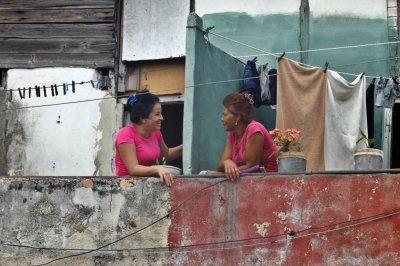

Women chat in Havana on Monday. Cuba’s national electrical grid has suffered a total collapse after a three-month halt in foreign oil shipments. Photo by Ernesto Mastrascusa/EPA
March 17 (UPI) — A magnitude 5.8 earthquake struck eastern Cuba early Tuesday, hours after the island’s national power grid collapsed, leaving nearly the entire country without electricity and compounding an already severe economic and social crisis.
The U.S. Geological Survey reported the quake at magnitude 5.8, while Cuba’s National Seismological Research Center measured it at 6.0. The epicenter was located off the coast of Guantánamo province and was widely felt across eastern Cuba.
State local newspaper Granma reported no fatalities or significant material damage.
The tremor followed the total disconnection of Cuba’s National Electric System shortly before 2 p.m. Monday, the sixth nationwide blackout in roughly 18 months. The Ministry of Energy and Mines said on X that the causes remain under investigation.
The outage left nearly 10 million people without electricity, disrupting water pumping, telecommunications and Internet service. Residents relied on candles, torches and battery-powered radios, according to a report by Mexican broadcaster TV Azteca.
The ministry said the failure affected the entire country, including Havana. The U.S. Embassy in Cuba issued a security alert saying no information was available on when power would be restored.
Energy Minister Vicente de la O Levy said on X that authorities are following established protocols and working to restore electricity to the country’s largest generating units.
Independent outlet Diario de Cuba reported that the government has yet to explain the collapse, which coincided with renewed protests in Havana and growing signs of public discontent.
Officials initially said service was being partially restored through localized “microsystems” in several provinces, prioritizing essential facilities while attempting to restart major thermoelectric plants. Full recovery could take time, especially due to fuel shortages that have limited distributed generation since January.
Frequent blackouts have slowed industrial activity and strained public services nationwide. Recent demonstrations in several cities have resulted in arrests.
Official figures show the Cuban economy has contracted more than 15% since 2020. Much of the state-run industrial sector remains idle and essential services have deteriorated sharply.
Independent experts estimate that fully restoring the power system would require between $8 billion and $10 billion, sums widely seen as beyond the reach of the Cuban economy.
Days after President Miguel Díaz-Canel acknowledged talks with the United States to address longstanding disputes, the government announced measures to allow greater entry of private capital, including from U.S. companies and Cuban expatriates in Miami.
In an interview with state-run Canal Caribe, Vice Prime Minister Óscar Pérez-Oliva Fraga said investors could own private companies on the island and access the financial sector. He confirmed that Cuban emigrants may become partners or owners of private businesses without living in Cuba and may associate with local firms under the Foreign Investment Law.
They also would be allowed to enter the national financial system, open foreign currency accounts and create cooperation and investment funds with authorization from the Central Bank.
Pérez-Oliva Fraga said the measures respond to demands from the diaspora and aim to expand its role in economic development as the government seeks to attract foreign capital and diversify the private sector.
He said “Cuba’s doors are open” to foreign investment, including U.S. companies, while again blaming the U.S. embargo for the island’s energy crisis and fuel shortages.
On Monday, President Donald Trump said he would have “the honor of taking Cuba,” describing the country as weakened after decades of rule by what he called violent leaders.
“You know, all my life I’ve heard about the United States and Cuba. When will the United States have the honor of taking Cuba? That would be a great honor,” Trump said from the Oval Office, according to CNN.
“Taking Cuba in some way, yes, taking Cuba. I mean, whether you free it or take it, I think I can do whatever I want with it,” he added.
His comments came as senior administration officials have repeatedly said a conflict with Iran could end within days and after Trump suggested that Cuba could be next on his agenda.