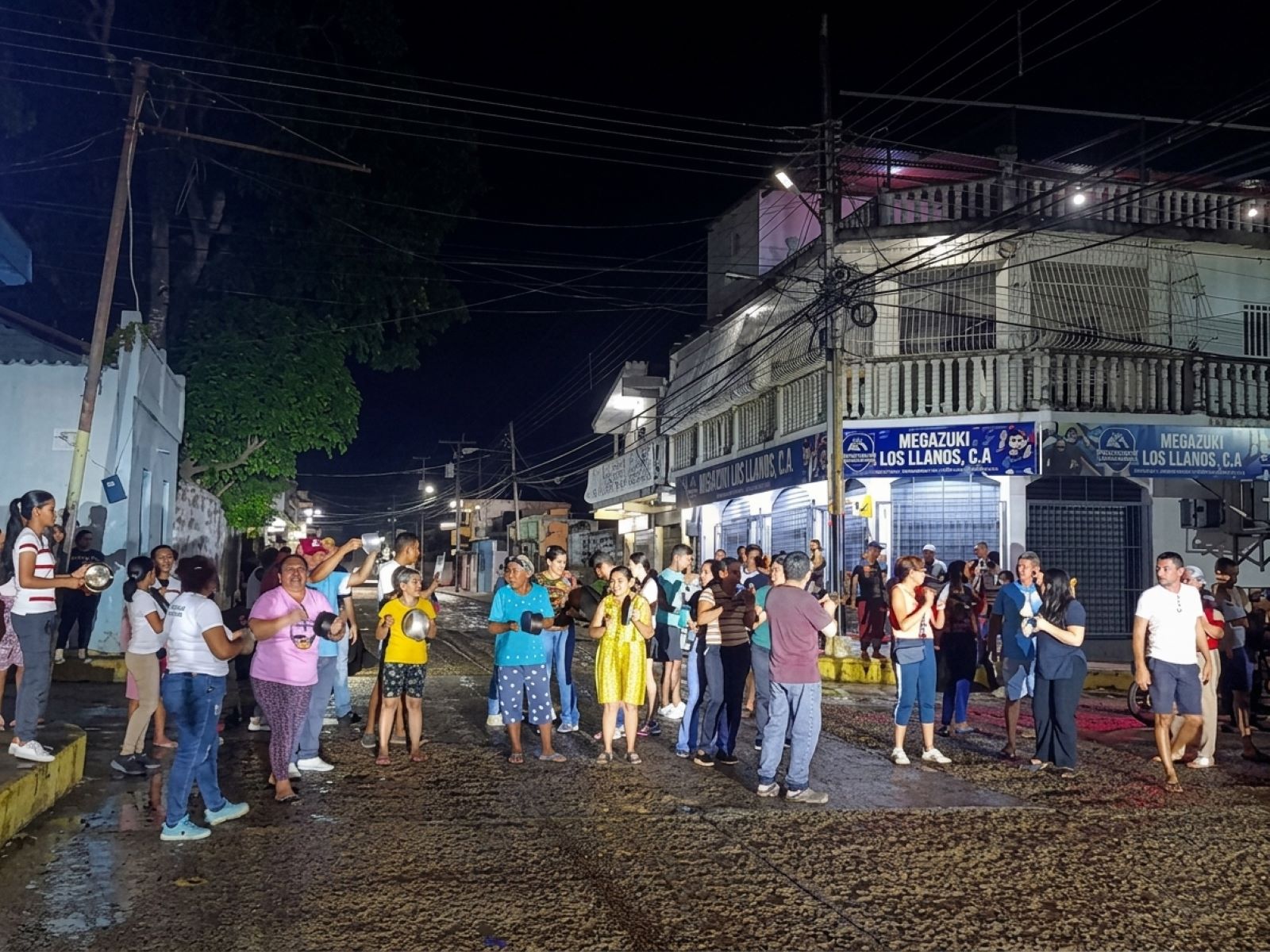
blackout

Venezuelan Gov’t Promises Electricity Improvements as Blackout Protests Increase

Venezuelan authorities have pledged to incorporate 1,300 MW into the grid by the end of the year. (Radio Fe y Alegria)

Caracas, September 30, 2026 (venezuelanalysis.com) – Venezuelan Minister of Electric Energy Rolando Alcalá announced a plan to add 1,300 megawatts (MW) to the country’s electric grid amid growing protests against recurring blackouts. 

In a televised message published on Tuesday, Alcalá pledged that the electricity supply would improve in the final quarter of 2026 to mitigate outages. He explained that a unit at Planta Centro, Venezuela’s main generation complex serving the central-western region, will come online “in the coming days” and provide 600 MW to the area.

The official also announced that seven generation units with a combined capacity of 500 MW will be added to a key thermoelectric plant in Zulia state, which borders Colombia and is one of the areas hardest hit by power failures. 

The government is also reportedly working on an alternative energy plan for the state, including the Machango solar panel park, which is expected to come online next year.

The remainder of the planned generation will come from units located in other regions of the country. 

“Other units will be brought online nationwide, for a total of 1,300 megawatts during this final quarter of 2026. These will help achieve greater stability, continuity, and fewer interruptions in electricity service nationwide,” Alcalá said in a video shared by Acting President Delcy Rodríguez on social media.

“We have a clear plan to face the challenges of the National Electric System and we are executing it,” she wrote on X. “With organization, coordination, and effort we move forward to overcome this situation.”

Meanwhile, the president of the National Electric Corporation (CORPOELEC), Juan Fernández, explained that “as a complement to the thermal generation plan, major transmission projects are being carried out.” He highlighted the expansion of the Planta Centro substation with the addition of a new 400-230 kV autotransformer, equipment that recently arrived from abroad.

“This year, we have gained access to original spare parts and components from the world’s leading manufacturers,” he added, referencing agreements with US-based GE Vernova, Germany’s Siemens, and Argentina’s Impsa. The US Treasury Department has issued sanctions waivers allowing transactions with Venezuela’s electricity sector.

The latest announcements came amid near-daily protests over power outages throughout the country. Demonstrators have taken to the streets to bang pots and pans or block streets to demand that authorities answer for blackouts that can add up to 16 hours per day.

On Wednesday night, protesters from Guacara, Carabobo State, temporarily blocked the Central-Regional Highway, the main highway connecting Caracas to Western regions, after electricity was shut off for a second time in the same day. 

In statements to local press, demonstrators have highlighted that high temperatures and mosquitoes make it hard to sleep without ventilators or air conditioning, leading children to fall asleep in school. They have also criticized authorities for not producing a rationing schedule, making it impossible for families and businesses to plan around outages.

In their Tuesday televised message, Venezuelan government officials stated that the country’s electricity demand has risen in recent weeks, driven by a “rebound in economic activity,” high temperatures caused by the El Niño climate phenomenon, and the twin June 24 earthquakes which “delayed plans that had been underway to repair the electrical system.”

On September 22, the Ministry of Electric Energy reported that electricity demand in Venezuela had reached a record high of 16,424 megawatts (MW), the highest level recorded in the past nine years.

Venezuela has a nominal installed generation capacity of approximately 35,000 megawatts (MW), twice the country’s peak demand. However, actual stable generation currently stands at just 12,000 MW due to a deep structural crisis resulting from US sanctions that prevented the purchase of spare parts, as well as issues of underinvestment, lack of maintenance, and corruption.

Nevertheless, authorities claimed that a proposed reform of the Organic Law of the National Electricity System and Service will allow “the integration of the public and private sectors in electricity generation, transmission, distribution, and commercialization,” with the aim of “promoting competitiveness, and attracting investment to strengthen electrical infrastructure.”

The new law was preliminarily approved by the National Assembly in June, with a second discussion and final approval yet to be scheduled.

The previous legislation, enacted in 2010 under President Hugo Chávez, exclusively reserved all activities across the electricity supply chain for the state, centralized through the state-owned CORPOELEC. The reform authorizes strategic partnerships and concession agreements with domestic and international private companies.

In defending the new law, Venezuelan officials have defended the adjustment of electricity tariffs to reflect “real costs” and secure returns for investors.

Edited by Ricardo Vaz in Caracas.



Source link

Fighting in northern Ethiopia spurs fears of blackout and blockade | Conflict News

Tigray was cutoff from the world during the 2020-2022 civil war, which killed around 600,000 people.

Fears of a communications blackout in northern Ethiopia have increased as fighting flares between the federal military and forces from the Tigray region and ⁠their allies.

Telecom and internet networks were reported to have stopped working on Friday as the conflict threatened to develop across the country into a full-scale war.

Recommended Stories

list of 4 itemsend of list

The interruptions have provoked fears of a repeat of the communications blackout and supplies blockade during the 2020-2022 civil war in ⁠northern Ethiopia, when Tigray was largely cut off from the outside world.

Web monitor NetBlocks said it had detected an “internet disruption in northern Ethiopia corresponding to reports of a telecoms blackout in Tigray”.

The Reuters news agency reported that Tigray’s ruling party, the Tigray People’s Liberation Front, had ordered private operator Safaricom and state-owned Ethio telecom to cut off access ⁠to phone and internet networks in the region.

Full-scale war

A source said the restrictions may be part of a tactic to neutralise the advantage of government forces using battlefield drones.

Lower-level clashes between federal and Tigrayan forces have been ongoing for some time. However, fighting intensified this week across Tigray and later spread to the neighbouring Afar and Amhara regions, after seven armed groups announced they have formed an alliance.

The Ethiopian Peoples’ Forces Alliance for Survival has committed itself to removing the government of Prime Minister Abiy Ahmed.

The Tigray Army said the federal government had launched a “full-scale offensive” involving infantry, mechanised units and drones, and said its forces had begun what they called a defensive war to counter aggression by Abiy’s government.

The alliance forces have seized three airports and launched attacks against ⁠federal troops in Afar and Amhara.

The ⁠federal government has accused Eritrea of financially backing the TPLF and its allies, which leaders in the capital Asmara deny.

Abdisalam Balema, a member of the Tigray People’s Liberation Front’s (TPLF) central committee, told Al Jazeera that the situation has become a “full war”.

The outbreak of violence is the most serious escalation ⁠since the civil war in 2020-2022. During that conflict, which killed an estimated 600,000 people, the telecoms blackout and supplies blockade imposed on Tigray caused famine-like conditions for hundreds of thousands of people.

People in Tigray are reported to have rushed to stock up on basic supplies and withdraw cash.

The renewed fighting comes at an awkward moment for the United States, which only this month lifted sanctions on Ethiopia and Eritrea related to atrocities committed during the last civil war, saying the “national emergency… has expired”.

The conflict could also draw in neighbouring Eritrea, which fears landlocked Ethiopia is planning to invade it to gain access to the Red Sea.

Source link

Cuba works to restore power after another major nationwide blackout | Energy News

The outage marks at least the sixth one this year after a United States-imposed energy blockade went into effect.

Cuba has worked to restore power after suffering a significant blackout that left many parts of the country in the dark.

The state-run company in charge of operating the country’s electrical system, Union Electrica (UNE), said nearly half of its customers in the capital of Havana had regained power on Saturday.

Recommended Stories

list of 3 itemsend of list

“The re-establishing is being done gradually, as conditions permit,” UNE posted on social media.

The latest blackout, at least the 12th since late 2024, first affected five of Cuba’s eastern provinces, including Havana, before spreading across the whole island. It is at least the sixth this year alone.

Cuban authorities told the Reuters news agency on Friday the collapse was the result of a failure in high-voltage transmission lines in the central part of the country. UNE said “unstable weather conditions” also played a role.

For years, Cuba’s ageing infrastructure and fuel shortages have led to sporadic blackouts. But power outages have become more frequent after the United States, in a bid to put political and economic pressure on the country’s government, imposed an energy blockade in January.

United Nations human rights experts have condemned the US oil blockade, calling it a violation of international law and warning ‌that ‌Cuba risks becoming a “silent Gaza” as shortages and blackouts grow ever more critical.

Some of the island’s residents said they were already out of power when Friday’s blackout happened.

“Yesterday, I’d gone without power for 24 hours. They turned the lights on for an hour, and then the grid collapsed,” Havana resident Frank Lorenzo, 23, told Reuters.

Others, like Lidia Fernandez, told the news agency AFP that a lack of fuel makes it difficult to power backup generators, which run on imported diesel.

“It’s one thing after another: no water, no gas for cooking, no electricity,” the 36-year-old teacher said.

Fernandez added, “Honestly, I don’t know how we haven’t gone crazy.”

Source link