Riverside-based radio station, 99.1 KGGI, has lost its last local on-air host.
Longtime radio personalities Evelyn Erives, Nick Nack and Garrison King were all cut from the Inland Empire station last week as part of iHeartMedia’s latest round of national layoffs. In an internal memo, the media giant said it would restructure its radio programming to better “leverage” the company’s technology.
iHeartMedia declined to comment on how many people lost their jobs, but dozens of on-air and other staff positions have reportedly been cut across the country.
The memo — attributed to Chief Programming Officer Tom Poleman and Ann Marie Licata, the chief executive of the company’s multiplatform group — framed the changes as a way to “move faster and operate with greater precision across markets,” and to “position us not just to adapt to the future, but to lead it.”
The cuts are part of a broader push to reduce costs. In May, iHeartMedia launched a new savings program, set to begin in the second half of 2026, aimed at trimming an additional $50 million on top of the $100 million in savings the company had already announced.
iHeartMedia is the nation’s largest radio operator, with more than 850 stations across 160 markets and a sizable presence in Burbank. Its Los Angeles–area stations include KFI-AM 640, KLAC-AM 570, KOST-FM 103.5 and KIIS-FM 102.7.
As the media landscape continues to evolve, the company has leaned harder into podcasting, home to hallmark shows like “Stuff You Should Know,” “Questlove Supreme” and “Las Culturistas.”
Last year, iHeartMedia introduced its “Guaranteed Human” campaign, an ongoing pledge that no iHeartMedia station or podcast will feature an AI-generated personality or AI-generated music.
How that promise squares with the layoffs is unclear. With stations like Riverside’s 99.1 now stripped of their local hosts, the company has said nothing about who — or what — will replace them.
Retirees have protested outside CANTV headquarters throughout the country. (Ronaldo Díaz)
Caracas, June 23, 2026 (venezuelanalysis.com) – Thousands of retired workers from Venezuelan state telecommunications company CANTV have staged protests in recent days to demand the restoration of a monthly “income complement” payment.
On Thursday, CANTV suspended the US $200 monthly payment with no prior notice. The measure prompted emergency rallies outside the firm’s headquarters in Caracas, Barquisimeto, Valencia, and several other Venezuelan cities on Friday.
Active workers received the bonus as scheduled, though many joined the protests in solidarity.
The cutback reportedly affected around 10,000 retirees for whom the bonus represents over 70 percent of their monthly income. Many told reporters that the unjustified cutback placed an immediate strain on day-to-day survival, especially for those suffering from chronic illnesses.
The swift grassroots response prompted the company to backtrack and pay the retired workers $150 over the weekend. The CANTV retired workers’ plight also drew support from the World Federation of Trade Unions.
“The company thought that we would be the weakest link in their bid to cut costs at the workforce’s expense,” retiree Arturo Morgado told Venezuelanalysis. “But the protests all over the country told a different story.”
Monday saw around 300 workers demonstrate again outside CANTV headquarters in Caracas. A commission from FETRAJUTEL, a trade union representing the firm’s retired workforce, met with the CANTV board but received no commitment that the remaining $50 will also be paid.
The announcement led protesters to temporarily block Libertador Avenue in central Caracas, vowing to maintain the pressure until the full bonus is restored.
“We are going to continue fighting, for the entire bonus and for other rights established in our collective bargaining agreement, including financial support for medical expenses and incomes that cover the cost-of-living,” Morgado added. “The company put these commitments in writing in a meeting with unions in late 2023.”
The former CANTV technician highlighted the “moral strength and honesty” of the retired workforce and warned that the present bonus-over-wage government policies leave workers vulnerable to discretionary cuts. Morgado’s social security pension is worth 570 bolívars per month, less than $1 at the present exchange rate.
With the Venezuelan economy heavily sanctioned by the US, the Nicolás Maduro government increasingly turned to non-wage bonuses while letting the minimum wage continuously devalue. Trade unions have criticized the policy for cheapening labor costs for employers and contravening the existing labor law.
Since taking over in January, after the US kidnapping of Maduro, Acting President Delcy Rodríguez has maintained the policy. On May 1, she increased the minimum monthly income for public sector workers to the official bolívar-equivalent of $240 a month, while pensioners received $70. Public sector retirees are entitled to $170 monthly, but in certain cases, like CANTV, they have secured improvements in direct negotiations with the company.
The labor dispute comes amid a controversial effort by the Rodríguez administration to “reengineer and restructure” the Venezuelan state, including public companies such as CANTV. The state telecoms provider was privatized in 1991 under the terms of IMF-imposed structural adjustment and partially acquired by a consortium headed by GTE, today Verizon. CANTV was re-nationalized by the Hugo Chávez government in 2007 and is currently under the purview of the Ministry of Science and Technology.
Education Minister Héctor Rodríguez, tasked by Miraflores with leading the state reform commission, recently sought to allay fears of massive public sector layoffs. He instead suggested that workers might be “strategically relocated and retrained” in order to improve the public sector efficiency.
The acting administration has likewise launched a process to determine the “strategic” value of state-owned assets. A commission, featuring government officials and private sector representatives, will recommend whether the state should retain ownership of firms, land estates, and other assets or open them for privatization.
Financial advisory group Orinoco Research identified CANTV as a prime candidate for privatization, while libertarian think tank CEDICE Libertad called the prior sale of the telecom company a “model to replicate.” The 1991 privatization was followed by a process of asset stripping that dismantled the firm’s regionally advanced technical base and institutionalized outsourcing and arbitrary firings.
BRITISH holidaymakers going to France may be forced to cover their bare chests or risk being slapped with a £130 (€150) fine.
Men have been banned from walking around shirtless in several seaside resort towns – with one mayor citing concerns over hygiene and decency.
Sign up for the Travel newsletter
Thank you!
Tourists and locals alike ripped their shirts off amid blistering temperatures in July last yearCredit: GettyA shirtless tourist at a water fountain in ParisCredit: Alamy
Topless sunbathing is still legal in France – but around 20 towns are clamping down on locals and tourists from baring their chests in city centres.
The glamorous resort of Deauville has hiked up its token fine of £15 (€17) to a heftier £130 (€150).
And in the southern French city of Narbonne – which last year saw blistering highs of 43 degrees – men are barred from going shirtless all summer.
The ban came into force on Monday and will end only at the end of September.
The mayor of the resort town claimed it was common sense for a tourist hotspot to crack down on bare-chests.
“It’s about hygiene and avoiding exhibitionism,” he said.
One Narbonne restaurant owner hailed the crackdown as “a very good thing”, saying that “this isn’t something the staff of our café can easily police on their own without getting into arguments with customers”.
“Having bare-chested guys on the terrace can put off other customers”, added Anthony Hill, 53, who runs Le 89 cafe in the city centre.
But as a heatwave swept across the holiday hotspot – hitting highs of 34 degrees – not everyone welcomed the ban.
Tourists cool off in the fountains opposite the Eiffel TowerCredit: AFPTwo women marching shirtless at a Gay pride event in 2019Credit: Alamy
“This excessive puritanism is disturbing. Let people live a little. A bare chest never killed anyone”, complained one user named Gabriel on X.
Another seaside port – La Grande‑Motte – has imposed the same restriction and local resident Marie welcomed the change with open arms.
“If I’m out with my kids in the town centre I really don’t want to see guys without shirts. It’s a matter of decency — and there’s also the smell when they walk past you”, the 37-year-old told French TV.
But one holidaymaker, 55, questioned whether the £130 (€150) was “a bit steep” – though he added that he found rule logical.
French law forbids women from going topless – but there is no nationwide ban on men’s shirtlessness.
If a woman walks around bare-chested anywhere other than on a beach she risks being arrested for “sexual exhibitionism” and thrown in jail.
She may also be charged a fine of around £13,000 (€15,000).
In 2020 a row erupted across the nation after cops asked three topless women sunbathing on a southern French beach to cover up.
A family had complained that the women’s bare breasts had upset their children – but when police took action they were blasted for betraying the “French way of life”.
WASHINGTON — A year after the Trump administration kicked off its aggressive immigration enforcement tour with military-style raids across greater Los Angeles, federal officials have veered toward a less flashy but broader strategy: making immigrants’ lives harder so they will leave.
The changes range in scale and scope, from disqualifying immigrants from certain jobs to indefinitely pausing the processing of visa applications. They target those lawfully present as well as the undocumented.
Since President Trump’s second term began, the administration has used executive orders and federal regulations to chip away at services or benefits, such as work permits and small business loans, that immigrants could obtain in the past.
Now, immigrants are finding that freedoms — the ones that once made the U.S. a desirable place to start over — are disappearing. Many are retreating back into the shadows as they fear previously routine tasks, such as traveling across states, filing taxes and seeking medical care.
“The priority is to force people to leave the country or not come, regardless of legal status or really any other criteria,” said David Bier, immigration studies director at the Libertarian think tank the Cato Institute. “They’re taking a sledgehammer to the system.”
Trump won the White House in part on his promise to clamp down on illegal immigration, but recent polling shows support for his agenda has waned, especially after immigration agents shot and killed two U.S. citizens in Minneapolis.
In a statement, White House spokesperson Abigail Jackson said Trump’s highest priority has always been the deportation of immigrants with criminal records. The Department of Homeland Security said Trump also prioritizes immigration that strengthens the country financially, socially and culturally.
President Trump displays the signed “Secure America Act” during a ceremony in the Oval Office on Wednesday. The act provides $70 billion for immigration enforcement and border-security agencies.
(Aaron Schwartz / CNP, Bloomberg)
The number of arrests by ICE agents has declined. On average, ICE arrested about 1,000 immigrants per day in early March, down from a peak average of just under 1,400 in mid-January, agency data show. And there are fewer detained immigrants — facilities across the country held about 60,000 detainees in April, compared to more than 70,000 in late January.
The downturns prompted some Trump loyalists to say the administration is failing to fulfill his signature promise, which is an assertion the administration rejects.
“ICE is NOT slowing down,” said Homeland Security spokesperson Lauren Bis. “Since Day One, DHS law enforcement has been delivering on President Trump’s promise to the American people to arrest and deport criminal illegal aliens.”
At a border security conference last month, Tom Homan, who leads border policy for the White House, suggested immigration agents would return to more muscular enforcement tactics.
“You ain’t seen s— yet,” he told the audience.
But along with focusing on deportations, the administration is deploying other tactics to deter illegal — and legal —immigration.
ICE agents confront protesters on June 8 as they gather outside the federal immigration center at Delaney Hall in Newark, New Jersey, where ICE is housing detained immigrants.
(Spencer Platt / Getty Images)
Curtailing visas
Last month, the Department of Homeland Security announced that “except in extraordinary circumstances,” immigrants seeking lawful permanent residency must leave the U.S. to complete the process. After a backlash, the administration defended the policy, saying it won’t prevent anyone who qualifies for a green card from getting one.
U.S. Citizenship and Immigration Services, the agency in charge of processing immigration benefits, has upped security screening since Trump took office. The agency says that’s to root out fraud, but critics say all it does is unnecessarily slow down a system that already vets applicants vigorously.
The administration indefinitely banned people from 75 countries from receiving immigrant visas, which allow people to move permanently to the U.S.
In a similar move, the government halted the processing of immigration applications for people from 39 countries and who are already in the U.S. On June 5, a federal judge struck down the policy in a scathing ruling that said the administration “justifies its actions with pretextual concerns of ‘national security’ that mask anti-immigrant sentiments.”
Children of Guatemalan origin, from left, Areimy, Mariela and Enrique, arrive at Miami International Airport on Dec. 4, 2025, as they prepare to leave the United States to reunite with their recently deported parents in Guatemala.
(Chandan Khanna / AFP via Getty Images)
The judge’s ruling may offer relief, but for many immigrants, the effects of the policy are devastating. Armin, a 42-year-old from Iran, said he has racked up more than $15,000 in debt since the pause took effect in December. Armin asked The Times not to fully identify for fear of jeopardizing his immigration case.
The nutritional scientist came to the U.S. in 2019 on a student visa and has a pending green card application under a provision that allows certain highly skilled immigrants to apply for permanent residency without needing an employer to sponsor them.
After receiving his PhD and completing a postdoctoral program, Armin was in between jobs when he received a research grant in November. But with the processing of his work authorization halted, the university that issued the grant said it couldn’t hire him as a research associate. In February, he was turned down for another job.
Armin said he is confused about why the administration won’t differentiate between legal immigrants and those who should be deported.
“I can’t believe it,” he said. “I’m doing research and my research has national interest benefits. You expect support from the government. Unfortunately they don’t differentiate. They don’t care about your resume.”
Bier said the visa policies affect half of all legal immigrants coming from abroad. He published a report in April about how Trump has cut legal immigration far more than illegal immigration, noting that the administration’s policies have led to big drops in visas for international students, high-skilled workers and refugees.
“The legal immigration system is being used as a means to carry out the mass deportation agenda,” he said.
Alessandro Negrete, who lived most of his life in the U.S. undocumented, crosses into Mexico after deciding to leave.
(Robert Gauthier / Los Angeles Times)
Encouraging self-deportation
More than 90,000 immigrants have been granted voluntary departure since the start of the Trump administration, according to federal immigration court data through April that was analyzed by TRAC, a data research organization. Voluntary departure avoids official deportation and can leave open the possibility of an immigrant returning to the U.S. legally.
Homan, who declined to be interviewed for this story, has said self-deportations were part of the administration’s immigration plan all along.
“We knew if we surged unlimited ICE resources in the interior, and we do these operations, that that will force those that are here illegally to leave on their own,” he recently told the Washington Examiner.
Halting work permits
In the past, asylum seekers and others with deportation protections have had the ability to seek permits to work legally in the U.S. But work is now an administration target.
One proposed regulation would prevent asylum seekers from working legally in the U.S. Another proposal, published Friday, would further restrict access to work permits for other immigrants.
Under a rule that took effect last month, asylum seekers pay an annual $102 fee within 30 days of receiving a notice from U.S. Citizenship and Immigration Services. If the deadline is missed, their applications will be rejected — with no opportunity to appeal — and they could be placed in deportation proceedings. Those who apply for asylum with the agency have entered the U.S. legally, such as on a visa, and are not undocumented.
Asylum seekers rest at a Tijuana migrant shelter a day after President Trump began his second term in the White House.
(Robert Gauthier/Los Angeles Times)
Conchita Cruz, co-executive director of the Asylum Seeker Advocacy Project, said many asylum applicants have not received notice that the fee is due.
Cruz said she believes the Trump administration is using these changes as an excuse to dismiss people’s asylum claims. While the president has the power to decide whether to offer or rescind humanitarian programs, such as Temporary Protected Status, the right to seek asylum is enshrined in law.
“We’re worried this is a pretext for people to fall out of the asylum system and fall out of the workforce,” she said.
The processing of work permits has already been slowed, leaving many immigrants who still qualify for employment authorization unable to work.
During a House Homeland Security Committee hearing last week, Rep. Lou Correa (D-Santa Ana) asked Homeland Security Secretary Markwayne Mullin to help him speed up the work permit renewals for two police officers who were recently fired by agencies in his district because their DACA status expired.
Mullin said he would help but that Congress ultimately must pass a permanent solution for DACA recipients.
“These are police officers on Main Street, sir,” Correa responded.
“Not all of them are,” Mullin said. “I’m not just going to wave a magic wand and fix them all.”
“You have that magic wand — that’s your job,” Correa said.
It wasn’t just Democrats complaining about slow processing. Rep. Gabe Evans (R-Colo.) similarly asked Mullin for help because many of his constituents — “farm workers, youth ministers, nurses, grocery store business managers” — who have lived and worked in the U.S. legally for decades are now having trouble renewing their visas.
Secretary of Homeland Security Markwayne Mullin, left, and President Trump, center, walk to the motorcade after exiting Air Force One at Joint Base Andrews, Maryland, on May 20.
(Kent Nishimura / AFP via Getty Images)
Calls for mass deportations
Mullin, who took the reins in March after Trump fired his predecessor, Kristi Noem, rolled back some of Noem’s policies, including telling agents to stop entering homes without judicial warrants and canceling some contracts she had initiated.
But the changes and the downturn in arrests have drawn criticism from some fervent Trump supporters.
“Trump’s legacy is tied up in this,” said Mike Howell, a former DHS attorney who founded a group called the Mass Deportation Coalition. “It’s going to be hard to tell a younger voter to get excited to show up when one of their top issues is mass deportation and, a year and a half in, it doesn’t appear it’s going full-steam ahead.”
Howell said enforcement at work sites is critical to scaling up arrests and deportations. That more such operations haven’t happened, he said, is a political decision to appease wealthy donors and special interest groups who don’t want to see their workers deported.
The architect of Trump’s immigration agenda is Stephen Miller, a top White House aid who has called for a “moratorium on immigration from third-world countries,” demanded 3,000 arrests per day and said that immigrants and their descendants “recreate the conditions, and the terrors, of their broken homelands.”
Royce Bernstein Murray, a former Homeland Security official who worked on immigration policy under the Biden administration, said the winding down of flashy enforcement surges has given the administration more time to “focus on tearing down the legal immigration system.”
“This is Stephen Miller’s sweet spot,” she said. “He was never in enforcement — he’s a policy guy. This is really an opportunity for him to make good on all he has planned for years.”
While ICE has, in recent months, returned to its more conventional targeted enforcement tactics, Homan has sought to make clear that mass deportations are still a goal.
“For the people out there saying ‘President Trump’s getting weak on mass deportation,’ you don’t know what the hell you’re talking about,” Homan said at the border expo.
On Monday, Homan told Fox News that he had just reviewed plans for an ICE operation that would surge agents to New York City.
A nationwide strike has started across Portugal todayCredit: APAirports in Lisbon, Porto and Faro have been affected by flight cancellations (stock image)Credit: Alamy
The strikes follow a proposed labour legislation change, which they claim are an “assault on workers’ rights”.
Airlines have been forced to cancel flights already, with TAP Portugal warning earlier this week that 500 flights would be cancelled and only 79 flights would be running.
Nearly 100 flights have been cancelled to and from Lisbon Airport already.
This includes a number of UK arrivals and departures including:
7:20am Lisbon to London Heathrow with British Airways
10:05am London Heathrow to Lisbon with British Airways
11am Lisbon to London Heathrow with British Airways
2:30pm London Heathrow to Lisbon with British Airways
3:15pm Lisbon to London Heathrow with British Airways
4:25pm Lisbon to London Heathrow with British Airways
11pm London Heathrow to Lisbon with British Airways
EasyJet and Ryanair flights are yet to be affected, but more may be cancelled throughout the day.
Nearly 60 flights to and from Porto Airport have been cancelled, including Ryanair flights, although no UK routes have been affected yet.
Faro Airport is also seeing cancellations , affecting around 40 arrivals and departures.
These include:
6:50pm London Gatwick to Faro with British Aiways
7pm Leeds to Faro with Ryanair
7:35pm Faro to Leeds with Ryanair
7:40pm Faro to London Gatwick with British Airways
More than 200 flights have already been cancelledCredit: AlamyCancelled flights from the UK include Ryanair and British AirwaysCredit: Alamy
Along with cancellations, there are lots of delays as well.
easyJet warned passengers that passengers should expect “some disruption” throughout the day.
They told Sun Travel: “Due to a national strike in Portugal on 3 June, like all airlines operating to and from the country we can expect some disruption to our flying programme.
“We will be doing all we can to minimise the impact of the strike action and will contact customers directly with their options if their flights are affected.
“While this is outside of our control we are sorry for any inconvenience this strike action may cause.”
Other public transport services are also being affected in the country.
Lisbon Metro said no train services will run at all today, wile the Porto Metro will have “limited services”
The strike could also cause problems in the coming days due to a knock on effect.
French Ministry of Interior says 416 people detained nationwide, including 283 in Paris, after PSG’s win over Arsenal.
Published On 31 May 202631 May 2026
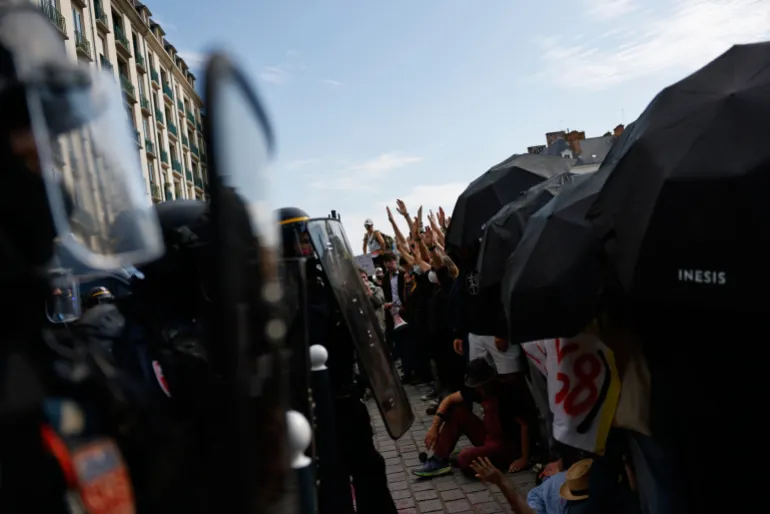
Police in France have detained more than 280 people in Paris after violent clashes erupted when thousands poured onto the streets after Paris Saint-Germain’s victory in the Champions League final.
About 22,000 police were deployed across France for the game on Saturday, including 8,000 in Paris, after unrest marred PSG’s win in the competition last year. Paris tram lines were halted, several metro stations shut and bus traffic halted in places in a bid to minimise disturbances.
Recommended Stories
list of 4 itemsend of list
According to the French Ministry of the Interior, 416 people were detained nationwide, including 283 who were apprehended in Paris. It was not immediately clear how many of these individuals were remanded in custody to face further investigation.
Interior Minister Laurent Nunez said seven officers were wounded and called the unrest “absolutely unacceptable”.
Six vehicles and two businesses were damaged.
A group of supporters also stormed the Paris ring road, the Boulevard Peripherique, bringing traffic to a halt for a time and setting off flares.
PSG supporters drive their scooters past antiriot police at the Place du Trocadero in Paris [AFP]
As fans celebrated the dramatic penalty shootout victory in the Hungarian capital, Budapest, about 20,000 people converged on Paris’s Champs-Elysees avenue, police said.
Shops boarded up their windows before the match to avoid a repeat of disturbances last year when youths ransacked shops on the Champs-Elysees and other streets. Hundreds of people were arrested.
Two dozen flares and about 100 fireworks were seized on Saturday while a bus shelter was destroyed near the Champs-Elysees.
The match was played on a hectic evening in Paris with singer Aya Nakamura performing at the Stade de France national stadium, rapper Damso at the La Defense Arena and the French Open tennis tournament in full swing.
Police said a bakery and a restaurant were damaged near PSG’s Parc des Princes stadium, where tens of thousands of people had gathered inside to watch the match. Another 4,000 to 5,000 people loitered outside with projectiles that were thrown at officers.
About 150 people “attempted to enter through one of the gates” at the stadium, but police pushed them back, a police spokesperson said.
Some also tried to erect a barricade with rental bikes, which was cleared by police.
Clashes broke out between police and supporters near the stadium, and officers responded with tear gas when fireworks were thrown at them.
PSG supporters gather on the Champs-Elysees after the club’s win [Romeo Boetzle/AFP]
‘Only in France’
The scenes angered the French far right. Three-time presidential candidate Marine Le Pen wrote on X that “only in France does a football club’s victory spark riots.”
“Only in France does everyone feel compelled to lock themselves in their homes on the evening of a victory to avoid being confronted with violence,” she added.
Nunez said there was a “very robust, very solid system in place” to curb violence.
“Our responsibility is to guarantee everyone a festive celebration that is calm and fully secure,” a police spokesperson said.
PSG’s players will take part in a parade on Sunday afternoon on the Champ de Mars in front of the Eiffel Tower in front of an expected crowd of 100,000 people before they are received by President Emmanuel Macron at the Elysee Palace.
May 1 (UPI) — May Day demonstrations are expected Friday, as organizers call for boycotts of school, work and shopping in protest of the Trump administration’s policies.
The May Day Strong protests are to mark International Labor Day. While Labor Day in the United States is in September and is a celebration of the achievements of organized labor, May Day — May 1 — is traditionally a day of protest.
The message this year is that the United States should be “focusing on workers over billionaires,” National Education Association President Becky Pringle told NPR.
“We know there are bus drivers in New York and teachers in Idaho and nurses in Louisiana who are feeling the impact of a system that has decided … to put billionaires ahead of everyone else,” she said.
More than 500 labor unions, student groups and community organizations are expected to participate, organizers said.
A student group, Sunrise Movement, said on X that more than 100,000 students were expected to miss school in the one-day strike. The organization said it is made of “young people fighting fascism to win a Green New Deal.”
This year, rising prices and stagnant wages make this year’s protest especially important, Terrence Wise, an organizer with Missouri Workers Center in Kansas City, Mo., told USA Today.
“If you want to see real change, you’ve got to be a part of the solution. Because if you’re not out organizing and you’re not out in the streets and you’re not talking to your neighbors, you’re part of the problem,” Wise said.
May Day began in Chicago in 1886 as a protest demanding an eight-hour workday and is celebrated around the world.
“People have figured out who’s rigging the game and are taking action,” People’s Action Executive Director Sulma Arias told USA Today. “What we expect is people to come out and deliver a clear message. … They understand that they’re seeing broken promises by an administration that promised to make things more affordable. And yet none of that has happened for everyday people who are still struggling.”
White House spokesperson Kush Desai said the administration of President Donald Trump supports workers.
“The Trump administration has never wavered from standing up for American workers, from renegotiating broken trade deals to securing trillions in manufacturing investments to slashing taxes on overtime to securing our border. President Trump will always have the backs of American workers,” Desai said.
Groups arrive to participate in a May Day protest to voice concerns on issues ranging from actions of the Trump Administration, immigration, social issues, the Iran war, among others in Chicago, on May 1, 2026. May first is also known at International Workers Day. Photo by Tannen Maury/UPI | License Photo
NEW ORLEANS — A federal appeals court has restricted access to one of the most common means of abortion in the U.S. by blocking mailing of mifepristone prescriptions.
Friday’s unanimous ruling from a three-judge panel of the New Orleans-based 5th U.S. Circuit Court of Appeals is requiring that the abortion pill be distributed only in person and at clinics, overruling regulations set by the federal Food and Drug Administration.
The ruling, which is likely to be appealed to the U.S. Supreme Court, is the biggest jolt to abortion policy in the U.S. since the 2022 Supreme Court ruling that overturned Roe vs. Wade and allowed states to enforce abortion bans.
In the ruling, Judge Kyle Duncan, who was appointed by President Trump, agreed with the state of Louisiana’s contention that allowing the drug to be mailed there makes moot the state’s ban on abortion at all stages of pregnancy.
“Every abortion facilitated by FDA’s action cancels Louisiana’s ban on medical abortions and undermines its policy that ‘every unborn child is a human being from the moment of conception and is, therefore, a legal person,’” the ruling states.
Commonplace treatment
Mifepristone was approved in 2000 as a safe and effective way to end early pregnancies. It is typically used in combination with a second drug, misoprostol.
Surveys have found that the majority of abortions in the U.S. are provided via pills and that about 1 in 4 abortions nationally are prescribed via telehealth.
One survey of abortion providers last year estimated that more women in states where abortion is banned obtained abortions that way than by traveling to other states.
Some Democratic-led states have laws that seek to protect providers who prescribe via telehealth to patients in places with bans.
That rise in prominence is why abortion opponents have targeted the pills in legislation and litigation.
Little precedent
There is little precedent for a federal court overruling the scientific regulations of the FDA, and it wasn’t immediately clear how quickly or completely the decision would affect mailing of the drug throughout the country.
Judges have long deferred to the agency’s judgments on the safety and appropriate regulation of drugs.
FDA officials under Trump have repeatedly stated that the agency is conducting a new review of mifepristone’s safety, at the direction of the president.
The judges, all nominated by Republican presidents, noted in their ruling that the FDA “could not say when that review might be complete and admitted it was still collecting data.”
Because of rare cases of excessive bleeding, the FDA initially imposed strict limits on who could prescribe and distribute the pill — only specially certified physicians and only after an in-person appointment where the person would receive the pill.
Both requirements were dropped during the COVID-19 emergency. At the time, FDA officials under President Biden said that after more than 20 years of monitoring mifepristone use, and reviewing dozens of studies involving thousands of women, it was clear that women could safely use the pill without direct supervision.
GenBioPro, which makes generic mifepristone, said in a statement that the court’s decision “ignores the FDA’s rigorous science and decades of safe use of mifepristone in a case pursued by extremist abortion opponents.”
Broader impact
In a court filing, Louisiana’s attorney general and a woman who said she was coerced into taking abortion pills requested that the FDA rules be rolled back to when the pills were allowed to be prescribed and dispensed only in person.
A Louisiana-based federal judge last month ruled that those allowances undermined the state’s abortion ban but stopped short of undoing the regulations immediately.
Friday’s ruling is in effect as the case works its way through the courts and extends beyond Louisiana and other states with abortion bans.
Telehealth prescriptions have become common even in states where abortion is allowed — and the ruling blocks them there, too.
“This is going to affect patients’ access to abortion and miscarriage care in every state in the nation,” said Julia Kaye, an ACLU lawyer. “When telemedicine is restricted, rural communities, people with low incomes, people with disabilities, survivors of intimate partner violence and communities of color suffer the most.”
The National Right to Life Committee said the ruling “restores a critical layer of oversight” in women’s health.
“Women deserve better than an abortion-by-mail system that prioritizes ideology over safety,” said Carol Tobias, the group’s president.
Next step
Friday’s ruling sets up a likely appeal to the Supreme Court.
“I look forward to continuing to defend women and babies as this case continues,” Louisiana Atty. Gen. Liz Murrill, a Republican, said in a statement.
The conservative-majority high court overturned abortion as a nationwide right in 2022 but unanimously preserved access to mifepristone two years later.
That 2024 decision sidestepped the core issues, however, by ruling that the antiabortion doctors behind the case didn’t have legal standing to sue.
Representatives for the FDA and the U.S. Department of Justice did not immediately respond to requests for comment Friday evening.
In the meantime, antiabortion groups are celebrating Friday’s ruling. Marjorie Dannenfelser, president of Susan B. Anthony Pro-Life America, applauded the ruling as “a huge victory for victims and survivors of Biden’s reckless mail-order abortion drug regime.” She also criticized the Trump administration for taking time to conduct its own review of mifepristone, saying its slow movement has forced states to take action.
“Women and children suffer and state sovereignty is violated every day the FDA allows abortion drugs to flood the mail,” Dannenfelser said.
Mulvihill and Schoenbaum write for the Associated Press. AP writers John Hanna, Matthew Perrone and Lindsay Whitehurst contributed to this report.
April 24 (UPI) — Hundreds of rallies are planned nationwide on Saturday as part of a “Communities Not Cages” action aimed at protesting the number of people detained by Immigration and Customs Enforcement.
The protests come amid ICE’s plans to construct eight new detection centers and 16 processing centers, adding at least 116,000 beds to the number the agency has available for detaining people who are allegedly in the country illegally, Axios reported.
At the end of March, No Kings held its third protest — which saw more than 3,000 simultaneous demonstrations across the United States — since President Donald Trump retook office and engaged in a crackdown on immigration.
Detention Watch Network, the organization behind this Saturday’s rallies, called the scouting, purchasing and retrofitting of warehouses to detain between 1,500 and 10,000 people each “particularly horrifying.”
“Shockingly, ICE’s budget now exceeds many militaries around the world,” the organization said on its website.
“In the face of the administration’s unrelenting expansion of immigration detention, communities across the country are demanding to shut down detention centers and halt detention expansion,” it said.
One local group that is coordinating with Detention Watch Network’s “Communities Not Cages National Day of Action” is Shut Down Etowah, a group that previously protested the Biden administration until it stopped detaining people there, AL.com reported.
The Etowah County, Ala., facility is “too broken to be fixed,” the group said this week in a press release, noting that its’ “atrocious” conditions include bed bugs, 23-hour lockdowns and light fixtures that have not been fixed.
ICE earlier this year said it was launching a program under section 287(g) of the Immigration and Nationality Act after lauding its 2025 record of motivating 2.5 million alleged illegal immigrants to leave the country, more than 600,000 of whom were arrested and deported.
Thousands of protesters march in sub-zero temperatures during “ICE Out” day to protest the federal government’s immigration enforcement surge in Minneapolis, Minnesota on Friday. Photo by Craig Lassig/UPI | License Photo