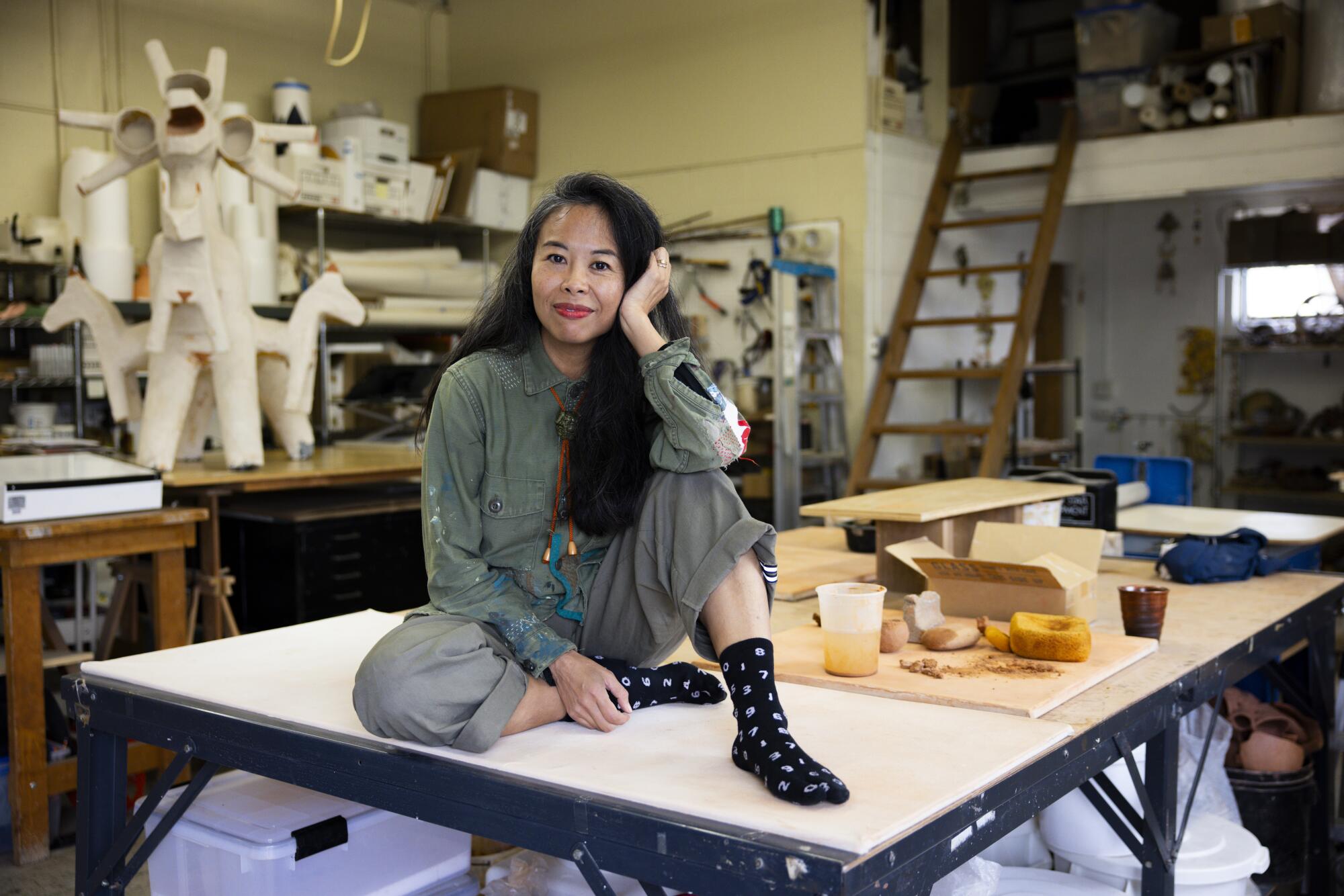
Artist Ako Castuera is best known for her work on the award-winning animated series “Adventure Time.” As a writer and storyboard artist, she helped intrepid heroes Jake the Dog and Finn the Human become iconic toon characters.
Though she brought flying rainbow unicorns and a platoon of plotting penguins to life on screen, there’s more to Castuera’s resume than hyper-imaginative animation.

Ceramist, writer and storyboard artist Ako Castuera in her studio.
(Kayla Bartkowski / Los Angeles Times)
The Echo Park-based creative is also a professional ceramicist whose hand-built vessels and sculptures have been on display at the Japanese American National Museum of Art, Oxy Arts and the Oakland Museum of Art.

In this series, we highlight independent makers and artists, from glassblowers to fiber artists, who are creating original products in and around Los Angeles.
While Castuera’s studio is filled with its fair share of playful “Pee-wee’s Playhouse”-themed ceramic charms and anthropomorphic banana figurines, her craft is just as much devoted to highlighting Southern California’s natural resources and Indigenous people, as well as her own Mexican-Japanese heritage.
“‘Whimsy’ is a word that’s been applied to my work a lot. This is not my word,” she said during a recent tour of the Monrovia workspace she shares with her husband, artist Rob Sato, and fellow ceramicist Rosie Brand.


Ako Castuera’s work is anthropological and at times unusual, like her foot box sculptures. She also feels a special connection to her tools. (Kayla Bartkowski / Los Angeles Times)
“Not that whimsy is negative, but I do feel like it doesn’t really get a handle on the substance of what I feel I’m working with, as far as the depth of the clay, the depth of the experience, of the land.”
She sat perched on a stool at her workbench, using a smooth stone to grind soil clumps into fine dust as she talked. She collects the red earth during nature walks around the San Gabriel Mountains area — whether the riverbed of the Arroyo Seco, or the foothills of Claremont, her hometown.
“This is special dirt,” she explained.
To her, it has a presence, a life of its own and a cherished history. She uses it to make anything from trinket boxes to ornate geometric vases to statuettes of quizzical creatures.
Some of her most recent creations stand on a nearby wooden shelf. They’re ceramic depictions of Pacific tree frogs and great herons, both denizens of the L.A. River. The waterway has long been a source of inspiration for Castuera.

Ako Castuera’s work ranges from massive pieces to the miniature, like these figurines.
(Kayla Bartkowski / Los Angeles Times)
“I love the L.A. River,” she said. “It’s my neighbor. It’s my teacher. It’s a place where I walk and bike.”
She regards the river as a muse and wants to inspire Angelenos of all ages to appreciate it. To that end, she teaches youth workshops at the riverside arts hubs Clockshop and Sooki Studio. What’s more, the river was a “main character” on “City of Ghosts,” the L.A.-celebrating, Emmy-winning Netflix animated series she directed. She’s even been known to use some of its water to transform soil into moldable clay.
“The more people who are brought into a sense of kinship with the river, the better,” she said. “Because then, they really feel like ‘The river takes care of me; I want to take care of the river.’”
Castuera’s work has an anthropological bent, as well as an ecological one. For example, her research into Southern California’s Kumeyaay and Cahuilla Indigenous tribes inspired a series of large jars patterned after ollas, traditional pots used for water and seed storage. She plans to incorporate these jars into an immersive installation that will be on view at the Candlewood Arts Festival in Borrego Springs in March and April. And last fall, she hosted a community event with Los Angeles Nomadic Division in which she discussed how soil played a vital role in the societies of both the Gabrielino-Tongva tribes of L.A. and the Ryukyuan people of her mother’s native Okinawa.
Finding the sweet spot where cultures combine is a constant source of motivation for Castuera. She’s created her own twist on shisa, lion-dog statues that are common sights all around Okinawa. And she’s currently working on a collection of small sculptures honoring her patrilineal ties to Puebla, Mexico. Her “taco babies” were inspired by one of the region’s best-known dishes, tacos árabes, which combine flavors from Mexico and the Middle East.
“I was thinking about the beauty of being in a living mix and what that would look like personified,” she said of the wee figures wrapped in colorful tortilla-like blankets.

Ako Castuera makes ceramics for the love of the process, not the final product.
(Kayla Bartkowski / Los Angeles Times)
Some of Castuera’s work makes it into gallery shows and some she sells. But just as often, she smashes it and takes the soil back to where she originally found it. It’s a habit of creating and destroying that she formed as a student at Claremont High School, where she studied the craft for two semesters, yet fired zero pieces.
“I don’t think I could’ve articulated this at 15, but it’s about the process of building, not the process of creating a product. It’s about working with the material — just making the space and the time for that practice,” she said.
“The excitement and the magic is really about the discovery of the unexpected. It’s so engrossing and it really just gets me engaged with life.”