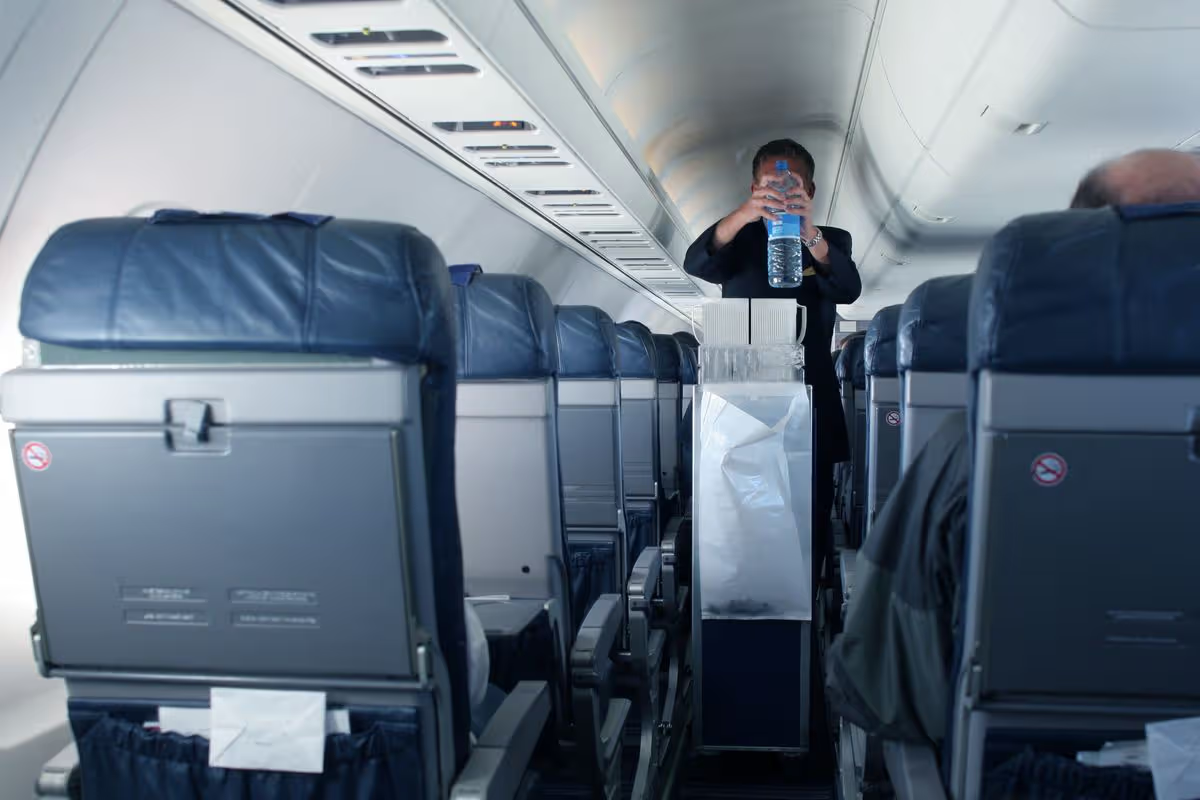
Former flight attendant turned travel expert Jane Hawkes has told the Mirror what really happens if a passenger dies aboard an aircraft, while dispelling one widely circulated myth

What really happens if you die at 30,000 feet? (Stock Photo)(Image: Getty Images)
A former flight attendant has opened up about what really happens should a passenger die at 30,000 feet, and the strict procedures crew members must adhere to.
Sadly, the fact is, we will all die one day, and we cannot always decide where this final parting with take place. With thousands of travellers jetting all across the world every day, it’s of course inevitable that not everybody who boards will reach their destination with their eyes still open. Fortunately, should such a sad event come to pass, you’ll be in good hands with the cabin crew, who will be specially trained to deal with this sort of onboard tragedy with care, dignity, and above all, discretion.
The Mirror heard from travel expert Jane Hawkes. Now a consumer champion, who specialises in travel, in a former life, Jane worked as a stewardess for a major UK airline. And as you might imagine from a job dealing with people from all walks of life amid the clouds, Jane, like all those in her profession, has to be prepared for the unexpected at all times.
READ MORE: I’m a flight attendant – I fell in love with a passenger after his selfless in-flight act
Discussing the skills required of all those who serve in the sky, Jane, from Gloucestershire, told the Mirror: “They’d have to go through aviation medical training to provide CPR if needed, to provide basic first aid, at least onboard an aircraft.” Within this training, flight attendants are also warned that there may be occasions when they are unable to resuscitate a passenger, after which point they will need to deal with a very different set of protocols.
According to Jane, who is now a Consumer Champion at ladyjaney.co.uk : “Obviously, if the passenger cannot be resuscitated, is showing no signs of life, then they would ask if there was a doctor or medical professional onboard because it’s not a crew decision to officially pronounce death. They would ask for a medical doctor, and they would then move them to a less visible area if possible. It could well be that the aeroplane is full. If the aeroplane is full, if all seats are taken, then they will just have to keep the body in the seat that it’s in, perhaps move it to the side, So at least move it somewhere so it’s in a side position if possible, because obviously, we dont want to be heavinga body around from one side of the aircraft to another and then cover the body.”
The crew will then make sure to wrap the deceased in blankets “as much as possible”, with a focus on preserving “dignity”. Jane explained: “Bodies, obviously, after they’re deceased, they’re not the nicest things to be around, and that’s the priorities, it’s safety and dignity. This is not a safety issue; this is a dignity issue in many respects, and it is unfortunate, of course, if it’s a long flight because that body will remain in situ for quite a long period of time.”
As challenging as this situation might be, Jane says it’s “very, very, almost completely unlikely” that the plane would divert in this instance, for a whole host of reasons, especially that, with no life left to save, this wouldn’t be considered a medical emergency. Indeed, it’s far more likely that the flight will continue on its intended journey, with the crew left to deal with the practical realities of having a body on a plane. This will naturally involve making sure to keep other passengers relaxed and as in the dark as possible about what’s going on.
Jane emphasised: “It’s kept very, very discreet, about as discreet as you can possibly do in the circumstances. Particularly if you’re the person who ends up sitting next to said body, which is still a possibility. They move people around as much as they possibly can, but you can’t magic seats up out of nowhere.”
In the course of her own career, Jane has had colleagues who’ve had to deal with this sort of heartbreaking situation, dealing with it by moving the deceased to a “less visible area” if possible, which may include the crew rest area. Meanwhile, passengers are given “very little information”, and may simply be alerted that there’s been a medical situation, with no further details.
Encouraging people to show compassion in this sort of devastating situation, Jane noted, “They will speculate, you see, this is it. People do speculate, and I think it’s quite worrying in that kind of instance. I think if anybody is on a plane and this happens, or they suspect that it’s happened, then just maybe bear in mind the dignity of the deceased and also those travelling with them. Because it may well be that there’s someone else. If you’re thinking about someone elderly, this was an elderly passenger that I’m thinking if in particular, it can happen anywhere at any time, but it happened on an aircraft.”
For many of us, this isn’t where we’d choose to spend our final moments, but Jane hopes that passengers will be reassured by the professionalism of the crew, who will be looking out for them “when the chips are down”. Of course, as pointed out by Jane, such instances demonstrate just how vital this sort of job actually is, with stewards and stewardesses being far more than simply “glorified hostesses in the air”. Stressing just how varied this role can be, Jane told us: “They are primarily there for your safety and well-being, and things like this are part and parcel of it. Sometimes they’re judge and juries, sometimes you’ve got restraint. So it’s much more than just serving you tea and coffee. In fact, that is just the fluffy bit that goes on top.”
On this topic, Jane has addressed rumours that flight attendants will go to extreme lengths to make it appear as though a deceased individual is still alive, perhaps “putting a hat on them so they can look at the TV or something.” As per Jane, nothing could be further from the truth. Jane said: “The crew are just going to keep it as simple and dignified as possible. You know, they’re not going to create a drama, a scenario where it looks like someone is still there. So I think, maybe dark glasses and a hat aren’t going to be the case. Looking towards the screen, positioned, you know it’s just not going to happen.”
Once the wheels hit tarmac, the crew face another challenge in terms of getting passengers disembarked safely and calmly, while continuing to preserve the privacy of the deceased and any loved ones who’d been travelling with them. It’s at this point that the emergency services will come on board. Outlining this process, Jane shared: “It could be, it depends on the procedures at whatever destination it is, it’s most likely that they would get the passengers off, and then they’d remove the deceased. So that is the most likely outcome. However, so people may notice then, while they’re getting their things together, that something’s not moving. So that may be noticed.
“But it could be, it could potentially happen that the body might go off first. But I think the best thing to state is that the emergency services will board and then the body will be taken off the aircraft. But passengers are usually allowed to leave their seats first. So you’ll clear the aircraft, and then you’ll deal with that.” She added, “In a medical emergency, you’d all be staying seated, and the medical and the passenger would go off first. So people might start to think, ‘it’s a medical situation they’ve come on the aircraft, but they’re waiting for us to get off first. They might think that’s a bit odd. But then they’ll realise perhaps there’s a bit more of a serious medical situation.”
Of course, once the body is off the plane, there will be further responsibilities to face, including a potential repatriation process. While it’s an ending few would imagine for themselves or a loved one, there is comfort to be found in knowing that, should the worst come to pass, cabin crew will be prepared and equipped to deal with such a sensitive situation.
Do you have a story to share? Email me at julia.banim@reachplc.com
READ MORE: ‘My period cramps were so bad I felt sick but this £25 item made it manageable’