

Heres

Here’s what to watch for in Tuesday’s California governor debate

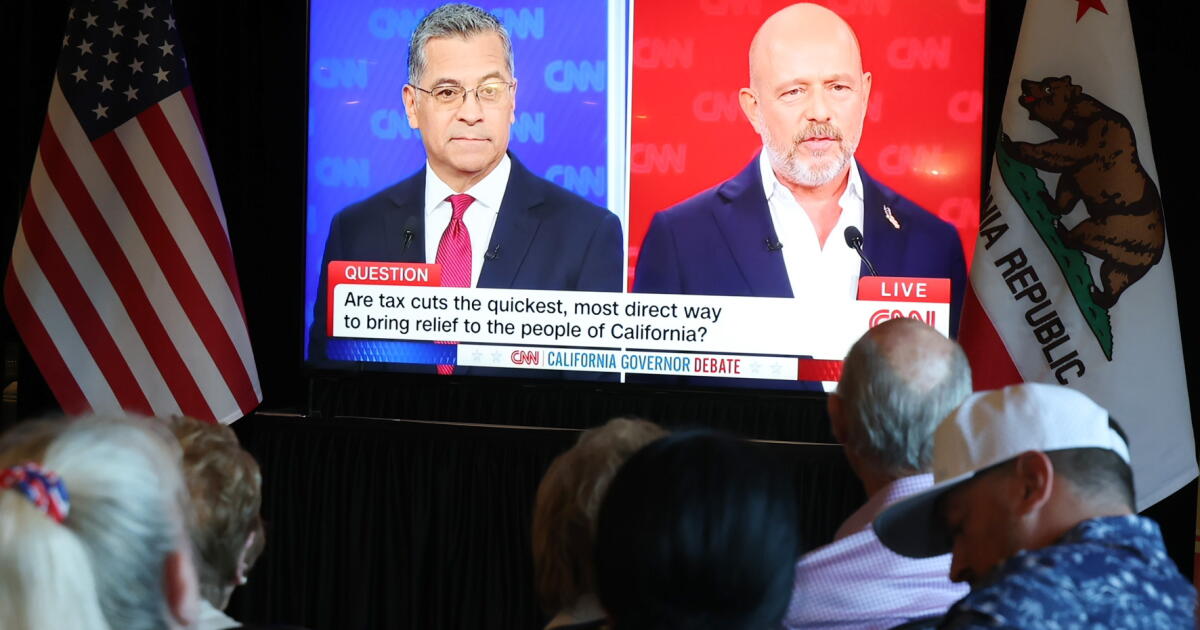
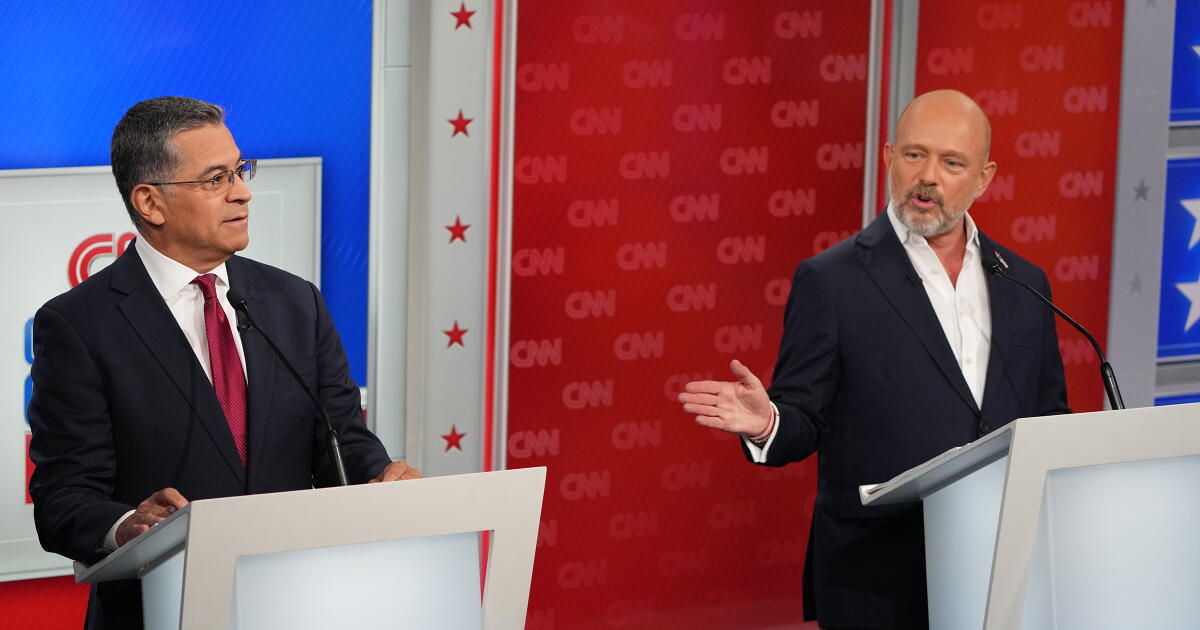
Contenders in the race to be California’s next governor will meet on stage Tuesday night for the second of three planned debates before the June 2 primary.

Last week’s meet-up in San Francisco didn’t provide the fireworks or memorable moments the candidates, and many voters, were hoping for — but it did manage to remind us all that ballots will hit mailboxes in coming days and decisions must be made.

Ahead of the forum at Pomona College in Claremont, a trio of our Times columnists — Gustavo Arellano, Mark Z. Barabak and Anita Chabria — weigh in with a cheat sheet on what to look for, what to expect and why it matters.

Chabria: I’ll start us off with the obvious — let’s hope Tuesday gives us at least one breakout candidate who comes with some fire and vision.

After last week’s debate, there was lots of social media posturing about who won and who trolled whom the best. But as one of the six people who actually watched, I can tell you it was mostly bland with no clear winner.

That’s in large part because many of the Democrats have only slivers of daylight between their policies, and ditto for the two Republicans.

So my hope is that at least a single candidate ups their game and comes to voters with not just attacks, but something that inspires, something that sets them apart. This far into the race, that hope is slim, but I’m keeping it alive.

What are your hopes and dreams — and maybe fears — going into this?

Barabak: I know I sound like a broken record. (Google it, kids.) Anita, you and I, in particular, have gone round and round on this one. But I don’t feel a particular need for inspiration from the guys and gal that are running for governor. If I want inspiration, I’ll go back and reread the Rev. Martin Luther King Jr.’s “Letter From Birmingham Jail.” Or listen to a Grateful Dead show from May of ’77.

Give me someone who can work with the Legislature, and as difficult as it may be, President Trump, to get stuff done.

Pursue a “California First” agenda, to borrow a phrase. Put voters and their interests ahead of ego, careerism and personal ambition. Start by pledging, if elected, to serve a full four-year term and not run for president so long as they’re serving as governor.

Of course, that kind of promise can be broken. (See then-Gov. Pete Wilson, who made that vow when he sought reelection in 1994, then turned around and — unsuccessfully — sought the White House in 1995.)

At least we’d have them on the record.

Arellano: I’m all for this morass of democracy. A small part of me wants two Republicans to make it into the general election because the California Democratic Party deserves a meteor-like extinction event. No GOP statewide elected official since Schwarzenegger. Supermajority in Sacramento for most of a decade.

And what do they have to show for their one-party rule? This.

But then I hear Chad Bianco and Steve Hilton mewl, and I’m suddenly hoping alongside Anita that someone vanquishes their foes with an unassailable vision. Problem is, I think all the candidates have reached their ceiling. The only one who has any chance of showing us something new is Xavier Becerra, who needs to drop his Dudley Do-Right shtick for a second and channel the inner cholo we all know is in him.

Instead, he was at a fundraiser in Fullerton over the weekend with professional Latinos — you should’ve been kicking it with my cousins in Anaheim who were watching their Dodgers slaughter the Cubs, loco, because they’re the ones who’ll make or break you.

Chabria: How the first potential Latino governor is failing to excite Latino voters is exactly what I’m talking about. If you don’t give voters something to be excited about, they don’t vote, and our fragile democracy needs every voter it can get.

But if we are forced to vote on nuance, let’s do it informed. Here are some questions I hope these candidates have to answer:

For San José Mayor Matt Mahan, funded in the mega-millions by tech bros, it’s not enough to promise to regulate artificial intelligence, or billionaire influence, for that matter. Tell us what those regulations look like and tell us how you reconcile your own politics with those of big donors such as Joe Lonsdale, co-founder of Palantir, who has called Gen Z the “loser generation.”

For billionaire investor Tom Steyer, who has said he will reform Proposition 13 (which limits property taxes) for corporate land owners: What assurances do homeowners have that they won’t be next?

For former Rep. Katie Porter, polling third among Democrats, the clock is ticking — is there a point where you will drop out and endorse a fellow candidate if you can’t break through? Same-ies for state schools superintendent Tony Thurmond and former L.A. Mayor Antonio Villaraigosa, who are included in this debate but polling in the single digits.

And I agree with you, Gustavo, Becerra is coming across as resolutely bland, but to Mark’s point, he’s using that to position himself as drama-free and experienced. So in an era when fraud and abuse are the words of the day, how does Becerra explain not catching fraud in his own office?

Mark and Gustavo, what are the topics you hope candidates will be grilled on?

Arellano: Slight correction, Anita — California already had a Latino governor: Romualdo Pacheco, the lieutenant governor who replaced Newton Booth in 1875 when the latter became a U.S. senator. Pacheco — a Latino Republican! — served all of 10 months before becoming a Congress member.

See, Californians? Political musical chairs is as much a part of our state as free-spending oligarchs — but enough about Steyer.

Issues? Immigration, of course. I want each one to address the state’s undocumented immigrants for 90 seconds in whatever matter they choose. Water: Believe in climate change or not, but our supply is shrinking faster than the gubernatorial chances of Thurmond. And since I believe that the more random the question, the more you learn about who a candidate truly is: What’s the best song about California, and why? Anyone who says “California Girls” or “California Gurls” deserves disqualification, even if both songs rock.

Barabak: Not an issue, per se. What I’d like to see is a bit of backbone.

The next governor is going to have to make some tough decisions, especially around spending priorities and/or cuts to the state budget. Inevitably, the next governor is going to make some people unhappy. And I’m not talking about just those members of the opposite party, or folks who didn’t vote for them.

So I’d like each of them to name an issue where, for the good of the state, they’re willing to take on their friends and allies, knowing they’ll be displeased. If you’re a Democrat, name something you would do that would, say, tick off organized labor. And for Republicans Bianco and Hilton, what’s an area where you’re willing to say to Trump, “Sir” — the president imagines everyone bowing and calling him sir — “you’re dead wrong about this and California needs to go its own way, whether you like it or not.”

Arellano: Good luck seeing any candidate buck their masters. I think we need to lower our expectations way, way, well, lower. So a simple question to conclude: Who needs to do the most tonight besides Mahan’s beard? I think it’s my fellow Orange Countian, Katie Porter. She’s now to the right of Steyer and left of Becerra, which means she needs to peel off supporters from both of them and grab undecideds if she wants to advance. Not sure how she can pull that off — but if anyone can bring necessary fire, it’s her.

Chabria: Porter definitely has a lot on the line.

One standout moment for her, Steyer or Becerra — good or bad — could tilt this very-much-undecided race — not so much because people will be watching, but because it will fuel the social media and advertising sure to follow. These next two debates are high-stakes, not just to avoid a Biden performance, but to do something, anything, that fires up momentum.

Politics ain’t beanbag, as the old saying goes, and it’s time to bring the heat. So in the spirit of Gustavo’s song request, I’ll leave it with these lyrics from the Rivieras (or the Ramones, if you prefer): We’re out there having fun, in the warm California sun.

Barabak: Not to be the pooper at the party but I think we shouldn’t overstate the import of tonight’s debate. For one thing, as Anita suggested, the audience will be exceedingly small — minuscule, even, relative to the state’s 23 million registered voters.

We know, from experience, that most folks will take away what they do based not on the debate itself but rather the coverage of it and whatever soundbites, memes, chatter and advertising it produces — and that’s only to the extent people are paying attention.

So, yes, what’s said and done in Pomona, will matter some. But we’re still five weeks away from election day, and I suspect many folks will be waiting at least another week or three to start focusing on the race and finally make up their minds.

I’ll end with something that Jerry Garcia sang: All good things in all good time.

Source link

Here’s how the GOP could scheme to keep control of the House

For Democrats or, for that matter, anyone who believes in checks and balances, things are starting to look up.

President Trump’s days of untrammeled war-making, law-breaking and generally doing whatever he damn well pleases may finally be drawing to a close. Public opinion, history and, especially, the surging price of gasoline and groceries, all point to a Democratic takeover of the House in November’s midterm election.

There’s a direct correlation between a president’s approval rating and the way his party performs at the midpoint of his term. Anything below 50% favorability portends political trouble; right now Trump’s positive standing in polls hovers around a dismal 40%.

Then there’s the history part. Since World War II, the party out of the White House has gained an average of more than two dozen House seats in midterm elections. Democrats need to pick up just three to take control beginning in January.

(While the Republican grip on the Senate seems weaker than just a few months ago, the GOP is still favored to hang onto the chamber in November.)

There is, however, a looming threat causing nervousness among Democrats and their allies as they contemplate a celebratory fall, a landmine of sorts buried deep in the congressional election process.

Let’s acquaint ourselves with Article 1, Section 5 of the Constitution.

The pertinent language written by the Framers states, “Each House shall be the Judge of the Elections, Returns and Qualifications of its own Members.” In other words, it’s up to the House and Senate to acknowledge and abide by the will of voters as expressed in the election returns.

What could possibly go wrong?

Well, if you let your paranoia run wild, quite a lot. If the election outcome is close — and probably it would have to be very close — Republican lawmakers could theoretically seize on phony claims of fraud and effectively nullify the results of enough contests to deny Democrats control of the House.

There’s plenty of skepticism that would or could ever take place. But if it were to happen, hello, national crisis!

Normally, we could count on the occupant of the White House to humbly submit to the election returns, even if it’s a “shellacking” as President Obama called his walloping in the 2010 midterm election, or a “thumpin’ ” as President George W. Bush described his electoral spanking in 2006.

Not Trump.

This president has amply demonstrated the lengths to which he’ll go to overturn an honest election, siccing a violent mob on lawmakers certifying his 2020 defeat, telling endless lies and using the Justice Department to confiscate ballots and intimidate innocent election officials and others Trump deems his enemies.

He strong-armed Texas into a highly unusual, highly partisan redrawing of its congressional boundaries, an effort to net five seats and lengthen the odds against a Democratic takeover.

The move appears to have backfired, spurring voters in California and, last week, Virginia to redraw their state’s political maps to more than offset Texas and boost Democrats in November. (The Virginia results are being contested in court.)

A gathering of Virginia voters in front of television screens

Voters attend an Arlington Democrats redistricting vote watch party during a special election Tuesday in Virginia. A measure to redraw the state’s congressional map was narrowly approved.

(Valerie Plesch/Bloomberg via Getty Images)

That failure doesn’t take away Trump’s malign intent. And in the supine Speaker Mike Johnson, he has the perfect handmaiden to undermine the midterm vote.

In 2020, Johnson was the lead author of a Supreme Court brief seeking to overturn the results in four states that Joe Biden had indisputably won. That speaks to Johnson’s probity and integrity.

How would subversion of November’s election take place?

One theory goes like this: When the balloting is over, Johnson could appoint a House committee packed with Trump’s acolytes to investigate alleged voting irregularities. (And if you think Trump won’t be bellowing the words “rigged” and “fraud” in the face of defeat, you’ve either been in a coma or living on another planet for the last decade.)

Those hearings and the “evidence” they turn up could then be cited by election officials in key states — collaborators, if you will — as a reason to delay the certification of election results and block the seating of majority-making Democrats in the next Congress. In their place, the theory goes, Republicans could vote to fill those seats with GOP candidates who lost at the polls, keeping themselves in control.

Derek Muller, an election law expert, suggests that scenario is little more than a fever dream of doomsday devotees and overly nervous Nellies.

He said he’d be very surprised if all the election results weren’t certified by Jan. 3, when the new Congress convenes, given the legal remedies available to prevent stalling and undue delay. And, Muller said, there is no assurance Republicans would march in lockstep behind a plan to prevent the seating of Democrats.

Thwarting a duly elected Democratic majority “involves extraordinary coordination and precedents that have never occurred, with a unique convergence of factors,” said Muller, who teaches law at Notre Dame — though, he added, if control of the House came down to, say, a single seat “all bets are off.”

Far-fetched? Perhaps. Some of the spun-up theories surrounding November’s election do sound a bit like a product of political science fiction.

But what kind of president picks a fight with the pope? Plunges the world into crisis by unilaterally going to war with Iran with no exit plan? Demolishes the East Wing of the White House on an egotistical whim?

If Trump, an inveterate norm-buster, sees a way to keep his grip on unchecked power, don’t put anything past him.

Source link

Some key groups moved toward Trump in 2024. Here’s what they think now, according to AP-NORC polls

Many of the groups that helped elect Donald Trump as president again are deeply unhappy with his performance, according to a new AP-NORC poll.

Trump’s return to the presidency was fueled by a wide-ranging coalition that built on his loyal base of supporters. Now that Trump has been in the White House for more than a year, the survey of more than 2,500 U.S. adults from The Associated Press-NORC Center for Public Affairs Research finds that many key groups — including Hispanic adults, younger adults and men — are increasingly dissatisfied with his presidency.

The poll was conducted from April 16 through Monday, as oil prices fluctuated and Americans spent more at the gas pump.

It’s a particularly bad moment for Trump, a Republican whose economic approval slumped over the past month as the Iran war drives prices higher. But AP-NORC polls show that discontent has been building among critical segments of the population over the past year.

Trump’s overall approval among Hispanic adults has fallen 16 percentage points since March 2025, and his support has declined by 9 percentage points among men.

And while Trump’s base is still largely behind him — most Republicans approve of his performance — there are signs that his second term may not be living up to their expectations.

Here’s what polling shows about Trump’s current status with four important groups:

Hispanic adults

Hispanic Americans have grown increasingly discontented with Trump over the past year.

About one-quarter of Hispanic adults approve of how he’s handling the presidency in the new poll, down from about 4 in 10 in March 2025.

That decline has been visible since late last year — suggesting that it’s not just the war in Iran or recent spikes in gas prices that are leaving this group unhappy.

Trump’s restrictive immigration approach may be playing a role. Only about one-quarter of Hispanics approve of his handling of immigration, down from 36% at the beginning of his term.

His immigration tactics appear to be particularly unpopular among younger Hispanics — a group with which he made gains in 2024. Only 18% of younger Hispanic adults approve of his performance on immigration, compared with 40% of Americans overall.

There is also broad discontent about the state of the U.S. economy among Hispanics. Only about one-quarter of Hispanic adults approve of how Trump is handling that issue, and about 2 in 10 say they approve of his approach to the cost of living. Few Hispanic adults, about 2 in 10, describe the nation’s economy as “good.”

Young adults

Trump’s overall approval with Americans under age 45 has slid over the past year, falling from 39% in March 2025 to 28% in the latest poll.

Younger women have a particularly dim view of Trump’s handling of the economy.

Only about 2 in 10 women under age 45 approve of how Trump is handling the economy, including only 7% of younger Hispanic women who approve of his economic approach. More young men, about 3 in 10, approve of him on this issue.

Trump’s struggles among young adults extend to other groups, too. Only about one-third of white adults under age 45 approve of his overall performance, compared with 45% of white adults age 45 or older.

A downtick among men

Trump made broad appeals to men throughout his 2024 campaign, and most male voters backed Trump in the presidential election over Democrat Kamala Harris. In particular, he made slight but significant gains with Black and Hispanic men, who were drawn by his vows to revitalize the economy.

Since he reentered office, though, American men have become slightly less likely to approve of his performance, declining from 47% at the start of his second term to 38% in the most recent poll.

There are signs that Black men, in particular, aren’t seeing Trump’s economic promises pan out. Black men are more likely than white or Hispanic men to disapprove of Trump’s approach to the presidency, as well as his approach to the economy, the cost of living and Iran. Only about 1 in 10 Black men say they approve of how Trump is handling the cost of living, and roughly 2 in 10 approve of how he’s handling the economy.

Hispanic men, too, have a relatively dim view of Trump’s overall performance. About 3 in 10 approve of how Trump is handling the presidency, regardless of their age. That support is stronger among white men, with about half approving of Trump.

While young Republicans are frustrated, MAGA still backs Trump

Trump has benefited from Republicans’ loyalty for years, but there are recent signs of frustration even within his base.

Roughly two-thirds of Republicans approve of Trump’s job performance. That is down slightly from 82% near the start of his second term and is generally in line with the GOP low point from his first term.

But only about half of Republicans overall approve of Trump’s approach to the cost of living, and a majority of Republicans under age 45 disapprove of him on that issue.

Trump is still buoyed by the support of his MAGA base, even as he faces backlash from conservative media figures on some of his recent actions in Iran.

About 9 in 10 MAGA Republicans — those who consider themselves supporters of the “Make America Great Again” movement — approve of Trump’s job performance, and a similar share approve of his handling of Iran.

It’s a good sign for Trump that his most robust supporters are still in his corner, but not all Republicans identify with MAGA. About half of Republicans, 54%, say they consider themselves MAGA supporters.

Among non-MAGA Republicans, Trump’s approval is much lower, at 44%.

Sanders and Thomson-Deveaux write for the Associated Press. The AP-NORC poll of 2,596 adults was conducted April 16-20 using a sample drawn from NORC’s probability-based AmeriSpeak Panel, which is designed to be representative of the U.S. population. The margin of sampling error for adults overall is plus or minus 2.6 percentage points.

Source link

‘If my people’: Here’s why the Bible passage Trump will read aloud is so potent and polarizing

The scriptural passage that President Trump plans to read Tuesday evening in a livestreamed Bible-reading marathon dates back to the depiction of an ancient event — but it’s one that carries a highly charged significance in the current religious and political climate.

It has long been quoted and promoted by those who believe America was founded as a Christian nation and should be one. It’s from the seventh chapter of 2 Chronicles, a book in the Hebrew (Old Testament) portion of the Bible.

The 14th verse — the one most often quoted — says:

“If my people, which are called by my name, shall humble themselves, and pray, and seek my face, and turn from their wicked ways; then will I hear from heaven, and will forgive their sin, and will heal their land.”

Trump is among hundreds who are taking turns reading the entire Bible aloud over the course of a week. Most of the readings are taking place at the Museum of the Bible in Washington, though Trump’s is coming by video from the Oval Office.

A passage often quoted at National Day of Prayer events

The Chronicles passage has for decades been a major theme at annual National Day of Prayer events. Organizers of the America Reads the Bible marathon invited Trump to read from it. “It’s a powerful statement that he decided to read that passage,” said Bunni Pounds, founder of Christians Engaged, which organized the project.

The passage has been recited over the decades at countless rallies, services and events, often organized around the disputed belief that America was created as a Christian nation and needs to repent of its sins and return to God. The passage has particularly been associated with annual events commemorating the National Day of Prayer, which has taken various forms since the mid-20th century and became fixed by law on the first Thursday in May since the 1980s.

The verse is set in a context far from modern America — during the reign of King Solomon in ancient Israel some 3,000 years ago. Solomon is presiding over the dedication of the first temple in Jerusalem, and in a lengthy prayer he asks for divine mercy if a future generation sins, is punished with military or natural disaster and then repents. In the key passage, God replies with a promise of restoration.

Critics say the passage is used out of context

But the use of the passage in modern settings has its critics.

The Chronicles passage is “a popular verse among Christian nationalists and has been for quite some time,” said Brian Kaylor, a Baptist pastor and president and editor-in-chief of Word&Way, a progressive site covering faith and politics.

He said its use has taken on a partisan and polarizing tone, often used in tandem with a promotion of a belief in a Christian America in an increasingly diverse country.

“This verse is not about the United States,” said Kaylor, author of “The Bible According to Christian Nationalists: Exploiting Scripture for Political Power.” It is “a promise made to one particular person in one particular moment. It doesn’t really work to pull it out of context and apply it to whatever you want to.”

But many have done so recently and in decades past, either saying America has a divinely ordained destiny similar to ancient Israel’s or simply that they believe every nation has a duty to follow God and repent when needed.

President Dwight D. Eisenhower took the oath of office in 1953 with his hand on a Bible opened to the 2 Chronicles passage. President Ronald Reagan quoted the passage in a proclamation declaring 1984’s National Day of Prayer. A speaker at the 2024 Republican National Convention also quoted it.

The National Day of Prayer, while officially nonsectarian, has long been drawn particular promotion and participation from evangelical Christians. Readings of the “If my people” passage has been a staple of such events.

Politicians, others joining in the Bible-reading marathon

Evangelicals — a loyal Republican voting bloc for decades — have formed a crucial part of Trump’s electoral base. His rallies have featured a fusion of Christian and national symbols and rhetoric, featuring songs like “God Bless USA” and T-shirts with slogans like “Jesus is my savior, Trump is my president.”

Many other Republican politicians are taking part in the Bible reading, along with celebrities, pastors and others. And Trump isn’t the only one reading a passage significant to his office or mission.

Mike Huckabee, a Baptist pastor and U.S. ambassador to Israel, is reading from a Genesis passage in which God says he will bless those who bless Abraham — a passage popular with many evangelicals who believe they have a biblical mandate to support Israel.

David Barton, whose Wallbuilders promotes belief in America as a Christian nation, will read from a passage that gave his organization its name, in which Nehemiah rebuilds the broken walls of Jerusalem.

Smith writes for the Associated Press.

Source link

Nike is denied trademark for Bronny James ‘b9’ logo. Here’s why

Nike has been refused a trademark for Bronny James‘ “b9” logo that appears on shoes have been worn in games by the second-year Lakers player and are being sold by the sports apparel giant.

The U.S. Patent and Trademark Office notified Nike of its decision with a letter of refusal earlier this week, citing “likelihood of confusion” with an already-registered mark by the Back9 Golf Apparel company.

“Applicant’s mark, B9, is confusingly similar to the registered mark, B9,” the refusal letter states. “The marks are similar in appearance, sound, and commercial impression. In addition, the marks are essentially phonetic equivalents and, thus, sound similar. Similarity in sound alone may be sufficient to support a finding that the compared marks are confusingly similar.”

Nike did not immediately respond to a request for comment from The Times.

The James logo features a lowercase “b” with a “9” embedded in the center (where a hole normally would be). The Back9 logo has a capital “B” and a “9” of the same size next to each other. The logos are in different fonts.

In its trademark application, filed on Feb. 27, Nike had indicated the intention of using the logo on seemingly all types of athletic apparel, including footwear, headwear, shirts, pants, shorts and jackets. Polo shirts and golf caps were listed among the many specific examples of possible uses.

The refusal letter notes the use of similar or identical language in the description of goods in Back9’s trademark application, which was filed in May 2021 and approved a year later.

“The overriding concern is not only to prevent buyer confusion as to the source of the goods, but to protect the registrant from adverse commercial impact due to use of a similar mark by a newcomer,” the letter states. “Therefore, any doubt regarding a likelihood of confusion determination is resolved in favor of the registrant.

“Here, because the marks are similar and the goods are related and/or legally identical, there is a likelihood of confusion as to the source of applicant’s goods, and registration is refused pursuant to Section 2(d) of the Trademark Act.”

Nike has until July 13 to appeal the decision.

The Lakers, seeded No. 4 in the Western Conference, start their opening-round playoff series against the No. 5 Houston Rockets on Saturday at Crypto.com Arena.

Source link

Here’s why Eric Swalwell escaped accountability for so long

The implosion of Eric Swalwell’s gubernatorial campaign and his once-promising political career has left a great many questions rising from the smoldering wreckage.

Questions about his character, judgment and staggering recklessness.

The question — as misguided as it is inevitable — of why his accusers hadn’t come forward sooner. (My columnizing colleague, Anita Chabria, incisively addressed that one, discussing the nature of suppressed trauma and the believability hurdle that many victims of sexual assault unduly face.)

Then there’s the question of how and why Swalwell’s creepy and allegedly criminal behavior stayed hidden from public view for so long — especially when the impossible-to-miss fixture of cable TV embarked on a high-profile campaign to lead the nation’s most-populous state.

Swalwell, 45 and married, had a widely whispered about reputation for showering inappropriate and unwelcome attention on younger women. Rumors — vague, unsubstantiated — were a source of incessant dirt-dishing among political insiders and also circulated extensively online. (Not, however, the more serious allegations of sexual assault.)

The veil was finally pierced last week when the San Francisco Chronicle published a graphic account of a woman alleging sexual encounters with Swalwell while the Democratic lawmaker was her boss. She said he sexually assaulted her twice when she was too intoxicated to consent.

A few hours later, CNN followed up with a report that three other women had recounted various kinds of sexual misconduct. On Tuesday, yet another alleged victim came forth, saying she was drugged and raped by Swalwell in 2018.

The former congressman has flatly and vigorously denied criminal wrongdoing while acknowledging and apologizing for unspecific “mistakes.”

Those vociferous, flat-out denials had been enough to sway the politicians and union leaders who endorsed Swalwell’s gubernatorial bid, until the weight of evidence made Swalwell’s assertions untenable.

If the allegations are true and Swalwell is, in fact, a liar, lecher and sexual assailant, why wasn’t that widely reported up until now? Was it negligence, or gullibility on the part of the political press corps? The short answer is that a wide gulf exists between rumor and fact and Swalwell lurked in that gray space, living and thriving in the shadows between provability and denial.

It’s not unusual for rumors about financial, sexual or other peccadilloes to attend a campaign. They’re often trafficked by political rivals, which automatically raises suspicion and invites particular skepticism.

Much of the chatter never moves past a relatively small, dishy circle of political gossips because the supposed misdeeds, while titillating, can’t stand up to rigorous scrutiny. Or a legal challenge. That’s the baseline for many news outlets to broadcast or publish a story. Call them what you will — legacy, corporate, mainstream, lamestream — many of the largest, most influential sources of news and information won’t pass along allegations they can’t independently verify and, if necessary, defend in court.

The challenge is verifying all that loose talk.

Politicians don’t wear body cams, or broadcast their lives 24/7. (OK, Beto O’Rourke did livestream from a Texas laundromat during his 2018 Senate bid, holding up a soggy pair of underwear when he addressed the “boxers or briefs” question. But he’s an exception.)

Journalists don’t have subpoena power and can’t force people to tell them what they know. A reporter is only as good as his or her sources, their knowledge, truthfulness and credibility.

Reporting on misdeeds of an intimate nature can be especially difficult and complex. There’s rarely black-and-white documentation, such as a money trail leading to a hotel bedroom. It’s hard to find an eyewitness or reliable third party who can vouch for what took place between people behind closed doors. It takes time and trust to develop sources who can substantiate incidents of sexual misconduct, assault or abuse.

Swalwell apparently did an excellent job deceiving those around him, including some congressional and campaign staffers who’d known him for years and worked closely with the seven-term lawmaker, day in, day out. They were shocked by the statements of his alleged victims; the words “double life” have come up many times.

If Swalwell managed to hoodwink those closest to him, it’s easy to see why journalists had a hard time wrangling the firsthand accounts and other facts they needed to make their findings public.

When it comes to reporting on scandal, there is often the question of timing.

In 2003, The Times was widely criticized for publishing an account of Arnold Schwarzenegger’s misconduct — touching women in a sexual manner without their consent — just days before California’s gubernatorial recall election. Despite the report, which Schwarzenegger did not contest, voters kicked Gray Davis out and replaced him with the Hollywood super-duper star.

In 1992, the Washington Post and Portland Oregonian were widely criticized for their failure to publish accounts of Sen. Bob Packwood’s misconduct — unwanted sexual advances and touching women without their consent — until weeks after he was elected to his fifth term. Packwood resigned in 1995 after the Senate Ethics Commission voted unanimously to expel him.

The allegations against Swalwell were revealed well before the June 2 primary. Not soon enough for those asking how he managed to get away for so long with his predatory behavior. But plenty of time to inform California voters before they weighed in on his candidacy.

Public attention will soon shift. But for Swalwell, the legal and other ramifications are just beginning.

Source link

Ukraine strikes Russian energy targets again — here’s what’s been hit

Ukraine has intensified its attacks on Russian energy facilities recently, as peace talks show no signs of progress. Several key facilities have been impacted:

NORSI, Russia’s fourth-largest oil refinery, owned by Lukoil, halted operations on April 5 due to a Ukrainian drone attack. This refinery, which processes 16 million metric tons of oil per year (around 320,000 barrels daily), is also Russia’s second-largest gasoline producer.

The Kirishi oil refinery may restart partial operations within a month after sustaining damage from drone attacks in late March that caused fires. Sources indicate that three of its four main units will resume operations, representing about 60% of its capacity. Last year, Kirishi produced 2 million tons of gasoline, 7.1 million tons of diesel, 6.1 million tons of fuel oil, and 600,000 tons of bitumen.

Novatek’s Ust-Luga processing plant suspended gas condensate processing and naphtha exports after drone strikes caused fires. The complex features three processing units, each with a capacity of 3 million tons per year, processing stable gas condensate into various fuels. In 2025, it processed 8 million tons.

Ukraine’s military reported hitting Russia’s Bashneft-Novoil oil refinery, located over 1,400 km (870 miles) from the border, which can process more than 7 million tons of oil annually.

The Saratov refinery was attacked on March 21, which led to the shutdown of its crude distillation unit. In 2024, it processed 5.8 million metric tons of oil, representing 2.2% of Russia’s refining capacity.

A fire at the Ilsky refinery occurred on February 17 due to drone attacks, with the blaze fully extinguished the next day. The refinery’s annual capacity is 6.6 million tons.

The Volgograd refinery was completely shut down on February 11 from drone strikes, affecting its primary processing unit, which accounts for 40% of its operations, with a processing figure of 13.7 million tons of oil in 2024.

A fire at the Ukhta refinery on February 12, caused by a drone attack, affected its primary oil processing unit, which processes 6,000 tons per day. In 2025, it processed around 3 million tons of oil.

The Afipsky refinery experienced a fire on January 21 due to drone attacks, focusing mainly on exports and processing 7.2 million metric tons of crude oil in 2024.

Additionally, a recent attack by Ukraine damaged facilities at the maritime transhipment complex in Novorossiysk, affecting oil product reservoirs. The damage did not disrupt CPC oil exports via the Black Sea, and U. S. oil major Chevron confirmed that crude oil exports from Tengiz remained stable. Ukrainian drones also caused fires at the Sheskharis oil terminal and damaged an oil pipeline at Primorsk, which saw significant storage capacity losses from drone attacks last month.

With information from Reuters

Source link

What could move the markets this week? Here’s what investors are watching

Published on

With European markets reopening after the Easter holidays, investors are set to navigate a mix of geopolitical risks and crucial economic data that may shape sentiment over the coming week.


ADVERTISEMENT


ADVERTISEMENT

Attention will focus on Iran’s response to US President Donald Trump’s deadline to reopen the Strait of Hormuz, a critical chokepoint for global oil supplies. Any escalation or de-escalation could quickly affect energy markets, driving oil prices and inflation expectations.

J.P. Morgan noted on Thursday that oil prices could reach as high as $150 a barrel if supply disruptions persist until mid-May.

Beyond geopolitics, inflation data, central bank signals and corporate updates will also draw attention as markets gauge the outlook for the second quarter.

Economic data in focus

The macroeconomic calendar kicks off on Tuesday with the release of eurozone PMI data, a key leading indicator of economic activity. Recent readings have pointed to slowing growth in the bloc, with the composite PMI signalling only marginal expansion amid softening demand and heightened uncertainty.

On Wednesday, investors will examine the latest eurozone retail sales and industrial producer price figures from Eurostat. These will shed light on consumer demand and upstream inflation pressures.

The European data schedule remains relatively light but still significant. Euro area financial accounts will provide additional detail on lending trends, while UK markets stay attuned to labour market and growth signals following recent signs of stagnation.

Focus then shifts to the US, with the release of the Federal Reserve’s latest meeting minutes on Wednesday. These will be scrutinised for hints on policymakers’ views regarding the timing of any potential rate cuts.

Thursday brings key US labour data, including weekly jobless claims, offering further insight into employment conditions.

The week ends with the US consumer price index for March, including the closely watched core CPI reading. A stronger-than-expected figure could dampen hopes for policy easing and spark volatility in global markets, including Europe.

On the corporate side in Europe, activity is limited, although Raiffeisen Bank International’s annual general meeting on Thursday will be watched for any signals on banking sector health and regional credit conditions.

Source link

I went on Eurostar standard and plus – here’s why it’s not worth the upgrade

It can be difficult to choose which class to go for when booking Eurostar. Recently, I tried Plus, and while it was a pleasant experience, here’s why I think it’s not worth the money

‘I went on both Eurostar Standard and Eurostar Plus to find out how they compare’

Eurostar offers a fast and efficient way to get from London to the continent, and if you’re doing a day trip or a short break, it can be much more time-efficient than flying.

When you choose your Eurostar train time, you’ll usually be presented with three fare options: Standard, Plus, and Premier. Recently, I took two trips in the space of a week, one on Standard and one on Plus to see how the two classes compare. With Plus tickets often costing double, triple, or even quadruple the cost of a Standard ticket, is it worth the upgrade?

I took the Eurostar Standard from London to Lille, which at just 90-minutes is the shortest journey from London St Pancras. I managed to pick up tickets for £35 one-way in a flash sale, so going to Lille was cheaper than visiting many UK cities by train.

Standard

Standard is a no-frills service. You get a luggage allowance of two bags up to 85cm long on routes to and from London, plus a small item such as a handbag and laptop bag. There are no weight or liquid limits like you’d find on planes, although you do need to heft your bags up and down the steep train steps, so keep that in mind before stocking up on wine at the supermarché.

There are two rows of two seats, which are comfier than most UK trains and have headrests and footrests. Impressively, Standard tickets are flexible up to an hour before departure, so if your travel plans change you can swap your ticket for no fee. You simply pay the difference for your new fare.

Seats come with a power outlet, and you technically get access to WiFi, although on all my journeys, this barely worked, so bring a book. Once settled in, we had some snacks and the journey flew by, and we stepped off the train into the centre of Lille ready for a city break.

Eurostar Plus

A few days later, I tried the Eurostar Plus, this time on a journey from London to Paris. The journey through St Pancras station is exactly the same, you don’t get access to a priority queue, lounge, or boarding, so you don’t really notice the difference until you board. Luggage allowances and rules around flexibility are also the same as Standard class.

The carriages are also very similar to Standard, except with one less seat in a row, so you have two seats on one side and single seats on the other. The single seats seemed popular with business travellers who quickly whipped out their laptops, although with the patchy WiFi, I’m not sure how much work they got done.

Unfortunately, I think I had bad luck with this train: half the toilets were out of order, and the other half were less than pleasant. I had to wobble my way up and down the aisles with a child in tow, trying to find a loo.

The main upgrade on Plus is that you get breakfast or a light meal, plus a choice of drinks, including wine and beer. Dishes are served cold, so they tend to be salads with chicken or fish or pasta dishes. My salmon and lentils were tasty enough, but about on par with what you’d get in Marks and Spencer at the station.

The staff on Eurostar Plus are also extremely friendly and helpful, and it was nice to sit back and be served a meal with wine and coffee on a well-presented tray. But is it worth the upgrade?

READ MORE: Spain airport strikes warning as Easter travellers face severe delaysREAD MORE: Brit lad books Airbnb stay in someone’s garage – and sums it up in 2 words

However, I will admit that the Plus carriage did have a slightly calmer, more business-like vibe, so if you’re on the way to an important meeting, it might be worth the money. Likewise, if you’re traveling alone and don’t want to risk ending up with a chatty neighbour, the thought of booking a single seat might appeal.

Otherwise, take your own sandwich and save your Euros for when you arrive at your destination.

Have a story you want to share? Email us at webtravel@reachplc.com

Source link

Kanye West’s comeback show at SoFi Stadium: Here’s what happened

On the first night of Passover, Ye — the superstar rapper, the artist formerly known as Kanye West, the man who once threatened in a tweet to go “death con 3 On JEWISH PEOPLE” — performed for what looked like a full house at Inglewood’s SoFi Stadium.

The first of a pair of Ye concerts this week at the gigantic NFL palace, Wednesday’s show came two months after the 48-year-old musician apologized for his past antisemitic comments, attributing his behavior to injuries he sustained in a 2002 car crash.

More to the point, perhaps, the gig came on the heels of last week’s release of “Bully,” Ye’s first solo LP since 2022’s “Donda 2,” which the trade journal Hits predicts will enter the album chart at No. 2, right behind the latest from BTS.

In other words, Ye’s trying to get a comeback going — and, to judge by the very warm reception he got at SoFi, he might prove successful.

Wednesday’s concert — Ye’s first full live performance in Los Angeles since a 2021 gig at the L.A. Memorial Coliseum — lasted about two hours and featured guest appearances by Don Toliver and Ye’s 12-year-old daughter, North.

The rapper performed atop an enormous dome set up on the stadium’s floor; for much of the night, a spinning globe was projected onto the dome so that Ye looked to be — well, on top of the world is how he might’ve put it.

Early in the set, Ye asked his technical crew to “make the earth move slower,” which somebody made happen.

Accompanied by what sounded like prerecorded backing tracks, Ye opened with a handful of songs from “Bully,” which seeks a middle ground between the soulful, sample-heavy sound of his early work and the gloomier, synthed-up vibe of more recent records like “Donda” and his and Ty Dolla Sign’s “Vultures 1” and “Vultures 2.”

After an extended version of the new album’s “All the Love,” he reached back for an assortment of oldies, including all-timers like “Father, Stretch My Hands, Pt. 1,” “Mercy,” “Black Skinhead” and “Can’t Tell Me Nothing,” which he stopped and restarted after telling the crew to mute the music during the song’s line about getting his money right so that he could hear the crowd join in.

He also did his and Jay-Z’s collaborative 2011 hit — the one whose title contains the N-word — which made you think about how he and his old frenemy are both mounting comebacks at the same time, Jay-Z as a kind of retiree’s victory lap and Ye in hopes of moving past a mess of his own making.

Other classics Ye performed included “Bound 2” and “Heartless,” to name two of his most emotionally potent songs, though thick smoke in the stadium made it hard to feel a sense of connection with him as he moved back and forth atop the dome.

Ye brought out Don Toliver to perform “Moon” and Toliver’s “E85,” then cycled again through the “Bully” tracks he’d done earlier. North West came out to perform “Talking” and “Piercing on My Hand,” after which Ye did his and Ty Dolla Sign’s “Everybody,” which prominently samples the Backstreet Boys’ “Everybody (Backstreet’s Back).”

Then he finished with a sprint through some of his most beloved hits: “All Falls Down” into “Jesus Walks” into “Through the Wire” into “Good Life,” which he restarted several times because he said the lights were “corny.”

“Is this like an ‘SNL’ skit or something?” he asked when nobody made the changes he was looking for.

Ye ended the show with “All of the Lights,” which got a huge pryo display, and “Runaway,” his epic 2010 warning to anyone foolish enough to consider falling in love with him.

“Run away fast as you can,” he sang, and the crowd roared right along.

Source link

‘I’m on The Apprentice this year and here’s what BBC viewers don’t see on camera’

EXCLUSIVE: Kieran McCartney has revealed what fans don’t see on The Apprentice including what Lord Alan Sugar, Baroness Karren Brady and Tim Campbell are really like

Kieran McCartney has revealed what the BBC bosses don’t show on The Apprentice.

The estate agent from East London is one of the eight remaining candidates in the running to become Lord Alan Sugar’s next business partner.

Last week, he put his neck on the line by cutting a dramatic “win or walk” deal with the business tycoon to save himself from being fired.

He’s the first contestant in the BBC show’s 21-year history to make a pact with Lord Sugar that he would lead the next task to victory – or walk away.

As fans wait to see the outcome of the bold move, Kieran’s shared some behind-the-scenes secrets including what Lord Sugar and his aides Baroness Karren Brady and Tim Campbell are really like.

“Those boardroom showdowns are as real as it gets,” he explained, before adding: “Everything is done in one take and they film everything once and once only. It’s all real and raw.

“What you see is what you get. Karren’s [Brady’s] very strong but a big softy and she grows on you.

“[Lord Alan] Sugar had lots of banter and I love that so I was giving it back to him. I don’t think anyone’s ever given back to the way I did and Tim’s just a lovely guy.”

Baroness Brady joined The Apprentice as one of Lord Sugar’s aides in 2010 replacing Margaret Mountford and Tim won the first series of The Apprentice in 2005 taking over Claude Littner in 2022.

Kieran went on to share exactly how much time he spent with Lord Sugar’s trusted advisors during the process.

He added: “When you split into your two teams, you then go into further two teams so there’s four groups overall.

“Karren and Tim spend the morning with one group and the afternoon with the other and then you see them in the boardroom.

“They kind of just sit there but I’m not sure they actually write anything down like you see on camera.”

To remember his ultimatum, Kieran has had a tattoo on his leg of Lord Sugar, Baroness Brady and Tim’s faces with the words “The Apprentice 2026” and catchphrase “win or walk”.

Addressing his thinking process behind his bold offer, he joked: “Lord Sugar will either love my tattoo or send me a legal letter.”

He continued: “I’d love to sit here and say it was all part of a bigger plan but it was a total impulse.

“I thought I was a goner and was going home, it was a last resort and I just came out with it.

“I had to make that deal with Lord Sugar to survive and I put my neck on the line. It was a one-off, never been done and that’s a bit of me.”

Kieran McCartney was speaking to BestBettingSites.co.uk – the leading comparison site for casino sites and The Apprentice airs Thursdays on BBC One and BBC iPlayer at 9pm

Source link

Here’s how to purchase tickets for 2028 Los Angeles Olympic Games

p]:text-cms-story-body-color-text clearfix”>

There’s a 12-ticket maximum for each fan across all sports and sessions, plus 12 tickets for soccer sessions that don’t count toward the general maximum. A four-ticket maximum per ceremony for the opening and closing ceremonies is included in the general limit. Each attendee, including children of any age, will need a ticket to attend.

Tickets included in hospitality packages sold by On Location, the official hospitality provider of the LA28 Games, will not count toward the general limit.

Source link

I got my new UK passport in under 2 weeks without fast track – here’s how

If you are planning a holiday abroad, you will want to double check your passport is valid

If you’re planning a trip overseas soon, it’s crucial to ensure your passport is valid for travel. This means, depending on your destination, you might need to renew it earlier than anticipated.

For example, if you’re jetting off to Spain, the Foreign Office warns travellers that the country adheres to Schengen area rules. This means your passport must have a ‘date of issue’ less than 10 years before the date you arrive.

If you renewed your passport before October 1, 2018, it may have a date of issue that is more than 10 years ago. The rules also mean that you should have an ‘expiry date’ at least three months after the day you plan to leave the Schengen area – the expiry date does not need to be within 10 years of the date of issue.

In other places, like Cyprus, you need to have “at least one blank page for stamping”. So if you need to get a new passport, here’s what you need to know before you’re set to travel abroad.

How long did it take me to get my new blue UK passport?

I submitted an application for a new passport on July 13 last year and posted my old passport, as directed, on July 14. The Passport Office received my old one on July 15 – this step is necessary as you cannot possess two passports.

I received my next update on July 23, informing me that my passport application had been approved. This was followed by an email on July 24 letting me know my new passport had been printed.

The next day, I received my blue passport with a new photo I had taken myself at home. So it took me less than two weeks to get my new travel document – and I didn’t pay for fast track.

So I was pleasantly surprised at how swift and straightforward the entire process was. You can check how long it will take to get a passport before you apply.

And if you need a passport urgently, you can opt for their Online Premium or 1 week Fast Track services. They warn: “Do not book travel until you have a valid passport – your new passport will not have the same number as your old one.”

How to apply for a new UK passport?

You can submit an application via the GOV.UK website. It caters for various needs, whether you need to apply for, renew, replace or update your passport, and you can also pay for it online.

How much does a UK passport cost?

If you’re looking to save money, it’s worth knowing that it’s £12.50 cheaper to apply for a passport online than by post. It’s worth noting that prices increase on April 8, 2026.

Apply Online

  • Adult (16 and over) standard 34-page passport – £94.50
  • Adult (16 and over) 54-page frequent traveller passport – £107.50
  • Child (under 16) standard 34-page passport – £61.50
  • Child (under 16) 54-page frequent traveller passport – £74.50
  • Passport for people born on or before 2 September 1929 – Free

Apply by paper form

  • Adult (16 and over) standard 34-page passport – £107
  • Adult (16 and over) 54-page frequent traveller passport – £120
  • Child (under 16) standard 34-page passport – £74
  • Child (under 16) 54-page frequent traveller passport -£87
  • Passport for people born on or before 2 September 1929 – Free

Can I get my passport quicker?

If you’re due to travel abroad soon and are concerned it won’t arrive in time, you can opt for a premium service. Again, prices rise on April 8.

  • When you’ll get your passport: Usually within 3 weeks (delivered securely to your home)
  • Cost: £94.50 (or £107.50 for a 54-page frequent traveller passport)
  • Needs an appointment: No
  • When you’ll get your passport: Delivered by courier to your home 1 week after the appointment
  • Cost: £178 (or £191 for a 54-page frequent traveller passport)
  • Needs an appointment: Yes
  • When you’ll get your passport: Collect it 4 hours after your appointment
  • Cost: £222 (or £235 for a 54-page frequent traveller passport)
  • Needs an appointment: Yes

How can I get a free passport?

If you were born on or before September 2, 1929, you can get or renew a British passport for free if you’re a British national. You can also utilise the Post Office Check and Send service for free and receive free secure delivery.

You must pay a fee if you need a passport urgently or want a frequent traveller passport, which provides 54 pages instead of 34.

Source link

As a Palestinian, I stand in solidarity with the Iranian people. Here’s why | US-Israel war on Iran

My deepest sympathies lie with the Iranian people, whose hearts are torn in many directions. Many long for freedom and dignity, yet they remain wary of the long history of Western imperial intervention across the world, including their own country.

The Iranian people who took to the streets in recent years did not call for one form of domination to replace another. They demanded an end to oppression in all its forms, not the beginning of a new round under the Western thumb. Nor did they want change at any cost.

At every step, history teaches us – these promises of freedom offered by the West are never fulfilled.

The reason is simple. The freedom of others is simply not on the Western agenda, no matter its public rhetoric. Imperialism of this nature does not want freedom; it wants control, domination, power and profit.

On March 4, as bombs were falling around him in Tehran, Mohamad Maljoo, an Iranian dissident, was finally able to connect to the internet. He wrote on his Telegram channel: “Those who claim that one can rain fire on the body of Iran in the name of striking the Islamic Republic while imagining that the people will remain unharmed either do not understand the reality of war or deliberately choose to ignore it. Bombs do not discriminate. Destruction does not operate selectively.”

The truth of his warning echoes from Palestine to Iran: “Life does not flourish in the shadow of oppression. Nor does it grow beneath the rubble of bombs.”

As a Palestinian, I feel the pain and determination in these words. I cannot help but feel solidarity.

We, Palestinians, know the horror of war in our bodies. We understand the shudders caused by yet another explosion, the tears of orphans and the despair of sleepless nights as fires burn everywhere. From the 1948 Nakba (catastrophe) to the current Ibadah (destruction), we have felt the pain of genocide for many generations. We see the echoes of our experience in the plight of others.

The US-Israel war on Iran began with something all too familiar to us: a strike on a school.

According to UNICEF, an average of a classroom full of children was killed each day for two years in Gaza; 432 out of the Strip’s 564 schools sustained “direct hits” from the Israeli army.

The Shajareh Tayyebeh, a girls’ elementary school in the city of Minab in southern Iran, was also a “direct hit”. About 170 young girls between the ages of six and 12 and staff were killed by two high-precision US-made Tomahawk missiles on February 28.

After the initial strike, teachers rushed to protect the students. Paramedics hurried to the scene to rescue the wounded. And then, a second bomb fell.

It was a double-tap strike – a horror of modern-day warfare that people of Gaza know all too well. It is designed to kill its target and then kill again those who come to the rescue.

Like in Gaza, the attack on the girls’ school in Minab did not remain an exception. Over the past three weeks, Israel and the United States have rained death and destruction on public spaces across Iran. Schools, hospitals, sports halls, stadiums, stores, cafes, bazaars and historical sites have been attacked. More than 5,000 residential units have been hit, and over 1,900 civilians have been killed.

As in Gaza, the cumulative goal is not only physical destruction, but also the spread of fear and terror. The targeting of civilian spaces thus operates as a form of psychological warfare — an assault on the very idea of safety and normality.

Targeting civilian infrastructure is against international law. Yet the US and Israel view international legal norms through the lens of US Defense Secretary Pete Hegseth, who has repeatedly expressed his disdain for the rules of engagement, calling them “stupid”.

By now, it is clear that Gaza has served as Israel’s laboratory, as a testing ground, for the vision it seeks to impose across the entire region.

Just days ago, Israel’s Finance Minister Bezalel Smotrich issued a chilling warning: “Dahiyeh [in southern Beirut] will look like Khan Younis.”

The destruction of Khan Younis – my hometown – has become the new model of devastation to be repeated elsewhere. In Lebanon, in the span of 20 days, this model has resulted in the massacre of nearly 1,100 people, including 120 children – a full classroom every three days.

What we witness in Gaza travels to Lebanon, then on to Iran.

What is the ultimate goal? The consolidation of Israeli hegemony in the region. The strategy is not necessarily the complete overthrow of the Iranian regime, but rather to break the Iranian state itself and significantly curtail its capacity to project power. A weakened or broken Iran would no longer be an obstacle to Israeli regional supremacy.

All this is happening with the full support of the US. Just last month, US Ambassador to Israel Mike Huckabee voiced his approval for Israeli expansion into “Greater Israel”.

Other Western powers have also consented, supporting the illegal war on Iran, albeit refusing to commit their own troops, ships and aircraft.

In his poem “The Earth Is Closing on Us”, Mahmoud Darwish wrote:

“Where should we go after the last frontier?
Where should the birds fly after the last sky?
Where should the plants sleep after the last breath of air?”

Soon, this may become the reality for the entire region. Under Israel’s absolute and unrestrained dominance, we will all feel as if we have nowhere left to go. What will life under this reality look like?

If Gaza is the laboratory, then we can picture that the region will burn in flames for years to come.  Whenever Israel wants to, it will “mow the lawn” to impose its will over any government and to suppress any rebellion from the people of the region.

The views expressed in this article are the author’s own and do not necessarily reflect Al Jazeera’s editorial stance.

Source link

The Riverside County sheriff has seized 650,000 ballots. Here’s what we know

Chad Bianco, the Riverside County sheriff and a leading Republican candidate for governor, has seized more than 650,000 ballots from last November’s election as part of an investigation that he called a “fact-finding mission” to determine if they were fraudulently counted.

Atty. Gen. Rob Bonta, the state’s top law enforcement official, has sharply criticized the probe, which he called “unprecedented in both scope and scale.”

In a March 4 letter to the sheriff, Bonta said the seizure of the ballots “sets a dangerous precedent and will only sow distrust in our elections.” He threatened to seek legal recourse if Bianco does not halt his investigation.

Bianco said Friday that his investigators are looking into allegations by a local citizens group that “did their own audit” and found that the county’s tally was falsely inflated by more than 45,000 votes — a claim that local election officials have emphatically rejected.

Here is what we know.

Why were ballots taken?

According to Bonta’s office, Bianco’s department on Feb. 26 took about 1,000 boxes of ballot materials in Riverside County related to the November election for Proposition 50, which temporarily redrew the state’s congressional districts to favor Democrats in response to partisan redistricting in Republican states, including Texas.

Bianco said that it’s his “constitutional duty” to investigate a potential crime and that he is not trying to change the election results.

The investigation includes all of the ballots cast in the county, where Proposition 50 passed with 56% of the vote, a margin of more than 82,000 ballots. Statewide, it passed with 64% of the vote, a margin of more than 3.3 million ballots.

Bianco said he had been contacted by “a group of citizen volunteers” that said it performed an audit finding that 45,896 more ballots were counted than were cast. He did not name the group, but the allegations match those made by a group called the Riverside Election Integrity Team.

In a February presentation to the Riverside County Board of Supervisors, Registrar of Voters Art Tinoco disputed the group’s allegations and said they were based on a misunderstanding of raw data that had not been fully processed.

The actual discrepancy, Tinoco said, was 103 votes — a variance of 0.016%.

How did the sheriff get the ballots?

Bianco said his department served the registrar with a warrant “approved and signed by a judge” on Feb. 9.

According to Bonta’s office, an additional warrant was issued on Feb. 23. Bianco said the warrants are now sealed.

In the March 4 letter to Bianco, the attorney general said he had “serious concerns” about whether the sheriff had probable cause to seize the election materials.

Bonta questioned whether Bianco had concealed information from the magistrate judge who approved the warrants, including details from the registrar’s analysis of the citizen group’s allegations.

An official from Bonta’s office told The Times that the attorney general “found out in the middle of the week that [Bianco] was going to execute the warrants on a Friday.” Bonta’s office asked the sheriff to slow down and share information about the investigation, but “instead of waiting, he actually moved it up” and seized the ballots sooner than planned, said the official, who would only speak on background.

Bianco said a Riverside County Superior Court judge ordered the appointment of a special master to oversee the ballot count. His investigators had already begun counting, but the tally would start over under the court’s guidance, Bianco said.

The ballots would have soon been destroyed

California law requires county officials to keep election materials — including ballots and voter identification envelopes — for 22 months for elections involving a federal office and for six months for all other contests.

The materials must be sealed and then destroyed at the end of the retention period.

The Proposition 50 election took place on Nov. 4, so the ballots are scheduled to be destroyed in May.

Why investigate now?

Political observers say that Bianco — a leading gubernatorial candidate — appears to be vying for attention from President Trump and his supporters.

Kim Nalder, a political science professor and director of the Project for an Informed Electorate at Sacramento State, said the investigation appears to be “an electoral ploy.”

“At this stage in the election, most voters haven’t really tuned into the gubernatorial race, and there are a ton of candidates,” she said. “People who don’t know his background will know now. This is clear signaling.”

Trump has repeatedly called on the federal government to “nationalize” state-run elections. He remains fixated on his 2020 election loss and has falsely claimed widespread fraud.

In January, the FBI raided the elections office in Fulton County, Ga., seizing 2020 presidential election records. And this month, the Republican leader of Arizona’s state Senate said he had handed over 2020 election records to the FBI, complying with a federal grand jury subpoena for records related to a controversial audit of the election in Maricopa County.

Bianco is an outspoken Trump supporter.

A poll released last week by UC Berkeley’s Institute of Governmental Studies and co-sponsored by The Times showed Bianco and conservative commentator Steve Hilton leading the crowded field of gubernatorial candidates by slim margins, with the Democratic vote split among multiple candidates in a left-leaning state.

The top two vote getters, regardless of party, will advance to the November election.

Bianco said the investigation was “not a recount” for Proposition 50 and had nothing to do with his campaign for governor.

Source link

‘Bluey’ experience opens at Disneyland. Here’s what it’s like

Animated Australian sensation “Bluey” has arrived in Disneyland, and the titular anthropomorphic pastel-coated canine has come ready to play. And dance. And to race some “barky boats.”

The Walt Disney Co. first teased that the Blue Heeler puppy and her younger sister Bingo would be coming to the Anaheim theme park in 2024. Bluey is now the star of a performance-focused takeover of the park’s Fantasyland Theatre, which officially opened Sunday.

Two shows, games and spontaneous dance parties are hallmarks of the experience, as Disneyland’s live entertainment team sought to translate the show’s particular broadcast-based appeal to the real world.

“Bluey” works because it’s charmed children and grown-ups alike, emphasizing imaginative parenting skills as much as it does Bluey’s playful spirit. Though only about seven minutes, each core “Bluey” episode unfolds patiently, often centered on make-believe, wonder and childlike ingenuity. Subtle life lessons, such as cooperation, understanding one’s self-worth, overcoming a fear of the unknown and much more, dot seemingly simple scenarios.

In many episodes, Bluey’s mom (Chilli) and dad (Bandit) indulge in their daughters’ penchant to play pretend, so much so that a friend of mine with a young girl joked that she needed to watch the show to learn how to be a better mom.

I arrived at “Bluey’s Best Day Ever!” as a childless columnist, and yet I came away enchanted by what Disneyland’s live entertainment team, led by Susana Tubert, had concocted. It’s a little silly and corny, yes, but manages to vary the tempo and can even tug at one’s heartstrings by showing the bond between siblings.

Theme park fare, especially when aimed at a preschool set, tends to fall back on high-energy, photo-op-based treatments, and while there’s plenty of amped-up goofiness here, “Bluey’s Best Day Ever!” understands that’s not why the series was the most-streamed program in 2025, according to data from research firm Nielsen.

Two core shows are featured in the experience, and some “Bluey” regulars make an appearance. The overbearing, bratty hand-puppet Unicorse, for instance, plays key roles in launching each performance. Set to play continuously throughout the day, with breaks for Bluey and Bingo to appear on stage and dance or play with youngsters, each has a slightly different tone and feel.

One emphasizes an adventure story, its themes encouraging Bluey to flash some bravery and dispel stereotypes. The other takes a lighter touch, with some of the softer, almost ballad-like songs from the show, such as “Rain (Boldly in the Pretend),” highlighted, seeking to emphasize the bond between Bluey and Bingo. Here, I thought of Bluey’s more tender moments — those, for instance, that emphasize becoming comfortable with growing older and letting go.

"Bluey's Best Day Ever!" cast with pastel-colored costume puppies stands on a stage in front of a house exterior

“Bluey’s Best Day Ever!” features live music, puppets and dance breakouts.

(Mark Potts / Los Angeles Times)

“We try to hit the humor, the play — shared play — and some of the more profound experiences that these characters go through,” Tubert says. “At the end of the second show, you’ll see a moment that is really quite beautiful. It’s a tribute to sisterhood, and how these two characters of Bluey and Bingo connect with one another.”

While one can certainly sit in the Fantasyland Theatre’s stands and simply take in the two shows, there are plenty of moments geared at getting audiences moving. Dances, for instance, may mimic animal behaviors, or reference popular moments from the series, such as getting grannies to floss.

A nod to the attention-seeking fairies — here, less Tinker Bell and more a metaphor for being noticed — inspires a “Riverdance”-like breakout. The five-piece, brass-heavy band gets a workout when Bluey’s impossible-to-control toy Chattermax has a cameo. The squawking plaything can test even Bluey’s patience.

Throughout, performers walk a line between teaching the maneuvers to the crowd and getting lost in the moment themselves. The challenge for Disney choreographer Taylor Worden was to create dance moves that also doubled as audience encouragement.

Spin, for instance, like a flower in the wind, or lightly snap your fingers to recall the sound of rain. Bounce with your hands in front of you as if you’re driving a car down a rocky street, or put your hand above your head and try for an elegant, ballerina-inspired twirl.

“It actually was letting go of all of those technical things that I’ve learned and letting that inner child come out,” Worden says. “As imaginative as Bluey and Bingo are, I wanted to hone in on that. I want everybody to enjoy, have fun and play. Play is at the forefront of everything. It’s so easy to get set in our ways, and even as an adult, it’s so hard to actually play nowadays. This has been such an experience to get to a childlike state.”

"Bluey's Best Day Ever!" show with a person in an orange and yellow puppy costume near two human cast members and a drum set

“Bluey’s Best Day Ever!” references many show moments from the series, including one with nods to the fairies.

(Mark Potts / Los Angeles Times)

There’s more, however, to “Bluey’s Best Day Ever!” than the two performances. The Fantasyland Theatre has been outfitted with pop-up installations. Some are purely photo ops, such as an opportunity for little ones to take a class photo with Bluey and her pals, while others aim to inspire exploration, such as a mini gnome village or fairy garden.

Taken as a whole, the feel is something of a fair, like hanging out with Bluey and Bingo at a backyard barbecue. The theater’s walk-up food window is serving pizza-inspired baked potatoes, a colored chocolate pretzel meant to mimic an asparagus pretzel wand, and more.

There’s also a place to race some “barky boats.” In the show, barky boats is a game that takes place on a tiny stream with tree bark, but there’s no water here. Instead, look for a track in a nook above the seating area, where one can race wooden blocks affixed with wheels — think Pinewood Derby — down a track painted to mimic a waterway. Throughout the theater, the colors are springlike and muted, pastels that are lightly bright and storybook-inspired. Even the dance costumes adopt this soft, crayon-like color palette.

People watch "Bluey's Best Day Ever!" cast on a theater stage.

“Bluey’s Best Day Ever!” at the Disneyland Resort invites audience participation.

(Mark Potts / Los Angeles Times)

“The color palette works perfectly with the set,” says Trevor Rush, a manager with costume design and development. “Lots of pastel colors. ‘Bluey,’ that world, focuses very much in that primary world. You won’t see a lot of black represented.”

“Bluey’s Best Day Ever!” does not currently have an end date, but is expected to be a Disneyland staple throughout the spring and summer seasons, with showtimes currently set for the late morning and early afternoons. For Tubert, who has an extensive background in theater, “Bluey’s Best Day Ever!” is meant to highlight the theme park as a place of play, where one can be a bit silly, and maybe even a little vulnerable.

“There’s a nonjudgmental safe space that we’ve created in ‘Bluey’s Best Day Ever!’ that invites everyone to feel uninhibited and the joy of playfulness,” Tubert says.

Source link

Do Terror Attacks in Nigeria Spike During Ramadan? Here’s What We Know

As Ramadan, the Islamic holy month of fasting, prayer, and reflection, entered its second week, specifically on March 5, terrorists from the Islamic State West Africa Province (ISWAP) attacked multiple military positions in Borno State, northeastern Nigeria, in a single night.  

The attacks killed at least 16 soldiers and officers. The following day, a suicide car bomb detonated near Njimya village inside Sambisa Forest, forcing Nigerian troops to retreat.

That same week, Nigeria’s Minister of Defence, General Christopher Musa, convened a closed-door security meeting with President Bola Tinubu at the Presidential Villa in Abuja. When he came out, his explanation for the rise in attacks was unusually direct.

“As usual with the terrorists during the Ramadan period,” he told journalists, “they feel when they die, they are going to heaven, so they are ready to commit any offence or get killed because they believe there is a reward.”

He assured Nigerians that security forces had adjusted their strategies. “You can see in the past few days we’ve taken over those locations. We’ve killed their commanders and taken over their assets. We’ll continue to do more,” he said.

The assurance arrived against a backdrop of twelve confirmed attacks on Nigerian military bases since January 2025 — eleven of them in Borno State alone.

However, the violence did not stop. 

On March 17, three suspected suicide bombings rocked Maiduguri, killing at least 23 people and wounding more than 100 others. The military said the attacks were carried out by “suspected Boko Haram terrorists”. Earlier, on March 6, terrorists from Jama’atu Ahlussunnah Liddaawati Wal Jihad (JAS), also known as Boko Haram, attacked Ngoshe in Borno’s Gwoza Local Government Area (LGA), abducting over 300 people and killing more than a hundred.

The real question is whether Ramadan genuinely drives this violence, or whether it merely overlaps with a war that was already escalating. HumAngle’s analysis of Armed Conflict Location and Event Data (ACLED)’s five-year data shows the answer is both. 

But only one part of that answer is getting worse.

Sacred month recast as a season of war

Just as it encourages insurgents to migrate to Africa, the Islamic State, ISWAP’s parent organisation, has long designated Ramadan as what its propaganda formally frames as a “season of jihad and harvest”. 

The ideological foundation reaches back to events central to Muslim memory.

Prophet Muhammad waged his first major battle, the Battle of Badr, in 624 CE, during Ramadan. The conquest of Mecca in 630 CE also fell within the month.

For ordinary Muslims, these are historical moments shaped by circumstances. For jihadist organisations, they are annual instructions.

While mainstream Islam understands Ramadan as a month of fasting, prayer, and restraint, jihadist ideology inverts this completely. In their reading, violence is not a departure from religion — it is its highest expression. For them, history is more than a context; it is a whole calendar.

JAS was the first Nigerian jihadi organisation to work from this theology, though inconsistently. Its former leader, Abubakar Shekau, was unpredictable. During his time, attacks came when opportunity appeared, not when doctrine demanded. 

ISWAP, which split from JAS in 2016, partly over Shekau’s methods, brought a different discipline. Trained by Islamic State commanders who operate on fixed ideological cycles, ISWAP insurgents do not treat Ramadan as one month among twelve. They treat it as a deadline. For them, the 2026 attacks were deliverables.

What the data shows and what it doesn’t 

Between 2021 and early 2026, Nigeria recorded 20,317 violent incidents involving armed groups: battles, explosions, and attacks on civilians, according to ACLED. Of these, 1,774 occurred during the months of Ramadan. That is roughly one in every twelve incidents nationally occurring in a month that lasts one in twelve months. On the surface, there is no obvious spike.

The total number of annual attacks also climbed sharply, from 3,269 in 2021 to 5,242 in 2025, a 60 per cent rise in four years. Ramadan months tracked that general rise without breaking dramatically above it. When you count incidents per day rather than per month — which is fairer, since Ramadan is only 30 days — the Ramadan daily rate of 9.5 attacks only sits slightly below the non-Ramadan daily rate of 10.2. If anything, the country as a whole is marginally quieter during Ramadan than outside it.

A group of armed, masked individuals in green outfits, with one holding a black flag, stand on a dirt path while one bows.
Illustration: Akila Jibrin/HumAngle.

But that national picture hides a more important local one.

Borno State alone accounts for 277 of Nigeria’s 1,774 Ramadan incidents — more than Zamfara and Kaduna combined, two states notorious for non-jihadi terrorism. Most of Borno’s violence traces to either ISWAP or JAS. And ISWAP’s Ramadan record tells a completely different story from the national trend.

In 2021, ISWAP recorded zero Ramadan attacks in the data. By 2022, that number rose to 7; by 2023, 16; by 2024, 12; and by 2025, 19. In the first three weeks of Ramadan in 2026, the figure had already reached 31, ISWAP’s highest Ramadan count on record as of the time of filing this report.

Every other major actor in the data, including communal militias from Kaduna, Zamfara, and Katsina, unidentified armed groups, and even the Nigerian military, shows a flat or inconsistent Ramadan pattern. ISWAP alone shows a line pointing upward, year after year, specifically during the holy month. 

What does this mean at the national scale? ISWAP accounts for just 85 incidents across all Ramadan periods in the dataset — 4.8 per cent of all Ramadan violence in Nigeria. The majority of other attacks during Ramadan are carried out by non-jihadi terrorists, communal fighters, and unidentified groups with no relationship to the Islamic calendar whatsoever. 

From the data, we can deduce that Nigeria’s broad Ramadan violence problem is a governance crisis. But  ISWAP’s Ramadan violence problem is an ideological one — and it is the only one that is systematically growing.

 The tactical evolution

What distinguishes ISWAP’s Ramadan 2026 campaign from previous years is not its scale, but its method.

The group has launched at least twelve coordinated attacks on military bases and infrastructure across Borno State since January 2025 alone — a pace comparable only to its 2018-2019 operational tempo, the period when it briefly seized Baga, the Lake Chad headquarters of the Multinational Joint Task Force.

The March 5 night assault hit multiple locations simultaneously. 

In April 2025, fighters detonated IEDs on bridges along the Biu-Damboa road, cutting off military reinforcements to a surrounded town. This is a deliberate encirclement strategy designed to isolate and starve bases of supply.

The weapons have changed, too. ISWAP insurgents have used armed drones, rocket-propelled grenades capable of destroying armoured vehicles, and suicide car bombs. These are not the weapons of an organisation improvising from local materials; they suggest sustained external supply chains.

Reports indicate that foreign insurgents have also entered and compounded the situation. At least ten have been killed in the past two years during engagements with regional security forces, including a Senegalese national previously resident in Sweden. Cameroonian forces also killed additional foreign insurgents in February 2026 near the border. 

The internationalisation of ISWAP’s fighter pool reflects the Islamic State’s central documented effort to reinforce its West African province ahead of what its propaganda calls the Ramadan offensive season.

State-backed regional cooperation, meanwhile, has deteriorated. Niger’s withdrawal from the Multinational Joint Task Force in March 2025 disrupted intelligence-sharing arrangements and opened corridors along the Nigeria-Niger border, which ISWAP has since exploited. 

The geography of an insurgency 

The ACLED data draws a line across Nigeria. To the North East of it, in Borno and Yobe, jihadist Ramadan operations follow a doctrinal tempo. But in the northwestern region – in Zamfara, Kaduna, and Katsina – and in the North Central, Ramadan-period violence is driven by land disputes, ethnic militia competition, and criminal enterprise. These conflicts share a calendar window, not a cause.

The distinction matters. Strategies built to counter ISWAP’s religious framing will not reduce militia attacks or cult violence in other states. Operations designed for terror suppression in Zamfara are poorly suited to ISWAP’s organised, doctrinally motivated attacks in Borno. Nigeria is not fighting one war during Ramadan. It is fighting several actors with different motives.

The northern Muslim-majority states make this clearest. Kano recorded 18 Ramadan incidents across five years. Jigawa recorded five. Gombe, three. These are some of Nigeria’s largest Muslim populations. 

However, the infrastructure that turns a holy month into an operational order – the preachers, the propaganda, the pipeline from grievance to detonation – is not spread across Muslim Nigeria. It is concentrated, almost entirely, around Lake Chad.

Overall, Nigeria’s conflict is worsening across all months, actors, and regions. A 60 per cent rise in four years is a trend that contains every other story, and  Ramadan does not create that trajectory. But for one group, in one geography, with one ideology, it sharpens it.  And that group is growing faster, fighting harder, and planning more carefully than it was this time last year.

Source link

WNBA, players reach a labor deal. Here’s what needs to happen next

p]:text-cms-story-body-color-text clearfix”>

Storm forward Nneka Ogwumike talks with teammates during a huddle before a game in June 2025.

Seattle Storm forward Nneka Ogwumike (3), president of the WNBA players’ union, said for the first time, player salaries will be tied to a meaningful share of league revenue.

(Lindsey Wasson / Associated Press)

The league and players association have not made the terms public yet, but the salary cap will start at $7 million, up from $1.5 million in 2025, and the supermax will start at $1.4 million, up from $249,244 in 2025, a person with knowledge of negotiations not authorized to discuss them publicly told The Times. ESPN was the first to report the figures.

The total salary cap will jump by around 4.64 times the previous amount. The super maximum salary will be elevated by 5.61 times the previous amount. It means the top players will be eligible for larger raises than the league’s middle class.

The average salary will be $600,000, a bump from the previous average of $120,000, and the minimum salary will be more than $300,000, up from $66,079.

“For the first time, player salaries are tied to a truly meaningful share of league revenue, driving exponential growth in the salary cap, increasing average compensation beyond half a million dollars and raising the standard across facilities, staffing and support,” union president Nneka Ogwumike told reporters.

The main sticking point during negotiations was revenue sharing, and that number will be around 20% for the entirety of the multi-year deal. The league had previously offered 15.5%, a source told The Times, and players went down from their 40% ask to around 26% at the end of February, and then reached the agreement around 20% on Wednesday morning. The Athletic first reported the shift in revenue sharing figures.

Players had been negotiating for a percentage of overall revenue without factoring in expenses while the WNBA was seeking sharing tied to net revenue, mirroring the NBA’s structure that deducts expenses before sharing 50% of profits. The players secured a gross revenue deal, which gives them a cut of WNBA revenue without factoring in expenses, a person with knowledge of the deal not authorized to discuss it publicly told The Times.

“This deal is going to be transformational, and you’ll see all the details hopefully soon,” WNBPA vice president Breanna Stewart told reporters on Wednesday. “But it’s gonna build and help create a system where everybody is getting exactly what they deserve and more from on the court and off the court aspects.”

Source link

Trump says we need a government shutdown. Here’s what’s happened in the past

It’s a political gambit that President Trump seems to think will pay off: Let the federal government grind to a halt.

“Our country needs a good ‘shutdown’ in September to fix mess,” he tweeted last week.

The unconventional proclamation from the unconventional president raised concern from both sides of the aisle.

His comments came as lawmakers agreed to a $1-trillion bipartisan budget bill that funds the federal government through September, which means another battle and potential government shutdown looms this fall.

Under a shutdown, thousands of federal employees would go without pay and national parks would close, among other things. In short: It will upset a lot of people.

Here’s a look at the key players and fallout from recent government shutdowns.


October 2013

How it happened

It’s simple — the battle over healthcare closed the government.

That year, House Republicans, angered by President Obama’s Affordable Care Act, repeatedly offered resolutions during budget negotiations that would have defunded the healthcare law. These resolutions were rejected by the Democratic-controlled Senate, which led to a budget impasse.

The government shut down for more than two weeks after Congress was unable to agree on a budget for the new fiscal year, leaving nearly 800,000 federal employees out of work without pay.

On the political front, the ramifications went both ways.

Members of the bipartisan budget conference Sen. Jeff Sessions (R-Ala.), Rep. Paul D. Ryan (R-Wis.), Sen. Patty Murray (D-Wash.) and Rep. Chris Van Hollen (D-Md.) speak to the media the day after Congress voted to ending a 16-day government shutdown. (Win McNamee / Getty Images)

Members of the bipartisan budget conference Sen. Jeff Sessions (R-Ala.), Rep. Paul D. Ryan (R-Wis.), Sen. Patty Murray (D-Wash.) and Rep. Chris Van Hollen (D-Md.) speak to the media the day after Congress voted to ending a 16-day government shutdown. (Win McNamee / Getty Images)

(Win McNamee / Getty Images)

Winners

Sen. Harry Reid (D-Nev.)

WASHINGTON, DC - OCTOBER 16: U.S. Senate Majority Leader Sen. Harry Reid (D-NV) (2nd L) speaks as Majority Whip Sen. Richard Durbin (D-IL) (R), Sen. Charles Schumer (D-NY) (L), and Sen. Patty Murray (D-WA) (3rd L) listen during a news conference after a vote October 16, 2013 on Capitol Hill in Washington, DC. On the 16th day of a government shutdown, the Senate has approved a bill to reopen the government until January 15 and raise the nation's debt ceiling until February 7, 2014. (Photo by Alex Wong/Getty Images) ORG XMIT: 185146633 ** OUTS - ELSENT, FPG, TCN - OUTS * NM, PH, VA if sourced by CT, LA or MoD **

(Alex Wong / Getty Images)

The then-Senate majority leader was a vocal Democratic critic of Republican-led efforts to defund President Obama’s healthcare bill. He relentlessly castigated Republicans for their tactics to defund Obamacare, which ultimately led to the shutdown.

“You know with a bully you cannot let them slap you around, because they slap you around today, they slap you five or six times tomorrow. We are not going to be bullied,” Reid told reporters.

In the end, Reid came out of the shutdown with a bolstered reputation as a fighter of Democratic causes and earned plaudits from Obama.

Obamacare

(Gary Friedman/Los Angeles Times)

At the time, the botched rollout of the healthcare law drew daily headlines. Web sites for healthcare exchanges didn’t work and the administration had few answers. Still, the healthcare law was able to remain intact and public scorn focused on Republicans as the government remained shuttered for 16 days and federal employees nationwide stayed home. Republicans thought their efforts would prove fruitful.

Sen. John McCain (R-Ariz.)

WASHINGTON, DC - MARCH 19: U.S. Sen. John McCain (R-AZ), talks with reporters on his way to the weekly Senate Republicans policy luncheon on March 19, 2013 in Washington, DC. The Senate is expected to pass a revised continuing resolution and send their edits back to the House in order to prevent a government shutdown next week, but any action in the Senate may be delayed until later in the week. (Photo by T.J. Kirkpatrick/Getty Images) ORG XMIT: 164200606

(T.J. Kirkpatrick / Getty Images)

In the months and weeks leading to the shutdown, McCain served as a voice of reason for the Republicans. He insisted that it would be unwise for the party to allow a shutdown over Obamacare.

“I campaigned in 2012 all over this country for months: ‘Repeal and replace Obamacare.’ That was not the mandate of the voters. If they wanted to repeal Obamacare, the 2012 election would have been probably significantly different,” he said at the time.

Ultimately, his efforts faltered as Republicans charged ahead with efforts to defund Obamacare and the government shutdown.

Losers

House Speaker John A. Boehner (R-Ohio)

WASHINGTON, DC - OCTOBER 16: U.S. Speaker of the House Rep. John Boehner (R-OH) walks to the House Chamber for a vote October 16, 2013 on Capitol Hill in Washington, DC. On the 16th day of a government shutdown, the House has passed a bill to reopen the government until January 15 and raise the nation's debt ceiling until February 7, 2014. (Photo by Alex Wong/Getty Images) ORG XMIT: 185146633

(Alex Wong / Getty Images)

He failed to rein in the most conservative grassroots wing of his party. Boehner was the middle man of sorts in negotiations between Democrats, moderate Republicans and conservative activists. Two years later, he resigned because of the strong opposition he faced from the Republican caucus.

Sen. Ted Cruz (R-Texas)

WASHINGTON, DC - OCTOBER 16: Sen. Ted Cruz (R-TX) answers questions from the media after meeting with Republican senators regarding a bipartisan solution for the pending budget and debt limit impasse at the U.S. Capitol October 16, 2013 in Washington, DC. The Senate announced that it had reached a bipartisan deal on funding the federal government and the extending the nation's debt limit after 16 days of a government shutdown. (Photo by Andrew Burton/Getty Images) ORG XMIT: 185146633 ** OUTS - ELSENT, FPG, TCN - OUTS * NM, PH, VA if sourced by CT, LA or MoD **

(Andrew Burton / Getty Images)

While Cruz raised his national profile as a staunch critic of Obamacare, he also made a lot of enemies. Weeks before the shutdown he delivered a 21-hour talkathon on the Senate floor, assailing the health care law — a move that drew scorn from Democrats and Republicans alike. Cruz’s vocal opposition to the law helped establish him as a force within the GOP grassroots and set him up for a presidential run in 2016.

Debbie Wasserman Schultz (D-Fla.)

(Carolyn Kaster / Associated Press)

(Carolyn Kaster / Associated Press)

(Carolyn Kaster / AP)

Public opinion polls consistently showed that Republicans were blamed for the government shutdown. Even so, the former Democratic National Committee chairwoman was unable to turn that into victory in the 2014 midterm. Many Democrats fault her leadership as a factor in the party’s sweeping losses in the midterm election.


November/ December 1995 and January 1996

How it happened

This battle over funding Medicare, public education and environmental initiatives pitted President Clinton against Republican House Speaker Newt Gingrich. It turned into the longest government shutdown in the country’s history. The shutdown came in two phases, with government services being shuttered from Nov. 14-19, 1995; then from Dec. 16 until Jan. 6, 1996. In total, the government closed for 27 days.

President Clinton and bipartisan leaders meet at the White House on Dec. 30, 1995, for talks on the federal budget. (Greg Gibson / Associated Press)

President Clinton and bipartisan leaders meet at the White House on Dec. 30, 1995, for talks on the federal budget. (Greg Gibson / Associated Press)

(GREG GIBSON / AP)

Winner

President Clinton

(Marcy Nighswander / Associated Press)

(Marcy Nighswander / Associated Press)

(Marcy Nighswander / AP)

He stood firm in his battle with the Republican-controlled Congress. Clinton wanted a budget that increased expenditures on, among other things, Medicare and public education, but Republicans wanted to slow government spending. This led to months of negotiations — the government closing, opening, then closing again — and through it all, Clinton’s public approval ratings dipped only slightly. He easily won reelection in November 1996.

Loser

House Speaker Newt Gingrich (R-Ga.)

(J. Scott Applewhite / Associated Press)

(J. Scott Applewhite / Associated Press)

(J.SCOTT APPLEWHITE / AP)

After sweeping gains in the 1994 midterm election, Republicans were emboldened and ready for a showdown.

“He can run the parts of the government that are left, or he can run no government,” Gingrich told reporters weeks before the first shutdown. “Which of the two of us do you think worries more about the government not showing up?”

News reports at the time also noted that Gingrich was open to a shutdown after Clinton made him exit the rear of Air Force One after the two attended the funeral of slain Israeli leader Yitzhak Rabin. The comments made the Republican leader appear petty. In the end, after weeks of a shutdown, Republicans ultimately conceded to Clinton and Democrats.


May 2017

What’s happening now

Last week Congress passed a $1-trillion budget that funds the federal government through September. However, the budget bill does not allocate funds for Trump’s much-promised border wall. It’s the first bipartisan piece of legislation of the Trump presidency and funding for his signature proposal is nowhere to be found. The bill, however, does have funding for border security and increases to defense spending — both of which were touted as wins by the Trump administration.

Senate Majority Leader Mitch McConnell (R-Ky.), flanked by Sen. Cory Gardner (R-Colo.), Sen. John Barrasso (R-Wyo.) and Sen. John Thune (R-S.D.), speaks to the media about the recent spending bill that averted a government shutdown. (Aaron P. Bernstein / Getty Images)

Senate Majority Leader Mitch McConnell (R-Ky.), flanked by Sen. Cory Gardner (R-Colo.), Sen. John Barrasso (R-Wyo.) and Sen. John Thune (R-S.D.), speaks to the media about the recent spending bill that averted a government shutdown. (Aaron P. Bernstein / Getty Images)

(Aaron P. Bernstein / Getty Images)

Key players

President Trump

It’s clear Trump does not like to lose and does not like bad headlines. By all accounts, Trump and his policies did not come out on top in the budget deal.

Trump blamed the Senate rules, which require 60 votes to pass most legislation, for the exclusion of key priorities from the spending bill.

This has in turn led some conservatives to push for Trump to support a government shutdown if Congress does not heed his policies this fall. Trump has always trusted his gut instinct in politics — so far it’s seemed to benefit him — and his comments will be closely watched this fall.

House Speaker Paul D. Ryan (R-Wis.)

FILE - In this April 4, 2017 file photo, House Speaker Paul Ryan of Wis. pauses during a news conference on Capitol Hill in Washington to talk about the failed health care bill. From cancer to addiction, doctors and patient groups are warning that the latest Republican health care bill would gut hard-won protections for people with pre-existing medical conditions. Some GOP moderates who may seal the legislation’s fate are echoing those concerns. (AP Photo/J. Scott Applewhite, File)

(J. Scott Applewhite / Associated Press)

He’s often had to stake out a position when Trump tweets. Indeed, this time was no different. Ryan alluded to Trump’s qualms with Senate rules.

“Look, we’ve got a long ways to go between now and September, but I share the president’s frustration,” Ryan told reporters. “What a lot of people in America don’t realize is appropriations bills, they take 60 votes to pass. They can be filibustered. So, all appropriations bills therefore have to be bipartisan because Democrats can always filibuster an appropriations bill. Having said all that, I feel very good about the wins that we got with the administration in this bill.”

Senate Minority Leader Charles E. Schumer (D-N.Y.)

Senate Minority Leader Chuck Schumer of N.Y. speaks with reporters about his opposition to Supreme Court nominee Neil Gorsuch on March 21, 2107, on Capitol Hill.

(J. Scott Applewhite / Associated Press)

He’s Trump’s chief critic in Congress and warned the president that a government shutdown is not wise.

“The president’s threat to shut down the government in September is just a very, very bad idea because it would hurt so many average folks,” Schumer said recently. “I strongly urge my colleagues, and they have already … said they have no desire to shut down the government. That is not the way to govern. That is not the way to come up with bipartisan compromise.”

Voters

Public opinion is not on Trump’s side when it comes to talk about a government shutdown.

In a Politico/Morning Consult poll released in April, 65% of voters said that Congress should “take all necessary steps to avoid a government shutdown.”

Other polls show similar disapproval among voters toward a government shutdown.

kurtis.lee@latimes.com

Twitter: @kurtisalee


Source link

Here’s the final list of candidates for L.A. city elections

The list of candidates running for Los Angeles city and school board offices is set, with a number of incumbents facing what could be competitive primary elections on June 2.

Fourteen Angelenos have qualified to run for mayor, including incumbent Karen Bass, City Councilmember Nithya Raman and former reality TV star Spencer Pratt.

Seven City Council incumbents face at least one challenger, while Councilmember Monica Rodriguez is running unopposed to represent her northeast San Fernando Valley district.

City Atty. Hydee Feldstein Soto is running against three opponents — deputy attorney general Marissa Roy, human rights attorney Aida Ashouri and Deputy Dist. Atty. John McKinney.

In the race for city controller, incumbent Kenneth Mejia will battle it out against Zach Sokoloff, who is on sabbatical from his job as senior vice president of asset management at Hackman Capital Partners.

For the last week and a half, workers at the City Clerk’s Office have been verifying the legitimacy of voter signatures submitted by the candidates, finishing the last batch on Friday.

Gathering the required 500 signatures is relatively easy in citywide races but harder in council and school board districts. Some candidates who submitted petitions by the March 4 deadline failed to qualify because some of their signatures were deemed invalid.

In each race, if no candidate gets more than 50% of the vote in June, the top two finishers will compete in a November runoff.

The field of 14 for mayor narrowed significantly from the roughly 40 who filed initial paperwork on Feb. 7. The qualifiers include a game streamer, a singer-songwriter and a tech entrepreneur, as well as government veterans like Asaad Alnajjar, a longtime engineer for the city. Rae Huang, a pastor and housing advocate, will also appear on the ballot.

Raman, a former Bass ally, shook up the race with her surprise entry, hours before the filing deadline.

A recent poll found that about 51% of Los Angeles voters are undecided on who they want for mayor. Bass led at 20%, followed by Pratt at just over 10% and Raman at slightly more than 9%, according to the Emerson College Polling/Inside California Politics poll.

Tech entrepreneur Adam Miller was supported by just over 4% of those polled, with Huang at about 3%.

In District 1, which stretches from Glassell Park and Highland Park to Chinatown and Pico Union, four challengers are looking to unseat City Councilmember Eunisses Hernandez. They are Maria Lou Calanche, a former Los Angeles Police Commissioner and founder of the nonprofit Legacy LA; Nelson Grande, an executive consultant and former president of Avenida Entertainment Group; Raul Claros, founder of CD1 Coalition, which organizes cleanup days; and Sylvia Robledo, a small-business owner and former council aide.

Councilmember Bob Blumenfield is terming out in District 3, leaving the race to represent the southwestern San Fernando Valley open to a newcomer. The three candidates are Timothy K. Gaspar, who founded a private insurance company; Barri Worth Girvan, a director of community affairs for an L.A. County supervisor; and Christopher Robert “C.R.” Celona, a tech entrepreneur.

In District 5, which includes Bel-Air, Westwood, Hancock Park and other West L.A. communities, Councilmember Katy Yaroslavsky faces two challengers: tenants rights attorney Henry Mantel and accountant Morgan Oyler.

With Councilmember Curren Price terming out in District 9, six candidates are vying to represent parts of downtown and South L.A. They are Jose Ugarte, who was formerly Price’s deputy chief of staff; Estuardo Mazariegos, a lead organizer at the Alliance of Californians for Community Empowerment; nonprofit director Elmer Roldan; entrepreneur Jorge Nuño; professor and therapist Martha Sánchez; and educator Jorge Hernandez Rosas.

Councilmember Traci Park, who represents the Westside communities of District 11, including Brentwood, Pacific Palisades and Venice, will face off against civil rights attorney Faizah Malik.

In District 13, which includes Hollywood and East Hollywood as well as parts of Silver Lake, Echo Park and Westlake, Councilmember Hugo Soto-Martínez is defending his seat against three challengers. They are Colter Carlisle, vice president of the East Hollywood Neighborhood Council; Dylan Kendall, an entrepreneur and founder of Grow Hollywood; and Rich Sarian, vice president of strategic initiatives for the Social District.

And in District 15, which includes San Pedro and other harbor-area communities as well as Watts, Councilmember Tim McOsker is running against community organizer Jordan Rivers, who is continuing his campaign after reports that he stabbed a neighbor when he was 12. Rivers said it was an “accident” that happened a decade ago.

Three seats are open on the Los Angeles Unified School District board.

In District 2, incumbent Rocío Rivas is being challenged by Raquel Zamora, an LAUSD teacher and attendance counselor.

In District 4, incumbent Nick Melvoin is facing off against Ankur Patel, director of outreach at the Hindu University of America.

District 5 school board member Kelly Gonez is running unopposed for her third term.

Source link

‘I worked on huge soap opera for years and here’s what really blew me away’

Zoe Markos, who appeared on Neighbours as an extra before landing a speaking role, has revealed what it’s really like working on the soap opera and let slip some backstage secrets

An actress who previously on a huge soap opera has opened up on what it’s really like on set.

Neighbours first aired in 1985 and initially ended in 2022, however, the show was later revived by Amazon before its final cancellation in 2025.

Over its long history, the Australian serial drama launched the careers of global stars like Margot Robbie, Kylie Minogue, Russell Crowe, and Liam Hemsworth but what is it actually like to be on the set of Erinsborough?

Zoe Markos first joined Neighbours in 2012 as an extra before eventually landing a speaking role in 2025 as Louisa Palamountain and she’s now shared some behind-the-scenes secrets that viewers might not know.

Speaking to JoeFortune, Zoe explained: “The studio is literally Erinsborough, built to feel like a real town. Walking around, you genuinely feel like you’re in an actual town because of how well it’s been designed. The sets are much smaller than they look on TV.

“For example, when you’re pretending to make juice or cook something, none of the utensils actually work but it doesn’t matter because the illusion is perfect.

“What really blows me away is how much history is packed into those sets. Especially when I was involved on the production side, I got to see props, furniture, and chairs dating back to the 1980s, all carefully preserved.

“They even have old VHS tapes of episodes that haven’t been digitised yet. It’s incredible. I think most people don’t realise just how much history was made in that studio and on that show. It’s truly remarkable.”

Zoe went on to share some bizarre rules she had to follow on set, revealing: “You can’t actually talk, so you have to mime.

“For example, if you’re opposite someone or asked to have a conversation on set, you just can’t speak. It’s probably common on all shows, but in party scenes, for instance, they don’t play the music, so you have to dance without it. It can feel a bit awkward.

“Another thing is that you really have to be very quiet and not make any noise, which is kind of funny when you think about it. Those would probably be some of the little secrets about being on set that people don’t usually notice.”

Moving on to clothing, Zoe added: “As an extra, it depends on your role. If you are part of the main background, like a work guard or a specific set role, they usually provide your costume. If you are just a regular member of the community in a scene, they might give you clothes or accessories.

“If not, they will send a brief to your manager or directly to you if you do not have one, explaining what you can and cannot wear.

“Generally, they avoid patterns like polka dots or anything too busy. They prefer plain clothing with no logos, and you definitely cannot wear anything that could be copyrighted.”

For the latest showbiz, TV, movie and streaming news, go to the new ** Everything Gossip ** website

Source link

Oil Underinvestment Could Hinder US’ Iran-Crisis Response: Here’s Why

Home News Oil Underinvestment Could Hinder US’ Iran-Crisis Response: Here’s Why

No matter how the Iran war gets resolved, the US and other countries will be forced to reckon with a global oil market in complete disarray.

Underinvestment in the oil industry makes the current supply shock much riskier worldwide, industry experts say, forcing the US, the EU, and various Gulf countries into a scramble over where and how to extract.

Prior to the US’ attack on Iran on February 28, the situation had already been precarious. Iran basically controls the Strait of Hormuz, the world’s busiest oil shipping channel. Transportation through this channel is currently closed, despite President Donald Trump’s promise to keep it open. Regardless of how this situation resolves, the broader implications of structural underinvestment across the oil and gas value chain have exposed just how unstable the global energy infrastructure is.

“This is not your father’s energy sector anymore,” Adam Turnquist, Chief Technical Strategist for LPL Financial, says.

Essentially, there was a shift from “drill drill drill” to returning cash to shareholders through dividends and free cash flow, he explained. This change led to better stock performance and improved financial metrics, such as credit spreads and default swaps. But, Turnquist adds, “there’s evidence of under-investment.”

‘A Multi-Million-Barrel Disruption’

Recall the 2011‑2014 time frame when oil prices were above $100 per barrel. Major oil companies like ExxonMobil, Chevron Corp, BP plc, Shell plc and TotalEnergies SE enjoyed strong cash flows, allowing them to generate substantial profits and reward shareholders.

When oil prices collapsed between 2014 and 2016, institutional shareholders pushed hard for capital discipline instead of growth. Corporations, rather than drilling aggressively, returned troves of cash to investors via buybacks and dividends.

In 2023, alone, Exxon, Chevron, Shell, TotalEnergies, and BP returned a record $114 billion to shareholders — 76% higher than their average payouts.

“That translated into lower reinvestment rates, fewer long‑cycle megaproject sanctions, and a bias toward short‑cycle barrels, even as global demand continued to grow,” Benny Wong, Senior Energy Analyst at PitchBook, told Global Finance.

There was also an energy transition, and companies prioritized ESG (environmental, social, and governance) over long-term oil projects, leading major funds to reduce fossil fuel investments.

“The result is a thinner spare capacity buffer and a smaller pipeline of readily deployable projects, which limits the industry’s ability to backfill a sudden, multi‑million‑barrel disruption like the one arising from the Iran conflict,” Wong added.

Oil Prices Spike

So far, the shock is reverberating across the globe. Brent crude, the international benchmark, entered 2026 oversupplied, with forward prices in the $50s, according to Chas Johnston, CreditSights senior analyst.

On Monday, the price of Brent crude spiked to $119.50 per barrel—the highest it has been since the summer of 2022, when Russia invaded Ukraine.

“It’s nearly the same cadence,” Turnquist says, citing Bloomberg data. See the chart below.

West Texas Intermediate (WTI), the U.S. benchmark, also saw similar price spikes, briefly reaching $119.48 per barrel. By late Monday, prices fell back below $90 per barrel, following mixed signals from US leadership, including contradictory statements from Trump and Defense Secretary Pete Hegseth about the conflict’s timeline.

And it could get worse, according to Wood Mackenzie, a consultancy firm for the energy sector. On Tuesday, the firm determined that $200 per barrel “is not outside the realms of possibility in 2026.”

To quell the panic, extreme measures are under consideration. The 32 member countries of the International Energy Agency (IEA) agreed on Wednesday to make 400 million barrels of oil from their emergency reserves available to the market to address the current disruption. That’s double the amount the IEA put into the market in 2022.

Over the weekend, Energy Secretary Chris Wright said the US could potentially release oil from its 400 million barrels of reserve to lower gas prices.

Trump subsequently confirmed that he would ease sanctions on certain countries to help reduce oil prices. This followed a recent 30-day waiver announced by US Treasury Secretary Scott Bessent on sanctions for Russian oil sales to India, due to global supply pressures.

Can Any Country Fill The Gap?

Further complicating matters, oil-producing countries like Bahrain and Kuwait declared “force majeure,” stopping production as storage nears capacity and exports falter. With Iran, Israel, and the U.S. each targeting energy infrastructure and the narrow Strait of Hormuz under threat, it remains unclear which alternative transport routes or supply sources could fill the gap.

Saudi Arabia and the United Arab Emirates remain two key options because they hold most of OPEC’s effective spare capacity. However, analysts still question how much cushion truly exists and how long they can sustain it. Reports already suggest Saudi Arabia and the UAE have begun reducing output by several million barrels per day.

“In other words,” Wong says, “the buffer is meaningful but not unlimited, particularly if the disruption is prolonged or widens regionally.”

West African and Guyanese deepwater projects won’t quickly replace lost supply, either. However, they could strengthen global production over the medium to long term, Wong says. Guyana’s rapidly developing offshore sector, for example, could add more output in the coming years, though expansion will still take time.

Then there’s Namibia, which has had significant offshore discoveries in recent years. BP, Shell and TotalEnergies are among the companies that have set up shop there, but as Wong puts it: “Commercial production is still a few years away.”

US Shale Is Another Issue

As for the US, a rapid ramp now requires more than just a strong price signal.

“Producers are operating with much tighter capital discipline, and scaling quickly requires having available rigs, completion crews, frac sand and pipeline takeaway capacity, all of which can act as bottlenecks,” Wong says.

CreditSights’ Johnston agrees.

“The ability for US producers to respond is also quite limited, because it still takes six to nine months to bring new production online, even from the short-cycle shale industry,” he says.

Until then, the stakes remain high. Wood Mackenzie projects roughly 15 million barrels per day (mbpd) of Gulf oil exports could be lost if the Strait of Hormuz remains disrupted. They note that alternatives like US shale and uncompleted wells might only add a few hundred thousand barrels per day over months — not even close to filling the 15 million‑barrel gap.

The circumstances are enough to give analysts pause, given the cavalier attitude coming from the US.

Turnquist echoed a point his firm’s chief macro strategist made during a recent call: “You can’t shake the hornet’s nest and then put it back away.” Once geopolitical issues ignite, they rarely resolve quickly, he said, pointing to wars in Iraq, Afghanistan and Russia-Ukraine as examples.

“There’s really no concrete signs that it’s going to end anytime soon,” he added.

Source link