In the latest episode of The Envelope video podcast, Oscar Isaac opens up about the connection he forged with director Guillermo del Toro for “Frankenstein” and Wunmi Mosaku reflects on the way her own heritage informed her work in “Sinners.”
Kelvin Washington: Hello, everyone, and welcome to a new episode of The Envelope. Kelvin Washington here, and you know who we have: We have Yvonne Villarreal, we have Mark Olsen, and you as well, so thank you for being here. Happy holidays to the both of you. First off, the green memo [gestures to Villarreal].
Mark Olsen: I feel like you guys have left me off the group text again.
Washington: We did.
Olsen: I’m not getting these messages.
Washington: By the way, tomorrow will be Christmas trees — but we’ll talk about that later. Don’t worry about that. Quickly, Christmas list. One thing you’re looking for.
Villarreal: A break. …. Sorry, I answered before you even finished.
Washington: You know our bosses and producers are looking at us right now. You deserve one. Mark, you?
Olsen: That sounds good, sure.
Washington: All right, that was it, thank you for watching this episode of … All right, let’s get into it. Yvonne, you had a chance to speak with Oscar Isaac, who’s taking on the role, of course, as Frankenstein in Guillermo del Toro’s adaptation of this classic. Tell me a little bit more.
Villarreal: He plays the brilliant but egotistical scientist Victor Frankenstein, who creates life with this monstrous experiment, and the result is the Creature, played by Jacob Elordi. It was really nice speaking with Oscar about some of the themes that the film explores, the father-son dynamic and breaking cycles of generational trauma. And he was talking a lot about where he pulled from, the conversations he had with Guillermo about what they wanted to delve into. And it was really fun also hearing him talk about the rock star inspiration, for his take on Victor. So it was fun.
Washington: All right, we’re looking forward to that. We’ll get there in just a moment. Mark, I swing to you. You had a chance to speak with Wunmi Mosaku, who in my mind was the kind of the breakout star of Ryan Coogler’s vampire thriller “Sinners.” I want to hear more about what you had to talk about.
Olsen: Exactly. I mean, this has been such a breakout role for her. Obviously, the film was a huge hit when it came out earlier in a year. And she, you know, she’s been acting for years now. I think a lot of people know her for when she was on “Lovecraft Country,” another sort of horror-themed story. Here she plays Annie, the former partner of Smoke, one of the two characters by Michael B. Jordan in the film. And just on a practical level, it was great to hear her talk about working with Michael, where he’s playing these two parts and the way he made it seem so effortless to shift back and forth between them. But then also on an emotional level, you know, she was born in Nigeria, raised in England, lives here in Los Angeles, and yet she just forged such a deep personal and emotional connection to this character from 1930s Mississippi. And so to hear her talk about that, there was just something really wonderful in the conversation. It was really terrific.
Washington: This happens all the time, as you all know, that moments like this, scenes like those in the movie, like she’s gonna become someone that’s, “Hey, you know what? We need to look into her more.” So I’m happy for her to have that breakout moment. All right, without further ado, here’s Yvonne and Oscar.

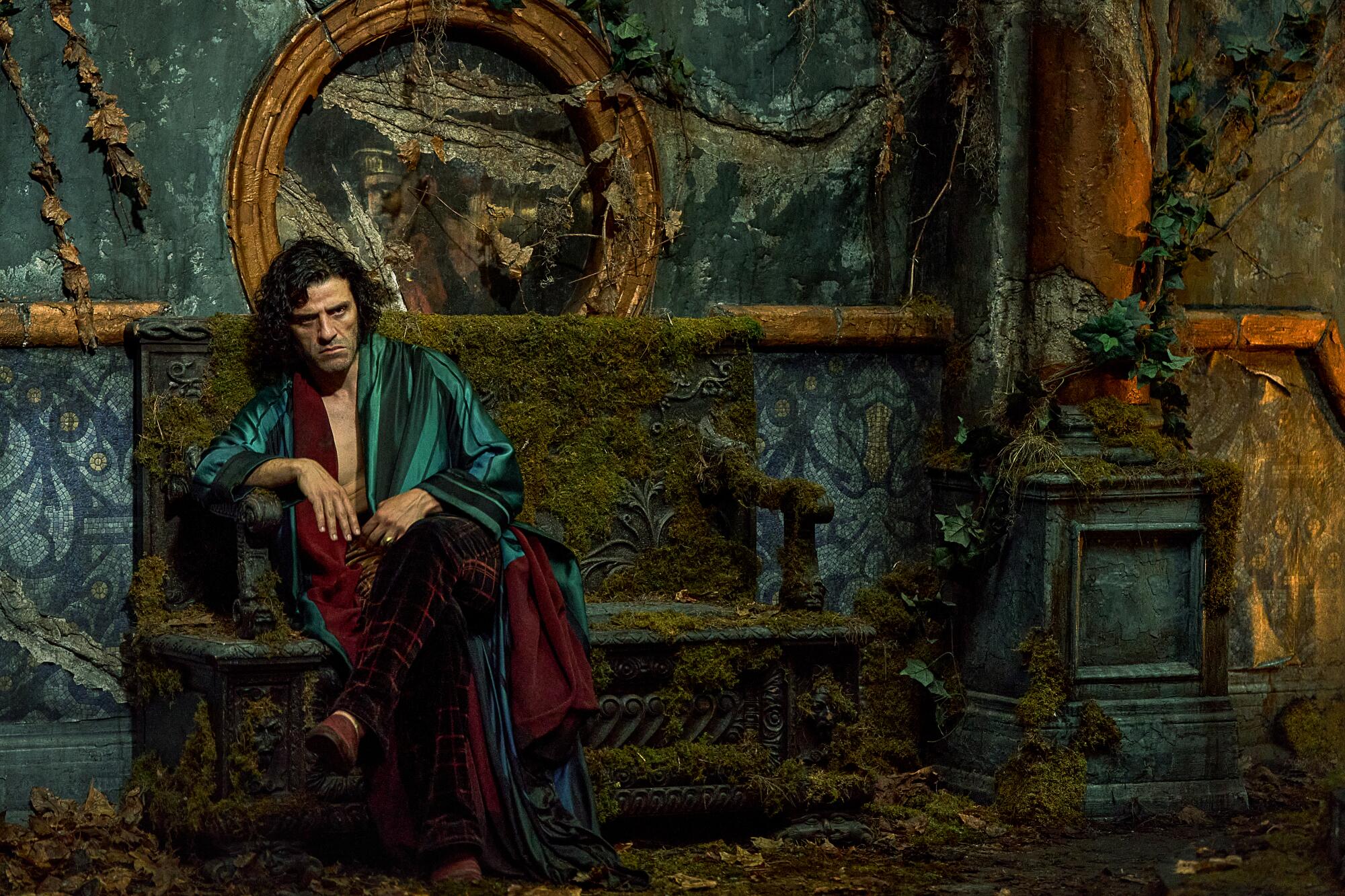
Oscar Isaac in “Frankenstein.”
(Ken Woroner / Netflix)
Villarreal: Oscar, thanks so much for being here.
Isaac: Very happy to be here.
Villarreal: I have to say, driving down the 110, I came across buses with your face wrapped around them.
Isaac: I’m so sorry.
Villarreal: It was a pleasant sight in L.A. I know you encounter a level of this with each project, but this does feel a little bit different. How you’re feeling in this moment with “Frankenstein”? How do you take stock of the small moments in this big production?
Isaac: There aren’t too many small moments with this, to be honest. Everything’s very big-sized. In a way, it’s the most I’ve really done to support a movie. I’d say even more than “Star Wars” to a certain extent, because it straddles so many things. It’s a big fun popcorn movie. It’s also an intense emotional drama. It’s a platform release, a few theaters then the streaming platform itself. So there’s been a lot of things to do for that. And it can be tiring, but the thing is when it’s in service of Guillermo [del Toro, the director] and his vision and it’s his love letter to cinema, it’s the story he’s always wanted to tell — that’s an energizing thing. Being able to do it with him. And with Jacob [Elordi] and Mia [Goth].
Villarreal: Have you come across a bus with your face on it yet?
Isaac: Maybe not a bus. I’ve seen billboards. I’ve seen bus stops, but the actual moving thing itself, no, I haven’t yet.
Villarreal: I know Guillermo has said that he has long seen you as the person to play this role of Victor, even before there was a screenplay. What do you remember about that lunch you had with him? What did he say that he saw in you for this?
Isaac: I wish I could really go back and like just parse it all out. We just immediately started speaking as friends, as fellow Latinos, as immigrants trying to navigate our way through this industry, as both having very intense relationships with our fathers and the way that’s changed over time, both becoming fathers and wanting to not necessarily follow in some of the same footsteps, but also recognizing what an incredible source of of life our fathers have been. But all the pain that came from that, and forgiveness. We talked about those things without any relation to a movie in my mind. It wasn’t until after that where he started talking about this project and he said, “I think you need to play Victor Frankenstein.”
Villarreal: I feel like Mary Shelley’s “Frankenstein” is so steeped in the culture because the creature, the monster, is such a part of pop culture. When did you first encounter the book? Did you have to read it in high school?
Isaac: I encountered it a little later. It was shortly after high school. I wanted to have a read because it’s such a famous, legendary, iconic book. I enjoyed it, but it didn’t really hit so hard for me. When I left that that meeting, Guillermo gave me Mary Shelley’s “Frankenstein” and the Tao Te Ching. He’s like, “Read these two books.” Going back to the book again, reading it, really hearing her voice, really hearing her voice in all of the characters — I thought that was very interesting, that everybody kind of sounds a little bit like her. And I love that Guillermo took that idea and did the same thing with his movie. He made it very autobiographical.
Villarreal: For “The Card Counter,” you also had to read a book about the way that we store trauma. Did you find yourself returning to that at any point?
Isaac: “The Body Keeps Score.” That’s right. Incredible book. I did, very much. Also, parts therapy. This idea that we’re all these different parts and different voices and we’re not any one thing. And gestalt therapy, this idea of, like, being able to hold that child-self of you that’s broken. For me, that was a very big one in thinking of the Creature. The Creature is a reconstruction of Victor’s broken child that has to chase him down to forgive him — to make him look at him, face him and forgive him.
Villarreal: Did you find that you wanted to understand both Victor and the Creature?
Isaac: Guillermo and I spoke very explicitly about the idea that they’re one and the same. That there are two halves of one full person. And that actually was really helpful in the playing of it, particularly in that one scene when the Creature comes back and demands a companion. That scene in particular was played on my part as if that’s his voice, his inner child, his addict, that darkness within him that he’s trying to suppress.
Villarreal: How did you both discuss Victor in terms of, is he a reliable narrator telling the story?
Isaac: We spoke that he’s very much an unreliable narrator. It is his remembrance. It’s a memory play. Did Elizabeth really look like his mom? Probably not, but that’s how he remembers it. That’s who he saw. And the sets are these massive archetypal Jungian visions that feel very much like they’re part of his inner conscious, his subconscious, and not so much objective reality.
Villarreal: I want to talk about the the look and vibe of Victor. I know that you’ve talked before about looking to some rock icons for inspiration, whether it’s Prince or David Bowie. I think Guillermo mentioned Mick Jagger at one point. How did you both arrive at that and what were the videos or the performances that you locked in on?
Isaac: That first meeting that we had, it wasn’t so much like he saw me and he’s like, “You’re my Victor.” It’s a conversation. And out of that conversation, inspiration starts to happen. That is what ultimately led for this thing to happening between us. And that conversation just keeps going. As he writes it, he has a few ideas, I look at a few scenes, I see where he’s going with it, we start talking about it more. He starts talking about the way he wants Victor to occupy space, especially in his memory, that he remembers himself like conducting a concert, like a rock star, like holding court and having this punk rock, iconoclastic energy. He’s like Mick Jagger. And suddenly “like Mick Jagger” becomes, “well, like a rock star.” Well, how does he move? What is it about Mick Jagger? What is it about these other musicians, these artists that that’s the form of expression to think about? Not so much the scientist or the mad scientist, but the passionate artist. Then those ideas mix with the incredible genius Kate Hawley, who does these costumes, who also is bringing in all of her ideas of punk rock in London in the ’60s and Jimi Hendrix and those bell-bottoms and those hats that have a bit of a Gothic-Romantic thing going for it. Then these little boots. And then suddenly I see these boots and I see this hat, but for me that looks more like prints to me. All these things are just conversations and pieces and things being put together that create a character. It is this amazing collaboration that happens, this collage that gives the impression of a character, and that’s really special.
Villarreal: You’re working opposite Jacob Elordi, and I think a lot of people come in with preconceived notions about maybe who he is as an actor based on his past work. He’s such a revelation in this film in terms of the work and prep that he did to get here. First, talk to me about seeing him as the Creature for the first time, but also what he was like as a scene partner.
Isaac: We only met briefly in Guillermo’s office at one point, and he seemed like a nice young fella. He had his little 35mm camera, was taking a lot of analog pictures, which was cool. And the first scene we shot was the last scene of the movie. That was the first time I saw him in the full getup. So he walked in and immediately I was really moved by how graceful he was. I remember him coming in, like, fingers first; his hands were like animals, like [a] sea anemone. There’s just like incredible movements that were happening and I found it really lonely and heartbreaking. I thought it was an amazing coincidental, if you believe in those, opportunity that that was the first scene that we were going to get to do together — the last scene, the time when these characters finally actually see each other for the first time. He was amazing and then so graceful and gentle and very emotionally available.
In between takes, I’d see this big lumbering monster taking photos with his little camera, which was incredible. What was incredible about that too is that he was loose. He was just taking everything in. And that’s a very hard thing to do in those high-pressured situations. People can kind of get, like, tunnel vision and narrow in and try just to do the thing that they want to do, but he was [operating from] open awareness, which is a place that we all hope to start from as artists.
Villarreal: Did you both have an idea of, “Do we need to approach this a certain way to be true to these characters, with the friction or tension that they have, or can we turn that off in between takes?”
Isaac: There was no need to do any of that. That would have been just extra work, more like an ego idea. It was very free on set, and that’s Guillermo; that comes from the top down. He’s ebullient, he’s joyous, he’s loud, he’s inclusive of everything. So there’s no secrets. If he likes something, everybody knows it. If he doesn’t like something, everybody knows it. Whatever he’s working on, everybody knows it. And so it feels like a team. There wasn’t really space for this kind of sheltering away or trying to manufacture some kind of dynamic.
Villarreal: Did your view or perspective on Victor shift over the course of making this film? As a son and as a father, how did you see him in the beginning and how did it change by the end?
Isaac: It’s funny because I have a lot of friends that have kids that have texted me saying, “Wow, man, that made me feel really guilty watching you do that,” because we can all think of those moments where we lose our patience and we yell or we get angry at these very innocent beings that didn’t ask to be here and yet they’re being forced to conform to these rules. And the idea that what we think is right trumps everything and that our children are just extensions of ourselves, accessories, things to be judged in relation to us, as either prideful or shameful. That horrible cycle that happens and those patterns that we fall into. So that became more and more evident, especially in those scenes with Jacob as the Creature, with the shaving and the washing and the being tired and all things that were additions from Guillermo that are not in the book. Because in the book, Victor leaves right away. But this is more of like a slow retreat from the responsibilities of bringing somebody into the world.
Villarreal: I want to unpack that more, because it’s been interesting to see the discourse online of people very much relating to this element of Guillermo’s take, the themes of generational pain and a father’s desire for redemption. Obviously, Victor is physically and emotionally abused by his father, and we see how the cycle repeats itself with the Creature. This idea of breaking generational trauma, like you said, it’s something that we try to be mindful of in how we work every day. Did you find yourself unpacking some of those emotions in the process, or is it just something that you’re sort of reflecting on now that it’s over?
Isaac: We spoke about those things at that first meeting, so that was actually like the touchstone of the whole thing. That’s what kept everything grounded. It’s a very heightened performance. It’s not naturalistic. It’s meant to be quite expressive. It also brings in modalities and forms of telenovelas and and Mexican melodrama. We watch those things very carefully to bring some of those elements out in this kind of fever dream that is this film. But we were only able to do those kinds of things knowing at the core it is about this generational trauma and this idea of what we inherit from our fathers or from our parents. And as much as we try to run away from them, we get blinded often by our own constructions of ourselves and our own egos and our own desires and are blind to repeating these exact same things again. And especially as artists — I can definitely relate to the idea of “Well, if I can just figure out this one thing, this character, this piece, if I can find the breakthrough here, then everything will make sense. Everything will be worth it, all the limbs that I’ve cut off, all the villages I’ve burned. The trail of debt I’ve left behind me will will mean something if I can figure this thing out.” Then you get to the other side of that and that’s not the answer. We very much were conscious of that.
Villarreal: I guess I ask because the interview I was referencing before, your interview with Terry Gross, which was around the time of “The Card Counter,” I was so struck by you talking about your [father and] upbringing in an evangelical household and this feeling like doom was around the corner. And I was so struck by how you talked about that. And you talked about your home in Florida being demolished by the hurricane. In my rewatch of “Frankenstein,” being focused on you and your character in particular, I was thinking about how much of that was playing in your head, especially in the scene where the place is burning down. Like, do you go directly to those kind of moments? How was it playing in your head?
Isaac: I don’t necessarily try to summon that specific moment. I think part of the preparation is reading and feeling; as I read through the script and as I think about it, where I connect with it emotionally. And sometimes if something feels far away, I do have to be like, “OK, well, how do I bridge the gap to this thing? How can I relate to it? Oh, well, I guess, yeah, I had to deal with this in my life. And how did I respond to it? Well, how would Victor respond to it? How would I respond to it if I had Victor’s circumstances?” That is some of the fun of meditating on the piece and thinking about what all the possibilities are. But with this, I didn’t find myself, like, literally reaching to stories in my past. I just allowed that to be available.
I did a bit with the last scene, thinking about, “When was the last time I was at a deathbed with a loved one?” And what was that like and what do I remember physically of that, what was the energy and what was the tone of that and how is it appropriate with this and how is it different? You use whatever’s available, and sometimes just the other person across from you is enough and sometimes you need to kind of summon it from the ancestors or from wherever to get through that performance ritual.
Villarreal: When you’re channeling those intense emotions, is it, like, hard to keep them under control sometimes for the good of the scene?
Isaac: Well, actually, that happened with this last scene. I’d spent a a day getting into that mode and summoning, and we did the scene and it was quite volatile sometimes. A lot of the emotions would come through and Guillermo would say, “OK, let’s do another one, but maybe tamp that down a little bit.” It’s like, “OK, let’s try that again.” We did it a bunch of different ways. And funny enough, even though it was a great day and everyone was happy, we ended up coming back and reshooting it. And it was done last minute. I didn’t have time to do all of this preparation, and we just went and that’s actually what ended up being in the movie. Because I wasn’t expending any energy trying to reach for something. It just was more reactive and it was a bit more sober and less an idea. It’s that balance sometimes between wanting to get to something, explore something, but also letting it go and allowing something to emerge that is not willed.
Villarreal: I want to talk more about the collaboration with Guillermo. What does that look like in practice? What is a note from him like? I saw another interview where you mostly spoke in Spanish with each other. How did that allow you to understand what he’s after more easily?
Isaac: That first meeting we only spoke in Spanish. So it set the tone. And my Spanish is good, but it’s like maybe seventh-grade vocabulary.
Villarreal: I feel a kinship.
Isaac: I would speak in Spanish to my mom. That was the person that I would only speak in Spanish to. And then when she passed eight years ago, I kind of lost that. I have my aunts and I talk to them, but it kind of starts to go away. So to suddenly have Guillermo show up, and that was the way that we really first interfaced. And with him, even though he could hear me sometimes, doing it in Spanglish or trying to get to it, he just was committed. It’s like, we speak in Spanish. He didn’t have to say it. That’s just what it is. It just created this real, almost, like, subconscious intimacy because it’s the mother tongue. That is the first thing that I heard. Even though when I learned to speak, it was in the United States, it was both always at the same time, then the English took over. But it just hits something different to have to communicate, to have to try to find a way to express myself in Spanish to Guillermo, talking about really difficult things. What would be great about it is it forced me to be simple and just, like, get to the f— point, and not like all this intellectual stuff around all these definitions and acting terms and all this. That was a really special thing.
Villarreal: We’ve talked a little bit about we’re working through, for lack of a better term, some daddy issues during the making of this. I know that “Hamlet” is such a seminal text in both your personal life and in your career. And obviously, this is a film that has parallels. With the passing of your mom, and working on this, especially with that last scene, how did you feel your mother while working on this project?
Isaac: Wow, that’s a very kind question. So, so, so much. She would have loved this movie. The last movie we saw actually was “The Handmaiden.” Super erotic too. I was like, “Mom, we’re sorry; close your eyes, Mom.” But it was so beautiful and kind of dark and opulent — she loved that stuff. She was always incredibly, incredibly present. Even the Elizabeth character — my mom had red hair as well. And this is in Mary Shelley’s text about the feminine and the masculine and those warring kind of energies. And for Victor, ironically, really tapping into more of the feminine energy with him in some ways. What he does is obviously — the penetrating nature, is a masculine thing, but at the same time, that freedom and the liquidity of that femininity was very important too. That last scene, it was interesting. That first time we did the scene, there was a lot of my mom there. Then when I had to let it go and I had to just respond, suddenly dad showed up. And that was really wild. There’s a bit of that warring energy with Victor all the time, and that was really surprising.
Villarreal: There was also the the detail that people really picked up on, which was the drinking of the milk. How did that inform you as you played Victor?
Isaac: Once his mom dies, he gets stunted. He never grows from that point on. His body grows. What he’s doing, his intellect grows, but emotionally, he stays that little boy that’s been hit in the face by his dad and rejected. And rejected by his mom because she died. It’s not rational, but that’s what it is. He’s orphaned. That’s also why mom feels so present. He’s just always looking for her. He’s always looking for her everywhere, everywhere, everywhere. The milk is just looking for her. It’s just comfort. La lechita. It’s also very funny because it’s so simple too. He likes playing with the saint-sinner thing, this guy that paints himself as the victim. He’s not a drug addict. The only thing he does is milk. And milk’s good for you, right? He starts off as Jesus Christ and ends up as Charles Manson. That’s what that milk does.
Villarreal: Do you have a sense — especially with a little bit of hindsight now, though I know you’re still in the whirlwind of it — what the character of Victor has done for you?
Isaac: What was surprising is that he is a sadist, but in like the Marquis de Sade kind of way. That wasn’t something that I thought about, but as it progressed, what was surprising to me was the pleasure that the character was giving me. For someone that is so dark and has such capacity for cruelty, the fact that he just felt so good, it was so free and so energized and kind of joyful. And I asked Guillermo at one point, I was like, “Maybe something’s wrong here? Because, like, shouldn’t it be a little darker and heavier?” He’s like, “The movie tells you what it needs.” You listen to the movie, and this is somebody that doesn’t have any doubts. And that feels pretty good to not have any doubts, until he crashes. He wakes up from this dream, this fever dream of no consequences. There’s no consequences, nothing matters, the rule of nature is dominance and cruelty, and actually pain is the same as pleasure. And the more perfect the crime, which is against something that’s virtuous and innocent, the more perfect an act that is, philosophically, nihilistically. So that is pure freedom. Pure freedom and pure pleasure, it’s like f— it. To play somebody like that, and to allow myself to be blind to the feeling of consequence and to just shoot like a rocket, that was incredibly freeing and pleasurable. Then suddenly to stop back and look back and be like, “Oh, what an awful thing. What awful things he did. He couldn’t see what he was doing.” But in the moment, that was unexpected.
Villarreal: We talked about the intensity of filming that last scene. What was the scene where you just felt so free and happy or excited?
Isaac: Creating the creature. Creating the creature was just like the rain coming down, the running up and down the stairs in the little high-heeled boots, the screaming at Christoph Waltz, you know, and his body flying down and him being like, “f— it, gotta throw him in the freezer, gotta keep this thing moving.” That energy, you know, climbing up the tower, putting the spear up there. He’s like a Gothic hero, a Gothic superhero. That kind of mutability within the character — it’s kinda like what I was saying about the artist. It’s like, “This I know; I know how to do this, and if I can do this, everything will make sense.” So that moment of just purely going for that thing, that was a really exciting moment. And also in that set, in Tamara [Deverell’s] incredible set, with Dan [Laustsen’s] lighting and Guillermo sitting there in the corner like this little crazy Mexican Buddha, just wanting more, more, more, that was electrifying. Pardon the pun.
Villarreal: I’ve wondered what it’s like walking into one of his creations, those sets. I can’t imagine. It feels like you’re in a dream.
Isaac: You do, and what’s the most incredible thing is that he’s surrounded himself with people for the last 30 years that are like an extension of himself. Through a process of elimination, he’s gotten these people that are just as passionate, just as detailed, and have ownership of the movie. The set decorator, the painter, the greens person that puts the moss in is like, “Do you see where I put the moss right there? You see the moss right there?” That kind of artisanal passion over it. So you walk in, sure, it’s inspiring for the imagination, but it’s also inspiring as a crafts person to be like, “OK, how do I bring the same amount of detail and passion and love for it?”
Villarreal: I’m asking this teasingly, but what’s the worst thing about Guillermo as a director? Is it that he wants so many takes, or is it that he just thinks you can do anything?
Isaac: I was gonna say what was challenging was to have somebody quilting the movie as we were shooting it. So that you would do a take and sometimes it would go straight into the edit and he could show you it in the movie itself. And as an actor, that could be tough because you’re like, “Oh, I’m not ready to see that yet.” But he was making it as it goes because the camera was always moving, so he needed to see that it was always connecting to the next thing. I had never experienced that before. For instance, that last scene, we did it, the next day he came in, and it was all edited with some temp score on it and I saw it, I was like, “Oh no, I don’t think that’s… “ But in that case, it was good that I saw it and had that reaction because we got to have another go at it. But it is dealing with like, “How much do I want to see? How self-conscious am I?” But it’s his openness. He’s not afraid.
Villarreal: Was he open with Jacob having his dog Layla on set?
Isaac: Yeah. That’s the thing. He was just free. He was really free. He’s like, “Whatever you need, man. Whatever anybody needs, that’s it.” He would embrace everything. Every mistake, he’d embrace.
Villarreal: Before we wrap things up, we’ve talked about swirling in this space of loss and renewal. In addition to tapping into that with “Frankenstein,” your wife, who’s a filmmaker, Elvira Lind, has this documentary, “King Hamlet,” where she documented a very transformative period in your life as you dealt with the loss of your mother, but also the birth of your child, while working on a staging of “Hamlet.” How has it been to sort of live in this space and have these parallel moments between these two projects?
Isaac: In a way, it’s like the father and the mother of these projects here. And the strange synchronicity of when they’re coming out at the same time, it’s kind of a beautiful thing, because “Frankenstein” is this massive thing, it’s very expressive, it has a lot of people, so much energy behind it. Having to do that and then flying to New York and showing a small group of people this tiny little movie made by just a handful of people, mostly my wife, this incredible documentary filmmaker, but made by her again by hand about this really small, quiet time of a play that we did that maybe a few thousand people saw, there is something quite grounding about that. It also feels generous because it’s about something that she’s made. But also it’s about showing a little peek for anybody, but also for artists as well, at what it costs sometimes and what it takes and how this particular family dealt with all this happening and the desire and the need to process it and create something out of it.
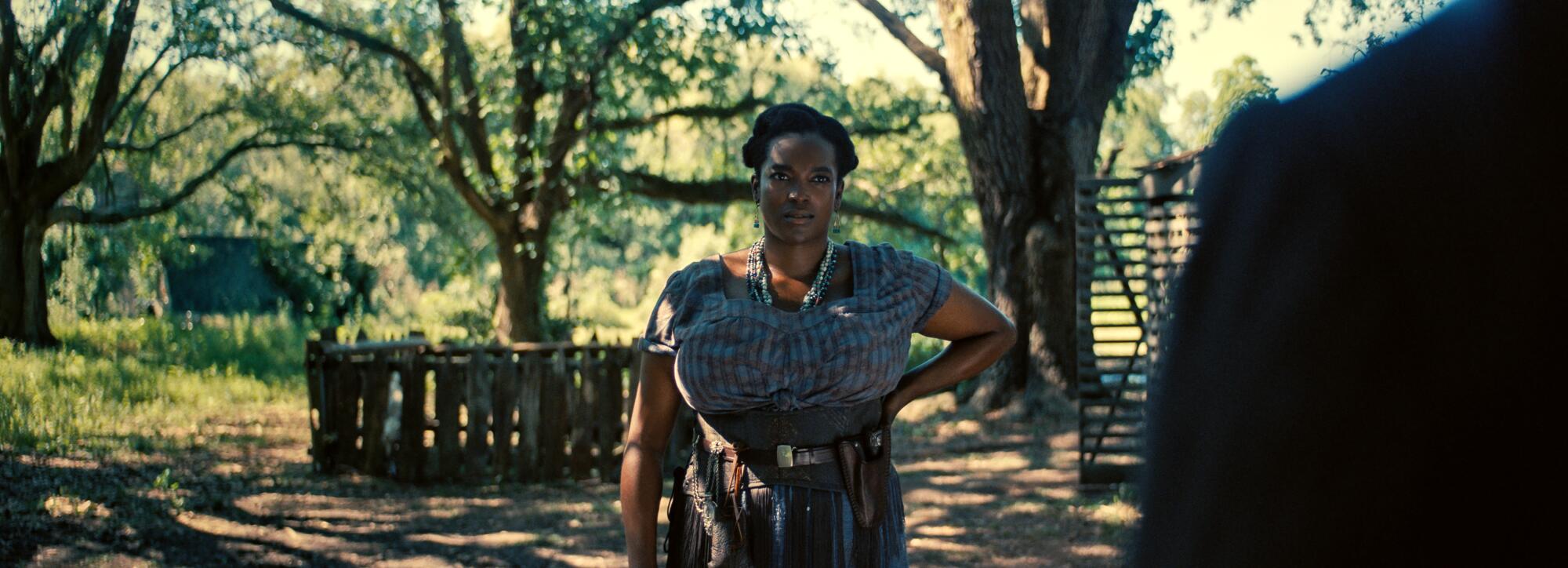
Wunmi Mosaku in “Sinners.”
(Warner Bros. Pictures)
Mark Olsen: “Sinners” obviously opened earlier in the year, and it’s really just hung in there. It’s a movie people are still talking about. What does it mean to you that the movie has already had such an enduring life?
Wunmi Mosaku: Oh, it means so much to me. I feel like you take a job because you believe in it and you trust the filmmakers and you’re excited, and then you get on set and you do your best and then all of a sudden you remember that it’s going to be out there and people are going to judge it and they might not like it and they may not like you and they might not respond to it. And we would turn to each other sometimes and be like, “Do you think they’re going to feel how we feel about this? I really hope so.” Because we really felt like it was so special. And so seeing the reaction has been so affirming and pretty magical because it’s not always the case that it translates the same as how it feels for you, that the audience feels that too.
Olsen: And what do you think it is that audiences are responding to? Mosaku: I think Ryan Coogler, his way of creating art is always based in truth and connection and honoring the people on the screen and the people that they represent in and around his life. And so I feel like people are responding to the fact that it feels truthful. Even though it’s got horror aspects and a musical aspect, it really just has heart and depth and it’s about community, it’s about freedom, it’s about the price of freedom. It’s about so many things that affect people every day. Capitalism, selling out, cultural appropriation. It’s deep and it’s layered, and it’s all rooted in truth.
Olsen: And now when you say that as you were shooting the movie, it felt special to all of you — can you describe that for me? What do you think you were feeling as you were shooting the movie?
Mosaku: I felt a deep connection to my ancestry, to my purpose, to how what I do today will reverberate in the future. My lineage, my child’s future. I just felt the film links the past to the present. It links West African traditional spirituality and it connects it to hip-hop and blues and all these different types of dance and culture. It feels kind of sprawling and encompassing of the Black diaspora experience. And it makes you feel connected to everyone in the diaspora. I felt really awakened to my position in that web of creativity. And artists like Ryan, who have this visionary, revolutionary way of creating, they just kind of feel like guiding lights, diamonds, in this web of us. It feels like, “Oh wow, he really is this jewel to be cherished, and I’m connected to that now.” So it was very multilayered, the connection I felt.
Olsen: That does sound like more than just a typical day at work. Mosaku: There was nothing typical about it. It felt like, vibrationally, it changed all of us.
Olsen: As I understand it, when you auditioned for the film, you were given this seven-page scene that introduces your character of Annie. It’s you and Michael B. Jordan’s character of Smoke, and from that scene you thought the film was a romantic drama. What did you make of it when you found out what the movie was really about?
Mosaku: Ryan explained the movie to me in and around the scene, and my mind was blown because it made complete sense, but it came completely out of left field for me. I had the themes that we see in the movie of the evolution of blues to modern-day music and ancestors and future ancestors, they weren’t quite there when he was explaining it to me, but it was there in the spirit of what he was explaining to me. So I knew it was epic and that there was depth, but then there was also vampires. I can’t explain how he explained it, but I felt the weight of all of the themes and messages, and it seemed to work with the idea of vampires coming in and taking blood. It was a surprise, but it made sense. I was completely hooked and in from the first scene, but his description, I was like, “This is genius.”
Olsen: I like the idea that you were still able to process your story in the movie, Annie’s story, as that of a romance. Even with everything else that’s happening in the film, there still is that story at the core of it. Mosaku: Because he only works with truth. Even in a fantastical world of vampires and spirits, he still works within the truth of relationships and character dynamics, and so their love is the community, the love and the bond between all of the characters, that is the heart of the movie. Sammie’s desire to leave the plantation and see the world, that’s the heart of the movie. These two people who love each other dearly and are insatiable for each other but can’t be together because of racism and the color of their skin, that heartbreak is the heart of the movie. A woman who just wants to sing and is young and is married to this old church type — that line I think is cut from the movie, but Jayme [Lawson]’s character says he’s older, church type — and she just wants to be completely free on the stage. That she gets to explore and to have this thrilling night in the community in the juke joint, I mean that’s the heart of the movie too. These relationships are the beating heart.
Olsen: But there’s something I’ve heard you talk about, that Annie relates to the character that most of us know as Smoke, as both Smoke and Elijah, his given name. Can you untangle that for me? It’s really compelling to think that she is relating to both sides of his personality. Mosaku: Well, everybody has a representative, right? Like, this is my representative. And then there’s Wunmi at home without the glam, the truth. So yes, she met Smoke. She fell in love with Smoke, but she knew Elijah. In Yoruba, we have your given name and then you get given an Oriki name, and the Oriki name is a pet name that your grandmother or your mom would call you and when they call you by that name, when you hear someone speak your Oriki name, you can’t say no. It’s like, “That person knows me like no one else, and they’ve used this name for a purpose.” So almost like Elijah is his Oriki name because everyone knows him as Smoke. He has his defenses up, he has his heart guarded, Smoke’s been through war, Smoke’s been through the gangster stuff in Chicago, but Elijah lost his daughter. So when she calls him by his name that’s like calling his Oriki. Olsen: You’ve spoken as well about how much you feel you’ve learned about yourself in playing this role, that it changed you. How so? Mosaku: I mean, even the fact that I can talk about Oriki names. I didn’t have an Oriki name. I didn’t understand the meaning of the Oriki name until I really just kind of immersed myself more in my culture that I feel like I had no choice in not being a part of. I came to England when I was 1½, and you try and assimilate, you try and fit in. And that is at the expense and the tax of your birth culture. And that’s something people don’t really pay attention to, what’s lost in order to feel safe in another culture. Researching Annie, I had to look back at where I’m from, because she’s a hoodoo priestess and hoodoo is a derivative of Ifa, and Ifa is the traditional Yoruba religion. That is where my people come from. That is part of my survival, that’s why I’m here. Their knowledge, their belief systems, that is why I’m here. And so having to research that just opened up a whole treasure trove of truth for me and inquiry and self-reflection and self-love and admiration of all the people that came before, the difficult decisions my parents made, and then the difficult decisions I’ve had to make in navigating being an immigrant in another country.
Olsen: What does it meant to you to connect with that part of yourself?
Mosaku: I’m unable to put it into words. It’s changed me profoundly. It’s changed my relationship to the world, my culture, my home. I feel inspired in so many different ways to reconnect, feel connected. I’ve been doing Yoruba lessons for five years, and only in the last year has it really stuck. And I think the sticking is because of the exploration, the real exploration, not just an intellectual “trying to learn a language.” It’s unlocked something emotionally in me. The language is sticking.
Olsen: “Sinners” is rooted so specifically in the world of the Jim Crow South here in America. Was that still something that you could relate to? Were there aspects of the story that still felt familiar to you?
Mosaku: Yeah, I can relate to being Black in America, I can relate to being Black in a different culture. But there’s a lot of research that has to be done. A lot of people in the cast were pulling upon the people that they knew in their history and their ancestry, whether it was Ryan and his uncle James who inspired the movie or Miss Ruth [E. Carter, costume designer, who] said my dress, the velvet dress was inspired by a picture of her grandma in a velvet dress on the stairs with her grandfather. They have different things they can pull on that are really from the time and the people. I do research in a different way, because I don’t have that same history to pull from, but I have an admiration and a love of the African American culture. My daughter’s African American. So I feel I have a respect and a duty to do my research, not just for my character work but for my family. I can relate to aspects, but I don’t have that shared cellular memory that the rest of the cast do.
Olsen: So what did you draw on for research? Mosaku: I spoke to hoodoo priestesses and that was really my main research, was kind of the faith, because that is who she is. That’s her foundation. And that’s her power. So that was my main research. Obviously, researching the era, Prohibition, Jim Crow South, the Great Migration. For me it’s about respect and honoring as truthfully as I can, if someone has trusted me with this role. And also I’ve said no to roles that I don’t think should be played by Black Brits or Nigerians. I’ve said no to roles that I think should be specifically for African Americans. There’s something about Annie that feels really close to me and really important to me, and I think she’s like a bridge, and I do think of myself sometimes in that way, of in the middle. I’m someone who was born in Nigeria but was never raised there, someone who was raised on a land that has never felt like my own, and then someone who’s come here and has, not inherited, but I have a daughter with this inherited history. And so I have a responsibility for her to understand all three aspects, and then I’m sure there are more aspects of her history that I am yet to figure out what they are. It’s my responsibility to understand that and guide her with it.
Olsen: When you’re shooting these kind of stories or dealing with sort of heavy topics, do you have anything that you like to do at the end of the day to pull yourself out of it?
Mosaku: I talk to my husband and I spend time with my daughter. I speak to my family. I go home.
Olsen: And I don’t think I’m spoiling anything, but I want to be sure to ask you about your last moments in “Sinners.” It’s deeply moving. You reappear in the film as a vision to Smoke. You’re nursing your infant daughter. Can you talk to me about that moment in the film and what it means to you?
Mosaku: It’s purity. He drops his representative, he drops Smoke. He has to drop Smoke in order to join us. The initial cost of this never-ending life as a vampire, it sounds like there’s a glamour to it, there’s a capitalism to it. Stack and Mary are still young and beautiful but there is such a great cost. They never get to see the sun, they never get to hold their loved ones again. And actually they’re not truly free. Whereas Smoke and Annie have chosen true freedom that fully incorporates everything that they love truly. It’s not money, it’s not eternal life, it’s not eternal darkness. They are basking in the sun with their ancestors and it’s purity, it’s love, it’s freedom.
Olsen: I have to ask you about the musical number where sort of the past and the future sort of collapse in on themselves. What did that read like in the script? And what was it like to be on set that day?
Mosaku: It read very much like it felt when you watched it. I had read a version without the future and past ancestors, where it was just about the two brothers and their women and reconnecting and it was beautiful. I loved it. And then before the read-through, we got given another draft, and it had the ancestors and the roof going on fire, and I threw the script down and I ran into my living room and was like to my husband, “Oh, my God, oh, my God, it’s amazing, it’s amazing. I think this is the most amazing thing I’ve ever read. I think it’s the most amazing thing that’s ever going to happen onscreen.” That’s how it felt. And on the day filming it, it very much felt magical. Sammie and Delta Slim have this scene where Delta talks to him about his gift and where it comes from. It comes from the homeland, it comes from your ancestors, it comes from home, Africa. And it’s such a powerful gift and to really guard it with all he has. Then Miles [Caton], who plays Sammie, is talking to the the older guy, Papa Toto, who plays his past ancestor. Who has the little guitar behind him, I don’t know what it’s called, like the original guitar. And he’s behind him in the scene, and then I kind of wander over to them, and Papa Toto basically does the exact same speech, never having read the script, to Miles about his gift and where it comes from and like how he should cherish it and keep it protected. That’s what they’re both talking about, protecting their gifts. And I was just like, “Oh, my gosh, this is magical. He doesn’t even know that this is the scene in the script.” It was a really special day.
Olsen: I’m going to ask this as politely as I can, but I found “Sinners” to be a much bawdier movie, it’s a much more sensual and sexy movie, than I expected. I’m curious how you found those scenes in the script and in particular what it was like for you shooting your scene with Michael.
Mosaku: It explores so many different emotions and feelings. It feels palpable, it feels tangible, it feels like it’s pulsing. It also feels kind of inevitable. Again, it just felt true, and it wasn’t difficult because we created such a safe space for everyone, and there’s no nudity in it, and it just feels really sensual and safe.
Olsen: What was it like shooting scenes with Michael where he’s playing both Stack and Smoke? I would imagine just him having to switch out for the scenes, how did that impact the rhythm and the momentum for the rest of you? Mosaku: It was pretty easy for us, honestly. We didn’t have to do anything. Michael had a stand-in, Percy Bell, and both would learn both twins’ lines, and then Michael would shoot as Stack, and Percy would do Smoke, and we would lock this, we would rehearse it, rehearse it, rehearse it, and then shoot it, shoot it, shoot it, find the one we liked and lock it. So then, if this is Percy and this is Stack, what they would do is he would go get changed, be Smoke, and we would kind of mime the scene. It was really harder for Mike, I don’t know how he did it. We would kind of mime the scene. They would play the scene back so he was responding to us in the real time of the scene that they had chosen. That was it. That was the only scene that we were going with. And then he would trace Percy’s steps and physique to make sure he wouldn’t step on Stack or whatever. So it was very easy for us. Like, we just had to play the scene. And I honestly don’t know how Mike did it. I have no idea how he did it.
Olsen: What has the response to the movie been like for you professionally? Do you find that you’ve gotten some offers? Are you finding yourself in rooms that maybe you wouldn’t have been in before? Mosaku: Everyone has been so complimentary and lovely about the movie. I think work has come from it, and I was in a room at the Governors Awards with Tom Cruise and Debbie Allen and Phylicia Rashad. I was like, “Well, this is new.” Me, Jayme [Lawson], Hailee [Steinfeld] got awarded one of the Elle Women in Hollywood awards yesterday, which was again really surreal, like, “Oh, hey, Jennifer Aniston. Hey, Rose Byrne. Hey, everyone. Hi, we’re in this room with you. Cool.” So a lot of really lovely things have come of it. Very grateful.
Olsen: And what does it mean to you that it’s for this movie in particular? Mosaku: This is the movie that just keeps on giving. I loved it from the first time I read those seven pages and I have grown as a person, as an actor, as a mom, as a wife. And now I’m experiencing this, which is really lovely, really nice. Olsen: You also have an upcoming role in “The Social Reckoning,” Aaron Sorkin’s sequel to “The Social Network.” Is there anything you can tell us about your role in the movie? Mosaku: I have no idea what I’m allowed to say about it. I’ve not been prepped on press for that yet, so I’m sorry. Olsen: You shot your part? Mosaku: I’ve shot a lot.