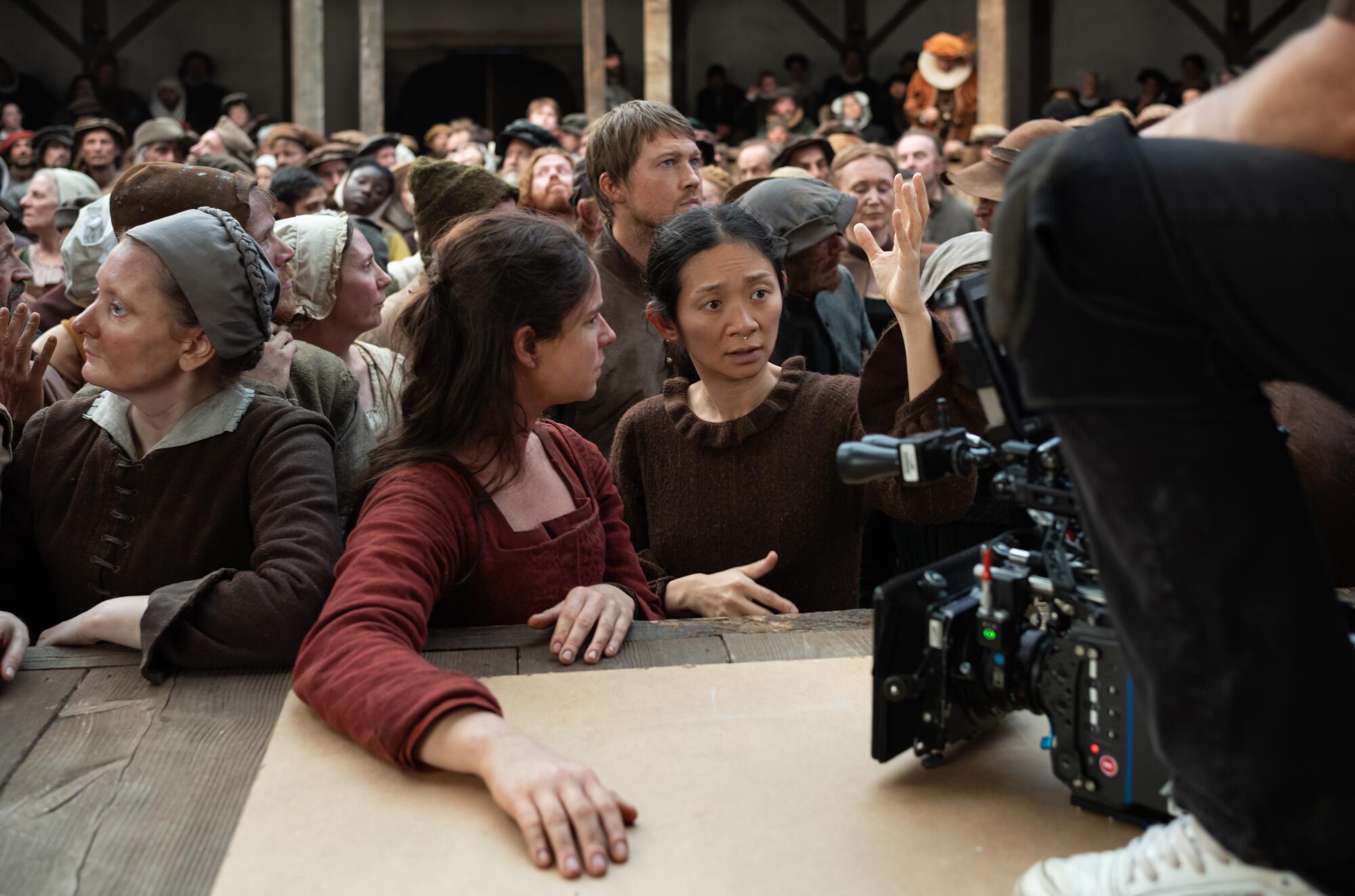
There were only four days left of shooting on “Hamnet” when Chloé Zhao realized she didn’t have an ending. The filmmaker had led the cast through a week filming the pivotal climactic sequence inside the Globe Theatre, where William Shakespeare (Paul Mescal) is staging his opus “Hamlet,” but something was missing. The script had Shakespeare’s wife, Agnes (Jessie Buckley), and her brother Bartholomew (Joe Alwyn) witnessing the demise of Hamlet (Noah Jupe), a denouement that should have evoked a sense of release. But even though the moment was meant to tie Shakespeare’s masterpiece to the still-fresh death of Will and Agnes’ 11-year-old son, Hamnet (Jacobi Jupe), neither Zhao nor Buckley could feel the necessary catharsis.
“Jessie and I avoided each other for the rest of the day because we both knew we had no film,” Zhao says. “We both went home feeling completely lost.”
“We were searching for this ending,” Buckley adds. “It was a daunting idea to try and pull together all the threads of the story we’d woven prior to this moment. I felt incredibly lost and a bit untethered.”
Zhao admits that she rarely preplans the endings of her films because she doesn’t tell stories linearly. She imagines the journey of her characters unfurling in a spiral, with the story extending downward into the darkness before rising back up.
“I’ve had to wait on every single film,” she says. “But this time I was going through the ending of a relationship, so I was terrified of losing love. I was holding on to it with dear life.”

Actors Jessie Buckley and Joe Alwyn with director Chloé Zhao on the set of “Hamnet.”
(Agata Grzybowska)
The morning after they filmed the scripted ending, Buckley sent Zhao Max Richter’s “This Bitter Earth,” a reimagining of his song “On the Nature of Daylight” with lyrics. The filmmaker played it in the car on her way to the set.
“I could feel the tears and the heart opening, and then I started reaching my hand out towards the window,” Zhao remembers. “I was trying to touch the rain outside of the car. I looked at my hand and I realized that I needed to become one with something bigger than me so I would no longer be afraid of losing my love. Because love doesn’t die, it transforms. When we’re one with everything around us, it’s the illusion of separation that makes us so afraid of impermanence.”
The true culmination of “Hamnet” occurred to Zhao as she reached for the rain. If Agnes reached her hand toward the dying Hamlet, he could then rest and she could let go of her grief over losing Hamnet. And if the audience joined her, the sensation of release would be even greater.

-
Share via
“The thing I didn’t expect, the surprise of it, was the absolute communal surrender,” Buckley says. “The way the fourth wall was broken between the play and the audience, the need to reach out and touch the core of the play. Agnes’ compass has always been touch.”
Although the specifics didn’t come to life until those final days, Zhao always planned the production so the Globe scenes would be done last. Production designer Fiona Crombie re-created the historic open-air theater on the backlot at England’s Elstree Studios using real timber brought in from France. The set version, which took 14 weeks to build, is smaller than the original Globe to create a sense of intimacy.

Plans for the building of the Globe Theatre set in “Hamnet.”
(Agata Grzybowska)
“This is my version,” Crombie says. “Our footprint is a bit smaller overall, but the essential architecture of the tiers and the roofline and the shape and everything is accurate. By virtue of having real beams that are scarred and aged, it feels more realistic. We wanted the whole thing to feel completely authentic. You want to smell these sets and feel these textures off the screen.”
“I told Fiona I wanted it to feel like the inside of a tree,” Zhao says. “So, spiritually, it’s correct for this story. And the play is accurate. We didn’t change any lines.”
Historically, there would not have been a backdrop onstage. But for the thematic purposes of “Hamnet,” a backdrop was essential. “There was a whole conversation about not just the aesthetic but the importance of that motif,” Crombie says. “It’s also a wall that separates Will from Agnes.”
“Hamnet’s” Globe was constructed to have a working backstage so Mescal, Jupe and the players could move in and out of the wings. There were real prop tables and makeup stations, as well as a nod to other Shakespeare plays. “We had a horse from ‘A Midsummer Night’s Dream’ that was loaned from the real Globe,” Crombie says. “There were loads of details everywhere that honored theater.”
The actors learned significant portions of “Hamlet.” Mescal led the cast of players in rehearsals before filming. “We would rehearse later in the evenings as an ongoing part of the process,” Mescal says. “Once the camera came in, it was Chloé’s baby, but we rehearsed consistently throughout the production. It was so cool. I have a lot of sympathy for directors. What I loved about it wasn’t necessarily the act of directing. It was more so the part of the process in helping me to act. It felt weird to direct them as Paul, but I could direct them as Will.”

Paul Mescal backstage at the Globe in “Hamnet.”
(Agata Grzybowska / Focus Features)
Mescal and the players acted out 30 to 40 minutes of “Hamlet” while filming. The actor describes the feeling of being on the Globe stage as “sacred,” both because of the physical space and because of the emotional quality of the scenes.
“It felt very charged,” he says. “Up until that point we knew we had made something very special, but we were also acutely aware that this is where you had to land the plane. And that came with its own pressure. There’s something very special about playing Shakespeare and hearing Shakespeare’s words spoken in that place. The film is talking about the collision of art and humanity, and there are no greater words to communicate that feeling than the words in ‘Hamlet.’”
Zhao enlisted 300 extras to be the theater’s crowd. Each day, Zhao and Kim Gillingham, a dream coach who worked on the film, led the cast and extras in a daily meditation or dream exercise. It was unlike anything many of the actors had previously experienced.
“Everyone dropped into this very deep place of connection to themselves and to what was happening in front of them on the stage,” Alwyn says. “It was this amazing collective feeling of catharsis and connection to something bigger than ourselves.”

(Evelyn Freja / For The Times)
“The performances from some of the supporting artists are extraordinary,” Mescal adds. “And that was intentional in terms of how Chloé constructed that feeling and by having Kim there.”
After Will notices Agnes in the audience, he goes backstage and finally breaks down, experiencing a long-awaited release of grief. Mescal prepared for the scene by listening to Bon Iver’s “Speyside.” Fittingly, it was the last thing he filmed.
“The play becomes something different because it’s being witnessed by Agnes,” Mescal says. “It comes alive for the audience because of this weird alchemy. Something feels different in the air. That moment felt like such relief, like he could just let go.”
“Hamnet” ends with Agnes reaching for Hamlet. In doing so, she gives herself permission to let her son go. It was a moment that had to be discovered rather than constructed.
“The scene became a holding of collective grief in a communal space where we were allowed to let it out,” Buckley says. “It was like a tsunami. I’ll never forget it.”
In Mescal’s mind, the film’s ending is really its beginning. He imagines the relationship between Will and Agnes will go on, continuing the spiral.
“I have no idea how a relationship survives the death of a child, but I do think there is a miraculous hope and they can see each other again in that moment,” Mescal says. “They’ve abandoned each other in certain moments, but now she understands where he went. And I think they will return to each other.”

(Evelyn Freja / For The Times)