hamlet

‘Elsinore’ review: Andrew Scott plays an actor making the run of his life

Shakespeare’s moody Danish prince of indecision isn’t a celebrated theatrical role because it’s easy. Hamlet is as likely to break an actor as make one, and what it requires is nothing less than playing the breadth of the human condition.

If a rising, not-yet-Oscared Daniel Day-Lewis hadn’t famously vacated a London production of “Hamlet” in 1989 following a mid-performance meltdown, hungry Scottish actor Ian Charleson wouldn’t have been granted the opportunity to wrestle the role into a brief, consequential and glorious run, his last before dying of AIDS. It’s a legacy that years later has now provided another wonderful actor, Andrew Scott, with a wrenching portrayal of his own, that of Charleson’s Hamlet journey, capturing what’s beautiful and painful in giving one’s life to the stage’s unique gauntlet.

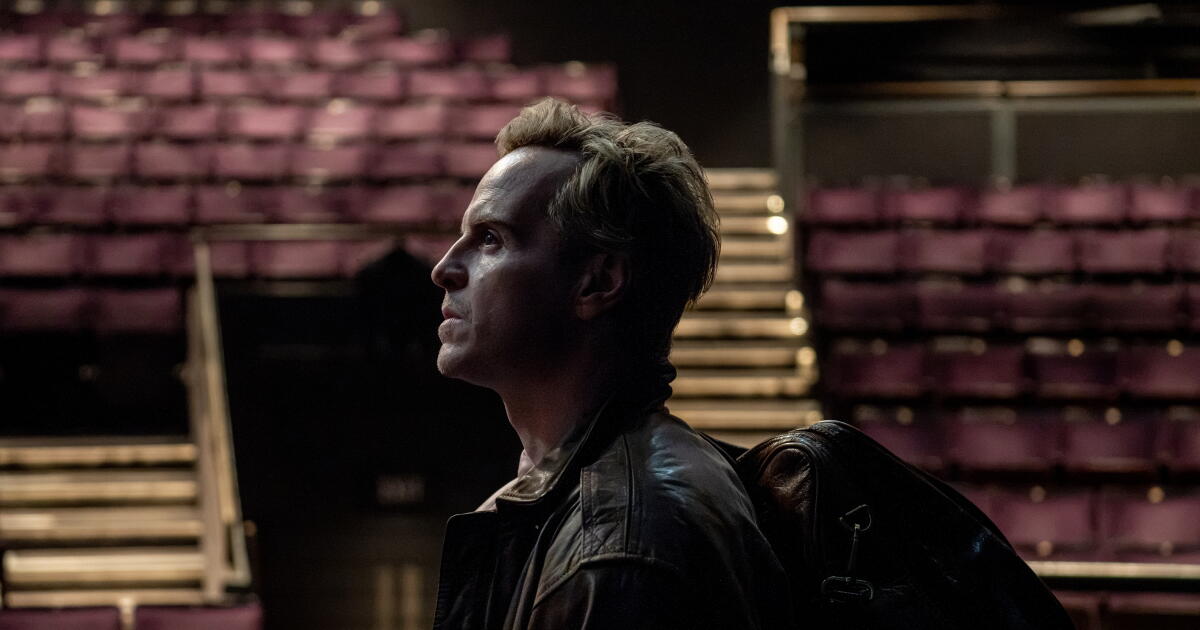
“Elsinore,” directed by Simon Stone from a screenplay by Stephen Beresford, becomes a vessel for Scott, himself an alum of Shakespeare’s most famous play. The movie doesn’t shy away from other “Hamlet” connections. The brutalist-designed National Theatre on London’s South Bank is filmed like a turreted fortress, and the era’s lethal stigmatizing of HIV and AIDS supplies an aura of lies that mirrors the isolating air of conspiracy driving Hamlet’s bid for justice.

But it’s the machinery that keeps “Elsinore” from doing more to support the wondrous intensity of its central performance. It’s a movie that wants you to root for someone running a race, not take you inside a daredevil’s ambition, although Scott — magnificent as he is — can do both anyway. He just has to convey it in fits and starts, through more impatiently conceived scenes than any movie should be allowed, especially one about staring mortality in the face.

We meet Scott’s sharp-tongued Charleson as a closeted, health-challenged actor at a crossroads. He’s tired of being associated with his breakthrough film “Chariots of Fire” and unsure what costume his career should wear. (Is action hero still a possibility?) Charleson checks himself rigorously for Kaposi’s sarcoma spots. His first such marker, on his face no less, comes just as “Hamlet” director Richard Eyre (an effortlessly warm Johnny Flynn) offers him the melancholy Dane.

With Eyre, Charleson is honest about his situation and is met with a supportive compassion to match not just that of his close friend Patsy (Billie Piper) but his own excitement at getting to escape into Shakespeare’s language. Yet when he concurrently begins a trailblazing clinical treatment with Dr. Margaret Johnson (Olivia Colman), who bristles at the risks he’s taking by taxing his body, “Elsinore” hamfistedly tries to make a medical hero into some joyless, straw-woman antagonist and it simply rings false, as enjoyable as it can be to watch Scott and Colman enliven a grim space with their sparring.

The real-life debate you want more of is between Charleson and his radically out, publicly HIV former collaborator Derek Jarman (David Dawson). Their handful of prickly confrontations about the curse of invisibility for dying gay artists — “If people see me, I fail at my job,” Charleson angrily answers Jarman’s accusations — suggest the better, thornier two-hander percolating inside the feel-good weepie “Elsinore” strives to be.

“Elsinore” seems afraid to live and breathe on its own without the aid of shortcut one-liners, a soundtrack that can’t stop swelling and more montages than a “Rocky” movie. Rehearsals, treatment, setbacks and ever-shortening time with loved ones (including Peter Mullan as Charleson’s dad) all become a cross-cutting blur of bite-size moments in forward motion, the restlessness at the edges of cinematographer Mike Eley’s images rarely adding to any deeper understanding beyond a quest for completion. It’s all sprinting for that grand exit, when we crave a semblance of the marathon process of tackling such a role.

Nevertheless, Scott carries it all so lovingly and perceptively, well-aware he’s painting in flashes of insight rather than the more protracted strokes of his craft. Wearing his increasingly depleted appearance like a badge of honor, Scott always finds the bittersweet spot where vulnerability, tenacity and charm meet — you’ll always be on your toes about what lies behind his eyes. And because he can deftly hint at what you don’t get from “Elsinore,” he succeeds at that other thing great actors in great parts can do: leave you wanting more.

‘Elsinore’

Rated: R, for language, some sexual content and brief graphic nudity

Running time: 1 hour, 51 minutes

Playing: Opens Friday, Nov. 20 in limited release

Source link

‘We couldn’t afford a home in UK so we bought a French hamlet for £26k’

It started with one house for £12,000

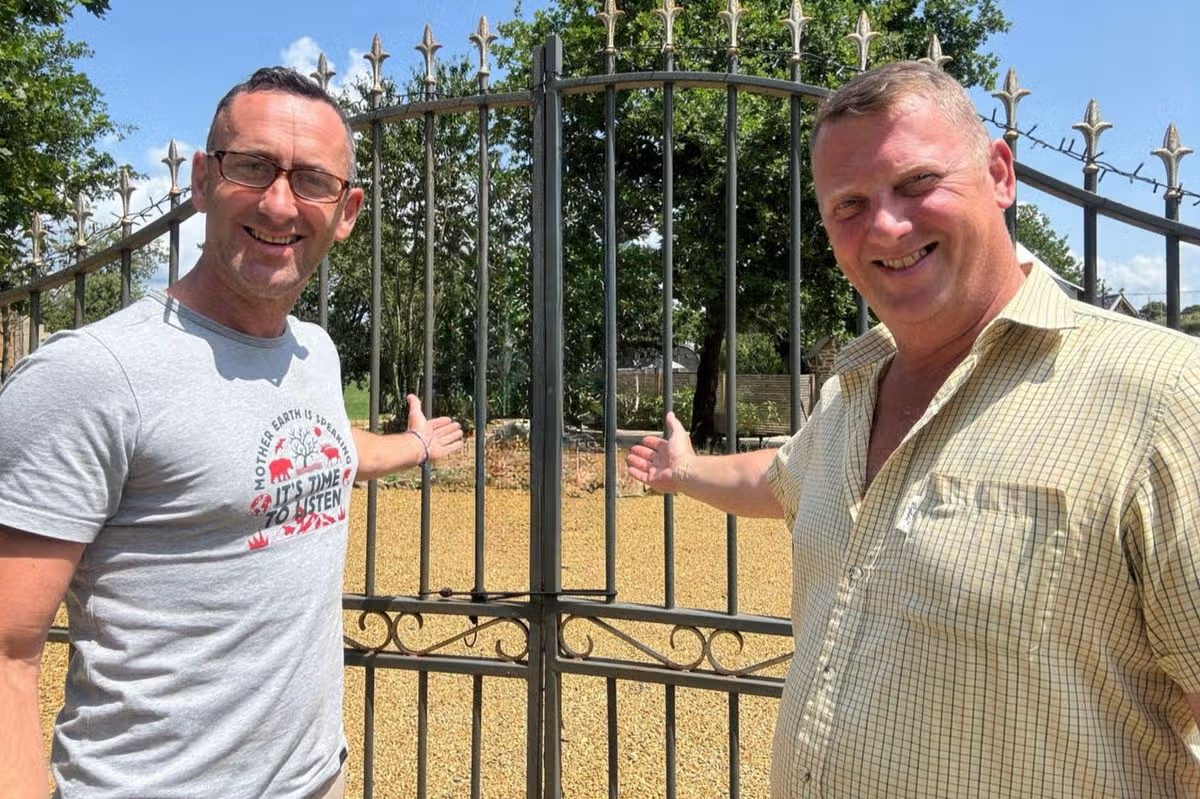
A couple who couldn’t afford to buy a house in the UK bought an entire French hamlet for £26,000.

Yip Ward and Paul Mappley, both 52, were living in a caravan in Tunbridge Wells when their friends offered them a chance to buy the property in Normandy. They went out to visit the home in Normandy and bought it straight away for £12,000 – funded by selling their belongings, including an old tractor of Paul’s.

Since then, the couple have snapped up the adjacent buildings and now own seven cottages, two barns, a workshop, a cider press, two traditional bread ovens and various other outbuildings – all for £14,000. They began restoring the hamlet building by building in 2020 and have now spent around £100,000 so far – completing the original cottage, which is a holiday rental, alongside a horsebox they brought from the UK that is “booked out”.

Restoration work

They have made their dreams a reality through fundraising efforts by their followers on social media and are set to have their second cottage complete by summer 2027. The pair reckon they have saved more than £100,000 doing the bulk of the work themselves with the help of builder friend Ian, 62.

Yip said: “People always say how did you find the village and it’s not that we were looking, it was a chance meeting with a friend who had got a place and was selling it. We definitely see it as the planets aligned.

“We went and sought out a wreck that had been abandoned 30 years ago and pieced it together. We’re really cracking on now.

“We say to ourselves we can’t believe this whole place is ours. Coming from where we come from, I don’t think the gratitude for being here will ever run out. It blows my mind.”

How they got started

The sellers had changed their minds about the property due to the huge amount of restoration work that needed to be done when they offered it to Yip and Paul. With the rules in France meaning they did not need to hand over the entire sum for eight months after purchase, they set to work during Covid, earning money through their jobs as landscape gardeners to seal the deal.

They even documented their restoration journey and appeared on Channel 4’s ‘Help! We Bought A French Village!’. Husband Paul said they were now in “full restoration mode” after working for years to transform their hamlet, called La Buslière.

He said: “I can’t express to you enough that, apart from cottages one and two, the other three cottages were covered, the whole roof in ivy. They were literally being swallowed by nature.

“We’re saving so much money doing it ourselves. We’ve got a friend we met here; he’s been in the trade for 47 years in building restoration and stuff.

“We knew of him and in 2019 he did repairs on cottage one. He did the roof repairs, minor works and then we didn’t see him for four years and he, unbeknownst to us, was watching our YouTube channel.

“We had a massive two-tonne roof thing that needed to come out as it was rotten on one end. We didn’t have anyone, machinery or money and we were sharing on YouTube saying ‘we don’t know what to do’.

“He saw this video and arrived one day and said ‘come on boys let’s get this beam out’. For the first six months he worked for no payment.”

Earning money

The couple are now able to pay Ian £1,000 weekly through the money they earn on YouTube.

Paul said: “We have five people turning up every single day to donate things – they bring bits of furniture or materials for the roof. I can’t tell you what a community we’ve built somehow.

“Every week we’re donated £400 worth of materials for free we can use. All of this saves us so much money.

“For example one side of the roof of cottage three was really bad and we were quoted £13,000 to fix it and we did it for £2,000 because we did it ourselves.

“We saved £11,000 just on one side of a roof. Take that per cottage doing it ourselves, that’s £22,000 per cottage, seven cottages, which is instantly saving us over £100,000.”

The couple plan, once they have all been restored, to try out and live in every single cottage in their hamlet.

Yip said: “People say ‘once all seven cottages are done you’ll rake it in’. That’s what a capitalist would say.

“We don’t want it to be a metropolis. Every single guest who stays here says they can’t believe how quiet it is.

“There is no light pollution, it’s a fantastic place and we don’t want to ruin it with seven cottages populated with people. The other buildings we’ll turn into workshop spaces.

“We’d like to do summer fairs here and markets. Once a month we’d like to do an outdoor cinema and do pizza making – we have two original pizza ovens.

“There won’t be things like TVs in the cottages. There won’t be UPVC windows. It’s an exciting, amazing place and we want to make sure people are transported back.”

You can follow Paul and Yip’s restoration journey on YouTube @helpweboughtafrenchvillage.

Source link

Patrick Stewart’s career stretched far beyond ‘Star Trek’ and ‘X-Men’

Unless you’re writing for a major national magazine or shooting video for Architectural Digest, it’s rare for a reporter to be invited into a celebrity subject’s home. More likely, it’ll be some neutral space like a publicist’s office, or coffee shop, or hotel room; even more likely, over the phone or Zoom. But Patrick Stewart, when I interviewed him in 2023 at the end of “Star Trek: Picard,” the “The Next Generation” sequel series in which he starred, asked to meet at his house.

Stewart, who died Wednesday at 86, was 82 then, friendly and dapper and emanating a youthful sense of wonder and readiness. He spoke of wanting to learn to play the piano and speak French — ironic for an actor perhaps best known as Jean-Luc Picard. He had written a memoir, “Make It So,” titled for a Picard catchphrase. And he was excited about the house, located on a leafy, McMansion-free, comparatively modest street in what real estate agents would call Hancock Park, where he’d been living with his wife, Sunny Ozell, since just before the COVID-19 pandemic shutdown.

“We were safe,” Stewart said of the COVID days. “We felt protected here. It was just a walk that way or a walk that way to some shops. I walk to a little post office and my pharmacy is on 3rd Street, and I always take the backstreets. It’s a fabulous neighborhood, it really is. No two houses are the same. I mean, I never thought I’d live in a house that had just got archways everywhere — no doors! Sitting here, you see one, two, three, four, five, six archways.”

From sheer weight of screen time and franchise muscle, “Star Trek: TNG” — which ran for seven seasons (on first-run syndication, a dynamic format that no longer exists), plus four films — and the “X-Men” movies have dominated coverage of Stewart’s death. (Confession: I have possibly seen one “X-Men” movie, though long before there were “X-Men” movies, I read the comics — so I am familiar with Professor Charles Xavier, a part for which Stewart did not need to shave his head, as well as his nemesis Magneto, played by Stewart’s good pal Ian McKellen.) But there’s more to the story.

Alice Krige's Borg Queen touches the face of Patrick Stewart's Picard in "Star Trek: First Contact."

Patrick Stewart’s Picard comes face-to-face with Alice Krige’s Borg Queen in the 1996 film “Star Trek: First Contact.”

(Elliott Marks / Paramount Pictures)

Stewart’s 70-year career does neatly divide into BST and AST — before and after “Star Trek,” which arrived in 1987 at its chronological midpoint. The first half is dominated by theater. He joined the Royal Shakespeare Company in 1968, after a decade on regional stages, and was a core member until 1982. “So that was my daily experience,” he told me. “Shakespeare and his contemporaries and other great 19th century, 20th century playwrights. It was home to me.” In 1982, he took part alongside fellow RSC members, including David Suchet, Ben Kingsley, Judi Dench and McKellen, in director John Barton’s illuminating series “Playing Shakespeare,” demonstrating the relation of text and performance. You can find it all on YouTube from the Shakespeare Network and really should.

American audiences might have gotten a look at him in David Lynch’s “Dune” or PBS-imported British TV productions like “I, Claudius” and “Tinker Tailor Soldier Spy,” or as Claudius opposite Derek Jacobi in BBC’s “Hamlet” — but for many Stewart appeared new and fully formed in September 1987 on the bridge of the USS Enterprise. (This paper, reporting on his casting, apparently called him “an unknown British Shakespearean actor,” a fact you will see printed many times over in the wake of his death, and which Stewart liked to repeat.) With a handsome, sculpted head unencumbered by hair and a rich musical baritone, he exuded compassionate authority. You felt you could trust him, not just because it was in the script. With his classical training, he could make the most mundane line sing as if it were written in iambic pentameter, and do it without sounding hammy. He was a fit 47 when the show premiered. And he rocked his body-hugging Starfleet uniform.

After “Star Trek” made him Hollywood-famous, making way for his “X-Men” role — which he reprised for his final film, “Avengers: Doomsday,” coming in December — other projects followed. As an established personality there were opportunities for self-mockery and oddball choices. In Ricky Gervais’ “Extras,” playing himself, he describes a screenplay he’s writing in which his character has the power to make women’s clothes fall off (“and I’ve seen everything”). In Riz Ahmed’s “Bait,” which premiered earlier this year, he was the hallucinated voice of “Pigtrick,” a decapitated pig’s head that is somehow also Patrick Stewart. He donned a bad wig to portray John Oliver on “The Daily Show” and was a regular voice on “American Dad!” More traditionally, he played Captain Ahab, Ebenezer Scrooge and Captain Nemo.

Kate Fleetwood as Lady Macbeth touches the uniform of Patrick Stewart's Macbeth in "Macbeth."

Patrick Stewart as Macbeth and Kate Fleetwood as Lady Macbeth in “Macbeth,” the film version of Rupert Goold’s production.

(Manuel Harlan / Illuminations TV)

Did success on the screen boost his stage career? Or was it just a different route to the same place? With McKellen he starred in Samuel Beckett’s “Waiting for Godot” and Harold Pinter’s “No Man’s Land” in repertory. He adapted Charles Dickens’ “A Christmas Carol” into a one-man show and played George in “Who’s Afraid of Virginia Woolf?” But it always came back to Shakespeare. Returning to the RSC, he played the Ghost and Claudius to David Tennant’s “Hamlet” and the lead in “Macbeth” (both were filmed and broadcast) as well as Prospero in “The Tempest.” He stayed busy as he aged, if not always as busy as he would have liked — the actor’s lot — and when the pandemic killed regular work, he went onto social media and spoke directly to the people in the language he loved so well, reading and commenting on all of Shakespeare’s 154 sonnets — “A Sonnet a Day” — from March to October 2020 (they’re available on CD).

“We play this game often,” he told me. “I played it when I was a kid: If you could go back in time, where would you go? And I’ve worked on my answer to that question — I want to be in the audience at the very first performance of ‘Hamlet, Prince of Denmark,’ that’s all, because I know Shakespeare would be there.”

Source link