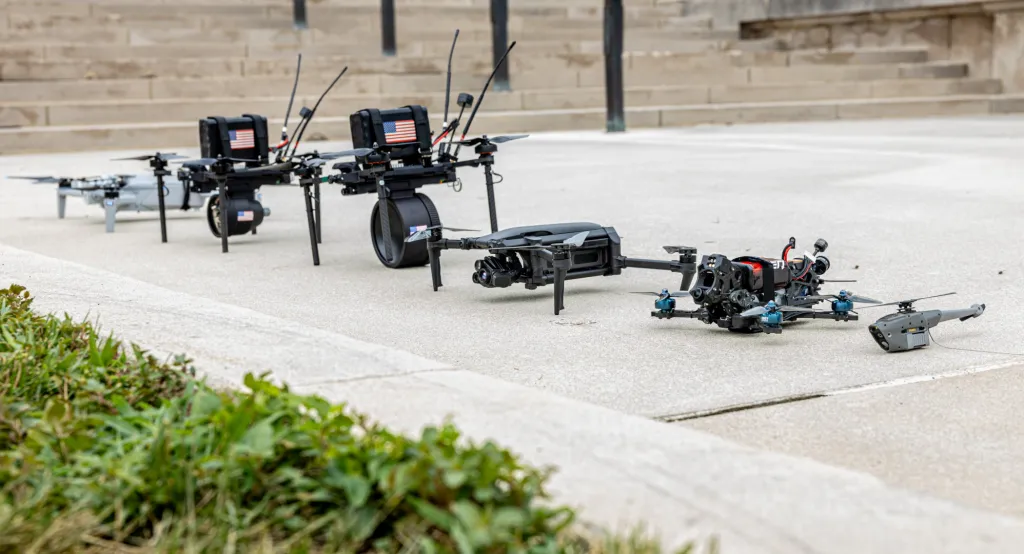
The Pentagon has created a new program to spend $1 billion over the next two years to buy hundreds of thousands of one-way attack drones for the military. Dubbed the Drone Dominance Program (DDP), it is an implementation of War Secretary Pete Hegseth’s July memo authorizing major changes to how the department procures and uses these weapons. You can read more about the Pentagon vision for how lower-end drones will be procured and employed across even the smallest units under this new strategy in our initial story here.
As we have frequently reported, despite the lessons learned from Ukraine and many other battlegrounds, the U.S. military has continued to move extremely slowly to field lower-end drones on a widespread basis. This is the latest Pentagon move to change that, albeit with still relatively conservative goals compared to the millions of drones used by Ukraine and Russia.
The Department of War (DoW) “expects to order 30,000 drones with deliveries to be fulfilled by July 2026,” according to the new DDP website. “By 2027, Drone Dominance intends to purchase over 200,000 drones that can produce lethal effects in the toughest battlefield environments.”

The plan calls for a total of more than 300,000 drones to be purchased by early 2028.
“Through the drone dominance program, $1 billion from the Big Beautiful Bill will fund the manufacture of approximately 340,000 small UASs for combat units over the course of two years,” according to the Pentagon announcement. We’ve reached out for additional details.
“The Drone Dominance Program (DDP) is designed to help industry organize around the need for low-cost, supply-chain secure sUAS manufacturing at scale, urgently,” according to a Request for Information (RFI) published Tuesday. “The DDP intends to place $1 billion in fixed-price orders utilizing 10 U.S.C. 4022 [existing federal procurement authorities] over four phases in the next two years.”
Each phase “begins with a Gauntlet challenge event and ends with completed delivery of production-quality sUAS,” the RFI states. “Vendor systems will be flown by military operators and evaluated on the systems’ ability to complete various mission scenarios.”
The objective is that after each phase, the number of drones purchased will increase while the price per unit goes down, from $5,000 per unit to a projected $2,300 per unit. After Phase II, the number of vendors will decrease as well, with the list ultimately being winnowed down to five vendors selected in the fourth phase, scheduled to run between August 2027 and January 2028.

The RFI does not specify what types of drones DDP is seeking, but based on the anticipated cost per unit, it is most likely first-person view (FPV) drones and other small quadcopters now ubiquitous on the battlefields of Ukraine.
Hegseth’s July memo gives an indication of what the Pentagon is seeking.
From our initial story on that memo: “Most notably, certain types of smaller uncrewed aerial systems (UAS) will now be treated as ‘consumables,’ more akin to hand grenades and other kinds of ammunition, than aircraft, which has broad ramifications. Lower-level commanders will now also be able to procure smaller UASs directly, as well as authorize subordinates to operate them.”
The first competition under the new DDP program is scheduled to begin Feb. 16, 2026, among 25 invited vendors.
“Participants will be selected based on responses to a Request for Solutions (RFS) anticipated to post 17 December, with final selections and notifications during the week of 26 January,” the RFI notes.
The competition will be judged based on the “achievement of two missions, likely to include [a] 10 km strike across open territory and a 1 km strike in simulated urban territory,” the RFI explains. Both missions will be carried out with a minimum 2 kg dummy payload.
After the first phase, the competition “will substantially increase in difficulty and operational realism, including significant Counter UAS challenges,” per the RFI. “Vendors are expected to incorporate feedback and improve their designs across the phases while maintaining production capacity to be competitive.”

Unlike most previous procurement efforts, the results of the competition will be publicly posted on a “leader board.” The RFI does not explain how that will be accessed. We’ve reached out to the Pentagon for more details.
After the first phase of the competition is completed, up to 12 vendors will be issued fixed-price orders of at least 1,000 drones. Payment for the drones is made at each delivery.
“Vendors will bear development and manufacturing risk,” the RFI notes. “The government will pay a fixed price only for units that are delivered, inspected and accepted. There will be no progress payments or cost-reimbursement terms under this effort.”
Another unique aspect of the DDP plan is that there will be no down-select, or elimination of vendors, between phases. Vendors not selected in any phase “are strongly encouraged to participate in later phases,” the DDP document explains.
Given that the DDP will be issuing contracts that are relatively modest by most large defense acquisition program procurement standards, it will be interesting to see who steps forward to take part in this effort. Regardless, the stakes are far larger in the long term for those who succeed.
Overall this is an extremely important issue, one that has been festering without conclusive forward progress for years. The fact that the DoW is committing to building up the industrial base and its understanding of mass drone procurement and deployment is a positive step in the right direction.
Contact the author: howard@thewarzone.com