Whenever a teammate needs a pep talk McKennah Iamaleava is quick to give it — a skill one learns growing up in a family full of accomplished athletes.
“Growing up my parents [Nic and Marlienna] would tell us family is No. 1 and whenever you’re in a hole or whatever the situation you can always come back to them,” Iamaleava said. “So, whether it be about sports or school we always have someone to go to.”
A 5-foot-9 senior outside hitter on the Long Beach Poly High girls’ volleyball team, McKennah is continuing the legacy of success of her four older siblings while simultaneously passing it on to her three younger ones.
“I’m one of eight so volleyball runs in the family,” the reigning Moore League player of the year said. “I started playing when I was 6 or 7.”
However, volleyball is not the only sport McKennah played as a child.
“I dabbled in basketball some too,” she confessed. “My aunt Janitah played at Carson High and the University of Oregon.”
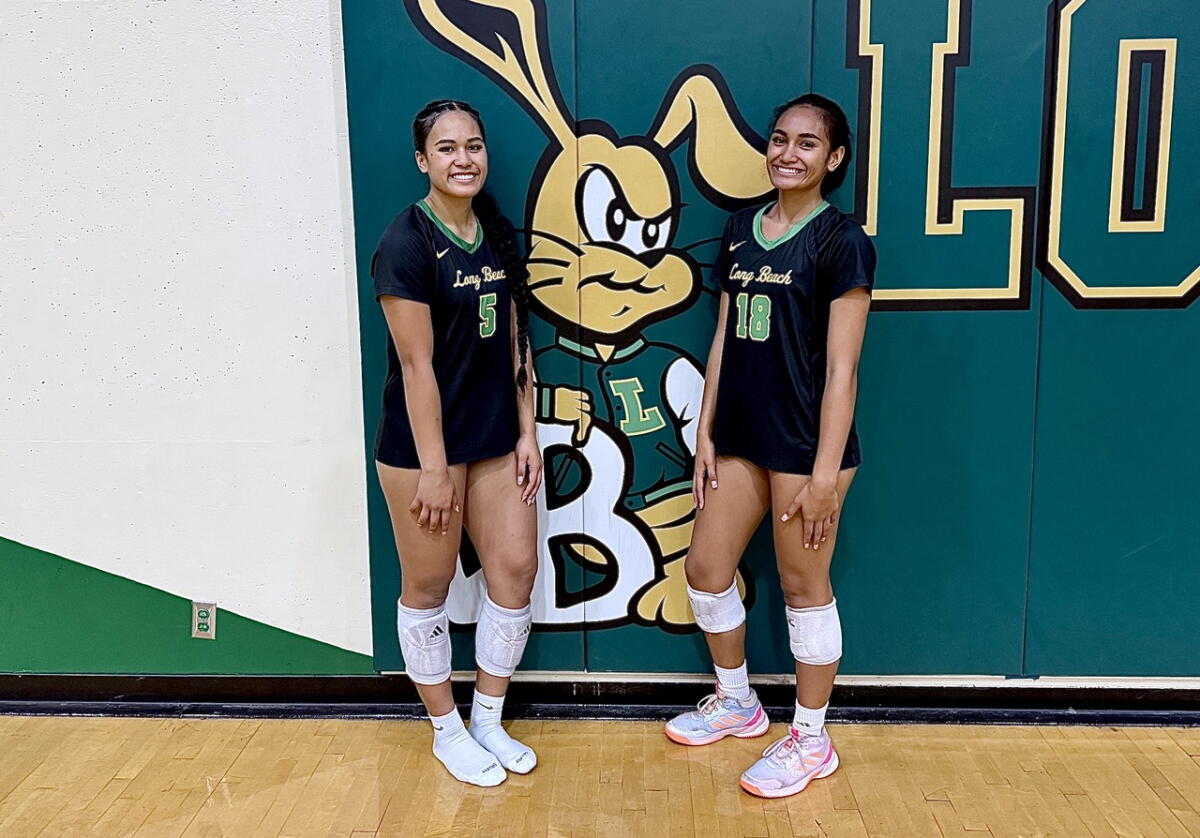
Sisters McKennah, left, and Ellie Iamaleava are two of eight siblings who have played volleyball.
(Steve Galluzzo / For The Times)
McKennah is committed to UC Irvine and, not surprisingly, its proximity was a major factor in her choosing to join the Anteaters’ program.
“First of all, it’s close to home and secondly I love the coaching staff,” she said. “All of the girls are super nice, the campus is beautiful and competing in the Big West is going to be exciting.”
Her oldest brother Matt played volleyball at Long Beach State, her older sister Nicaylah played at Cypress College and her two closest brothers, Nico and Madden, also grew up playing the sport while excelling in football and both are now quarterbacks at nationally ranked UCLA.
“We see them [Nico and Madden] a few times a week,” McKennah said. “We have dinners together. Of course we go to all of their home games.
“We don’t talk for long right after, we’ll keep it short and then next day is usually the recap.”
Nico suffered a knee injury in the second quarter of UCLA’s 17-15 win at Oregon on Oct. 10 and is out indefinitely. McKennah was among the first people to offer him encouragement.
Long Beach Poly High senior McKennah Iamaleava celebrates after winning a point against Redondo Union.
(Steve Galluzzo / For The Times)
“I wasn’t there but I was watching,” she said. “It was a hard shot to take but Nico’s tough and he’ll come back strong. I was texting him right after the game and also in our group texts. I hope Madden gets some playing time. It would be good for him as well.”
Having such a strong support system makes McKennah well-equipped to handle the ups and downs of volleyball and life.
“I probably talk to Matt the most,” McKennah said. “He’s already gone to college and graduated and I went to a few of his matches, which was so fun. Nicaylah is the libero of our family. … I watched her passing and she would teach me a lot. I’m glad I have her.”
McKennah’s two youngest sisters, Mallory (15) and Nori (12), also play volleyball but her tightest bond is with her closest sibling Ellie, a junior opposite hitter at Poly.
Long Beach Poly High junior Ellie Iamaleava celebrates winning a point during a recent match.
(Steve Galluzzo / For The Times)
“Ellie and I are close,” McKennah added. “Our rooms are right next to each other so every time I want to annoy her I just go to her room. My sister is encouraging to me because she’s very hard on herself. She’ll get a great kill but won’t be satisfied, which motivates me even more to be better as a person and a player.”
“McKennah and I are always with each other,” Ellie agreed. “Her being an older sister kind of plays into that. She really pushes me. She helps me through all my hardships as a new player and I look up to her a lot.
“She’s always on top of everything and the game’s real natural to her. I want to play in college too — anywhere close to home.”
Poly (25-7) wrapped up its fourth straight league title last week under head coach Gerald Aquiningoc, who guided the Jackrabbits to theSouthern Section Division 3 championship in 2024 and the Division 2 semifinals last season.
Along with Madden (then a senior), McKennah (a sophomore) and Ellie (a freshman) transferred to Poly from Warren High in September 2024.
“Amazing family,” Aquiningoc said of the Iamaleavas. “McKennah and Ellie are super coachable and huge pieces of our program. When they transferred in even though they couldn’t play that whole first year they were still super involved. They helped us practice and to prepare for our matches. They were our best scout team.”
Aquiningoc cited McKennah’s leadership as a big reason the program has been on the rise.
“I think I lead more by example — I’m just always thinking,” McKennah said. “If I don’t say it I’m usually thinking it, no matter how it comes out and I have a close relationship with our setter [Mina Orbiso]. I’m super confident that I can put the ball away and I tell her.”
Iamaleava, who plays club for SC Rockstar, appreciates the trust that Aquiningoc has in her.
“Coach G gives me the space to grow as a person and a player,” she said. “I’m thankful because I know that on the court I can pick what I want and how I’m feeling and it means a lot to me. The confidence he has in his players is amazing.”
The Jackrabbits are seeded second in the Division 2 playoffs and host Gold Coast League champion Campbell Hall in the first round Tuesday night.
“I’d say this our best team, yes,” McKennah said. “We have so much talent at every position. It’s kind of fun because you can throw anyone out there and they’ll perform.”
What Iamaleava lacks in height she makes up for with her intelligence, placement and angles that keep opponents guessing whether she will hit it down the line or crosscourt. She is adept at receiving serve and what she does in the back row is as valuable as what she does in the front row.
“Being a short hitter you have to use the hand, hit off the block and find different kinds of shots,” she said. ”There’s a lot to think about.”
McKennah’s stats from Poly’s regular-season finale at Redondo Union on Wednesday reflect how complete a player she is. She had 22 kills, 14 digs, six blocks and did not miss a single serve in the Jackrabbits’ five-set victory.
Iamaleava is planning to major in business and is happy to the see the sport grow so much since she started playing.
“Women’s volleyball is getting so much attention and I love it because it encourages all of the younger players to keep doing it,” she said. “What do I want to do long-term? Something with a sport but I’m still deciding if I want to keep playing volleyball or just stay around it.”
In the short term, Iamaleava wants to conclude her high school career with a medal around her neck and make her family proud.
“That pressure turns into a motivation to keep pushing ourselves,” she said. “For Ellie and I there’s a really high ceiling with our older siblings and we try to live up to that.”
Steve Tatham always wanted to work in theme parks. And growing up in Anaheim, some sort of career associated with Disneyland seemed readily attainable.
“Disneyland was the local business,” Tatham says. “It’s where everyone ended up when they were students and working part-time, and I was no exception.”
You’re reading Mr. Todd’s Wild Ride newsletter
Todd Martens’ newsletter delivers news and commentary on the past, present and future of theme parks, right from the theme park capital of the world — Southern California.
By continuing, you agree to our Terms of Service, which include arbitration and a class action waiver. You agree that we and our third-party vendors may collect and use your information, including through cookies, pixels and similar technologies, for the purposes set forth in our Privacy Policy such as personalizing your experience and ads.
While in college, he got a job as a Jungle Cruise skipper, and since then, he has never looked back. Over the course of his career, Tatham has spent nearly 30 years with the Walt Disney Co., many of them in theme park design with Imagineering. More recently, Tatham worked at Universal Creative for more than a decade and was the executive creative director of Epic Universe, the company’s impressive new Florida park.
Today, Tatham is turning his focus toward the next generation of theme park designers, having recently been tapped by USC to lead the Bachelor of Fine Arts in Themed Entertainment program, which is offered out of the cinema school. The four-year program is designed to prep students for a myriad of fields — modern theme park design firms work not only on new attractions but readily contribute to museums, zoos, immersive marketing events and more.
And yet theme park designer can feel like an elusive dream job, one based on connections, mentoring or even just luck. Part of that myth was shaped by the initial Disney Imagineers, many of whom were simply making up the job as they went along. As a longtime admirer of Tatham’s work, I recently chatted with the newly crowned academic leader on how one should prep for a career in the field, hoping to demystify it just a little bit.
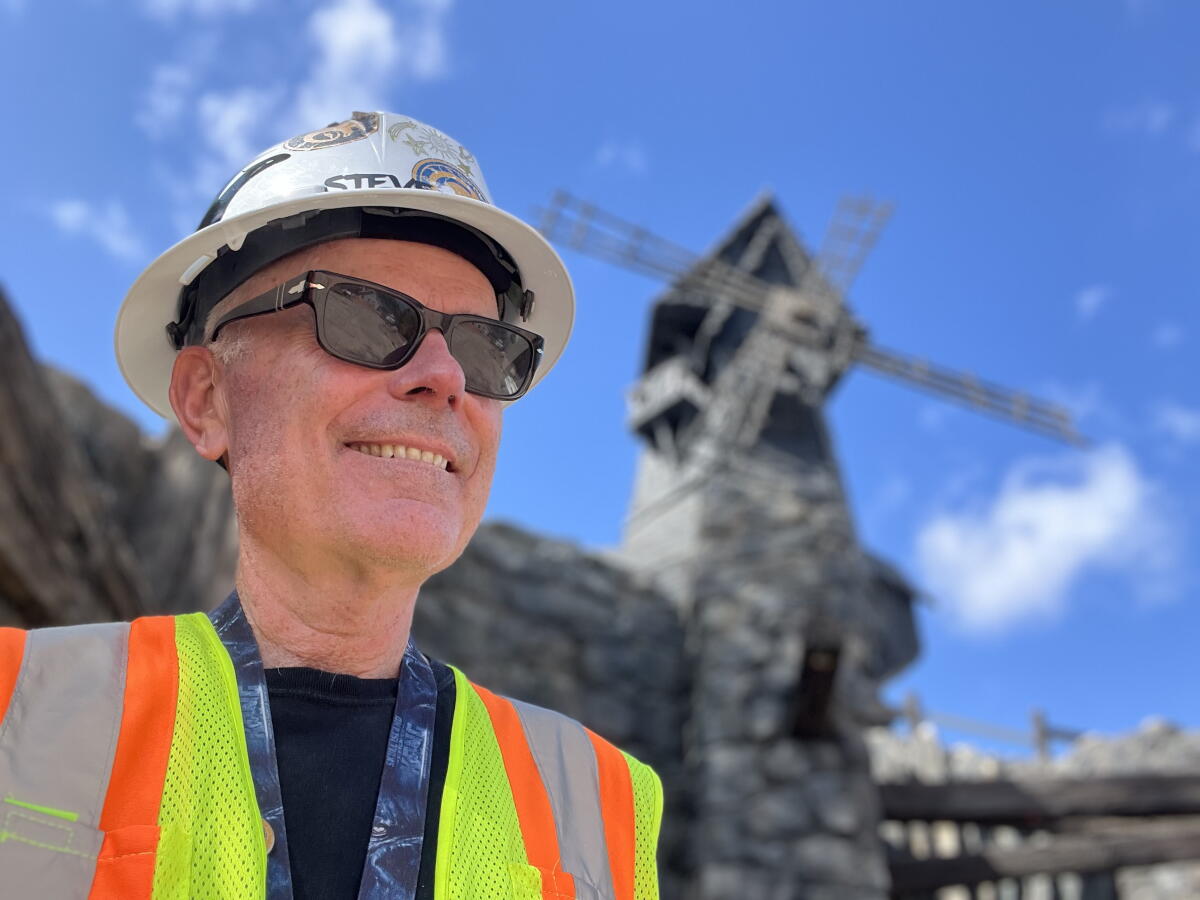
Steve Tatham, photographed in Florida’s Epic Universe, is leading USC’s undergraduate program in theme park design.
(Steve Tatham)
You don’t need to major in themed entertainment to work in theme parks
There aren’t too many universities that offer a theme park design degree. (Along with USC, Purdue offers a themed entertainment design major and the Savannah College of Art and Design has one of the best-known and longest-running programs in the country.)
But Tatham notes that when he began his career in the industry, it generally wasn’t a field accounted for by universities. And many theme park designers I meet as a reporter, whether relatively new to the industry or veterans, created their own paths into the biz.
Tatham’s own background still provides a solid template for those students looking to enter themed entertainment design, as not everyone will have the means or the ability to attend a program such as USC’s. “I wrote my own major,” he says of his time as an undergrad at UC Berkeley, where he targeted theme parks as his career goal. He majored in film design but took courses that combined theater, architecture, environmental psychology and film studies. After graduating, Tatham went to UCLA for a masters in architecture.
Architecture was a career path pushed to Tatham by longtime scenic designer Henry May, who was his advisor at Berkeley. It was an early recognition that theme park design is an offshoot of urban design, requiring principles necessary in both stagecraft and real-world planning.
Think beyond theme parks
People are hungry for themed experiences. Global theme park attendance topped 246 million in 2024, a 2.5% increase, according to the Themed Entertainment Assn., which also charted a nearly 15% growth in attendance at the world’s top 20 museums, which are often a fertile industry for theme park designers. And that says nothing of the domestic trend of smaller, more locally-focused entertainment centers (think Netflix House or Meow Wolf).
It’s why Tatham tells his USC students to think beyond a Disney or Universal creation.
“If you look in the world out there, there’s marketing firms doing pop-up retail and pop-up dining, and they are doing immersive design in museum spaces,” Tatham says. “In addition to theme parks, there are opportunities within marketing and within architecture. Students who get this interdisciplinary training, which involves coding, architecture, design, exhibition work, landscape architecture and lighting, it’s a growing field.”
Steve Tatham once served as a tour guide on Universal Studios Hollywood’s behind-the-scenes tram tour.
(Genaro Molina / Los Angeles Times)
The best lessons come from observing guests
Long before Tatham was designing Epic Universe, he was working as a tour guide at Universal Studios Hollywood. As a film buff, he enjoyed the early-career job, but says one lesson from those days continues to stick with him.
“I would go on and on, because I love movie history, and I would be like, ‘Right here is where Jimmy Stewart worked, and Edith Head designed costumes,’” Tatham says. “They would politely listen, but then when ducks walked across, they would get excited and take pictures. People love things that are alive and immediate and happening now. People respond to what is immediate.”
The best theme park design is in conversation with guests. I think of Epic’s “How to Train Your Dragon”-inspired land and the bounty of movement found in the space via animatronic dragons (if you promise dragons, guests better see dragons!), or Disneyland’s New Orleans Square, where the curved, winding paths encourage constant discovery.
AI won’t replace great original ideas
Tatham is careful when speaking on the subject of artificial intelligence. He doesn’t want to dismiss its potential to be used as a development tool. And yet Tatham is direct when it comes to AI and creativity.
“I think there are a lot of challenges with AI. I think there are a lot of things that are scary,” he says. “But I think, ultimately, if it’s used as a tool, it can be useful to artists.”
But there are limits.
“AI is never going to come up with a great idea,” he says. “It’s just going to recombine and reconfigure and spit back to you ideas that others have had. So I think this is an opportunity for original thought to stand out even more than it has in the past.”
Jennifer Bascom of Disneyland, gives a telegram to Disneyland guest Keith Kocienski of Fullerton while playing a live-action role-playing game in Frontierland called Legends of Frontierland back in 2014.
(Christina House / For The Times)
But the integration of smartphones remains a challenge
While Disney recently shuttered its Play Disney Parks mobile app, the park is experimenting with connectivity between the video game “Fortnite” and its attraction Millennium Falcon: Smugglers Run. Tatham cautions that any time a theme park invites someone to use a smartphone during their day at the park, designers are then pulling them away from the curated experience.
“The problem is when you’re in Universal or Disneyland, you’re now competing with all the opportunities that people have to explore their own entertainment,” Tatham says. “Are they going to be on Instagram or playing Solitaire online? So now you’re competing with that.”
And yet Tatham thinks there are lessons to be learned from the interactive world, as long as designers focus on real-world play. Tatham, after all, worked on what was once of my favorite Disneyland projects, the great but short-lived Legends of Frontierland. Some of those who contributed to it brought it to Knott’s Berry Farm, where it has been fine-tuned into the terrific Ghost Town Alive! The latter is a rarity in the theme park space.
Yes, it’s possible to make a decent salary
So how much can one expect to make? This isn’t an easy question to answer, as there’s only so many slots at Walt Disney Imagineering and Universal Creative, and the theme park design industry encompasses so much more.
There are independent themed entertainment firms to marketing outposts to studios to museums to architecture companies to theaters and more. And salaries can vary greatly between the public or private sector, as well as entry level versus senior positions. Even recruiting sites have a broad range, from around $50,000 to above $200,000.
The good news, says Tatham, is there is a high ceiling. Additionally, that there is a breadth of industries to work in should help any potential graduates. “There are many different job descriptions with different salaries in the themed entertainment field,” Tatham says.
And yet he knows it’s a concern of parents.
“I want students and parents to know that it is possible to make a solid steady income in the arts and that they shouldn’t focus on a backup plan but rather on putting together a killer portfolio because there is work for those who have honed their skills,” he says. “I would tell them that they should be prepared to live in Orlando, Fla., or Glendale, Calif., and be open to international assignments. Top directors can make in excess of $250,000 a year, but they should be prepared for starting salaries similar to architecture, graphic design or similar creative fields.”
A Disneyland cast member playing the role of Alice in Wonderland interacts with guests.
(Christina House / Los Angeles Times)
Remember why theme parks still matter
Anytime I have an opportunity to chat with someone with Tatham’s experience I want to hear their take on one question in particular, and that’s why they love theme parks and why they believe the spaces resonate with so many people. As someone charged with creating passion among the next generation of theme park designers, I was especially interested in Tatham’s response.
“If you go to a theme park, there is something for every demographic,” he says. “There are things for kids. There are things for grandparents. There are things for everyone in between. People can enjoy those times together, which was the original intent of Walt Disney. He was looking for a place while in Griffith Park where he could go do things with his daughters. He created it because it did not exist.”
For Tatham, it’s about the memories.
“If you ask people about their experience in theme parks, they will remember in great detail which parks they went to and who they were with,” he continues. “Ask them about going to the movies, they might say, ‘Sure, I went with my family, but can’t tell you what movies and who I was with.’ But they will remember those moments with theme parks. It’s a great bonding experience. That’s the reason they exist and the reason I love to create them.”
This week in SoCal theme parks
Plans are underway to refurbish the Griffith Park merry-go-round.
(Christina House / Los Angeles Times)
The Griffith Park carousel will spin again. Assessments are underway to see what it will cost to once again get the Griffith Park merry-go-round spinning. Theme park fans best know it as the site that is said to have inspired Walt Disney to dream up what would become the Disneyland Resort, and it has been shuttered since 2022. Curiously, there’s also a Disney connection with the carousel today, as some of those who work at Walt Disney Imagineering are volunteering their time and efforts to restore this treasure in Griffith Park. Read my story here.
Six Flags Magic Mountain shuts down second coaster. Six Flags is closing several rides across the U.S. and Canada — including the Goliath roller coaster at Six Flags Magic Mountain in Valencia — after a man fell to his death from a roller coaster at one of its parks in Georgia. Park officials said Tuesday that the closures were out of an abundance of caution and were temporary. Times writers Hailey Branson-Potts and Fedor Zarkhin have more on this story.
Merry Minions. Universal Studios Hollywood has unveiled its slate of holiday of programming, and returning this year are its popular “Grinchmas” offerings, including the 65-foot winding, drooping, Dr. Seuss-inspired Christmas tree. There will be meet-and-greets, including a reading of “How the Grinch Stole Christmas,” as well as holiday carolers and ornament decorating. New this year will be holiday festivities in the park’s kid-focused Minion Land, complete with Minions in holiday attire. Super Nintendo World, Wizarding World of Harry Potter and other areas will also be dressed for the season, beginning Nov. 21 and lasting through Jan. 3.
A heads-up for ‘Cars’ fans. It’s the 20th anniversary of the “Cars” franchise, and those with a special affinity for the series will want to find their way to Disneyland’s Pixar Place Hotel and park themselves on the hotel’s second floor art gallery. That’s where the hotel is hosting an exhibit honoring the film with drawings, paintings, sculptures and behind-the-scenes footage that document how Radiator Springs Racers was brought to life. And before you go, read my story on how Route 66 inspired the film and Cars Land.
Step into the world of ‘Dune.’ Tickets are now on sale for an immersive “Dune” exhibition in downtown L.A. that promises spectacle, as well as a bit of mystery. Step around, and potentially inside, awe-inspiring vehicles from the film, or come face-to-face with the Bene Gesserit, a group of priestesses who possess, among other things, the ability to bend the will of others. “Dune: The Experience” opens Nov. 20 and and is currently set to run through Dec. 20, although an extension is likely. Standard tickets start at $42 but there are various ticket packages available.
Ride Report
The dinosaurs on the Disneyland Railroad.
(Todd Martens / Los Angeles Times)
It’s always a good idea to hop on a Disneyland attraction that has been recently refurbished. It’s generally a chance to see the ride in tip-top shape. And so I was eager to get on the Disneyland Railroad on a recent trip to the park, as the dinos in the Primeval World world section of the attraction had recently been hidden behind illustrated tarps. Good news, as the dinosaurs are looking as sharp as they ever have. No real changes were made to the figures, but they’re all moving as they should, be it munching on grass, rattling out of an egg or getting ready for battle.
The theatrical lighting overall feels a little brighter, and the few digital effects — a volcano erupting in the background, for instance — are all in working order and bring an added sense of dimension to the diorama scenes. Be sure to add it to your day. The Disneyland Railroad is also a fine reminder to slow down during your Disneyland visit.
Tell us your stories. Ask us your questions.
Have a theme park tale to share? Whether it was a good day or less-than-perfect day, I would love to hear about it. Have a question? A tip? A fun photo from the parks to share? Email me at todd.martens@latimes.com. I may feature your note in an upcoming newsletter.
Ride on,
Todd Martens
P.S.
What is “Eggs in Space”?
(Todd Martens / Los Angeles Times)
A cinematic mystery is brewing, one that seemingly has connections to the local immersive entertainment community. What, for instance, is “Eggs in Space”? A recent sci-fi event at indie nonprofit movie theater and store Vidiots ended with the beginnings of a puzzle.
The screening appeared to be interrupted by a film that was taking control of the projectors. The film? “Eggs in Space.” As an abstract image of an egg appeared on screen, performers began walking toward the front of the theater in a transfixed, cult-like fashion.
There is, of course, no record of a film titled “Eggs in Space,” although there is a website dedicated to its disappearance. So dig in. A new alternate reality game just dropped. I have a hunch you’ll want to know where it leads.
—
This newsletter is free thanks to the support of L.A. Times subscribers. If you’re not yet a subscriber, explore subscription packages to unlock unlimited digital access and support award-winning local reporting.
Was this newsletter forwarded to you? Sign up here to get it in your inbox.
In March 2025, when California ran out of Medicaid funds to pay doctors and hospitals, the state borrowed $3.4 billion to keep the program afloat. It was, as a spokesperson for Gov. Gavin Newsom insisted, nothing new. Indeed, a handful of times over the years, the state had taken out internal, short-term loans to sustain its healthcare program for poor and disabled people.
The unprecedented move came a few months later, when Newsom and Democratic state lawmakers agreed to pay down the loan — which grew to $4.4 billion — over 10 years instead of later in the year. California’s healthcare safety net, it seemed, was buckling.
Rising healthcare costs systemwide were partly to blame. But so were several state-led expansions that made California’s Medicaid program, known as Medi-Cal, one of the nation’s most generous.
Now, with congressional Republicans’ One Big Beautiful Bill Act expected to reduce federal Medicaid spending by more than $900 billion over 10 years, California and dozens of other states must contemplate the limits of their generosity. The problem is particularly acute in the nation’s most populous state, which spends more on Medicaid than New York and Texas combined.
“We know we can’t afford to serve everybody we want to serve in the model that we have today,” said Mark Ghaly, the former top Newsom health official who now co-chairs the Future of Medi-Cal Commission, a 29-person panel with the goal of modernizing and sustaining California’s Medicaid program for those who need it. “What can we do differently? What can we do smarter?”
The 2025 law that Newsom, a Democrat, has dubbed President Trump’s “Big Ugly Bill” is expected to leave millions more Americans without health insurance, mostly because of new work requirements. It also curbs the use of healthcare provider taxes and other strategies states have deployed to maximize federal funds. Some state lawmakers and consumer advocates have argued the federal cuts, along with rising costs, present an opportunity for the next governor to overhaul a program plagued by long appointment wait times, low reimbursement rates for healthcare providers, and volatile financing.
“If we continue to just give millions and millions into the same system and expect something different — I’m sick and tired of that,” said Caroline Menjivar, a Democratic state senator representing a Los Angeles-area district where roughly half of constituents rely on Medi-Cal.
Democratic lawmakers, who have often clashed with Newsom on Medi-Cal rollbacks, succeeded in getting him to delay a number of painful cuts until 2027 in hope that a new governor might reverse them.
So far, neither of the gubernatorial candidates running in the November election to replace Newsom has offered substantive proposals for a program that covers 1 in 3 Californians — roughly 13.6 million people.
Republican Steve Hilton, a former Fox News commentator, wants to pare back Medi-Cal eligibility and has promised to end coverage for immigrants without legal status, citing that benefit as an example of “wildly unsustainable” state spending. Democrat Xavier Becerra, who has spent decades trying to expand government-funded healthcare, has promised to protect Californians from the massive federal cuts and find and cut billions in administrative waste.
Expanding coverage
President Johnson signed the law that established Medicaid and Medicare in 1965 to cover certain low-income groups, such as families with children, older people and those with disabilities. Over the last six decades, states have substantially widened that pool, most notably under the Affordable Care Act’s Medicaid expansion to childless adults.
Starting in 2024, California offered healthcare coverage to all low-income residents, regardless of age or immigration status, although lawmakers scaled that back this year. At the same time, the state opted to cover a slew of non-mandated benefits such as physical therapy, hospice care and housing assistance.
“California has always struggled with wanting to have as broad a program as possible but then having to figure out a way to pay,” said Jennifer Kent, who oversaw Medi-Cal under Gov. Jerry Brown, a Democrat. “There is no population that we have met that we don’t want to offer coverage to, and we’ve never met a benefit that we don’t like.”
Since 2010, California’s Medi-Cal enrollment has nearly doubled while spending has ballooned from $50 billion a year to $222 billion. It now makes up more than 40% of overall state spending, according to the nonpartisan Legislative Analyst’s Office.
Conservatives argue the program is bloated and rife with fraud. They say the federal changes will force states to refocus resources on the neediest.
“The role of the safety net programs was just that — to be a safety net,” Hilton said in an interview. “I don’t think it’s a particularly positive boast to say 40% of Californians should be on a program that was designed for people living in poverty.”
Becerra declined an interview request.
Nelly, a 59-year-old from Los Angeles County, was one of millions who have benefited from the state’s Medi-Cal expansion, but she was initially reluctant to sign up.
For years after she left her corporate job to care for her ailing mother, Nelly said, she didn’t consider applying. She remained uninsured until three years ago, when she woke up and couldn’t see out of her left eye.
She enrolled in Medi-Cal in the emergency room. It now covers her appointments with specialists and transportation to and from. While her condition may exempt her from the new Medicaid work requirements, Nelly said, she’s still worried about losing coverage after experiencing numerous paperwork hiccups simply trying to renew.
Nelly, who asked that her full name not be used because she hasn’t told her family about her condition, said she understands not everyone on the program may need it. But, she added, “it should be there for someone like me.”
Tough choices ahead
When Republican state lawmakers got wind of Newsom’s plan to stretch the debt repayment over a decade, they accused Democrats of trying to “paper over” the state’s structural deficit.
“This leaves future governors and legislatures to clean up the mess,” stated a July 2025 memo from GOP senators. The Legislative Analyst’s Office later called the maneuver “unusual.” That could leave Becerra, the favorite to succeed Newsom in the overwhelmingly liberal state, as the face of staggering changes to a program he spent his career defending.
More than 2 million Californians under age 65 could lose health coverage over the next four years as a result of the state and federal policy changes, according to recent estimates by the UC Berkeley Labor Center and the UCLA Center for Health Policy Research. At least 730,000 residents have already disenrolled since June 2025.
State agencies are scrambling to implement new federal work requirement rules for adult Medicaid enrollees under 65, hoping to automate as much verification as possible to blunt coverage losses. And in 2028, states will be required to charge some enrollees fees for many services, making it harder for them to maintain coverage.
Disability rights activists say new asset limits will prevent Californians from getting needed home care, which they say is more cost-effective and humane than nursing homes. Counties, deemed by state law to be healthcare providers of last resort, say they need immediate funding for the millions of uninsured patients they anticipate in the new year.
Hospital administrators have urged policymakers to help them keep their facilities stable, and the state’s most recent budget included some $390 million to assist public and distressed hospitals.
Martin Luther King Jr. Community Hospital in Los Angeles treats five times the patients it was designed to serve, and 80% of patients are uninsured or on Medi-Cal. Demand is so high in the chronically underserved area, MLK Community Healthcare CEO Elaine Batchlor said, that the hospital has erected tents in the parking lot. Most emergency room patients are now treated there.
“We already have an extremely overcrowded, overburdened emergency department,” MLK Community Healthcare CEO Elaine Batchlor said. “Insured care will turn into uncompensated care, and the financial burden for that will fall on providers.”
Becerra has said he opposes the state’s recent freeze on enrollment for adult immigrants without legal status, as well as new monthly premiums set to take effect next year, saying such moves will only saddle taxpayers with higher bills for ER care.
Aside from promising to find and eliminate billions in administrative waste from the industry, the nation’s former top health official has not explained how he would cobble together the tens of billions of dollars the state is likely to need just to maintain status quo.
The next governor must tread carefully, Kent warned. “When people come and say, ‘Well, you should just do this because it’s the right thing,’ ” she said, “all of those right things have fiscal consequences.”
Mai-Duc writes for KFF Health News, a national newsroom that produces in-depth journalism about health issues and is one of the core operating programs at KFF — an independent source of health policy research, polling and journalism.
When it comes to the future of Tail 844, the SR-71 Blackbird that mysteriously disappeared from NASA’s Armstrong Flight Research Center, few people have more insights than Tim Conners. When he worked at NASA in the 1990s, Conners was the lead propulsion engineer for the agency’s Blackbird program. He worked extensively on 844 and has an intimate knowledge of what made the iconic aircraft tick. Now, he brings an insider perspective on NASA’s secretive work to get the Blackbird back in the air and speculates on what it would take to do so, as well as the famed jet’s possible flight test role for the agency after 27 years of dormancy.
In an exclusive interview with TWZ, Conners, now technical director for advanced weapons systems at Tiberius Aerospace, gave us his take on NASA’s Blackbird revelations and insights into what NASA is working on and how far along they are in the process.
Some of the questions and answers have been slightly edited for clarity.
Tim Conners
Q: Tell me about your background with the SR-71 program. How did it begin? How long did it last? And what did you do?
A: So that basically fell in my lap when I was an engineer at NASA’s Dryden [Flight Research Center] back in the early ’90s when NASA took delivery of three of the airframes when the Air Force was retiring the fleet. So NASA got two A models and a trainer. Obviously, tail number 844, which is NASA’s designation, is the one that’s getting all of the attention right now. But those came to Dryden in the early ’90s.
By luck of the draw, I was in the propulsion group. We were short-staffed for a number of reasons, and they needed an engineer on Blackbird. And I had been with NASA for about three or four years at that point, and I got tapped to prepare the NASA side of the mission for the upcoming research flights. So I had a few years to get familiar. That was a part-time job, by the way. I also owned the F-15 fleet at NASA as a propulsion engineer, and that was occupying a lot of my time, but it did give me an adequate amount of time to get familiar with the way that the airplane operated, at least from the propulsion standpoint. And then we began doing research missions in ’96. I left NASA in ’98, but I was able to support the program through two years of flight testing and all the years of preparation for those two years.
Q: Tell me more about your role with the Blackbirds.
A: I was lead propulsion engineer on the NASA side. So what NASA would do is they would assign disciplinary leads across from their industry and government counterparts. So Dryden’s disciplinary leads, their job was basically to make sure that any experimental packages were integrated safely with the airframe, and that we could execute the proposed test missions safely and successfully. I owned propulsion and I also owned performance. So if you recall the Lockheed Linear Aerospike rocket engine activity, that package weighed 20,000 to 25,000 pounds and was mounted externally on the back of the SR-71. That was a drag issue, obviously. So part of my role was to make sure that we could actually accelerate through the transonic drag rise with that package and get out to the target test conditions.
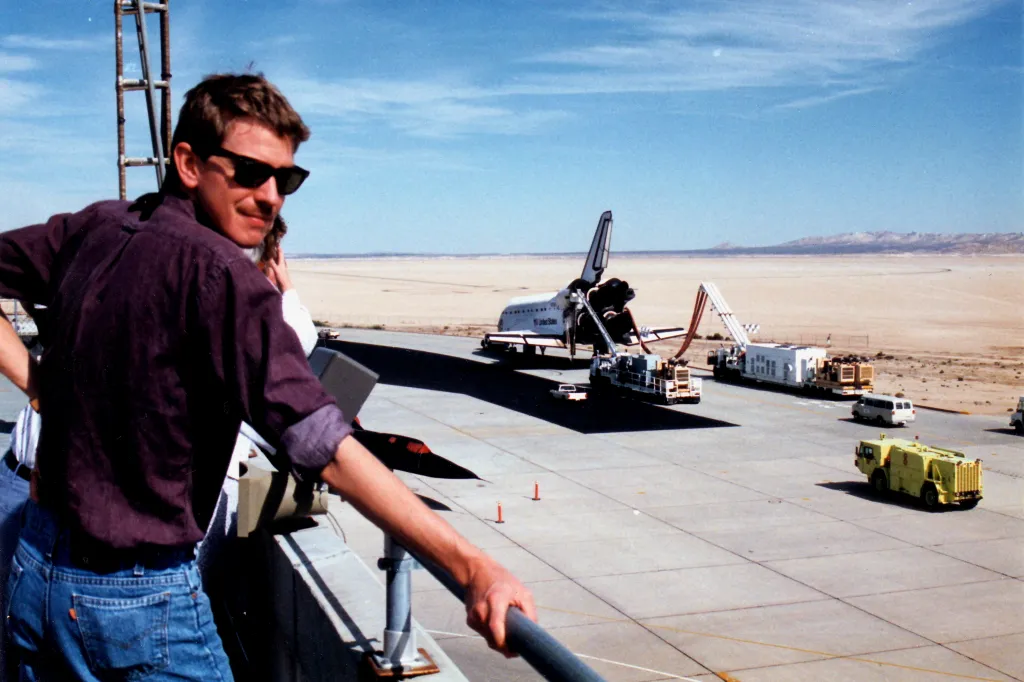
SR-71 tail number 844 during its service with NASA. This picture was taken on October 31, 1997, during a flight in support of the NASA/Rocketdyne/Lockheed Martin Linear Aerospike SR-71 Experiment (LASRE). NASA
Q: There is a tremendous amount of interest in seeing the Blackbird fly again. The biggest question seems to be why? What kinds of experiments or research would an SR-71 provide that couldn’t be done more effectively with a modern aircraft, rocket or unmanned vehicle? Can you walk us through some of the reasons NASA would like to see it in the skies again?
A: Yeah, that’s a question that everybody’s been asking. Why? I’m speculating, although I do have a good feel for where this is going. So bear with me.
They probably are not going to do this for — or trying to do this — for aerodynamic reasons. You can do CFD [computational fluid dynamics]-based modeling in this speed regime all day long and very accurately in this day and age. It does not take a lot of time or money to do that. What you cannot do is an accurate representation of a new type of engine integrated into a high-speed airframe. You can do the conceptual modeling of it. Of course, it’s difficult to get the final installed answer, especially if it involves an engine that operates at long duration. That is where I think they’re going with this. I believe that they’re developing basically a high-speed engine test bed. That would make the most sense to me.
Q: That’s something you couldn’t do with a more modern aircraft or rocket or unmanned vehicle?
A: That’s a good question. But you know, probably two-thirds of that battle is just developing the airframe. It does depend on the size of the engine that you’re after.
Obviously, if this were a Williams engine or that size class, you could get by with probably a bespoke drone to do your testing. That wouldn’t be that expensive. If your goal is to test something that’s man-rated or very large, like a J58-size engine, what better way to do it than use an airframe that’s already proven to fly at that speed?
SR-71 Blackbird. (Courtesy photo via USAF)
Q: Were you asked to join a team at NASA tasked with getting a jet back in the air? Who else was asked, and what kind of team were they building?
A: I did not receive an offer. There was a tongue-in-cheek text that I got earlier in the year that said, ‘Hey, Conners, how would you like to help get the Blackbirds flying again?’ And that was from somebody who was positioned with inside information. That is where I first heard of this. This was back in spring, but nobody formally reached out to me.
I believe that the only one that’s been tagged so far, as far as a retiree, was Mike Relja. Mike was a crew chief on the Blackbird, and that makes sense that they would potentially want to pull on him. But there was no formal offer, and I tell you what: If somebody approached me to work it, I don’t think I could turn them down.
Q: Do you know where the idea for this project came from and who is in charge?
A: I don’t have an answer. I’d love to know as well.
Q: What can you tell me about this effort? What are the latest developments in this project that you know of?
A: So what I’m hearing is that they’re looking at doing power-on testing fairly soon. That’s pretty big. So of course that’s not engine power on. That’s external power applied to the airframe, seeing which systems still live, which ones don’t, and then moving from there. So that would be an expected first step.
It’s an encouraging step. That means NASA would have gotten beyond cracking open all the bays, inspecting the interior, making sure that the thing at least passes visual inspection for airworthiness from that standpoint.
Q: Have they actually gotten any systems working?
A: No, they’ve done the visual inspection, actually, putting electrons on the airframe. [To get systems working] would be the next step, but it is forthcoming, from what I understand.
(NASA) Courtesy Photo
Q: What is the timeline?
A: That’s supposed to happen within the next couple weeks.
Q: Really? Where is this work taking place?
A: That I do not know for sure. Although I assume it’s happening at [NASA’s] Armstrong [Flight Research Center].
Q: So what is going to happen?
A: That’s a good question. Let me tell you about what I heard more recently, and then you can begin to connect the dots. JP-7. People ask about the fuel. I think it’s pretty well known that NASA had a huge amount of JP-7 stockpiled that they received from the Air Force back in the early ’90s. So much that it was in a dedicated tank, like one of the giant jet fuel tanks at Edwards Air Force Base. You know, the tanks up on the ridge.
From what I understand, that supply unfortunately was discarded about 20 years ago, and JP-7 is a unique fuel. Obviously, low volatility. When I poked at what might be the way forward there, it didn’t sound like that was a showstopper. I got the impression that there’s been dialogue underway with refineries for a replacement or a surrogate that would work. So I went from being deflated, hearing that the fuel was gone, to being encouraged that potentially there was a surrogate workaround.
A statically mounted Pratt & Whitney J58 engine with full afterburner on disposing the last of the SR-71 JP-7 fuel prior to the program’s termination. (NASA)
But that led to the question regarding the engines themselves, so the feedback there was more discouraging in that it looks like the engines are indeed unserviceable. I don’t believe that is based on an actual attempt to run them. It is based on inspection. Probably no surprise. They’ve sat idle, you know, for 27 years. That is what led to questions going back and forth regarding how the airframe would be powered. And that’s what led into where, if you connect the dots, that’s where the airframe would be used as an engine test bed.
So different engines, they would have to be high-Mach bypass systems. We can speculate on which engine company might be developing those systems, but yeah, I don’t want to give it too much away because I don’t want us to lose the inside information that we got.
Q: Are they working on a completely different engine to power Blackbird?
A: I don’t know that for sure. I think if the J58s are not an option for powering the Blackbird, you either button it back up and walk away from it, or you go bring in engines that are already under development that we’re not privy to at this point in time. But there’s no other option. So what are we going to use? It’s not like we can slap in F100s or F110s. They’re not going to cut it.
The Pratt & Whitney J58 – The Engine of the SR-71 Blackbird
Q: Obviously, restoring an aircraft sitting out in the elements for years into one able to withstand the rigors of Mach 3 flight is one hell of an undertaking. In your mind, what are the biggest hurdles to this endeavor?
A: Number one would be the engines for sure. Number two would be anything that’s made of elastomerics. Plastics, wiring. Covering connectors. All that stuff degrades and oxidizes with time. You can imagine what frayed wiring and broken wiring insulation – what kind of havoc that would create. What Blackbird has going for it is that all those casings and connectors were built for the rigor of sustained Mach 3.2 flight for an hour, an hour plus, so they are not going to deteriorate quickly. The question is: Have they deteriorated in 27 years? So, if the answer is not a significant amount, then we’ve probably addressed one of the biggest questions – other than the engines – regarding reviving the airplane.
Q: Do you think NASA is going to attempt to just fly Tail 844 largely in its original configuration, or will they deeply modify it or build something new based on it?
A: Completely unknown. They definitely have the ability to modify the airframe, right? They did it before in the ’90s to carry the Linear Aerospike package. That was a huge undertaking on the airframe itself. They did it successfully. Armstrong still has a pretty deep bench in that area, so if they wanted to take on modifying the titanium structure, I think they could do it.
View of the Linear Aerospike SR Experiment (LASRE) pod on NASA SR-71, tail number 844. (Photo by Heritage Space/Heritage Images via Getty Images) NASA
But it’s a good question. Again, that would probably point to aerodynamic studies, and if it were me and my dollar as a taxpayer, I would lean on computational studies to get those answers. That’s what I tend to do in my day job is forego testing in lieu of computational when it involves external aero, but it’s when you do the integrated propulsion in this speed regime, that’s really when you need test data from the actual operating conditions.
Q: As opposed to digital modeling?
A: Yes. For instance, say the aerodynamic databases for Blackbird are gone, which they might be. I know there are simple aerodynamic models that still exist, but like a true high-fidelity model that would go into a piloted simulator, that could probably be regenerated fairly quickly. Probably on the order of months computationally in this day and age. So I think simulation capability could be stood up in fairly short order. That, of course, will be foundational for the pilot training task.
Q: We’ll talk more about pilot training later, but first I want to ask about modernization. If NASA were to inject modernized features into the SR-71, what would you like to see? And what makes the most sense in terms of material science, avionics, propulsion and so on?
A: I’m not a materials expert. I think it would be really interesting to see how the airframe could be optimized using adaptive flight control capabilities. So, if the flight control system could be digitized, I think that would lead to some very interesting in-flight experiments. I doubt that that would be. I could be wrong, but if the goal is to get the airframe back up as a propulsion test bed, you don’t need to cut out the hydromechanical flight control system and replace it with a digital one.
A left-side view of an SR-71 aircraft from the 9th Strategic Reconnaissance Wing landing. The aircraft is silhouetted against the sunset. (U.S. Air Force) U.S. AIR FORCE
That all said, what I would like to see is what we talked about a few minutes ago, and that’s basically modern high-speed engine technology. So what could be done? The J58s were low operating pressure ratio systems. What could be done with a modern, digitally controlled, multistream, high-Mach engine, I think, would be truly trailblazing.
One of the reasons why there’s interest in this speed regime, it was neglected for a number of years. The focus was on hypersonics. If you proposed anything going back, say, 15 years in the Mach 3.5 speed regime, it was ignored. The glitz and glamor was on hypersonics. Hypersonics is great tactically for certain scenarios, but the weaknesses of hypersonics are now becoming apparent.
And as far as countermeasures, hypersonics still has a place. Don’t get me wrong, but every system cannot be hypersonic from an affordability standpoint. So, now you’ve seen it over the last, say, five years. A lot of systems are coming back on the scene that operate in the Mach 2 to Mach 4 regime, and there’s a reason they’re all fitting in there, right? You stay below the speed limit that requires more exotic metallics. You stay in the titanium regime. You can fly, of course, up to [Mach] 3.5 with brief excursions up to about [Mach] 4, so that is tactically relevant against a lot of military targets and defensive systems. So here it is. You know we now have a potential flying test bed that can carry engines in the J58 size class.
The Mighty J58 – The SR-71’s Secret Powerhouse
Q: How much could a project like this cost, and is it really economically feasible? How long do you think it could take?
A: I’ve been thinking that over, and I think it depends on who does it. I don’t want to disparage my former government brethren. I had great respect for the folks at NASA when I worked with them, but one of the reasons why I left the agency is because it was becoming so risk-averse. That was adding bloat to everything. And what we used to do quickly, we no longer could do quickly or cheaply at what was Dryden Flight Research Center, so that is what concerns me.
If NASA could operate with the agility that it had, if Dryden/Armstrong could operate with the agility it had 30 years ago, they could do this work in probably a few years. I would say again, it would depend on what exactly they need to do to the airframe. If it’s to resurrect the airframe and bolt in new engines using existing interface hardpoints, that would go much, much more quickly than doing extensive airframe modifications.
Q: Given that 844 has been sitting idle since 1999, what would be the very first thing you would want to inspect or test before even considering putting it back in the air?
A: Exactly what I’m hearing the rumor is that they’re doing this. What is the condition of all the components in the airplane that are flowing electrons? Because if the entire airframe is shorted out, you know how it is.
If you have a car where you’ve hooked up the battery cables backwards – I had a car once where somebody jumped in and did that. It ruined the car because I was chasing shorts constantly, constantly breaking down in the months that followed because the wiring was compromised, melted, bubbled all over the vehicle. And then it would get wet. You get shorts. That, I believe, is what one of the objectives of power-on testing is. To make sure continuity still exists, reliable continuity throughout the airframe. So that’s exactly the first step.
I would say the second would be hydraulics. That vehicle is hydromechanical. So what is the state of the actuators and whatnot?
Q: And you said that work is taking place now?
A: It’s certainly being inspected. That was one of the reasons why they pulled it off of the display pad at Armstrong. But that work has been going on for a couple of months, and it certainly seems that there was at least reason to be encouraged and to go forward with this next step. Otherwise, they would have just towed it back to the parking spot.
The SR-71 Blackbird, Tail 844, when it was on display at NASA’s Armstrong Flight Research Center (Google Earth)
Q: And the next step is testing the systems?
A: That is correct.
Q: We touched on this a little before, but how realistic is it to get an SR-71’s J58 engines operational again after nearly three decades of inactivity? What would worry you most about those engines? How many are left?
A: Well, that’s a good point. As far as [engines] that are readily available, there are several that are at the [Air Force Flight Test (AFFT) Museum at Edwards AFB]. I believe they’ve been stored outside. But if you consider all the museums around the world with Blackbirds on display, almost all of them have installed J58s, and there’s usually one sitting alongside the airframe on display, so there are plenty of engines. Whether or not they’re serviceable, that of course is the question.
But probably the biggest problem with an engine – well, there are several with a gas turbine that sits unmoved for decades – it’s going to be that you’re going to flatten the bearings. Probably not visible to the eye, but rotating turbo machinery doesn’t like flats on the bearings. So for obvious vibration reasons, you got that. And you’ve got the seals. Seals are going to crack. Trapped fuel is going to turn to gunk and clog up lines. That engine was all hydromechanical, of course, or no digital controls on that because of the heat involved. So fuel hydraulics played a big role in that engine.
There is likely a lot of goo in those lines. I believe that’s why they’ve essentially been written off as unserviceable. I was discouraged because one of the questions I asked that I didn’t get an answer to was: Did anybody try to run the engines or pull them apart? But I don’t even know if the instructions exist to unstack a J58 at this point. I’m sure it could be figured out with the right people, but you know how it is. Pulling something apart is a lot easier than putting it back together.
Q: So there’s no manual for that anymore?
A: I don’t know if there’s a manual specific to that. Like I told Steve [Trimble] at Aviation Week, there certainly are operating manuals. You’ve probably seen the pilot’s manual for the SR-71A. It’s a beauty. There are a lot of copies online. You can get PDFs of those. They are very well-written, huge manuals. I know prints exist for the airplane. Those were in the keeping of the Edwards Museum. I believe those have been handed back over to NASA. So, it’s not like there’s a complete dearth of information.
SR-71 Blackbird 844 basks in the evening moonlight at Edwards Air Force Base, California. (Air Force photo by Todd Schannuth) Todd Schannuth
When I was at NASA, I was the person who received everything that Pratt & Whitney had left on the J58s when the Air Force decommissioned the program, and that information was in two or three smallish boxes and consisted of hard copy code printout or printout of numerical data, along with some magnetic reels of code. It was not much. And I was told at the time the only reason I received that information was somebody missed it when the Air Force gave the destruct notice. It was under somebody’s desk, so it was not much in the way of knowledge transfer, unfortunately.
Q: What did you do with all that?
A: I left it behind in 1998 when I left NASA.
Q: What happened to it?
A: I have no idea. Hopefully, somebody scanned it. But again, that was J58 info, right? So if they’re going with a new engine, they’ll have the full digital models for those new systems. And I do believe that recreating the aerodynamic database, including inlet performance, that kind of data can all be regenerated fairly quickly with computational tools.
Q: We touched on this a little bit before, but how difficult would it be to reproduce the JP-7 fuel that powered the Blackbird? It would need designated tankers too, correct?
A: So that was one of the questions I asked is whether or not that formulation exists still. The answer I got back was that essentially a refinery should be able to recreate a suitable surrogate. If you think about it, JP-7 was unique in that it had a very low volatility characteristic.
What I’ve learned about Jet A from some of the ramjet work that I’ve been doing is that it has a ridiculously low volatility too, of course, by design. So I don’t know that JP-7 is that far apart from the chemical characteristics of a Jet A-class fuel, JP-8-type fuel. JP-8 was a significant change from JP-4, so the Air Force was using JP-4 in their fleet, and then moved to JP-8 to be consistent in the ’90s with the Navy with their formulations. That’s a lower volatility fuel, and at NASA we had to recharacterize the flight performance of all of our jets with JP-8, but it worked fine.
We were concerned about operability – that we were going to have flameouts and engine relight and flight relay problems. Those did not materialize, so I don’t want to oversimplify it, but I am thinking that you might be able to take an existing Jet A and with the right additives knock down the volatility to a level that’s safe for flying in the Blackbird.
Airman 1st Class James Douds, a fuels specialist with the 386th Expeditionary Logistics Readiness Squadron, offloading JP-8 jet fuel. (U.S. Air Force photo by Tech. Sgt. Jonathan Hehnly) Senior Master Sgt. Jonathan Hehnly
Q: What would need to happen to have aerial refueling jets be able to handle fuel for the Blackbird?
A: There were dedicated JP-7 tankers for the Blackbird. I don’t know if they can take an existing system and flush it. It would depend on the formulation, right? JP-7 was notorious for its unseemly characteristics. It was toxic.
I had a shirt that got dripped on when I was standing under the wing of the Blackbird once, and I had to throw it out. I could not get the stink out of that shirt from the JP-7. It was a weird fuel. So if you can get one that’s more aligned with the fuels used in the service, then I don’t believe that’s going to be a showstopper as far as tanker support, but you do know tanker support is going to be required for that airplane.
Q: You said the JP-7 fuel stank. What did it smell like?
A: I just remember it turning my stomach. Like I kept smelling something as the day went on, and I reached over and saw a stain on my shoulder. I don’t recall what happened the rest of the day, but I just remember being repulsed by the odor and then not being able to get it out when I washed the shirt.
Q: Beyond the fuel, the SR-71 depended on a huge ecosystem of specialized equipment, fluids, personnel and procedures. Which parts of that infrastructure would be hardest to recreate today?
A: That was something that Mike Relja pointed out when he talked to Steve Trimble. That’s a good one. You probably heard that the J58s were started with a start cart that was basically a bank of Buick 12-cylinder engines, all next to each other. It’s a beautiful-sounding system, but very unique. But what is starting, you know, other than you’re either doing a power takeoff via shaft, or you’re using compressed air. It depends on what the engine demands. So I think the start cart development would be fairly straightforward.
But there is a lot of specialized equipment, like Mike pointed out, the wings when they’re split up, they are held in place by a specific scaffolding. The way the engines were craned out of the wing required special equipment. Pulling the inlet spike off that required a special cradle. Those are not insurmountable, but you don’t want to wait till the last minute to realize you need unique equipment. So it’s all got to be taken into consideration.
This engine starter cart was developed specifically for the SR-71 family of aircraft. It used two Buick V-8 racing car engines, linked together through a common gear box, to deliver power to the starter drive shaft of the aircraft engine. More than 600 hp from the two V-8 engines was required to “spool up” the J58 to about 3,200 rpm for starting. (U.S. Air Force photo)
Q: Could existing SR-71s in museums realistically be used as sources of spare parts for 844, or would cannibalizing those aircraft create more problems than it solves? Were those airframes left structurally intact?
A: I believe that was the agreement with the Blackbirds. If a museum were to put one on display, there was a certain expectation regarding care and maintenance. Not so much maintenance, but care and preservation. If you think about it, many of them are under [a] roof in climate-controlled facilities. I know several of them that are preserved like that, including one here in Tucson. That, of course, is the best place for preserving anything with elastomerics and plastic. So I think it’s encouraging that so many of them have been so well cared for. Again, it’s going to come down to which components, regardless of whether or not they’re indoor or outdoor, which components are going to fail first, and I believe that’s the exercise NASA is looking at.
Then you’ve got to start beating down, chasing supply chain sources for some of this, and you know the nightmare that’s out there with supply chain and aerospace. So it’s not going to be an easy task. I don’t want to act like it is. I don’t think it’s insurmountable though.
Q: So these aircraft can be used as sources of spare parts?
A: Sure, absolutely.
Q: Is anyone with a Blackbird already contributing parts?
A: I know that the Edwards Air Museum is contributing what they can as far as spares and prints. I don’t know who else, although I believe the second NASA SR-71A went to the Evergreen Aviation & Space Museum in Oregon. I would expect them to be in the loop.
(TWZ reached out to the Evergreen to find out what, if anything, it is contributing to this effort.)
An extremely well preserved Blackbird on display inside at the North American Aerospace Museum in Oregon (formally the Evergreen Airventure Museum). (NAAM) Stephanie Tassone
Q: How difficult will it be for modern test pilots to fly Tail 844, or whatever aircraft is created from this project? What would actually be the hardest part of training a pilot to fly the aircraft today? Do you think they will convert it into an unmanned configuration?
A: Well, that would be a difficult airplane to convert to unmanned, unless it went with a digital backbone, and like I said, I think that would be an enormous undertaking. It’s not unheard of. NASA, along with McDonnell Douglas, converted a couple of F-15s to all-digital backbones before the F-15E program began. It can be done. It’s just expensive. It’s not easy.
But the piloting task starts with a good simulator, right? The piloting task is absolutely a big deal. I saw it firsthand at Dryden. That said, it took a couple years, probably two. I would say that’s about right for the Dryden pilots, who are pretty good at what they do, to learn to fly the Blackbird safely, and that was with the use of the two-seat trainer, which we’re not going to have this time.
So I think the key to this happening is getting a digital sim together very quickly, and it wouldn’t surprise me if NASA has begun this process already. Getting that together, plus getting the former pilots who are still with us in the seat to make sure that it aligns with what they recall as far as the unique features of the airplane.
I have 100 hours of stick time on the Air Force Blackbird simulator. I’m not a pilot, but I used to pre-fly the maneuvers for the pilots and NASA on the high-drag missions, so I’m familiar with the way the airplane flies up and away, and it is a bear to fly. It is not easy. So training is not insurmountable. Like I said, it takes a good, high-fidelity sim. NASA is expert at building those kinds of simulators, modular simulators quickly. In this day and age, we should be able to put a high-fidelity sim together fairly quickly for training.
If you recall, the cockpit is an analog nightmare on a Blackbird. Breakers everywhere. Dials everywhere. I doubt that somebody suggested that we go with an all-digital cockpit. That would be so much work to do. But if we go for it with just a pure analog cockpit that we used previously, that’s going to require a lot of familiarity. I do believe that the training systems might still exist for that. It would just be for that airplane. It would just be getting them all cobbled back together.
SR-71 Cockpit Checkout
Q: What made the Blackbird so difficult to fly?
A: It’s a low-G airframe, so you got to baby it. It’s easy to get an angle of attack out of range. And then with those chined surfaces, it’s easy to get a pitch-up with the airplane. That’s how I always managed to wreck it in the sim. I would let alpha get away from me.
Q: Do you know if any of the pilots have been recalled for this effort to get this thing flying again?
A: No, I don’t know.
Q: It has been close to 70 years since the A-12 Oxcart first flew. There had to have been other high-speed aircraft that at least came and went in the classified test environment. Considering all the work in hypersonics today, it isn’t hard to believe new platforms exist. Why would the SR-71 still have relevance here, and why not use one of those aircraft instead, if they exist? If they do, is it because the SR-71 is declassified?
A: Yeah, that could very well be what we’re looking at here. I’ve had friends ask that question this week. We were talking about the SR-72. Where is that at? I don’t know. I know people who went to work on it years ago. I’ve never heard anything since. So it could be that that’s so deep black that there’s no way that platform could be used as a test asset. So I think it’s precisely what you said. The Blackbird’s no longer classified, and that it’s possible that the engines that might be used in Blackbird wouldn’t be classified either.
A rendering of the proposed SR-72. Lockheed Martin
Q: Would any of those engines be applicable for this SR-71 reboot?
A: Certainly.
Q: Do you know if they exist anywhere?
A: No. But from what was leaked or hinted at regarding the size of the vehicle, it would seem that whatever was the power plant for that aircraft, it would be about the right size.
Q: What do you think generally about the renaissance of sorts in high-speed aerospace capabilities in recent years?
A: I worked on HAWC [Hypersonic Airbreathing Weapon Concept] at Raytheon, which became HACM [Hypersonic Attack Cruise Missile]. One of the systems that I helped design was the inlet isolator used on HACM, which is not operational yet, but it will be. But it’s an air breather by Raytheon. That gave me a lot of exposure to the level of exquisite technology that’s required to field a system like that.
It is expensive. It’s difficult. Supply chain is a challenge. There’s a reason why they cost what they do per unit. So you see the push to develop lower-cost hypersonic systems like Castelion’s Blackbeard [lower-cost hypersonic missile]. It’s not an air breather. So I think it’s an easier problem than what we dealt with at Raytheon with an air breather. But nevertheless, it’s impressive that they’ve gotten a price point down to what they’ve gotten, so you see that happening in hypersonics.
You’re kind of stuck in the same block of speed, but the price is dropping. And then meanwhile, you’ve got this massive group of munitions that are setting up camp in a Mach 2 to Mach 4 speed regime for reasons I mentioned. Those are running much cheaper per shot and per effect, which is why that’s happening. So that you give up something on survivability by pulling down into that speed range, but the price point allows you to volley at such a level that you overwhelm the defensive systems.
To date, this is the only picture the US Air Force has released showing an actual air-breathing hypersonic cruise missile test article related to the Hypersonic Attack Cruise Missile (HACM) program and/or the Defense Advanced Research Projects Agency’s preceding Hypersonic Airbreathing Weapon Concept (HAWC) effort. (USAF)
Q: If an SR-71 took to the skies again, would it not be one of the highest-profile aviation moments in a generation? It would certainly capture the imagination of many young and old. What do you think about the social aspect of all this?
A: I have yet to find anybody who isn’t excited by the prospect. Certainly, everybody within aviation thinks it’s cool. Some of my family who don’t know much about airplanes – they all think it’s cool. Everybody thinks it’s just super. That said, everybody also wonders why we’re doing it. But what’s funny is everybody still says, ‘Let’s do it anyway because it’s such an iconic airplane, beautiful airplane, an inspiration.’ Hopefully, there would be a good reason to spend the money. But I think even if it’s a bad reason, everybody wants it to take to the skies again.
Q: If you were a betting man, Tim, what would you say are the odds of this thing flying again?
California is set to bring back a program aimed at reducing conflict between wild animals and people, as the state’s rebounding wolf population continues to cause concern among ranchers.
Newsom signed a bill restoring the program Tuesday ahead of a “fireside chat” focused on biodiversity and natural resources, during which he described growing up with a father who was dedicated to protecting mountain lions, condors and other wildlife.
Protecting nature is “a moral issue,” Newsom said, describing a “relationship we have to what’s above us, and … how that connects us to our Creator.”
The California Department of Fish and Wildlife once employed 13 specialists dedicated to resolving human-wildlife conflicts, but it let all but one of them go after funding ran dry in 2024. The loss came as such clashes are increasing, with climate change and urban sprawl bringing people closer to bears, mountain lions and other animals.
State Sen. Catherine Blakespear, author of Senate Bill 1135, said she’s seen it play out with sea lions around La Jolla Cove. This year, someone kicked one of the marine mammals, she said, and in general there have been no government staffers “to provide the guardrails.”
When the program ended, “we weren’t doing the education, and we didn’t have staff at the state that could help intervene or provide guidance,” Blakespear (D-Encinitas) told The Times. “It was a clear lack.”
The legislation also codifies a program to compensate ranchers when they lose livestock to wolves or suffer indirect harm. The program also provides money for nonlethal equipment to deter wolves, such as electric fences with bright flags.
Part of the law is rebranding, adding “coexistence” to both programs’ names.
The California Cattlemen’s Assn. and the California Farm Bureau shifted from opposing the bill to an “enthusiastic neutral,” said Kirk Wilbur, vice president of government affairs for the former trade group, noting his colleague coined the term.
Wilbur’s group was initially concerned about parts of the bill focused on livestock compensation, but he said they were amended in a way to avoid impeding how the program operates. However, the changes “didn’t quite get us to a support position because we didn’t necessarily view it as a significant improvement over the status quo.”
His group is in favor of the bill’s requirement to relaunch the Wildlife Coexistence Program, as it’s now called, saying it “does provide resources, for instance, for my members that are contending with mountain lion depredations of their livestock.”
The bill signing comes as California’s gray wolves had at least 42 pups this year — a record. The apex predators were extirpated in the state in the 1920s, beginning to naturally recolonize their native digs only 15 years ago.
“It’s a great sign for the conservation of the species that the population continues to reproduce, and that the number of individuals continues to reproduce,” said Axel Hunnicutt, gray wolf coordinator for the Department of Fish and Wildlife.
The animals’ success has delighted conservationists but frustrated some cattle ranchers, whose livelihood can become dinner for the endangered canids.
Hunnicutt spoke to The Times from Siskiyou County, where he was trying to get more GPS collars on wolves in the Whaleback pack, linked to 41 confirmed or probable livestock attacks this year, according to a recent report. That’s by far the most of any pack in the state.
Hunnicutt’s team consists of him and two other employees, along with temporary staffers. Collaring wolves in a pack that doesn’t already have the devices is challenging, he said. It involves setting up cameras, howling throughout the night to try to get the animals to respond and sometimes driving hundreds of miles looking for tracks.
Some members of the Whaleback pack are collared, providing a good starting point. While on the phone, he said he could see the tracks of two wolves on the road where he was walking.
Proponents of SB 1135 say it could lead to the expansion of Hunnicutt’s team or more resources for efforts such as collaring, which wildlife officials say helps reduce conflicts by enabling ranchers to know where wolves are.
However, the legislation does not guarantee funding for the programs it establishes.
Pamela Flick, California program director for Defenders of Wildlife, a co-sponsor of the bill, said advocates asked state leaders for $18 million in one-time funding for the human-wildlife coexistence program, followed by $15 million annually. They also asked for around $30 million for wolf compensation and management.
What they got this year is $6 million, with $2.5 million earmarked for compensation, according to Flick.
“It’s really a drop in the bucket when we’re talking about statewide human-wildlife conflicts,” she said. “So we will be advocating for additional funds in out years for sure.”
WASHINGTON — The Trump administration plans to limit the number of refugees admitted to the country to 17,500 mostly white South Africans, the administration told Congress on Tuesday, as it continues to transform a program that at one point served as a pathway to safety for people fleeing war and strife from countries around the world.
In a notice to Congress obtained by the Associated Press, the administration said the white South Africans faced seizures of their land and other forms of persecution and would be likely to assimilate when they come to America. The South African government has repeatedly rejected the idea that the white South Africans, who are Afrikaners, are a persecuted minority in the home country.
The Trump administration has dramatically altered a refugee program that historically enjoyed strong bipartisan support as it welcomed tens of thousands of refugees from countries around the world to new lives in America, and instead the administration has transformed it into a vehicle to resettle white South Africans in America.
The administration told Congress in the announcement that it intended to spend about $500 million to resettle the new arrivals to the U.S.
Presidents set the cap on how many refugees the U.S. will approve through the program each year, and historically, they’ve allocated those numbers across various geographic regions while factoring in wars or conflicts that spark humanitarian needs around the globe.
The new incentive is aimed at bringing back jobs for the industry’s editors, sound mixers, composers and visual effects artists. It will allow a 35% to 50% credit on qualified expenses related specifically to post-production work done in California, and unlike the state’s existing film and TV credit, it doesn’t require productions to shoot here.
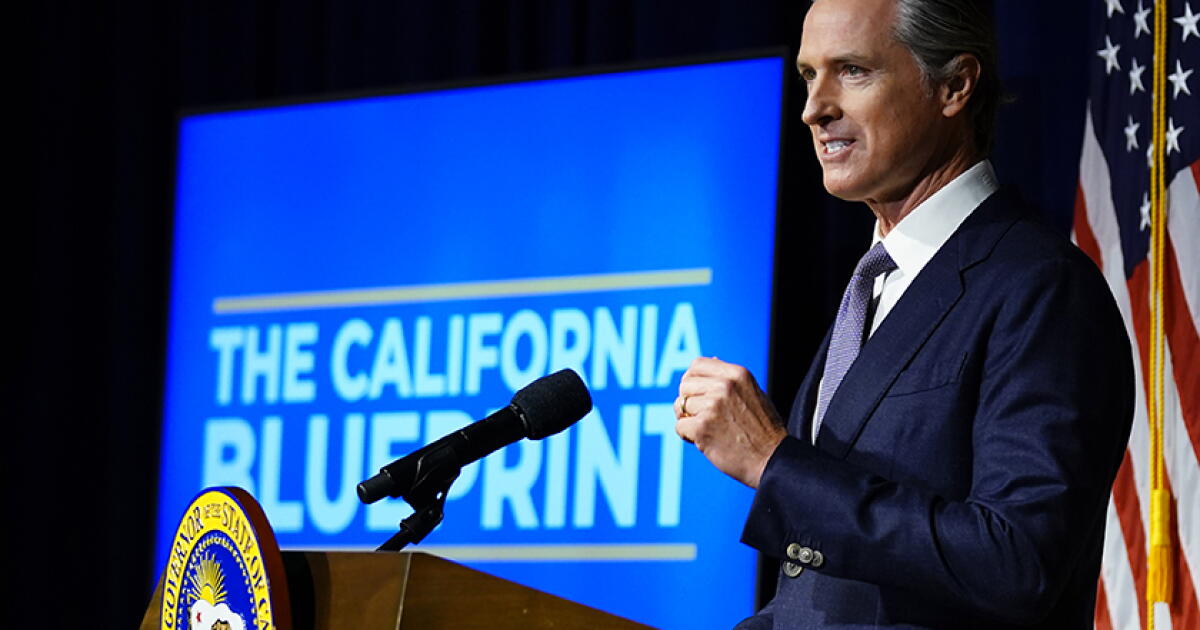
“This legislation protects the extraordinary people who make this industry possible and makes it unmistakably clear: California is still the future of film and television,” said Gov. Newsom in a statement. “We have the talent. We have the infrastructure.”
The bill, AB 2319, was authored by Assemblymember Nick Schultz (D-Burbank) and introduced earlier this year. It cleared the state Senate 33 to 5 on Aug. 30, and the Assembly approved the final version 72 to 2 the same day. Schultz originally sought $100 million for the program. It is expected to start in January with $10 million, according to the Assemblymember Schulz’s office.
“It’s a historic moment for California’s post-production community. But it’s also just the beginning of what we really need to do to to fight for our industry,” said Marielle Abaunza, president of the California Post Alliance, a group advocating for the bill. She said the group is readying its strategy to get more funding for the program next year.
As Hollywood productions continue chase tax credits to other states and countries, much of the post-production work is going with them. California’s share of U.S. post-production employment has fallen from 53% to 42% over the last 13 years, according to CVL Economics, an economic consulting firm tied to California Post Alliance. The state had about 12,000 post-production jobs last year, per CVL Economics.
Ben Urquhart, 51, spent 18 years as a post-production executive at NBCUniversal. The Culver City resident hasn’t been able to find work in the two and a half years since he was laid off.
“It’s grim and it’s hard. There are jobs, but we have a large amount of extremely qualified people competing for every level of job,” Urquhart said. “When I was a kid, I was a [production assistant] in the 90s, and you could get a job within a couple of weeks. But when I got laid off a couple of years ago, I realized that is certainly not the case at all anymore. It’s been a large-scale transformation.”
Urquhart said the new incentive would help California compete with jurisdictions that already offer these credits and “level the playing field.”
Last year, California expanded its film and TV tax credit program, more than doubling the old $330-million cap to $750 million through June 30, 2030. The existing program already covers post-production, but only if 75% of filming or the overall budget is spent in the state.
Newsom also signed a bill that would strengthen the current tax incentive program overall. In June he revealed a state budget measure that capped how much in tax credits a business can claim each year, a limit industry groups warned would undercut the expanded program. But the new Senate Bill 186 enhances refundability for the industry and exempts independent productions from the credit limits, starting next year.