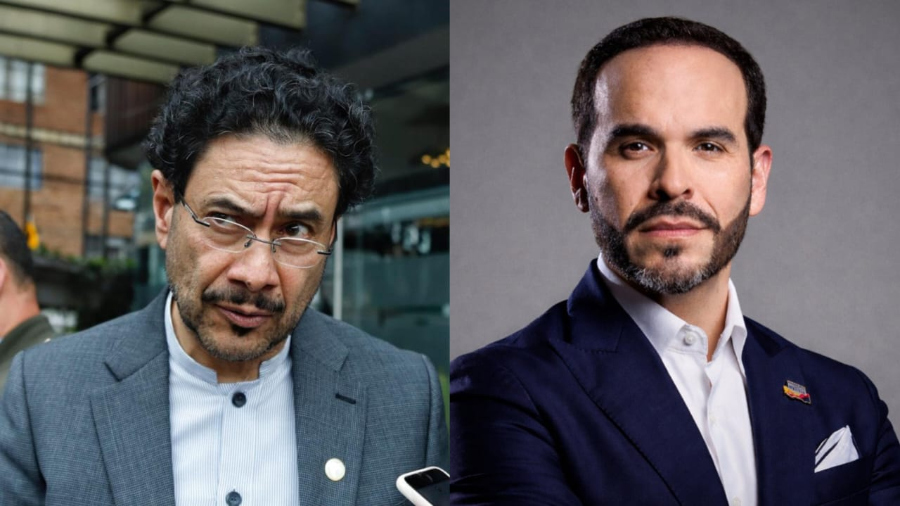
As Colombia comes down from the ecstasy-filled high of its recent win in their 2026 World Cup opener, a sadder, and much darker reality is beginning to set. On June 21st, 2026, Colombians will vote in a historic runoff election that will not only hurt Colombia but will have serious effects on the future of Venezuela.
No matter the outcome, Colombia will be worse off, as both Iván Cepeda and Abelardo De la Espriella are a study on how a democracy can offer voters a choice between two particular brands of terrible.
The first-round of the election provides a clear insight into the current state of Colombian civil society. Like many presidential systems, Colombia structures its presidential elections in a two-round system. If no candidate surpasses 50% of the vote in the first round, as happened on May 31st, a second runoff election is called between the first and second placed candidates. That runoff is this Sunday, June 21st. Moderate and moderate right-wing candidates Sergio Fajardo and Paloma Valencia achieved historic electoral lows for centrists with 4% and 6% of the vote respectively, whilst the radical extremes of the political scale rejoiced in victory.
The biggest surprise was undoubtedly Abelardo de la Espriella´s first round victory, with the self-anointed “Tiger” garnering 43.7% of the vote to first round favourite Iván Cepeda´s 40.9%. With a mere 600,000 votes separating the candidates and about 3 million votes being contested, both can win the election.
Cepeda, who is President Gustavo Petro’s hand-picked heir, initially questioned the results alongside the controversial president, and only accepted them on June 7th, a week after the election. With his institutional backing, that delay matters. All in all, Colombians ran to the extremes, which provided a clear data-backed picture of just how polarized Colombian civil society is.
Whoever gets sworn in Bogotá on August 7th2026, will have more operational influence over Venezuelan affairs than any other head of state in the hemisphere, apart from Trump.
Regardless of the result in the June 21st runoff, the Colombian elections will have a lasting effect on the future of Venezuela and could be the catalyst for very different answers to the question of the country´s political future.
First and foremost, Colombia is the country that has received the largest number of Venezuelan migrants, with approximately 3 million Venezuelans calling the country home. Since January 2025, Colombia has been hosting the diaspora without US funding and support. Furthermore, part of the the 2,219 kilometre-long border between both countries is controlled by the Colombian Guerrilla ELN (Ejército de Liberación Nacional), who lost key ally and facilitator Nicolás Maduro on January 3rd and is currently massing on the Colombian side.
Bogotá’s diplomatic influence and posture is one of the few international players that can have significant effects on whether interim dictator Delcy Rodríguez will eventually push for elections in Venezuela.
All in all, whoever gets sworn in Bogotá on August 7th 2026, will have more operational influence over Venezuelan affairs than any other head of state in the hemisphere, apart from the self-proclaimed most popular man in Venezuela, Donald Trump.
Now, it’s time to get down to brass tacks, the who is who. Inside trash can number one we find Iván Cepeda. Cepeda’s personal arc is worryingly similar to that of the Rodríguez siblings in Venezuela. His father was a radical Left politician murdered by far Right paramilitary groups. That fuelled Cepeda’s deep hatred towards the Colombian political system and institutions. A career senator and politician, Cepeda is probably the smartest mind in Colombia’s hard Left. He is also an admirer of Hugo Chávez, and strong critic of former president and kingmaker Álvaro Úribe. Cepeda’s followers will frame him as a left-wing moderate, but he is not. He is Petro without the cocaine, prostitutes and charisma, running on continuing the Total Peace framework that has seen record numbers of cocaine production in the country, and bolstered the rearming of the ELN. His commitment to governmental continuity will no doubt hurt Colombia, starting with the fact that current policies have driven down Foreign Direct Investment in Colombia by 30% from a 2023 peak.
De la Espriella is a one-man band who won the first round through violent speeches, AI anthropomorphic videos of himself as a tiger, and evangelical networks.
Furthermore, his delay in recognizing the electoral results provides an interesting insight on how Cepeda could interact with institutions that he finds inconvenient. A man who questions clean elections certified by international observers has no business rewriting constitutions, a key pillar on his first-round electoral campaign, which he recently dropped in a pathetic attempt to attract centrists and moderates. Cepeda’s rhetoric and language is extremely divisive. He frames every political opponent as an oligarch, every private enterprise as an exploiter, every security operation as state violence whilst analysing the deep social gaps and concerns the country must navigate. Rather than seeking to solve them, Cepeda weaponizes them to further divide the Colombian population.
But Cepeda’s rottenness is not counterbalanced by a knight in shining armour, but by a different but equally foul-smelling individual. We find Abelardo “The Tiger” de la Espriella inside trash can number two. The part-time attorney, part-time rum maker, aspiring opera singer, fashionista with terrible taste is one of the most questionable figures in the Colombian public sphere. A criminal defence attorney, who became famous for being the lawyer and fixer for chavista allies like Alex Saab and paramilitary leaders, has found a new “passion project” in his expanding list of questionable side hustles: becoming the president of Colombia. De la Espriella comes in as a true outsider who has no congressional or political backing. He is a one-man band who won the first round through violent speeches, AI anthropomorphic videos of himself as a tiger, and evangelical networks.
Abelardo’s rhetoric only serves to perpetrate a never-ending cycle of violence. The anti-democratic claims that he will literally “gut leftists,” his active endorsements of states of exception and support for arbitrary concentrations of power within the presidency, his promise to open ten CECOT-style mega prisons, and his constant disregard and attacks against human rights are problematic.
His “security agenda” is not offering any coherent security policy. On the contrary, he’s seeking to create a permission structure for state-sponsored political violence, dressed as law and order. His policy against the ELN of all-out war has no institutional backing, and risks triggering considerable escalation. Events like the April 25th bombing can serve as a prelude of what an empowered ELN can look like.
De la Espriella’s polarization is of a different flavour to Cepeda’s, but equally problematic. Instead of using social and class divides, the Tiger weaponizes the us-versus-them mentality along the lines of patriots and enemies. In a country with such a tragic and saddening history of political violence, that rhetoric has a body count attached to it.
Cepeda’s attitude will likely be lukewarm and soft on Venezuela, dragging his feet on any meaningful action such as Venezuelan migrants in Colombia or elections in our country.
At the end of the day, either candidate will face serious problems to govern, and will bring a myriad of conundrums for Colombia, but how do their stances translate into the Venezuelan question? On one hand, Iván Cepeda has constantly framed the operation to extract Nicolás Maduro as violation of sovereignty, a position which lacks any diplomatic nuance, and at the same time provides strong insights into how Cepeda will behave towards Venezuela and how much pressure he´ll exert on Venezuela to call for elections. The Total Peace Framework will provide the ELN with the political umbrella to consolidate in the border region, stacking an unpredictable situation on top of an already volatile powder-keg in Venezuela. Calling Cepeda a “friend” of Maduro or Delcy is not accurate, but he is the regime’s useful neighbour. His attitude will most likely be lukewarm and soft on Venezuela, dragging his feet on any meaningful action like his predecessor Gustavo Petro such as Venezuelan migrants in Colombia or elections in our country.
On the other hand, analysing Abelardo’s impact on Venezuela must begin with the fact that he was the leading defence attorney for Alex Saab between 2013 and 2018, the same years Saab ran Maduro’s sanction-busting operation. Although his divisive rhetoric claims forceful actions, his personal history and contacts in his rolodex prove that rather than full force, there is a clear entanglement with the chavista operation. De la Espriella also has no real plan for the domestic situation with refugees, and his ultra-nationalist stance could cause serious problems for foreign populations in Colombia. Furthermore, his full force campaign against the guerrillas can drive the ELN back over the Venezuelan border.
A small “silver lining” does exist. On one hand, Cepeda has stated that he will try to push for regularization mechanisms in Colombia. On the other, Abelardo’s ties to the International Right and Donald Trump can transform him into a key figure to push for a decisive presidential election and as a source of pressure on Delcy.
Colombia’s role as a key interlocutor with Venezuela is undeniably at risk regardless of who wins the presidency. Because the region and Venezuela needed a Colombian president that could be a genuine bridge between Washington and Caracas, between the Venezuelan diaspora and integration, between the ELN and disarmament, and for the ever-divided poles of the Colombian population. But rather, on June 21, the country was forced to choose between ideological blindness dressed in progressive language, and maximum pressure dressed over an obvious conflict of interest. Venezuela might again pay the price for someone else’s terrible choices.