Colombias

What Venezuelans Should Know About Colombia’s Pick-Your-Poison Election

As Colombia comes down from the ecstasy-filled high of its recent win in their 2026 World Cup opener, a sadder, and much darker reality is beginning to set. On June 21st, 2026, Colombians will vote in a historic runoff election that will not only hurt Colombia but will have serious effects on the future of Venezuela. 

No matter the outcome, Colombia will be worse off, as both Iván Cepeda and Abelardo De la Espriella are a study on how a democracy can offer voters a choice between two particular brands of terrible.

The first-round of the election provides a clear insight into the current state of Colombian civil society. Like many presidential systems, Colombia structures its presidential elections in a two-round system.  If no candidate surpasses 50% of the vote in the first round, as happened on May 31st, a second runoff election is called between the first and second placed candidates. That runoff is this Sunday, June 21st. Moderate and moderate right-wing candidates Sergio Fajardo and Paloma Valencia achieved historic electoral lows for centrists with 4% and 6% of the vote respectively, whilst the radical extremes of the political scale rejoiced in victory. 

The biggest surprise was undoubtedly Abelardo de la Espriella´s first round victory, with the self-anointed “Tiger” garnering 43.7% of the vote to first round favourite Iván Cepeda´s 40.9%. With a mere 600,000 votes separating the candidates and about 3 million votes being contested, both can win the election. 

Cepeda, who is President Gustavo Petro’s hand-picked heir, initially questioned the results alongside the controversial president, and only accepted them on June 7th, a week after the election. With his institutional backing, that delay matters. All in all, Colombians ran to the extremes, which provided a clear data-backed picture of just how polarized Colombian civil society is.

Whoever gets sworn in Bogotá on August 7th2026, will have more operational influence over Venezuelan affairs than any other head of state in the hemisphere, apart from Trump.

Regardless of the result in the June 21st runoff, the Colombian elections will have a lasting effect on the future of Venezuela and could be the catalyst for very different answers to the question of the country´s political future. 

First and foremost, Colombia is the country that has received the largest number of Venezuelan migrants, with approximately 3 million Venezuelans calling the country home. Since January 2025, Colombia has been hosting the diaspora without US funding and support. Furthermore, part of the the 2,219 kilometre-long border between both countries is controlled by the Colombian Guerrilla ELN (Ejército de Liberación Nacional), who lost key ally and facilitator Nicolás Maduro on January 3rd and is currently massing on the Colombian side.

Bogotá’s diplomatic influence and posture is one of the few international players that can have significant effects on whether interim dictator Delcy Rodríguez will eventually push for elections in Venezuela. 

All in all, whoever gets sworn in Bogotá on August 7th 2026, will have more operational influence over Venezuelan affairs than any other head of state in the hemisphere, apart from the self-proclaimed most popular man in Venezuela, Donald Trump.

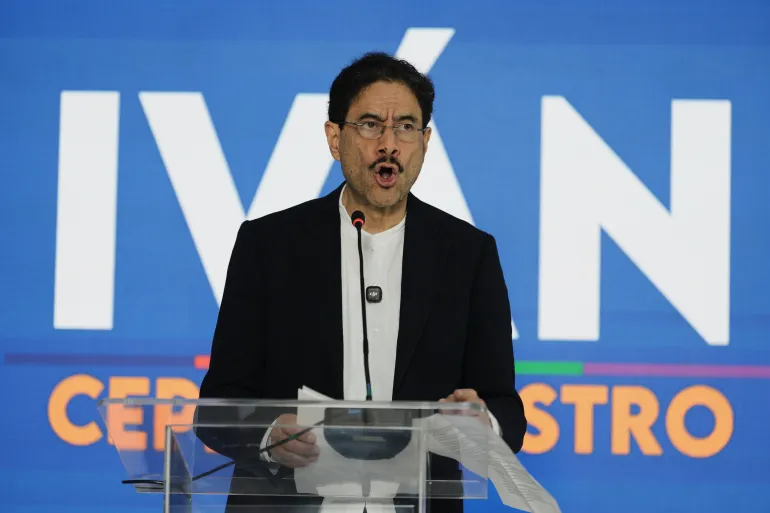
Now, it’s time to get down to brass tacks, the who is who. Inside trash can number one we find Iván Cepeda. Cepeda’s personal arc is worryingly similar to that of the Rodríguez siblings in Venezuela. His father was a radical Left politician murdered by far Right paramilitary groups. That fuelled Cepeda’s deep hatred towards the Colombian political system and institutions. A career senator and politician, Cepeda is probably the smartest mind in Colombia’s hard Left. He is also an admirer of Hugo Chávez, and strong critic of former president and kingmaker Álvaro Úribe. Cepeda’s followers will frame him as a left-wing moderate, but he is not. He is Petro without the cocaine, prostitutes and charisma, running on continuing the Total Peace framework that has seen record numbers of cocaine production in the country, and bolstered the rearming of the ELN. His commitment to governmental continuity will no doubt hurt Colombia, starting with the fact that current policies have driven down Foreign Direct Investment in Colombia by 30% from a 2023 peak.

De la Espriella is a one-man band who won the first round through violent speeches, AI anthropomorphic videos of himself as a tiger, and evangelical networks.

Furthermore, his delay in recognizing the electoral results provides an interesting insight on how Cepeda could interact with institutions that he finds inconvenient. A man who questions clean elections certified by international observers has no business rewriting constitutions, a key pillar on his first-round electoral campaign, which he recently dropped in a pathetic attempt to attract centrists and moderates. Cepeda’s rhetoric and language is extremely divisive. He frames every political opponent as an oligarch, every private enterprise as an exploiter, every security operation as state violence whilst analysing the deep social gaps and concerns the country must navigate. Rather than seeking to solve them, Cepeda weaponizes them to further divide the Colombian population.

But Cepeda’s rottenness is not counterbalanced by a knight in shining armour, but by a different but equally foul-smelling individual. We find Abelardo “The Tiger” de la Espriella inside trash can number two. The part-time attorney, part-time rum maker, aspiring opera singer, fashionista with terrible taste is one of the most questionable figures in the Colombian public sphere. A criminal defence attorney, who became famous for being the lawyer and fixer for chavista allies like Alex Saab and paramilitary leaders, has found a new “passion project” in his expanding list of questionable side hustles: becoming the president of Colombia. De la Espriella comes in as a true outsider who has no congressional or political backing. He is a one-man band who won the first round through violent speeches, AI anthropomorphic videos of himself as a tiger, and evangelical networks.

Abelardo’s rhetoric only serves to perpetrate a never-ending cycle of violence. The anti-democratic claims that he will literally “gut leftists,” his active endorsements of states of exception and support for arbitrary concentrations of power within the presidency, his promise to open ten CECOT-style mega prisons, and his constant disregard and attacks against human rights are problematic. 

His “security agenda” is not offering any coherent security policy. On the contrary, he’s seeking to create a permission structure for state-sponsored political violence, dressed as law and order. His policy against the ELN of all-out war has no institutional backing, and risks triggering considerable escalation. Events like the April 25th bombing can serve as a prelude of what an empowered ELN can look like. 

De la Espriella’s polarization is of a different flavour to Cepeda’s, but equally problematic. Instead of using social and class divides, the Tiger weaponizes the us-versus-them mentality along the lines of patriots and enemies. In a country with such a tragic and saddening history of political violence, that rhetoric has a body count attached to it.

Cepeda’s attitude will likely be lukewarm and soft on Venezuela, dragging his feet on any meaningful action such as Venezuelan migrants in Colombia or elections in our country.

At the end of the day, either candidate will face serious problems to govern, and will bring a myriad of conundrums for Colombia, but how do their stances translate into the Venezuelan question? On one hand, Iván Cepeda has constantly framed the operation to extract Nicolás Maduro as violation of sovereignty, a position which lacks any diplomatic nuance, and at the same time provides strong insights into how Cepeda will behave towards Venezuela and how much pressure he´ll exert on Venezuela to call for elections. The Total Peace Framework will provide the ELN with the political umbrella to consolidate in the border region, stacking an unpredictable situation on top of an already volatile powder-keg in Venezuela. Calling Cepeda a “friend” of Maduro or Delcy is not accurate, but he is the regime’s useful neighbour. His attitude will most likely be lukewarm and soft on Venezuela, dragging his feet on any meaningful action like his predecessor Gustavo Petro such as Venezuelan migrants in Colombia or elections in our country.

On the other hand, analysing Abelardo’s impact on Venezuela must begin with the fact that he was the leading defence attorney for Alex Saab between 2013 and 2018, the same years Saab ran Maduro’s sanction-busting operation. Although his divisive rhetoric claims forceful actions, his personal history and contacts in his rolodex prove that rather than full force, there is a clear entanglement with the chavista operation. De la Espriella also has no real plan for the domestic situation with refugees, and his ultra-nationalist stance could cause serious problems for foreign populations in Colombia. Furthermore, his full force campaign against the guerrillas can drive the ELN back over the Venezuelan border.

A small “silver lining” does exist. On one hand, Cepeda has stated that he will try to push for regularization mechanisms in Colombia. On the other, Abelardo’s ties to the International Right and Donald Trump can transform him into a key figure to push for a decisive presidential election and as a source of pressure on Delcy.

Colombia’s role as a key interlocutor with Venezuela is undeniably at risk regardless of who wins the presidency. Because the region and Venezuela needed a Colombian president that could be a genuine bridge between Washington and Caracas, between the Venezuelan diaspora and integration, between the ELN and disarmament, and for the ever-divided poles of the Colombian population. But rather, on June 21, the country was forced to choose between ideological blindness dressed in progressive language, and maximum pressure dressed over an obvious conflict of interest. Venezuela might again pay the price for someone else’s terrible choices.

Source link

Why is the US so invested in Colombia’s election? | Donald Trump

NewsFeed

Colombia’s far-right, pro-Trump candidate, Abelardo de la Espriella, is in the lead after Colombia’s first round of elections. If he wins the June 21 runoff against left-wing Senator Ivan Cepeda, progressive policies could be reversed. Al Jazeera’s Hala Al Shami explains why US officials are invested in de la Espriella’s success and walks us through the stakes.

Source link

Colombia’s Petro doubles down on election fraud allegations

Colombian President Gustavo Petro said he has evidence of software modifications that allegedly introduced hundreds of thousands of voter identification records that were not properly registered and altered voting tables. Photo by EPA

June 2 (UPI) — Colombian President Gustavo Petro reiterated allegations Tuesday of possible electoral fraud in the first round of the country’s presidential election, claiming irregularities in the voter registry and vote-counting systems ahead of the June 21 runoff.

In a message posted on X, Petro said he was presenting the “verified basis of possible fraud” and claimed he could submit evidence to the relevant authorities.

Petro said he has evidence of software modifications that allegedly introduced hundreds of thousands of voter identification records that were not properly registered and altered voting tables.

Petro contended that last-minute technical changes to systems operated by Colombia’s National Civil Registry, known as the Registraduria Nacional, resulted in irregularities, including an increase of 885,409 voter identification records in the electoral roll and the appearance of 1,493 additional voting tables that he claimed were not authorized.

He also alleged that the algorithms used in private software for preliminary vote counting and official tabulation were secretly modified three times during the final week of the campaign.

As a result, Petro said, he would only recognize the final official results certified by judicial authorities serving on Colombia’s electoral review commissions.

He said the alleged irregularities benefited far-right candidate Abelardo de la Espriella and harmed his preferred candidate, left-wing Sen. Ivan Cepeda.

After preliminary results showed De la Espriella leading with 43.74% of the vote and Cepeda in second place with 40.90%, Petro said he would not accept the preliminary count and pledged to present evidence to electoral authorities.

Before the election, several polls had projected Cepeda as the frontrunner, although analysts noted a rapid surge in support for De la Espriella during the final weeks of the campaign.

Petro intensified his criticism Tuesday, claiming electoral authorities were seeking to “close the vote count quickly” to avoid reviewing his allegations.

The National Civil Registry reported that the official count had reached 99.98% completion and said final results matched the preliminary count of 99.94%, rejecting claims of widespread manipulation.

According to Colombian media reports, Cepeda significantly softened his position Monday after initially supporting Petro’s concerns on election night.

The candidate of the Historic Pact coalition said that after an extensive review conducted by his monitoring team, no evidence was found of irregularities significant enough to call the legitimacy of the first-round results into question.

Voters will return to the polls June 21 to choose between two sharply different political visions.

De la Espriella, a political outsider associated with what supporters describe as a “new right,” has centered his campaign on public security and advocates a hardline approach to crime inspired by the policies of El Salvador’s President Nayib Bukele and Argentine President Javier Milei.

Cepeda, meanwhile, has campaigned on social justice and supports continuing and expanding Petro’s agrarian reform and energy transition agenda, while promoting negotiations with armed groups as part of a broader peace strategy.

Source link

Celebration, shock and scepticism follow Colombia’s presidential election | Elections News

Less than two hours after polling stations closed on Sunday, it was clear that Colombia’s presidential race would be settled in a run-off between two finalists: hard-right political outsider Abelardo de la Espriella and leftist Senator Ivan Cepeda.

Though the overall result surprised few, de la Espriella’s strong showing upended pollsters’ predictions.

Recommended Stories

list of 3 itemsend of list

Cepeda, President Gustavo Petro’s chosen successor, had been expected to win the most votes, based on public opinion surveys.

But instead, de la Espriella came in first place, winning 43.74 percent of the vote. Cepeda trailed with 40.90 percent.

Supporters of de la Espriella, a criminal defence lawyer, held rapturous celebrations in the coastal city of Barranquilla, where the candidate has an office.

“Colombia won, and with more than 10 million votes, democracy won,” said Elsa Suarez, a de la Espriella voter living in Bogota.

The far-right candidate has modelled himself after politicians like Donald Trump in the United States and Javier Milei in Argentina, flamboyant media personalities who won the presidency despite having little to no political experience.

Like them, de la Espriella has pledged a return to “law and order”, as well as a pared-back national government and policies to support traditional family values.

Notably, he promises to use an “iron fist” to stamp out crime and build megaprisons to jail criminals, mimicking the policies of Salvadoran strongman Nayib Bukele.

Analysts say de la Espriella’s populist messaging resonated with voters in Colombia’s interior, where urban crime is a growing concern.

Electoral maps show de la Espriella besting Cepeda in 16 of the country’s 32 departments, primarily in the heart of Colombia and along the border with Venezuela.

“In more central areas and closer to the capitals, people prioritise security,” explained Laura Bonilla, the deputy director at the Peace and Reconciliation Foundation (PARES), a Bogota-based research nonprofit.

By contrast, de la Espriella’s security messaging failed to sway voters along the coast and in border areas afflicted by rebel violence.

Bonilla argues that people in these regions instead place greater value on the socioeconomic issues that Cepeda represents, as the continuity candidate for Petro’s Historic Pact party.

“Over the past four years, they have received constant attention from the government,” said Bonilla, citing state development projects under the Petro administration.

Colombian presidential candidate Ivan Cepeda of the Historic Pact party attends a press conference about the second phase of the presidential race, in Bogota, Colombia, June 1, 2026. REUTERS/Enea Lebrun
Colombian presidential candidate Ivan Cepeda of the Historic Pact party holds a news conference in Bogota, Colombia, on June 1 [Enea Lebrun/Reuters]

A blow to the conservative establishment

De la Espriella’s success also highlights growing anti-establishment sentiment in Colombia, according to experts.

The lawyer, who has never run for public office before, comfortably beat his main rival on the right, Senator Paloma Valencia, who was backed by former President Alvaro Uribe, the figurehead of Colombian conservatism.

Initially, Sunday’s election was predicted to be a close race between Valencia and de la Espriella, both of whom lagged behind Cepeda in the polls.

But as Sunday’s ballots were tallied, Valencia flopped with less than 7 percent of the vote.

Miguel Silva, a Colombian political consultant, credited some of de la Espriella’s success to his campaign messaging.

De la Espriella, he explained, used his campaign to draw a distinction between the haves and the have-nots, those who have benefitted from the government and those who feel ignored.

“He [succeeded] by portraying himself and the people he represents as ‘Los Nunca’ and by portraying Paloma and her followers as ‘Los Siempre’,” Silva said, using the Spanish words for “The Nevers” and “The Always”.

Pollsters predicted the right would be divided in the first round, paving the way for Cepeda to win the most votes, but de la Espriella captured millions of votes from traditional conservatives, marking a shift in Colombia’s political landscape.

In Bogota, the only province in the country’s interior to vote for Cepeda, the left-wing candidate’s supporters were shocked by Sunday’s results.

“Everyone is a little surprised,” said Juan Camilo Rodriguez, who voted for Cepeda. “These results don’t match the polls.”

Newspapers at a newsstand show the results of the first round of Colombia's presidential election, in Bogota, Colombia, June 1, 2026. REUTERS/Enea Lebrun
Newspapers at a Bogota newsstand show the results of the first round of Colombia’s presidential election on June 1 [Enea Lebrun/Reuters]

Petro himself had hammered his base to flood the polls, warning that the left’s chances of success could be hampered by electoral fraud.

The outgoing president rejected last night’s results, which were based on the “pre-conteo”, or preliminary count, a non-legally binding process.

Instead, Petro called on the public to wait for the official, scrutinised count, which will be released in the coming days.

Cepeda echoed the president’s scepticism in a speech on Sunday night. “Only once the vote-counting committees have fully, clearly, and thoroughly clarified this matter, will we comment on tonight’s results,” he told supporters.

But the candidate appeared to mellow his stance this morning, acknowledging that there was no evidence of irregularities in the vote. He trailed de la Espriella by more than 670,000 votes.

Experts warn that Cepeda is losing precious time by focusing on fraud allegations and should instead concentrate on swaying moderate voters.

“By crying fraud so early, it’s hard to bring more voters to the table,” said Silva.

A second round of voting, between Cepeda and de la Espriella, is scheduled for June 21.

Up for grabs are more than a million votes for centrist candidate Sergio Fajardo and 1.6 million for Paloma Valencia. While Valencia endorsed de la Espriella, her running mate, moderate politician Juan Daniel Oviedo, did not.

Miguel Jaramillo Lujan, a Colombian political strategist, said the final two candidates must tread carefully in the next three weeks to prevail.

“As the saying goes, whoever makes fewer mistakes will be the winner.”

Source link

Colombia’s outsider candidate defied the polls | Elections

NewsFeed

Colombia’s presidential election is headed to a runoff on June 21. Far-right outsider, Abelardo de la Espriella, will face leftist senator, Ivan Cepeda. Professor Jorge Restrepo describes de la Espriella’s rise in the polls as a punishment vote against Colombia’s long-established political class.

Source link

Cepeda, de la Espriella advance in Colombia’s presidential election | Elections News

Far-right outsider Abelardo de la Espriella will face left-wing Senator Ivan Cepeda in the run-off for Colombia’s presidential election next month.

After polls closed on Sunday, the two candidates quickly surged ahead in the vote tally, extinguishing the hopes of right-wing Senator Paloma Valencia, a former frontrunner.

Recommended Stories

list of 3 itemsend of list

As of Sunday afternoon, with 99 percent of the votes tallied, de la Espriella took the lead, with 43 percent of the ballots cast in his favour.

Cepeda trailed him by more than 600,000 votes, earning 40 percent support.

Neither candidate breached the 50-percent threshold needed to avoid a head-to-head match-up on June 21. But the results are likely to buoy de la Espriella’s campaign going into the final round.

Cepeda had consistently topped public opinion polls in the final weeks before the vote. A May 24 poll from the National Consulting Centre (CNC) showed him with more than 33 percent support, ahead of de la Espriella’s 30.9 percent.

TOPSHOT - (COMBO) This combination of pictures, created on May 31, 2026, shows Demanding Senator Ivan Cepeda speaking with the press at the end of the trial of Colombian former President Alvaro Uribe in Bogota on February 10, 2025, and Colombian presidential candidate Abelardo de la Espriella, of the political movement Defensores de la Patria, looking on during an interview with AFP in Bogota on February 11, 2026.
Ivan Cepeda, left, will face Abelardo de la Espriella in the June 21 run-off election [AFP]

De la Espriella’s ‘outsider’ campaign

Questions about security were at the forefront of voters’ concerns going into Sunday’s election.

De la Espriella, a businessman and lawyer who has never held elected office, leaned heavily into fears of crime as he launched an outsider campaign, similar to the dark-horse bid of Argentinian President Javier Milei.

By contrast, Cepeda is a well-known quantity in Colombian politics. His father was a senator, too, before he was assassinated in 1994, in what was widely considered to be an act of political violence.

Cepeda himself has served as a senator since 2014. Before that, he served in the Chamber of Deputies, representing the capital, Bogota.

During his political career, he became embroiled in a long-running legal dispute with former right-wing President Alvaro Uribe, whom he accused of complicity with right-wing paramilitaries.

Uribe initially sued Cepeda for defamation, but in a dramatic twist, Colombia’s Supreme Court dismissed the charge and instead investigated Uribe for witness tampering.

While Uribe was initially found guilty and sentenced to 12 years of house arrest, an appeals court ultimately struck down the verdict, citing procedural errors, including insufficient evidence.

epa13007654 Electoral workers greet voters at a polling station during the presidential election in Bogota, Colombia, 31 May 2026. More than 41 million Colombians are registered to vote. EPA/MAURICIO DUENAS CASTANEDA
Electoral workers greet voters at a polling station in Bogota, Colombia, on May 31  [Mauricio Duenas Castaneda/EPA]

Security a top concern

Central to the rift in Colombia’s politics is the country’s six-decade-long internal conflict.

Since 1964, criminal networks, government forces, left-wing rebels and right-wing paramilitaries have all jockeyed against one another for power and territory.

Cepeda has been critical of right-wing efforts to solve the conflict through military might alone.

Instead, he has allied himself with Colombia’s outgoing president, Gustavo Petro, the first left-wing figure ever elected to the country’s highest office.

A former rebel fighter, Petro has championed a policy he calls “Total Peace”, which actively seeks negotiated solutions to the fighting.

While critics have questioned the efficacy of “Total Peace”, pointing to a recent uptick in violence, Cepeda has nevertheless pledged to carry it forward. He represents Petro’s left-wing Historic Pact party in this year’s election.

In an interview this month with CNN, Cepeda acknowledged the policy’s “immense challenges”, saying: “We cannot continue to develop conversations that do not yield clear results.”

But he rejected overly militaristic solutions, as well as the prospect of intervention by the United States. The US-led “war on drugs”, Cepeda said, has “failed spectacularly”.

De la Espriella, meanwhile, has embraced the kind of hardline security platform commonly associated with El Salvador’s leader, Nayib Bukele.

His platform includes a pledge to crack down on crime and build 10 megaprisons in Colombia.

Nicknamed “The Tiger”, he founded the Defenders of the Homeland political party and is known to rally with the slogan, “Stand firm for the nation”.

“The only peace process I believe in is one imposed by the force of arms and the laws of the republic,” de la Espriella told The Associated Press news agency this month.

Like US President Donald Trump, de la Espriella has also threatened to launch a bombing campaign to disrupt drug-trafficking, killing suspects by downing planes and shooting boats.

But such campaigns have been widely denounced as a form of extrajudicial killing, effectively denying suspects the chance of defending themselves in a court of law.

Supporters of presidential candidate Ivan Cepeda of the ruling Historic Pact react as they follow election results outside his campaign's election night headquarters in Bogota, Colombia, Sunday, May 31, 2026. (AP Photo/Matias Delacroix)
Supporters of presidential candidate Ivan Cepeda watch the election results arrive in Bogota, Colombia, on May 31 [Matias Delacroix/AP Photo]

Narrowing odds for Colombia’s left

More than 23.6 million Colombians voted in Sunday’s election, though there was a high number of blank or nullified ballots.

Early estimates, with 99 percent of ballots tallied, indicate that 245,342 voting sheets were null, and another 406,830 were left blank.

The second round is likely to be an uphill battle for Cepeda. Colombia’s right-wing is expected to consolidate behind de la Espriella in the second round.

In Sunday’s vote count, more than 10.3 million ballots were cast for de la Espriella, compared with roughly 9.7 million for Cepeda.

A victory for the right would continue a regional trend in Latin America. Last year alone, left-wing governments in Chile, Honduras and Bolivia were all replaced by right-wing presidential contenders.

De la Espriella signalled his optimism about the second round in a social media post as the results rolled in.

“We are going to defeat tyranny and absolutism,” de la Espriella wrote. “We have advanced to the run-off thanks to the more than 10 million Colombians who answered the roar. In 21 days, we will make history!”

Source link

Juan Manuel Santos on Colombia’s peace process, 10 years on | Politics

Ten years after Colombia’s landmark peace agreement, former president Juan Manuel Santos assesses its legacy. The Nobel Peace Prize laureate discusses renewed violence, political divisions and what Colombia’s experience can teach a world facing growing conflict.

Source link

‘Opposite visions’: What to know about Colombia’s presidential election | Elections News

On Sunday, voters in the South American country of Colombia are facing a choice.

Four years ago, they elected the first left-wing president in the country’s modern history, Gustavo Petro. Now, they must decide whether to continue with Petro’s leftist push — or restore the political right to power.

Recommended Stories

list of 3 itemsend of list

Fourteen candidates will be on the ballot for the first round of voting in Colombia’s presidential election.  The packed field includes contenders from the left, right and centre, who are slated to face off over issues like security and the cost of living.

But Petro will not be among them: Presidents in Colombia are limited to a single four-year term.

The right wing is expected to have the advantage, particularly if the race proceeds to a second round. Petro is struggling with low poll numbers, and voters have expressed frustration with crime and violence, driven in part by the country’s six-decade-long internal conflict.

But leftist candidate Ivan Cepeda has surprised observers, consistently placing at the top of the polls ahead of the first round.

When is the election, who are the candidates, and which issues are top of mind for voters? We look at those questions and more in this brief explainer.

When is the election?

The first round of voting is set to take place on May 31, 2026.

Will there be a second round of voting?

A candidate would need to win more than 50 percent of the vote in the first round to avoid a run-off.

If no single candidate meets that threshold, a run-off will be held between the top two finishers on June 21.

Why is this election important?

In recent years, across Latin America, long-entrenched left-wing governments have met defeat at the ballot box.

Last year alone, right-wing candidates have been elected to replace left-wing presidents in Bolivia, Chile and Honduras.

But Colombia does not have a long history of left-wing presidents. Petro was the first. That makes this race one to watch, according to Gimena Sanchez, a Colombia expert at the Washington Office on Latin America (WOLA), a human rights nonprofit.

“This is the first election to be held after the first-ever leftist administration in Colombia’s 200-year history,” Sanchez explained.

Colombia now stands at a fork in the road. One of the dominant issues in the election is how to resolve the country’s internal conflict, which forced more than 235,619 individuals from their homes in 2025.

Another 87,069 people were caught up in mass displacement events due to the fighting, according to the International Committee of the Red Cross.

Petro has embraced negotiation as a tool to end the conflict, which has seen government forces, criminal networks, left-wing rebels and right-wing paramilitaries all battling one another.

But the political right has advocated a return to the more militarised approach backed by the United States, according to Sanchez.

“The leading candidates fall into two camps: continuity with the leftist government of Petro and an approach to security that focuses on negotiations with armed groups, and right-wing candidates who very much want to go back to a hardline security model that Colombia had in the past,” Sanchez said.

“You have polar opposite visions for the country.”

Who is the main candidate on the left?

Senator Ivan Cepeda has emerged as the primary candidate of the political left, running as the head of the governing coalition, known as Historic Pact.

Cepeda has largely pledged continuity with Petro’s platform, including social and economic policies meant to reduce inequality.

He has also embraced Petro’s “Total Peace” approach, which aims to resolve the country’s internal fighting by negotiating with armed groups and criminal networks, as opposed to solely relying on military force.

Confronting state-backed violence has become a hallmark of Cepeda’s life and career.

His father, who was also a senator, is believed to have been assassinated by a government-backed paramilitary. For years, Cepeda was also embroiled in a legal battle for accusing former President Alvaro Uribe of connections to right-wing paramilitaries.

Colombia's presidential candidate Ivan Cepeda, of the Pacto Historico party, speaks to supporters during his final campaign rally in Barranquilla, Atlantico department, Colombia on May 24, 2026.
Presidential candidate Ivan Cepeda speaks to supporters during his final campaign rally in Barranquilla, Colombia, on May 24 [Vanessa Romero/AFP]

Who are the main candidates on the right?

While Cepeda has become the standard-bearer for the left, the political right has had to contend with a more fractured field of candidates.

Running on the far right is Abelardo de la Espriella, a lawyer for the Defenders of the Homeland Party who has generated comparisons with Salvadoran President Salvador Bukele and Argentina’s Javier Milei.

Like those leaders, de la Espriella has offered a hardline vision for his country’s security. If elected, he says he would end negotiations with armed groups, bomb rebel camps, and resume the aerial fumigation of coca ⁠crops, which produce the raw material for cocaine.

Senator Paloma Valencia, a candidate with the Democratic Centre Party, is running as a more moderate alternative to de la Espriella. She too has promised a stricter approach to crime. Her platform involves expanding the police and armed forces, while cutting taxes and promoting pro-business policies in the economic realm.

Their election-season competition has become a source of acrimony for Valencia and de la Espriella, who have accused each other of paving the way for a leftist election victory.

“There is a more familiar, establishment right, represented by Valencia, and a far right in the form of de la Espriella, who pitches himself as an outsider,” said Sanchez.

Valencia, for her part, has criticised de la Espriella as two-faced, defending criminals in his legal practice but advocating for tighter security on the campaign trail.

De la Espriella, meanwhile, has dismissed Valencia as a member of the country’s political establishment and chided her in a social media post, stating that the presidential election is “not for little games”.

Colombia's presidential candidate Paloma Valencia, from the Centro Democratico party, speaks to supporters during her final campaign rally in Bogota on May 24, 2026.
Paloma Valencia of the Democratic Centre Party speaks to supporters during her final campaign rally in Bogota on May 24 [Raul Arboleda/AFP]

What are the polls saying?

Polls generally show Cepeda ahead of his rivals, with de la Espriella in second place and Valencia in third.

A May 24 poll from the National Consulting Centre (CNC) and the publication Cambio suggested that Cepeda had drawn 33.4 percent of voter support, the most of any candidate.

But de la Espriella was on the upswing with 30.9 percent. Valencia, meanwhile, trailed with 12.6 percent.

The same surveys, however, suggest that Cepeda would struggle to win a run-off against either of the two right-wing candidates, with de la Espriella eking out about three points in a head-to-head contest, and Valencia coming within a percentage point of victory.

Undecided voters could play a key role in deciding the outcome, though. An analysis cited by the Spanish paper El Pais estimates that undecided voters could account for as much as 28 percent of the electorate.

Colombia's presidential candidate Abelardo de la Espriella, of the Defensores de la Patria party, speaks behind bulletproof glass during his closing campaign rally in Medellin, Colombia on May 24, 2026.
Presidential candidate Abelardo de la Espriella, of the Defensores de la Patria party, speaks behind bulletproof glass during his closing campaign rally in Medellin, Colombia, on May 24, 2026 [Jaime Saldarriaga/AFP]

Which issues are front and centre?

Concerns over crime, security and economic issues like unemployment and affordability have dominated the election.

In a poll from the firm Invamer, the highest proportion of voters — 37 percent — identified security as the top issue facing the country.

Basic needs and unemployment ranked second and third, with 17 percent and 16 percent, respectively. Eleven percent of voters, meanwhile, named corruption as a leading concern.

The threat of violence has lingered over the presidential campaign over the past year.

Two political staffers with de la Espriella’s campaign were killed by gunmen on motorbikes earlier this month. And in June 2025, presidential candidate Miguel Uribe Turbay was shot while leaving a campaign rally. The 39-year-old died two months later from his injuries.

Political violence is a serious concern in Colombia, and all of the frontrunners in the race travel with heavy security.

Source link

What the Alex Saab Paradox in Colombia’s Elections Means

Venezuela is becoming increasingly important in Colombia’s presidential election, though not necessarily from a policy perspective. The three leading candidates are not offering radically new approaches toward Caracas. Instead, they broadly accept that Colombia will not shape Venezuela policy in a vacuum, but within a regional framework increasingly defined by Washington.

Even among the Colombian Right, the differences are narrower than the rhetoric sometimes suggests. Some candidates favor preserving parts of the thaw in relations initiated under Gustavo Petro, while others align themselves more openly with the Trump administration’s emerging three-phase approach toward Venezuela, combining pressure, negotiation, and eventual normalization while maintaining support for María Corina Machado and the democratic opposition.

The real competition is happening elsewhere.

As Bogotá increasingly adapts itself to strategic realities designed in Washington, Venezuela has become less a matter of concrete policy and more a source of symbolic legitimacy inside the Colombian Right. The question is no longer simply who has the best Venezuela strategy, but who is most closely aligned with the hemisphere’s most internationally legitimized anti-chavista figure.

Both Paloma Valencia and Abelardo de la Espriella have sought proximity to Machado, likely recognizing her growing political value among Colombian-Venezuelan voters and sectors of the Colombian Right that increasingly view her as a hemispheric democratic symbol after July 28, 2024. Early in the electoral cycle, both candidates publicized meetings with Machado and members of her team, presenting themselves as politically aligned with the Venezuelan opposition’s struggle. Valencia recently traveled to Panama to meet Machado personally, while De la Espriella has repeatedly emphasized his relationship with anti-chavista circles to position himself as part of a broader regional conservative realignment.

Yet the two candidacies embody very different political instincts.

Support from figures close to Machado, Trump-world Republicans, Miami exile networks, and conservative media ecosystems now carries political value extending far beyond Venezuela itself.

Valencia represents a more traditional conservative internationalism tied to institutional anti-chavismo, democratic legitimacy, and Atlanticist conservatism. De la Espriella, meanwhile, has increasingly embraced a far more populist style of politics, openly presenting himself as a Colombian version of Nayib Bukele that promises to build ten CECOT-style mega prisons in Colombia.

That contradiction becomes particularly striking when placed alongside one of the defining professional relationships of De la Espriella’s career: his representation of Alex Saab during the height of the CLAP era. Saab became one of the clearest symbols of late-stage chavismo’s corruption architecture, embodying the opaque financial networks, sanctions arbitrage, and humanitarian corruption that increasingly defined the Maduro era.

The irony of Saab’s former lawyer attempting to embody Colombia’s hardest anti-chavista and anti-corruption posture is difficult to ignore. But the contradiction also reveals something deeper about contemporary Latin American politics, where anti-establishment rhetoric and proximity to opaque power structures are no longer necessarily disqualifying contradictions.

The contradictions are perhaps most visible within parts of the Venezuelan opposition’s own media ecosystem. Some anti-chavista pundits spent years cultivating reputations as uncompromising anti-corruption crusaders, often accusing opposition figures of moral weakness, accommodationism, or hidden financial interests. Their enthusiastic support for Abelardo de la Espriella, despite his long professional relationship with Alex Saab during the height of the CLAP era, suggests that ideological affinity and political aesthetics are increasingly overriding the moral rigidity that once characterized parts of anti-chavista discourse.

Venezuela’s role in the Colombian election is not primarily about foreign policy. It is about political identity.

At the same time, other sectors of Machado’s broader international coalition appear more naturally aligned with Valencia’s institutional conservatism. The result is an increasingly visible fragmentation within the anti-chavista ecosystem itself, one that reflects broader tensions inside the Latin American Right between institutional conservatism, populist maximalism, and Bukele-style punitive politics.

Washington has only reinforced those dynamics. As the US once again becomes the principal external actor shaping Venezuela’s political future, different Colombian candidates increasingly compete to position themselves as the preferred interlocutors of the emerging regional order. Support from figures close to Machado, Trump-world Republicans, Miami exile networks, and conservative media ecosystems now carries political value extending far beyond Venezuela itself.

In that sense, Venezuela’s role in the Colombian election is not primarily about foreign policy. It is about political identity.

And perhaps more importantly, it may also offer a glimpse into the future political terrain of a post-transition Venezuela itself. If chavismo eventually collapses or evolves into some form of negotiated transition, the country will not emerge into a region defined by liberal democratic consensus. It will emerge into a hemisphere shaped by Bukele, Milei, Trumpism, social media maximalism, and deep public exhaustion with traditional political elites.

The rise of figures like De la Espriella suggests that the post-chavista Right may not necessarily resemble the liberal democratic opposition that spent decades fighting chavismo. It may instead reflect a harsher, more punitive, and more performative political culture, one forged not despite the region’s prolonged crises, but because of them.

Source link

Venezuela’s Rodríguez and Colombia’s Petro Hold Talks on Security, Trade, Energy

Petro was the first head of state to visit Caracas since the January 3 US attacks. (Presidential Press)

Caracas, April 24, 2026 (venezuelanalysis.com) – Venezuelan Acting President Delcy Rodríguez hosted Colombian President Gustavo Petro for bilateral talks in Caracas on Friday. 

The meeting marked the first official visit by a head of state since the kidnapping of President Nicolás Maduro during a US military operation on January 3.

Following talks at Miraflores Presidential Palace, Rodríguez said both governments committed to tackling organized crime along their shared border, one of the longest in the region at over 2,200 kilometers.

“We have undertaken a very serious and concrete approach to combating criminal groups and transnational crime,” she said, announcing the development of joint military plans and “immediate” mechanisms for intelligence sharing in a new level of security cooperation.

Petro, for his part, stated that both countries would work toward the “liberation of border communities” through coordinated military, police, and social action.

“Building a fully coordinated common effort to free border populations from mafias engaged in various illegal economies,” he said, accusing irregular groups of human trafficking, drug trafficking, and illegal gold trade activities.

The leaders also agreed on economic initiatives aimed at supporting Venezuelan and Colombian populations in border regions. Petro expressed hope that these efforts would help reintegrate the two territories and boost food security.

The joint action commitments come amid escalating violence in the Catatumbo region of Colombia’s Norte de Santander department, which borders Venezuela’s Táchira state, where clashes between armed groups have displaced thousands in recent weeks.

Armed organizations operating in the area include the National Liberation Army (ELN), the Estado Mayor Central (EMC) and the Segunda Marquetalia, both descendants of the former FARC, and the Clan del Golfo, among others.

Friday’s talks also included the neighboring nations’ trade relations. Rodríguez highlighted discussions on “import substitution” between the two countries.

“It makes no sense for Colombia or Venezuela to look to other regions or hemispheres for what we can produce within our own territories,” she said, noting that bilateral trade currently stands at approximately $1.2 billion per year.

The leaders further addressed electrical interconnection projects for western Venezuela, a region heavily affected by blackouts, as well as reopening a pipeline that would allow Venezuela to export natural gas to Colombia and beyond.

Rodríguez and Petro also discussed the revival of air connectivity to boost tourism, including the development of multi-destination travel initiatives.

Present at the private meeting were Colombia’s foreign minister Rosa Villavicencio and defense minister Pedro Sánchez, alongside Venezuela’s foreign minister Yván Gil and Interior Minister Diosdado Cabello. The presidential summit followed an earlier meeting of the two countries’ Neighborhood and Integration Commission, with bilateral working groups established for a number of areas, including trade, energy and defense. 

A prior meeting scheduled between Rodríguez and Petro on the border in early March was suspended due to security concerns.

Rodríguez hosts new US chargé d’affaires

Venezuelan Acting President Delcy Rodríguez also welcomed the Trump administration’s new chargé d’affaires to Venezuela John Barrett at the presidential palace on Friday.

Alongside Cabello and Gil, Rodríguez held a private meeting that reportedly focused on energy and a “long-term cooperation agenda.” For its part, the US embassy in Caracas stated that Barrett will continue implementing Washington’s “three-phase plan” for the Caribbean nation.

Barrett recently replaced Laura Dogu, who had been on the post since January. A career diplomat, he last served as chargé d’affaires in Guatemala, where he was accused of interference in magistrate elections in March.

Washington and Caracas fast-tracked a diplomatic rapprochement following the January 3 military strikes and kidnapping of Maduro. In March, the White House recognized Rodríguez as Venezuela’s sole leader, while the acting president recently thanked Trump and Secretary of State Marco Rubio for their “good disposition” in establishing “cooperation” between the two countries.

The diplomatic reengagement and US recognition have likewise led to a resumption of ties between Caracas and the International Monetary Fund (IMF).

Edited and with additional reporting by Ricardo Vaz in Caracas.

Source link