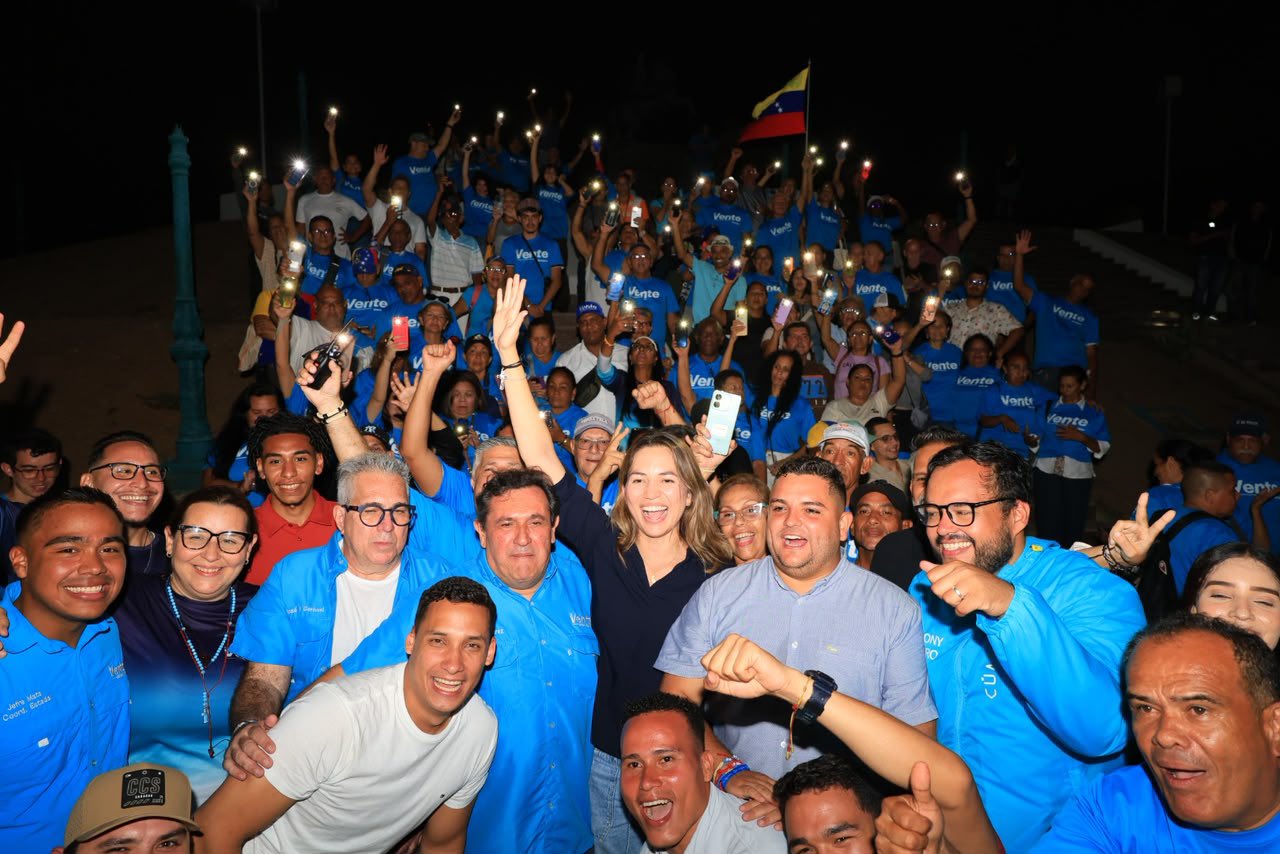
Vente Venezuela members embraced Claudia Macero on Sunday night. Photo by Vente Joven.
Since the aftermath of the June earthquakes, the media had spread stories about Maria Corina Machado trying to come back to Venezuela and local officials in the US and neighboring countries frustrating her plans. The most recent case exploded in simultaneity with the triumphal trip of Delcy Rodriguez to the United Nations, that included a meeting and a picture with Donald Trump. Now we know, from journalists like Idania Chirinos and David Alandete, that Machado has tried seven times in total to come back. Vente Venezuela is using the public reaction to those news to organize rallies in many cities and made a big party of the return of Claudia Macero, Machado’s communications chief, who was one of Vente’s refugees in the Argentinean Embassy. They are clearly turning the apparent join effort of Delcy and Trump to keep Machado out into an Odyssey when Machado is the hero looking for the friends to complete the voyage while the Neptune of Mar-a-Lago and the Suitors of Miraflores block the beaches of Ithaca.
Once Machado finally overcomes those obstacles, as she would eventually do, she would have to leave her story behind and focus on the stories of the population. She needs to face the alliance dilemma, use her popularity and manage the expectations trap.
Machado needs to build alliances. Her Vente Venezuela party is disciplined and attractive to many activists and voters, but they can’t do this alone. The problem is that Machado is reluctant to forge alliances with other politicians, and her followers don’t want to see her with them.
Her dilemma here is that she needs to widen her influence by building a broader platform without alienating her followers.
She has a known history of trouble dealing with politicians from other parties. Machado is a product of what Venezuelans got used to call “civil society” in the 1990s: neighbors and parents associations, business chambers, groups organized mostly in the middle class to protect and improve conditions for specific realms like suburbs, private schools and businesses, and to organize and fund charity NGOs or networks like Dividendo Voluntario para la Comunidad. All of them tended to have a common drive for initiative, besides ethics: we need to do what politicians aren’t doing. Súmate, the platform for electoral rights where Machado emerged before the recall referendum against Chávez, was a civil society organization and was key to collecting the millions of signatures that opposition parties were not collecting, not only because of Súmate’s organizational skills but because people trusted them more than the parties. Machado later became a lawmaker but as an independent, and created her own party instead of joining another.
Her dilemma here is that she needs to widen her influence by building a pressure platform with other parties, including the people currently sitting at the small opposition fraction in the National Assembly and the dialogue experiment behind Dinorah Figuera, but at the same time she needs to do so without alienating her followers, who can turn hope into frustration if they start to see her as another regular politician who will betray them.
The voice of the people
Machado has something anyone else in Venezuela has: real, solid popularity. Besides Edmundo Gonzalez Urrutia —whose prestige among voters is pretty much an extension of Machado’s—, María Corina holds a 50% approval rate that has endured the three years passed since the opposition primaries she famously won with more than 90% of the vote, the two years after the fraudulent 2024 vote and the ten months with Delcy.
Machado’s political career rocketed in 2023 and 2024 when she connected with the collective trauma of families broken by mass migration and embodied the nation’s grief, especially in countryside villages ravaged by economic collapse and population loss.
The people’s expectation is that a new election will turn María Corina into president and remove chavismo from power, creating the space for the country’s reconstruction.
In 2026, she has the opportunity to achieve that political miracle again, with the domestic following she already has and the global fame the Nobel Prize gave her, to make everyone hear the voice of the nation that is being ignored by the interim chavista regime and the Trump administration. The voice of those people who saw Maduro and Cilia removed but the rest of the dictatorship staying, who waited in vain for the authorities to help save lives and recover bodies after the earthquakes, and who see American officials and CEOs signing deals without any improvement in the ordinary citizen’s daily struggle to survive.
Machado is echoing the people’s call for an election. The citizens seem to have taken as a fait accompli that the 2024 elections were stolen, but they took that event as proof that, if elections are repeated, Maria Corina will win. So elections now! is spreading as the common claim that encapsulates the urgency to have a legitimate government elected by the people instead of Delcy’s. The expectation is that a new election will turn María Corina into president and remove chavismo from power, creating the space for the country’s reconstruction. Because while chavismo is still there, there is no hope that things will improve. On that, people are quite convinced.
The challenge of patience management
Machado needs to keep hopes alive, no doubt. Many people are looking at her as the only source of hope available. However, she also needs to sustain that hope with achievements. It won’t suffice to keep telling people that freedom is inevitable and unstoppable. People know it isn’t.
She needs, with Vente and their allies, to build up expectations toward a horizon of possibilities; this is why Machado will focus on pressuring for an election date, which they are suggesting should be July 24, 2027, Simón Bolívar’s birthday.
Machado knows, on the other hand, that she can’t afford to make the same mistake that Juan Guaidó and many other opposition leaders of the past made: promising that paradise is around the corner. Actually, she has been walking that tightrope for a while. Finding the equilibrium between giving hope and adjusting the people’s expectations into a moderate frame will be very hard, especially in an unprecedented context when it is impossible to predict how the next year will be.
An enormous pressure on a person who holds no office and is not even a candidate yet.