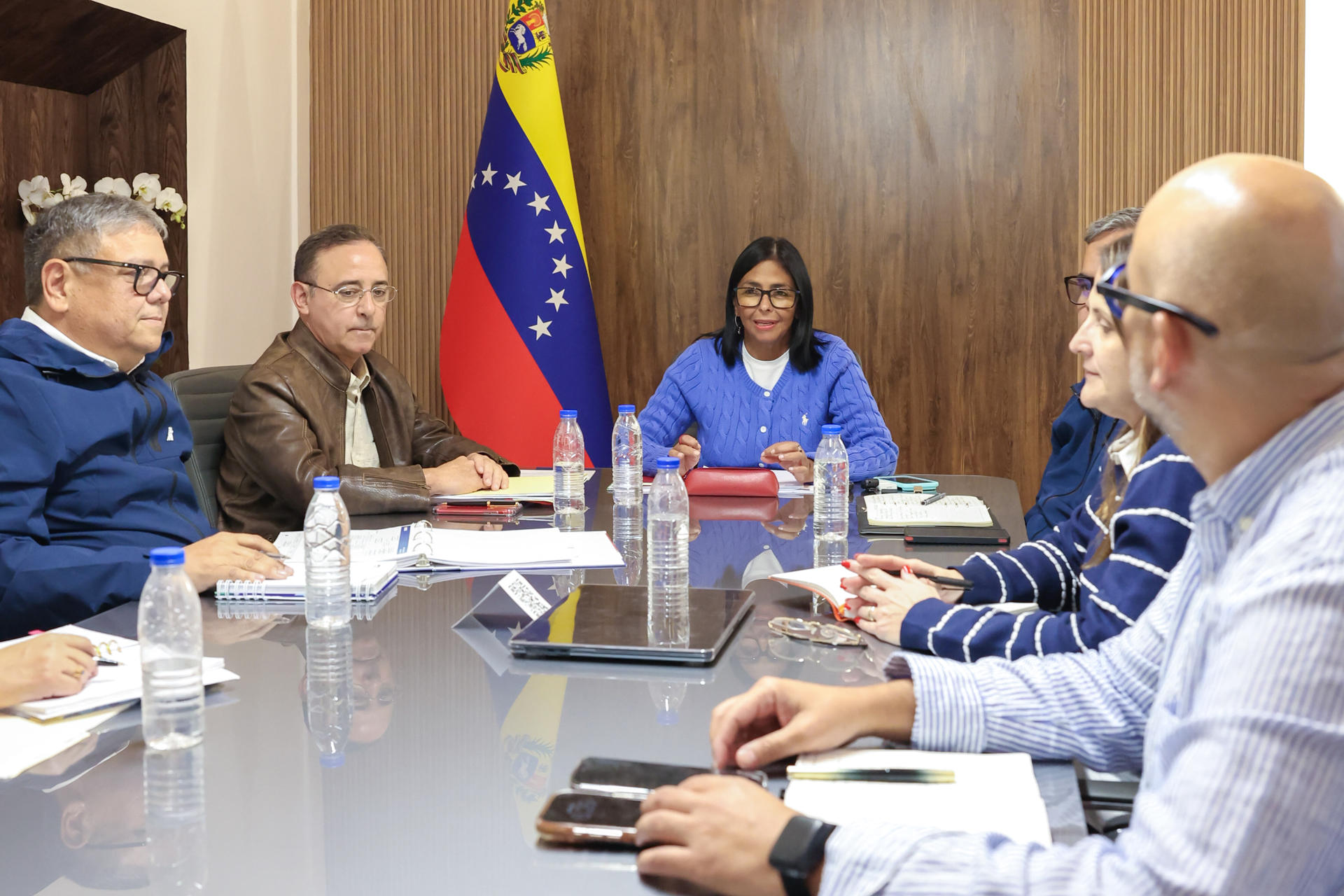
The Venezuelan acting president called for a rational use of electricity in the coming weeks. (EFE)
Mérida, March 23, 2026 (venezuelanalysis.com) – The Venezuelan government announced a 45-day electricity saving plan as extreme temperatures and regional outages impact Venezuela’s power grid.
The announcement, made by Acting President Delcy Rodríguez on Saturday, comes on the heels of recurring blackouts, particularly in western states.
“We are entering a period where solar radiation will impact our territory directly, intensifying heat and drought across the country,” Rodríguez stated during a televised cabinet meeting with officials responsible for the electricity and infrastructure portfolios.
She explained that the “perpendicular passage” of solar rays would significantly increase energy demand for cooling. Alongside drought forecasts, officials expect a greater strain on Venezuela’s electricity generation and transmission infrastructure.
As part of the contingency plan, the Ministry of Electric Energy is set to publish a protocol urging reduced air-conditioning use other rationing measures. In addition, the government has authorized the deployment of thermal drones to monitor high-temperature areas and prevent forest fires from compromising transmission lines.
In March 2025, the Nicolás Maduro administration implemented a similar electricity-savings plan and was compelled to reduce public sector work hours to half a day to ease demand. While the 2025 measures were temporary, the recurrence of shortages underscores the systemic vulnerabilities of the electric grid.
Last Friday, residents in Zulia, Táchira, Mérida, and Trujillo experienced widespread power outages lasting several hours. Local media outlets in the Andean region reported that some sectors are facing daily rationing of up to four hours. Nationwide electricity fluctuations were likewise registered on Monday, with parts of Caracas suffering temporary outages.
The origins of Venezuela’s electrical instability extend over a decade, culminating in the 2019 widespread nationwide blackouts that authorities blamed on “cyber-sabotage.” The alleged attacks compounded infrastructure hard-hit by years of economic sanctions, as well as underinvestment, inadequate maintenance, and the departure of skilled personnel.
Venezuela’s electric grid remains heavily dependent on the Simón Bolívar Hydroelectric Plant, also known as the Guri Dam, in southeastern Bolívar state, which provides approximately 80 percent of the nation’s power.
However, the transmission lines stretching from the southeast to the western border are often unable to handle the load, with thermoelectric plants in the region unable to cover the additional demand. Current estimates indicate that while Venezuela has an installed generation capacity of approximately 34 gigawatts (GW), only around 12 to 14 GW are currently operational.
Sanctions and push for private investment
In her Saturday address, Rodríguez reiterated the damage caused by US-led unilateral coercive measures and called for their removal. The Venezuelan acting president argued that sanctions hampered the state’s capacity to procure essential technology and components from international suppliers.
“The blockade has impeded the full recovery of this essential service,” Rodríguez said. “Though we have recovered capacity through our own efforts, sanctions limit our response to a demand that grows alongside the economy.”
The Venezuelan government has also announced plans to scale back state control over the electricity sector in order to attract private investment. Earlier this month, authorities unveiled a “pilot plan” to promote foreign investment into the electric grid, following similar blueprints from the oil industry.
Under the proposed framework, the government aims to update the Organic Law of the Electricity System (LOSSE) to allow private companies to assume control of generation and distribution through joint ventures.
According to the Venezuelan Chamber of Construction (CVC), a preliminary investment of US $1.29 billion could lead to the reincorporation of over 6,300 MW to the grid in two phases. The CVC is specifically promoting a project with the Latin America Development Bank to stabilize 2,000 MW in the central industrial region.
The new electricity management model would allow private actors to take control of specific “industrial nodes,” ensuring a reliable supply for manufacturing while retaining a portion of the proceeds to cover maintenance costs.
However, the immediate focus for the Venezuelan executive remains on electricity rationing. Rodríguez concluded her address by calling for “national consciousness,” urging the public to see energy saving not just as a government mandate, but as a collective necessity to navigate the coming weeks of extreme heat and drought.
Edited by Ricardo Vaz in Caracas.