Windy conditions are not unusual to the festival, which attracts roughly 125,000 attendees to the Empire Polo Club each of its weekends, but it’s rare to see the weather cause performances to be canceled.
“Due to strong wind conditions affecting Anyma’s stage build, he is unable to perform. Coachella & Anyma have made this decision together with your safety as the priority,” the fest wrote in a message on its app just after midnight on Saturday morning.
On Friday night, there were social media reports that showed that the Do Lab — a stage on the southern side of the festival grounds, which includes shade structures with colorful bolts of fabric — was closed for the night with yellow caution tape around the area and that a speaker may have fallen to the ground.
Festival promoter Goldenvoice and the organizers of the Do Lab stage did not provide comment at the time of publication.
The wind wreaked havoc in the campsite as well, blowing tents and canopies over.
“It was definitely pretty impactful last night. The wind reports in the area saw gusts up to 35 to 40 mph yesterday during late afternoon,” said Isaac Longley, a meteorologist with AccuWeather. “Unfortunately, that was when there were a lot of performers on the main stages, and a pretty impactful situation with the tents at Coachella.”
According to the online forecast for the weekend from the National Oceanic and Atmospheric Administration, temperatures in Indio were expected to reach 86 degrees on Saturday with 5- to 10-mph winds in the afternoon and a low of 56 degrees with the winds increasing to 15 to 20 mph and changing direction after midnight. Gusts were expected to be up to 30 mph later into the evening.
“As we head into Saturday afternoon and evening, we expect pretty similar conditions to [Friday] and for winds to pick up,” Longley said. “I would definitely consider staking my tent down.”
Sunday’s forecast was cooler, with a high of 79 and winds of 10 to 20 mph in the day. The expected low is 53 with winds expected at 15 mph with gusts of up to 30 mph.
There’s also an air quality alert for the windblown dust through 5 a.m. Sunday.
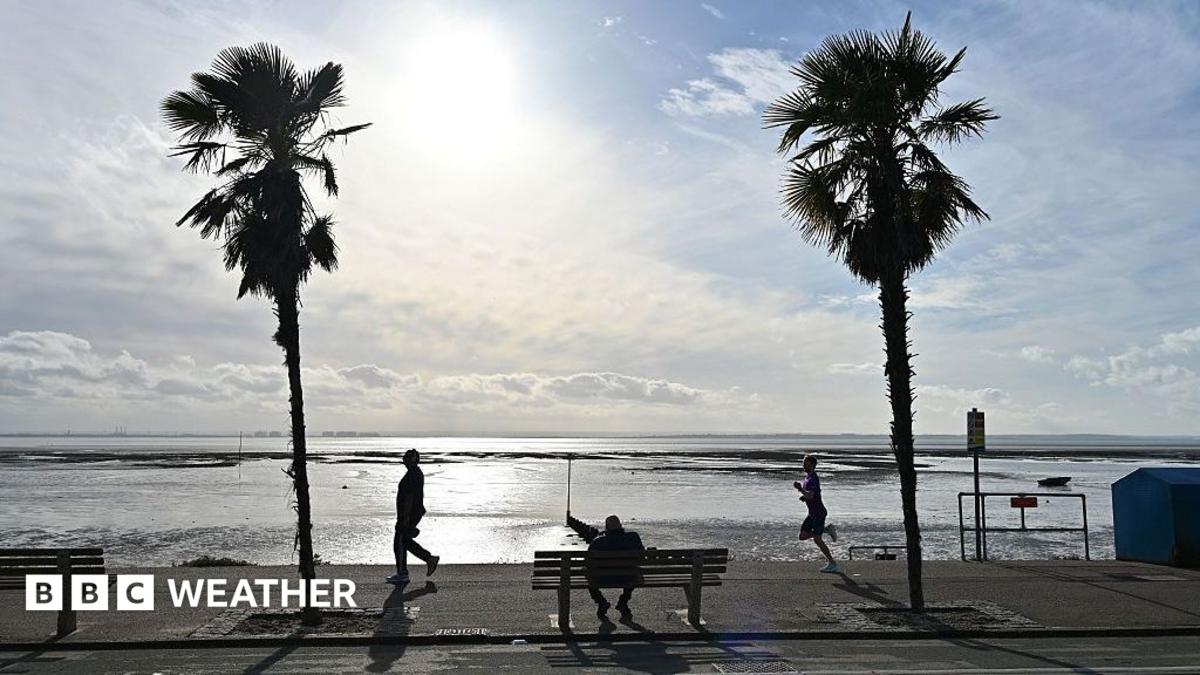
Before today, all four nations of the UK had recorded their highest temperature of the year so far on Tuesday after very warm air was dragged in from continental Europe.
The addition of the foehn effect – a warming wind on the leeside of a mountain – meant that north-west Wales saw the highest temperatures.
Wales – 24.8C (76.7F) – Mona, Isle of Anglesey
England – 22.5C (72.5F) – Merryfield, Somerset
Scotland – 22.5C (72.5F) – Kinloss, Moray
Northern Ireland – 19.0C (66.2F) – Armagh, County Armagh
The focus of the highest temperatures on Wednesday will be the Midlands, East Anglia and south-east England, possibly reaching 26C (79F) in some localised spots.
This is around 10C above average for early April.
The last time before this week that 25C or more was recorded in the UK was 19 September 2025, when temperatures peaked at 27.8C at St James’s Park, London.
Around this time in April in 2017 and 2020 25C (77F) was recorded, but last year that temperature was not reached until the last day of the month.
The highest temperature ever recorded in the UK in April was 29.4C (84.9F) measured in London in 1949.
Scotland and Northern Ireland will not be as warm. The cloud will break to give some sunshine and temperatures could still reach as high as 18C (64F) in eastern Scotland.
Brisk south-easterly winds developing on Tuesday and Wednesday will drag in much warmer air from the European continent.
Temperatures will be around 6 to 10C above average for early April.
On Tuesday temperatures will rise to the high teens and low twenties in most parts.
Across the south Midlands and the west coast of Wales it is likely to reach 22C, making it the warmest day of the year so far.
The previous highest temperature this year was 20.9C, recorded on 31 March at Pershore, Worcestershire.
Tuesday will be a mostly sunny day, especially across England and Wales but cloud will build in Northern Ireland and western Scotland with a few showers.
By Wednesday temperatures will rise even further to 23C, perhaps even 24C in south-east England.
With sunshine continuing, temperatures across England and Wales will still be into the low twenties, so it will feel more like a typical summer’s day for most of us.
However, conditions will turn a little cooler in western Scotland, Northern Ireland and Irish Sea coasts with more cloud and rain moving in later in the afternoon.
A container pier in South Korea’s southeastern port city of Busan, South Korea. The Organization for Economic Cooperation and Development cut South Korea’s 2026 growth forecast to 1.7% from 2.1%, citing the economic fallout from rising energy prices and supply disruptions linked to the conflict in the Middle East. File. Photo by YONHAP / EPA
March 26 (Asia Today) — The Organization for Economic Cooperation and Development cut South Korea’s 2026 growth forecast to 1.7% from 2.1%, citing the economic fallout from rising energy prices and supply disruptions linked to the conflict in the Middle East.
The OECD released the revised outlook Thursday in its interim economic report, which said the conflict has disrupted shipments through the Strait of Hormuz, pushed up energy costs and added uncertainty to global demand.
South Korea’s downgrade of 0.4 percentage points was one of the largest among Group of 20 economies, according to the report. The OECD kept its 2027 growth forecast for South Korea unchanged at 2.1%.
The OECD also raised its forecast for South Korea’s inflation this year to 2.7%, up 0.9 percentage points from its previous projection. It said inflation is expected to ease to 2.0% next year as energy price pressures fade.
The report said countries that depend heavily on imported energy are especially vulnerable if the Middle East conflict drags on, as higher fuel costs can weigh on output and feed broader price pressures.
Despite the downgrade, the OECD said South Korea’s medium-term outlook remains relatively stable, with growth expected to recover next year if current energy disruptions prove temporary. The organization said its projections assume energy prices begin easing in mid-2026.
South Korea’s Ministry of Economy and Finance said it would maintain emergency readiness, warning that the economic impact could widen if the Middle East war continues longer than expected.
Imagine waking up early, eager to peep dazzling carpets of brilliant orange flowers at the Antelope Valley California Poppy Reserve. Instagram posts promised a spectacle.
You drive to the reserve north of Los Angeles, but the rolling hills aren’t alive with color.
Bummer. The bloom is over.
Thanks to AI, and a local scientist, such disappointment may soon be a thing of the past.
This year, Steve Klosterman, a biologist who works on natural climate solutions, launched a “wildflower forecast,” powered by a deep-learning model, satellite imagery and weather data.
In a sense, Klosterman, of Santa Monica, developed the tool to meet his own need.
Last spring, the Midwest transplant was hankering to see some wildflowers. He assumed there was some online resource that offered predictions or leveraged satellite images.
“Surely, there must be something,” he recalled thinking. “But there was nothing.”
There are tools. The state reserve operates a live cam trained on one swath of land. Theodore Payne, a California native plant nursery and education center, runs a wildflower hotline, where people can call in and hear weekly recorded reports on hot spots.
“These are all essential resources,” Klosterman said. “At the same time, they’re limited.”
Klosterman isn’t green when it comes to plants. His PhD, at Harvard, focused on the timing of new leaves on trees in the spring and color change in the fall.
For a class project, a team he was part of built a website that predicted those leaf changes in the Boston area. It was a hit.
California poppies bloom in Lancaster, near the state natural reserve, in mid-March.
(Kayla Bartkowski / Los Angeles Times)
To create the poppy bloom predictor, Klosterman turned to AI initially developed for medical imaging. He has harnessed it to instead analyze satellite images of the Antelope Valley.
The model scans 10-by-10-meter squares of land to determine whether poppies are present by their telltale orange color. (It also identifies tiny yellow flowers called goldfields.)
The model is trained on satellite images — which go back nine years — along with past weather data.
It then uses the current forecast, and recent flower status, to peer into the future.
If the mercury is going to hit 100 degrees and wind is picking up — and in previous years that led to withering flowers — that will guide the prediction.
Right now, the model can forecast five days out and is, as Klosterman puts it, “very much a work in progress.” It would be better, more powerful, if it had 100 years to learn from.
As more data are collected, it might someday be able to forecast a week or two out.
Right now, poppies are popping at the reserve in the western Mojave Desert.
It rained throughout the fall and into winter, and poppies need at least seven inches of rain to make a good showing, said Lori Wear, an interpreter at the reserve.
Snowfall in January seems to push them to another level, but that didn’t happen this season. So it’s a good bloom, but not extraordinary, she said.
Still, poppies — California’s state flower — blanket swaths of the protected land.
“It almost looks like Cheeto dust,” she said, “like somebody had Cheetos on their fingers and just smeared it on the landscape.”
Poppies here have typically peaked around mid-April, but variable weather in recent years has made it hard to predict, she said. Klosterman believes right now is likely the zenith.
Also blooming now: goldfields, purple grape soda lupine and owl’s clover. Wear described the latter, also purple, as looking like a “short owl with little eyes looking at you and a little beak.”
An SUV drives through blooms near the reserve. “It almost looks like … somebody had Cheetos on their fingers and just smeared it on the landscape,” said Lori Wear, an interpreter at the reserve.
(Kayla Bartkowski / Los Angeles Times)
On Sunday, Klosterman experienced the blooms for himself, using his technology as a guide.
It offers predictions in two forms. The first is the amount of the valley — shown in a satellite image — covered in poppies and goldfields, expressed as a percentage. The other is an overlay of orange and yellow splotches on the land.
The map showed a fairly high concentration of poppies near a stretch of Highway 138. He went there and, lo and behold, vibrant flowers awaited him. He sent proof: a smiling selfie in front of a sea of blossoms.
Klosterman’s tool may help answer arguably more complex questions than poppy or no poppy, such as a more precise understanding of the conditions the flowers need to thrive.
Experts know rain is key, but it’s more complicated than that.
Steve Klosterman takes a selfie in a field of California poppies.
(Steve Klosterman)
Heavy rain can supercharge invasive grasses, crowding out the blooms. Natives actually tend to do better after several years of drought, once invasives not adapted to the arid climate die out. That’s what led to an epic superbloom in 2017, Joan Dudney, an assistant professor of forest ecology at UC Santa Barbara, told The Times in 2024.
Klosterman wondered if the recent heatwave would desiccate them. But his model didn’t show that, and neither did his trip. So it’s possible other factors play a significant role in their persistence, such as length of day.
The model could also shed light on what could happen to the flowers as the climate warms. Will they migrate to the north? Will there be fewer blooms?
To game that out, Klosterman said you could invent and plug in a weather forecast with higher temperatures.
For now, Klosterman’s forecast is limited to the Antelope Valley. But if it expands to other areas, and other flower types, it could help people like Karina Silva.
Silva woke up at 5 a.m. last Wednesday to travel from her Las Vegas home to Death Valley National Park, hoping to beat the heat and the crowds to the superbloom.
But several hours later, she and her husband, David, were still trying to find it.
The hillside behind her was sprinkled with desert golds, but the display fell short of the riotous eruption of flowers posted on social media. The superbloom ended in early March, according to park officials.
“I was just thinking it was going to be this explosion of different colors,” Silva said by the side of the road overlooking Badwater Basin.
The Venezuelan acting president called for a rational use of electricity in the coming weeks. (EFE)
Mérida, March 23, 2026 (venezuelanalysis.com) – The Venezuelan government announced a 45-day electricity saving plan as extreme temperatures and regional outages impact Venezuela’s power grid.
The announcement, made by Acting President Delcy Rodríguez on Saturday, comes on the heels of recurring blackouts, particularly in western states.
“We are entering a period where solar radiation will impact our territory directly, intensifying heat and drought across the country,” Rodríguez stated during a televised cabinet meeting with officials responsible for the electricity and infrastructure portfolios.
She explained that the “perpendicular passage” of solar rays would significantly increase energy demand for cooling. Alongside drought forecasts, officials expect a greater strain on Venezuela’s electricity generation and transmission infrastructure.
As part of the contingency plan, the Ministry of Electric Energy is set to publish a protocol urging reduced air-conditioning use other rationing measures. In addition, the government has authorized the deployment of thermal drones to monitor high-temperature areas and prevent forest fires from compromising transmission lines.
In March 2025, the Nicolás Maduro administration implemented a similar electricity-savings plan and was compelled to reduce public sector work hours to half a day to ease demand. While the 2025 measures were temporary, the recurrence of shortages underscores the systemic vulnerabilities of the electric grid.
Last Friday, residents in Zulia, Táchira, Mérida, and Trujillo experienced widespread power outages lasting several hours. Local media outlets in the Andean region reported that some sectors are facing daily rationing of up to four hours. Nationwide electricity fluctuations were likewise registered on Monday, with parts of Caracas suffering temporary outages.
The origins of Venezuela’s electrical instability extend over a decade, culminating in the 2019 widespread nationwide blackouts that authorities blamed on “cyber-sabotage.” The alleged attacks compounded infrastructure hard-hit by years of economic sanctions, as well as underinvestment, inadequate maintenance, and the departure of skilled personnel.
Venezuela’s electric grid remains heavily dependent on the Simón Bolívar Hydroelectric Plant, also known as the Guri Dam, in southeastern Bolívar state, which provides approximately 80 percent of the nation’s power.
However, the transmission lines stretching from the southeast to the western border are often unable to handle the load, with thermoelectric plants in the region unable to cover the additional demand. Current estimates indicate that while Venezuela has an installed generation capacity of approximately 34 gigawatts (GW), only around 12 to 14 GW are currently operational.
Sanctions and push for private investment
In her Saturday address, Rodríguez reiterated the damage caused by US-led unilateral coercive measures and called for their removal. The Venezuelan acting president argued that sanctions hampered the state’s capacity to procure essential technology and components from international suppliers.
“The blockade has impeded the full recovery of this essential service,” Rodríguez said. “Though we have recovered capacity through our own efforts, sanctions limit our response to a demand that grows alongside the economy.”
The Venezuelan government has also announced plans to scale back state control over the electricity sector in order to attract private investment. Earlier this month, authorities unveiled a “pilot plan” to promote foreign investment into the electric grid, following similar blueprints from the oil industry.
Under the proposed framework, the government aims to update the Organic Law of the Electricity System (LOSSE) to allow private companies to assume control of generation and distribution through joint ventures.
According to the Venezuelan Chamber of Construction (CVC), a preliminary investment of US $1.29 billion could lead to the reincorporation of over 6,300 MW to the grid in two phases. The CVC is specifically promoting a project with the Latin America Development Bank to stabilize 2,000 MW in the central industrial region.
The new electricity management model would allow private actors to take control of specific “industrial nodes,” ensuring a reliable supply for manufacturing while retaining a portion of the proceeds to cover maintenance costs.
However, the immediate focus for the Venezuelan executive remains on electricity rationing. Rodríguez concluded her address by calling for “national consciousness,” urging the public to see energy saving not just as a government mandate, but as a collective necessity to navigate the coming weeks of extreme heat and drought.