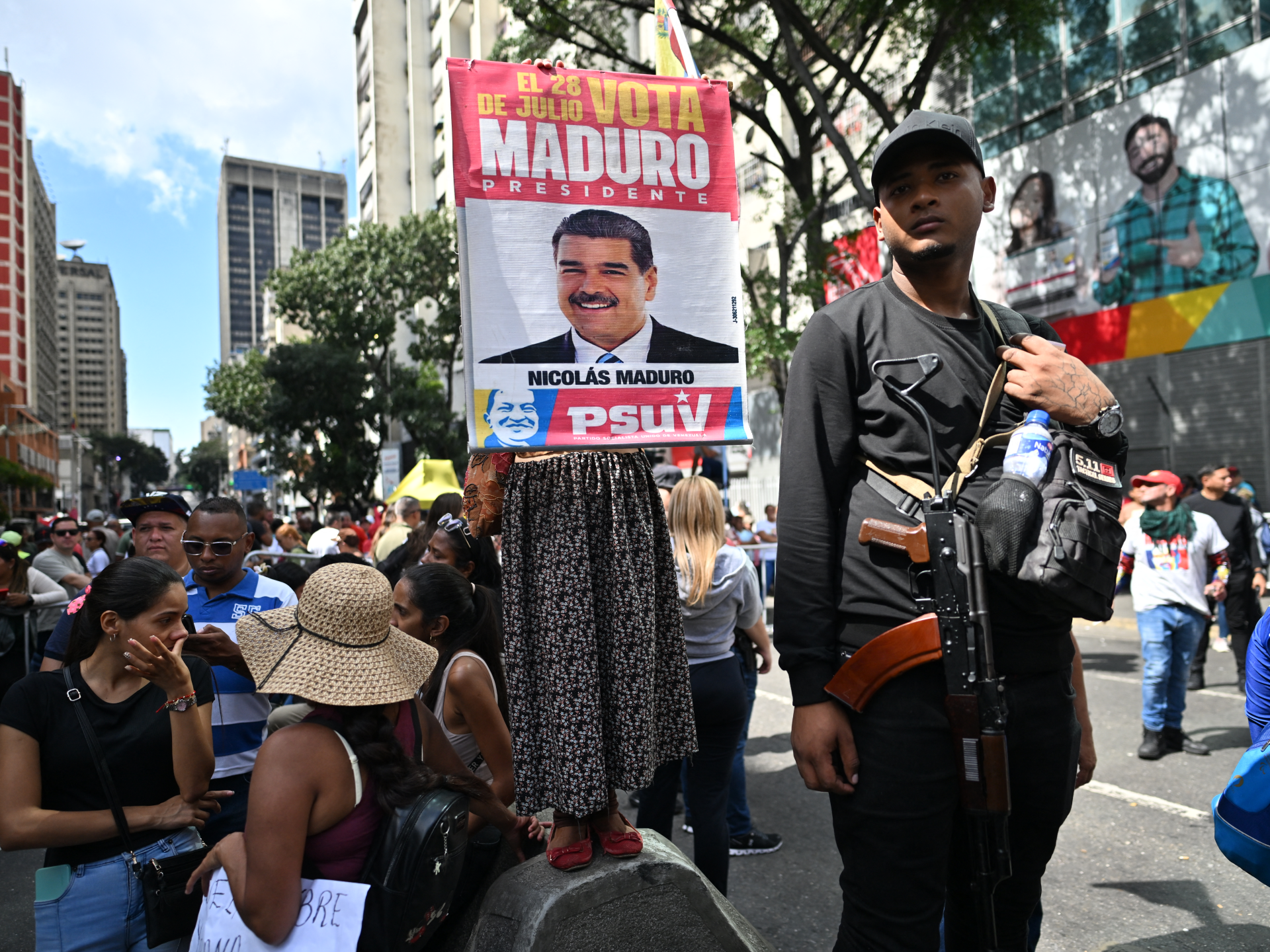
Venezuela’s Defence Minister Vladimir Padrino Lopez has denounced the United States’ move to abduct leader Nicolas Maduro as a “cowardly kidnapping”, adding that some of the president’s bodyguards were killed “in cold blood”, as well as military personnel and civilians on the Venezuelan side.
In his televised statement on Sunday, Padrino Lopez also endorsed a Supreme Court ruling that appointed Vice President Delcy Rodriguez — who also serves as oil minister — as acting president for 90 days.
Recommended Stories
list of 3 itemsend of list
US President Donald Trump threatened that Rodriguez will pay a “very big price” if she doesn’t cooperate with Washington. “If she doesn’t do what’s right, she is going to pay a very big price, probably bigger than Maduro,” Trump told The Atlantic in a telephone interview.
US forces attacked Caracas in the early hours of Saturday, bombing military targets and spiriting away Maduro and his wife to face federal narco-trafficking charges in New York. The Venezuelan president was escorted off a plane at Stewart Air National Guard Base in New York state and taken to a Brooklyn jail.
He is due to make his first appearance on Monday in Manhattan’s federal court.
US to use oil blockade to leverage change in Venezuela
US Secretary of State Marco Rubio on Sunday suggested that Washington would not take a day-to-day role in governing Venezuela other than enforcing an existing “oil quarantine”, using that leverage to press policy changes in the country.
Rubio’s statements seemed designed to temper concerns, a day after Trump announced the US would “run” the oil-rich nation. The Trump administration’s actions drew unease from parts of his own Republican Party coalition, including an “America First” base that is opposed to foreign interventions, as well as from observers who recalled past nation-building efforts in Iraq and Afghanistan.
Rubio dismissed such criticism, saying that Trump’s intent had been misunderstood by a “foreign policy establishment” that was fixated on the Middle East.
Al Jazeera’s Phil Lavelle, reporting from Doral, Florida in the US, said Trump had been elected on an “America First” policy centred around no engagement in foreign wars or sending US service personnel into danger.
“Now we’ve got this situation where he said, less than 24 hours ago, ‘We’re not afraid of putting boots on the ground,’” Lavelle said.
Protests took place in cities across the US against Trump’s military action in Venezuela. Hundreds gathered in the rain in downtown Los Angeles, carrying signs saying “Stop bombing Venezuela now!” and “No blood for oil”.
“I stand against US imperialism altogether. They want oil … They want to help the corporate billionaires. Bombing is just their means to building power like that, of taking control. So again, I’m against it,” said one protester named Niven.
Trump on Saturday delivered a speech in which he made little mention of the so-called “war on drugs” – which for months had been his main justification for bombing Venezuelan ship and assets – but argued that Venezuela had “stolen” oil from the US and that it would now be taken back.
The United Nations special rapporteur on human rights and counterterrorism, Ben Saul, said the US actions in Venezuela were illegal, calling on Trump to be investigated and impeached. “Every Venezuelan life lost is a violation of the right to life. President Trump should be impeached and investigated for the alleged killings,” he said in a social media post.
The UN Security Council (UNSC) was set to meet on Monday to discuss the situation in Venezuela. UN Secretary-General Antonio Guterres said he was “deeply alarmed” by the US strikes, which a spokesperson said could “constitute a dangerous precedent”.
Uncertainty in Venezuela after Maduro’s abduction
Some Venezuelans in Caracas have welcomed the US’s seizure of Maduro, but others said the action could worsen conflict in the country, with protests denouncing the US taking place.
“There should be a positive change for all Venezuelans, because it has been 28 years of government, and now is the time for transition in this country,” said Ronald Gaulee, a motorcycle rider in Caracas.
Merchant Juan Carlos Rincon was more cautious. “The truth is that there is a lot of manipulation behind all this,” he told the Reuters news agency. “We want to be at peace, move forward, and for Venezuela to have, like any other country, the right to choose its own destiny and its own leaders.”
Baker Franklin Jimenez said he would heed the government’s call to defend the country. “If they took him away, I think they shouldn’t have done so, because this will create an even worse conflict than the one we have now,” he said. “And as for the bombings and all that, we have to go out, we all have to go out into the streets to defend our homeland, to defend ourselves.”
Some Venezuelans decided to flee the country amid the uncertainty, crossing the Venezuela-Colombia border to reach the Colombian town of Cucuta. Karina Rey described a “tense situation” in the Venezuelan city of San Cristobal, just across the border.
“There are long lines, and people are very paranoid, or on edge, over food. Supermarkets are closing,” Rey told Al Jazeera. “The lines are very long just to stock up on food, because we don’t know what will happen in the coming weeks. We’re waiting to see what happens.”
Al Jazeera’s Alessandro Rampietti, reporting from Cucuta, said many Venezuelans there initially felt jubilant after Maduro was ousted. “But that quickly shifted to uncertainty,” he said.
“Several people said they expected the United States to immediately bring opposition leader Maria Corina Machado back into the country, along with Edmundo Gonzalez Urrutia, who many Venezuelans believe won the last presidential election,” Rampietti continued.
“Instead, with much of the existing leadership still in place and with Vice President Delcy Rodriguez appointed as interim leader, there is growing fear about what could happen next.”
Tiziano Breda, a senior analyst at the Armed Conflict Location and Event Data Project, said what happens next hinges on the response of Venezuela’s government and armed forces.
“So far, they’ve avoided direct confrontation with US forces, but deployments on the streets point to efforts to contain unrest,” he said. “A smooth transition remains unlikely, and the risk of resistance from pro-regime armed groups – including elements within the military and Colombian rebel networks active in the country – remains high.”