A Nashville judge ordered Tennessee officials to preserve evidence from Christa Pike’s failed execution, including drugs, syringes, medical equipment and recordings. Pike’s lawyers say the two failed lethal-injection attempts amounted to unconstitutional cruel punishment.
The NFL Referees Assn. says the suspensions handed out by the league to two game officials this week went too far and that it will attempt to get them reduced.
On Monday, the NFL issued a two-game suspension for line judge Jeff Seeman and a one-game suspension for referee Adrian Hill for separate instances of “unprofessional conduct toward a player” during games they were working the previous day.
The NFLRA said in a news release Tuesday that it “believes the suspensions imposed by the NFL on two officials following incidents this past weekend were excessive and inconsistent with past precedent.”
“Given these concerns, the NFLRA will challenge the severity of those suspensions and meet with the NFL Officiating Department to discuss the League’s disciplinary standards,” the NFLRA said. “The association also plans to meet with NFL Players Association leadership to address on-field conduct and the growing levels of confrontation between players and officials.”
Late in the Arizona Cardinals’ 36-24 loss to the New York Giants, Cardinals tight end Trey McBride argued a non-call with Seeman. A video of part of the interaction between McBride and Seeman, posted on X by ESPN’s Adam Schefter, appears to show the line judge shouting profane language at McBride.
“This kind of behavior from an official towards a player is unacceptable,” NFL Players Assn. executive director JC Tretter wrote with a repost of the footage. “Players are consistently held accountable when the roles are reversed. We expect the NFL to hold officials to the same standard.”
Early in the Minnesota Vikings’ 15-10 victory over the Miami Dolphins, Vikings linebacker Eric Wilson appeared to be shoved into Hill, who was knocked to the ground. When Wilson attempted to help Hill to his feet, the official jumped up and appeared to yell at the player and point for him to move away.
“I ended up apologizing to him and explained the situation,” Wilson told reporters after the game. “He was cool about it. He understood what was happening. He just said he was trying to get me — he didn’t want us fighting apparently, me and the Dolphins guy. So he was just trying to break us up.”
NFLRA executive director Scott Green acknowledged that both officials “fell short” in conducting themselves professionally on the field, but he also suggested that players often do the same.
“Officials are routinely subjected to highly charged interactions and, at times, verbal abuse from players and coaches,” Green said in the association’s news release. “While that never excuses misconduct by an official, it shouldn’t be dismissed as simply part of the game. The League expects the highest level of professionalism from its officials, and it should demand the same from everyone on the field.
“We will defend the principle that discipline must be fair, consistent and proportionate,” Green continued. “Holding officials accountable while ignoring or minimizing the conduct directed at them is neither fair nor an effective way to address this issue. We look forward to working with the League and NFLPA toward that shared goal.”
The United States Department of Justice has filed 40 new cases seeking to strip naturalised Americans of their citizenship over alleged crimes they have committed.
In a statement on Monday, federal prosecutors said they were targeting individuals accused of “serious offenses”, including money laundering, child sexual abuse, visa fraud and tax evasion.
Recommended Stories
list of 3 itemsend of list
The statement touted the 40 cases as the largest volume of denaturalisation petitions submitted in such a short period under President Donald Trump. The petitions were filed from late August through early October.
“Today’s announcement marks the largest denaturalization effort in modern history,” said Attorney General Todd Blanche.
“Under President Trump’s leadership, the Department of Justice will continue to employ the denaturalization process to maintain our national security and protect the American people.”
The 40 citizens targeted in Monday’s announcement include people from a range of countries, including Mexico, Pakistan, China and Sierra Leone.
They are accused of concealing criminal acts and other facts about themselves as they sought to obtain citizenship. Their criminal convictions largely came after they took their oaths of citizenship.
Two people on the list are also accused of engaging in espionage on behalf of China. Committing these crimes before they became citizens, the Department of Justice alleges, meant these individuals lacked “good moral character” and should have been denied citizenship.
Expanded use of denaturalisation law
The laws to denaturalise US citizens have been used for decades, but historically, they have been reserved for serious crimes.
After World War II, for instance, the US government moved to denaturalise dozens of citizens accused of concealing involvement in the Holocaust or engaging in war crimes.
Notable cases include that of Emma Goldman, a Lithuanian-born anarchist and women’s rights activist who was jailed in 1917 for her antiwar activities, before being denaturalised and deported to the Soviet Union.
But the practice has become much less frequent since the end of the Cold War.
Top officials in the Trump administration, however, have sought to expand denaturalisation as part of a push to conduct the largest deportation operation in US history.
Under US law, prosecutors can ask courts to strip citizenship from those born outside the country if they wilfully concealed a “material fact” during their citizenship application that would have otherwise disqualified them.
But Trump’s efforts to widen denaturalisation proceedings have received pushback from human rights groups, which argue they could leave people stateless.
Critics have also warned that Trump has sought to leverage denaturalisation against specific groups he perceives to be political rivals or enemies.
Last year, for instance, the Trump administration indicated it would seek to denaturalise large numbers of Somali Americans after allegations emerged in Minnesota of daycare fraud involving the Somali diaspora.
“Send them back from where they came, Somalia, perhaps the worst, and most corrupt, country on earth,” Trump wrote at the time.
Members of Trump’s Republican Party, notably Representative Andy Ogles, have also floated the possibility of yanking citizenship from New York City Mayor Zohran Mamdani, who was born in Uganda. Trump himself has falsely suggested Mamdani may be in the country illegally.
At one point, Trump even floated the idea of withdrawing citizenship from tech entrepreneur Elon Musk, a close ally and adviser to his second administration, after the two men had a falling-out in 2025.
Trump has also pushed to do away with birthright citizenship, which is granted to virtually all children born in the US. The few exceptions include the babies of diplomats and foreign military forces.
Birthright citizenship is protected under the US Constitution and cannot be taken away the way naturalised citizenship can.
In June, the US Supreme Court struck down Trump’s efforts to dismantle birthright citizenship, but legal battles continue after the president issued a second executive order also seeking to restrict how birthright citizenship is applied.
The NFL has issued suspensions for two officials involved in confrontations with players during Sunday’s games, including one who was caught on camera apparently cursing at Arizona Cardinals tight end Trey McBride.
“The NFL confirmed today that line judge Jeff Seeman has been suspended for two games and referee Adrian Hill has been suspended for one game, each for an instance of unprofessional conduct toward a player in Sunday’s Arizona-New York Giants (Seeman) and Miami-Minnesota games (Hill),” the league said Monday in a statement. “The suspensions were issued by NFL Vice President of Officiating Ramon George.”
Late in the Cardinals’ 36-24 loss to the New York Giants, McBride argued a non-call with Seeman. A video of part of the interaction between McBride and Seeman, posted on X by ESPN’s Adam Schefter, appears to show the line judge shouting, “F— you!” at McBride two times.
NFL Players Assn. executive director JC Tretter posted a clip of the interaction that zoomed in on Seeman as he shouted toward McBride.
“This kind of behavior from an official towards a player is unacceptable,” Tretter wrote. “Players are consistently held accountable when the roles are reversed. We expect the NFL to hold officials to the same standard.”
CBS reporter Aditi Kinkhabwala reposted Tretter’s post and commented that she was “standing right there” during the interaction between McBride and Seeman.
McBride “was heated for sure, but I never heard a curse from him,” Kinkhabwala wrote. “The harshest he got was, ‘You’re ruining the game.’”
The other incident took place early in the Minnesota Vikings’ 15-10 victory over the Miami Dolphins. On a play that was whistled dead because of a neutral zone infraction, Vikings linebacker Eric Wilson appeared to be shoved into Hill, who was knocked to the ground. When Wilson attempted to help Hill to his feet, the official jumped up and appeared to yell at the player and point for him to move away.
“That was funny, honestly,” Wilson told reporters. “I ended up apologizing to him and explained the situation. He was cool about it. He understood what was happening. He just said he was trying to get me — he didn’t want us fighting apparently, me and the Dolphins guy. So he was just trying to break us up.”
The NFLPA said it had no further comment on either incident other than Tretter’s X post. The NFL Referees Assn. did not immediately respond on Monday to multiple requests for comment.
New York Governor Kathy Hochul has said the woman at the centre of the Cornell University rape case was “failed” at “every turn”.
The woman, known as Jane Doe in legal documents, alleges she was drugged and raped by several men at a fraternity house in 2024.
The case was investigated at the time but no charges were laid. It recently reopened after the woman filed a civil lawsuit last month that thrust the allegations into the national spotlight.
At a news conference on Friday, Hochul said she was “deeply disturbed” by how the investigation was handled. She has now appointed New York Attorney General Letitia James to lead the case.
This appointment was made after Hochul said she “lost faith” in the local prosecutor’s ability to oversee the investigation.
Expressing outrage that local prosecutors did not interview the accuser themselves, Hochul on Friday said: “This young woman had already endured something that is utterly unspeakable, and then at every turn she was failed by people and institutions with an obligation to protect her.”
She has also vowed to close a “loophole” that prevents prosecutors from pursuing rape charges in cases when the victim has voluntarily consumed drugs or alcohol. Jane Doe is believed to have voluntarily taken drugs and alcohol on the night of the alleged gang rape.
“If someone is too intoxicated to consent it should not matter if they chose to use drugs or alcohol,” said Hochul, adding: “Voluntary intoxication is not a licence for gang rape.”
James, who is the state’s chief legal officer, appeared alongside Hochul at Friday’s news conference, pledging to “lead a process guided by the facts and the law”.
She said her office would interview witnesses and pursue prosecutions if warranted.
District Attorney Matthew Van Houten, who previously led the investigation, has defended his office’s previous decision not to file charges in the case, arguing they were not given enough evidence to meet the legal threshold.
Van Houten said much of the information released in recent weeks about the case was not passed to his office.
In a statement on Friday, he said he supported James’ investigation, adding: “It has become clear that we were not provided the full picture by the university.”
Cornell has said it provided evidence to the district attorney’s office from its own investigation, including a Snapchat group chat in which fraternity members discussed a “free” sexual encounter with Doe on the night of the alleged assault.
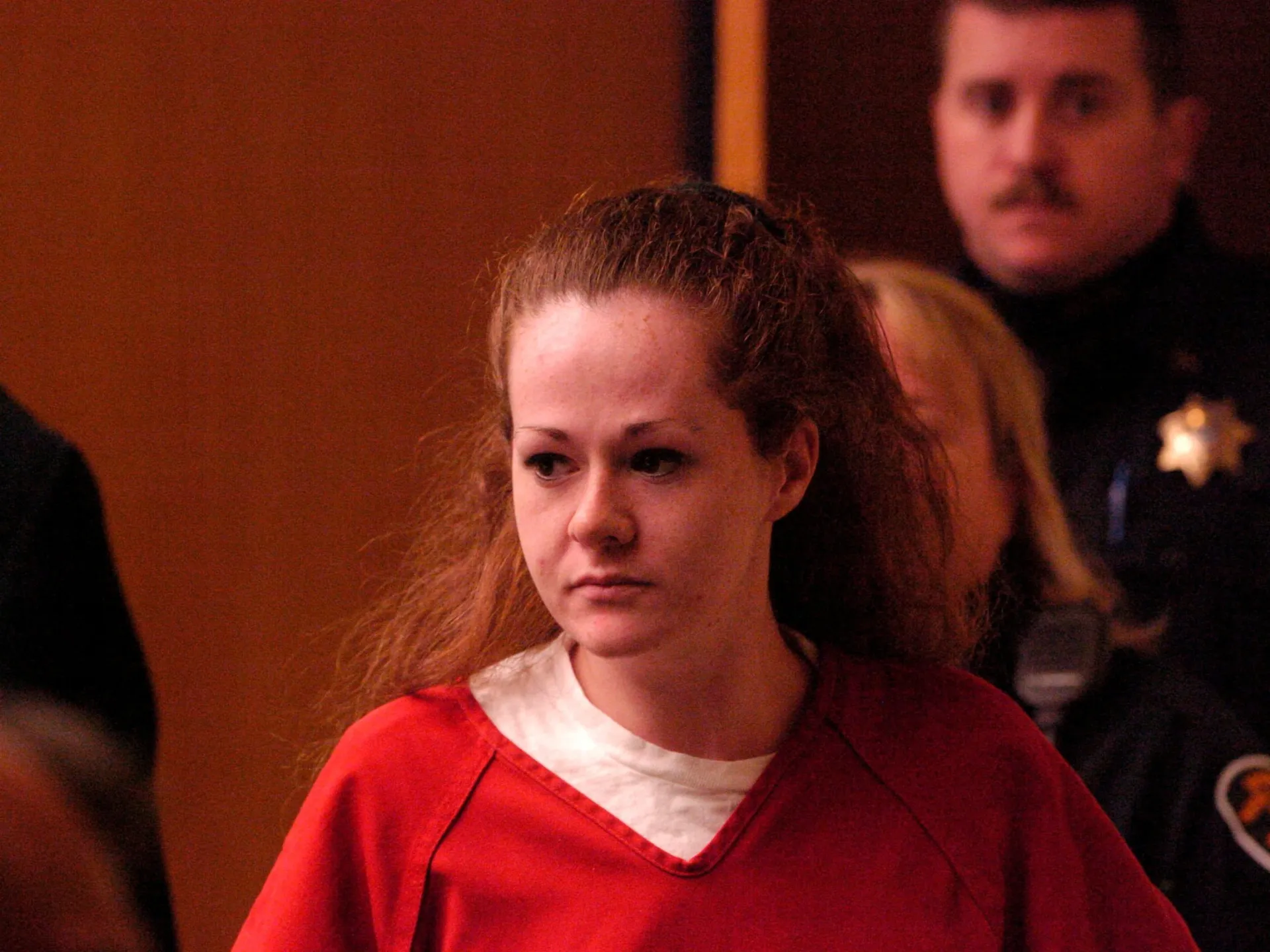
Witnesses say Tennessee officials were unable to execute Christa Pike after a lethal injection attempt.
Published On 1 Oct 20261 Oct 2026
Officials in the United States have failed to put a Tennessee woman to death for a murder she committed in 1995, after the lethal injection was halted for hours as courts considered a last-minute appeal to stay her execution.
Christa Gail Pike, 50 had been scheduled to die on Wednesday for a killing she committed at age 18, after the US Supreme Court overturned an appeals court ruling that stopped the lethal injection just an hour before it was to start.
Recommended Stories
list of 4 itemsend of list
Her death would have been Tennessee’s first execution of a woman in at least 200 years.
Following the top court’s ruling, officials attempted to go ahead with the execution as planned and appeared to give Pike two doses of the sedative pentobarbital, according to media witnesses.
At 7:46pm local time, prison officials closed the curtain separating Pike from the media viewing room. It was raised three minutes later, when witnesses said Pike could be heard loudly snoring.
The curtain was closed again at 8:06pm. Witnesses continued to hear Pike snoring until the microphone was switched off at about 8:53pm, when they were told to leave the area. The Associated Press news agency reported that emergency vehicles were seen coming and going from the prison.
The Tennessee Department of Correction did not immediately explain why the execution had not been completed.
Supreme Court ruling
Pike had initially been scheduled to die on Wednesday morning, and witnesses had already gathered at the Riverbend Maximum Security Institution in Nashville when the 6th Circuit US Court of Appeals voted 2-1 to issue a stay.
The appeals court said a delay was needed to consider whether Pike’s allegations of childhood sexual abuse were fully considered during her sentencing.
Later on Wednesday, the Supreme Court cleared the way for the execution to proceed. Its conservative majority did not explain the decision, while the three liberal justices dissented.
Justice Sonia Sotomayor wrote that vacating the stay “unnecessarily prevents” the appeals court from giving due consideration to Pike’s claim.
Tennessee’s attorney general had argued that delaying the execution traumatised the family of Pike’s victim, Colleen Slemmer, and rewarded what it called “abusive delay tactics”.
1995 killing
Pike and her boyfriend, Tadaryl Shipp, were convicted of the fatal stabbing and beating in 1995 of 19-year-old Slemmer, their classmate at a job training facility in Knoxville.
Shipp was 17 when the crime happened and received a sentence of life in prison with the possibility of parole. Pike was the only one sentenced to death.
Pike does not deny committing the killing, but her supporters argue the state should consider her age at the time, her mental illness and her allegations of severe sexual abuse, including that she was raped from early childhood.
“It is inconceivable that in the 21st century, the criminal justice system is poised to execute a survivor of rape and child sexual abuse whose jury never had the opportunity to consider those facts in weighing the defendant’s moral culpability,” her lawyers wrote in a filing.
After the killing, Pike was diagnosed with bipolar disorder and post-traumatic stress disorder. In her clemency petition, she said she had initially intended to fight Slemmer but killed her in a frenzied attack when she could not “put the brakes on”.
“I was a mentally ill 18-year-old kid. It took me numerous years to even realise the gravity of what I’d done. Even more to accept how many lives I affected. I took the life of someone’s child, sister, friend. It sickens me now to think I had the ability to commit such a crime,” Pike said in a statement.
Slemmer’s mother has said she wants Pike’s death sentence carried out after waiting decades for the execution.
Tennessee has not executed a woman for at least 200 years, according to the Death Penalty Information Center.
Since the Supreme Court reinstated the death penalty in 1976, 18 women have been executed in the US, representing about 1 percent of all executions, according to the centre.
The deaths appear to be the first at the hands of Somali pirates in more than a decade.
By Al Jazeera Staff, AFP and Reuters
Published On 30 Sep 202630 Sep 2026
Pirates have killed five crew members on board a Palau-flagged oil tanker off the coast of Somalia before security forces rescued the ship, according to Somali authorities.
The deaths on the tanker, the MT Honour 25, were announced on Tuesday.
Recommended Stories
list of 3 itemsend of list
They appear to be the first deaths at the hands of Somali pirates in more than a decade and come amid a resurgence of Somali piracy that experts have attributed in part to the effects of the United States and Israel’s war on Iran.
The MT Honour 25, which authorities said was carrying 18,500 barrels of oil, was seized by pirates off Somalia on April 21.
The Information Ministry of Puntland, a semiautonomous region of Somalia, said in a statement that a rescue mission had freed the ship and captured 16 suspected pirates.
“Before the operation began, the pirates on board the ship killed five of the crew,” the statement said. “Among those killed were three from Pakistan, one from Myanmar and one from India.”
Four other crew members, three Pakistanis and one Indian, were injured, it said.
In a post on social media, the Puntland Maritime Police Force said the vessel was “safe” and under the government’s control. It said efforts were continuing to find others involved in the hijacking.
The rescue follows another operation last week in which the maritime police freed the Sibu 1, a tanker sanctioned by the US that Somali pirates had hijacked in August.
But 28 of the 41 pirates arrested in that operation later escaped while being transferred to jail, and several Puntland security officials accused local police of complicity.
At least 15 attacks have been reported off Somalia since April, according to officials.
A previous wave of piracy, from 2008 to 2014, disrupted one of the world’s busiest shipping routes, cost the global economy billions of dollars and resulted in hundreds of millions of dollars in ransom payments.
Warden among five officials suspended over the discovery of an apartment-style compound for inmates at the Cibinong prison.
Published On 30 Sep 202630 Sep 2026
A prison warden in Indonesia has been suspended, along with four other officials, after investigators discovered a compound of luxury apartment-style residences allegedly used by inmates at a penitentiary near the capital, Jakarta.
The action was announced on Tuesday by Rudi Setiawan, the inspector general of the Ministry of Immigration and Corrections. “We have suspended five structural officials, including the Cibinong prison chief, who are suspected of being responsible for the incident uncovered by the Ombudsman,” he said.
Recommended Stories
list of 3 itemsend of list
Dozens of inmates and prison employees have been questioned, he said.
The units, more than 10 in all, stood apart from the regular cellblocks at Cibinong prison in Bogor, near Jakarta.
They were found on September 23 during a surprise inspection by Indonesia’s Ombudsman, the government’s public-service watchdog.
Investigators said the residences contained air-conditioners, big-screen televisions, refrigerators, sofas and dining areas. They also reported finding a gym, a golf simulator under construction, and luxury vehicles on the grounds.
“We found strong indications that certain inmates had access to special facilities unavailable to ordinary prisoners,” Syafrida Rachmawati Rasahan, an Ombudsman member, said at a news conference.
“We encountered inmates inside the residential compound and discovered facilities resembling homestays, apartments and villas rather than prison housing,” she said.
The buildings were originally intended as official housing for prison personnel, but investigators are examining whether they were converted into unauthorised accommodations for inmates.
The incident has drawn widespread public attention and renewed scrutiny of Indonesia’s prisons, which have long faced allegations that wealthy or well-connected inmates can obtain preferential treatment through bribery.
The Cibinong prison, which sits on 4 hectares (10 acres), holds a mix of inmates, including people convicted of corruption and other high-profile prisoners. The identities of those who lived in the compound have not been officially disclosed.
Lawmakers, anticorruption activists and watchdog groups have urged authorities to identify which prisoners occupied the facilities and whether prison officials accepted payments in exchange for the privileges.
The case is the latest embarrassment for the Indonesian corrections system, which has struggled for years with overcrowding, corruption and repeated allegations that affluent inmates can buy privileges unavailable to the broader prison population.
An investigation into Indonesia’s prisons in 2010 already found that some inmates live a life of luxury behind bars.
California Gov. Gavin Newsom on Sunday signed legislation that bars public officials from issuing meme coins and restricts cryptocurrency platforms from offering certain tokens linked to politicians to California residents.
Assembly Bill 2409, authored by Assemblymember Avelino Valencia, is aimed at preventing
NEW YORK — The nation’s cybersecurity agency on Thursday released an election infrastructure security plan 40 days before November’s midterms, laying out potential threats to election systems and listing services it would offer to election officials to protect the vote.
Election officials said the plan is both inadequate and belated after the administration gutted the agency’s election security work last year, prompting the officials to pay for private services to ensure they were prepared for the upcoming elections.
“For them to come in five weeks before the election, yeah, nice effort,” said Nevada’s Democratic Secretary of State Cisco Aguilar, who added that he would have liked to see the federal government provide more funding for cybersecurity, rather than Nevada taxpayers having to pay for it.
Homeland Security Secretary Markwayne Mullin had originally promised to release the plan by mid-August as part of the Trump administration’s move to kickstart election security assistance after a hiatus. He announced the plan at the same time he threatened election officials for not cooperating with the administration’s preferred methods to hunt down noncitizen voting, a phenomenon that research shows is extremely rare.
The U.S. Cybersecurity and Infrastructure Security Agency, which is housed under the Department of Homeland Security, has since its founding in 2018 helped warn state and local election officials about potential threats from foreign governments.
But CISA, as it’s known, was largely absent from that role in last year’s elections after the Trump administration dismantled much of its role in election security. The administration cut some 1,000 employees from CISA and slashed $10 million from two cybersecurity initiatives, including one dedicated to helping state and local election officials.
CISA has also gone the entirety of Trump’s second term without a Senate-confirmed director, instead cycling through a series of acting leaders.
Plan refers to ‘consistent’ support that many election officials say has been lacking
The 13-page document released Thursday warns of various threats to election security, including software vulnerabilities, hacks of voter registration databases, insider threats and physical security incidents, such as bomb threats that targeted several polling locations in the 2024 elections.
But it affirms that many longstanding election practices can address such threats and says the agency’s goal is “to ensure the American people can trust voting systems and know that physical safety measures will be in place when they go to their assigned polling locations to cast their votes.”
It states that DHS has “consistently supported CISA’s delivery of cybersecurity and physical security services to election officials,” something numerous election officials around the country have said isn’t true.
Multiple secretaries of state told the Associated Press that services previously provided by CISA, such as live tabletop exercises and penetration tests to evaluate security of their systems, were not available in the lead-up to this year’s midterms.
Minnesota Secretary of State Scott Simon, a Democrat, said in August that his office expects to spend roughly $250,000 on private vendors to conduct penetration testing, which can expose security vulnerabilities and recommend actionable fixes.
Shenna Bellows, the Democratic secretary of state in Maine, told the AP the same month that communications with CISA had been “sporadic and irregular, to say the least.” She said it would be helpful if the Trump administration could restore intelligence briefings that used to be granted to election officials about threats from foreign adversaries, but noted that trust with federal officials had been broken with the cuts to the agency.
Thursday’s plan doesn’t mention any specific 2026 threats from adversaries like Russia, Iran or China, all of whom have sought to meddle in U.S. elections — either directly through hacking or indirectly through influence campaigns.
Kris Warner, the Republican secretary of state in West Virginia, said Thursday that some of CISA’s assistance to his state had been continual throughout the Trump administration, including no-cost reviews of its public-facing websites for cybersecurity issues.
Warner acknowledged CISA had cut back under the Trump administration but said he views the agency “as a resource and not as a service provider” and said his office had last year hired a departing CISA election security advisor who has helped fill any gaps that may exist.
Report follows August call between CISA and election officials
In early August, two CISA officials — acting director Nick Anderson and assistant director for integrated operations Jim Harrell — joined a National Assn. of Secretaries of State call attended by a bipartisan group of secretaries of state, according to several election administrators.
The call grew tense when Arizona’s Democratic Secretary of State Adrian Fontes voiced his concerns about the withdrawal of federal resources.
Fontes told the AP at the time that he told the CISA officials he didn’t trust them. He said it seemed to him the officials were there “to cover their butts.”
“They even acknowledged on the call that it was too late for them to do anything for 2026,” he said.
Simon said the officials appeared interested in rebuilding relationships and previewing their future plans, which he appreciated. But he said the effort at goodwill came later than election officials needed.
“Secretaries of state have already moved on and sought other partners and other resources for the services that CISA has retreated from over the last year and a half,” Simon said.
In Michigan, a voting rights group has tried to fill the gap
In Michigan, where mail ballots have already been sent out for the Nov. 3 elections, Deputy Secretary of State Aghogho Edevbie said the state’s relationship with CISA has been “nonexistent” this year despite working together closely in previous election cycles.
“If the federal government wants to be helpful, they can’t do so at the 11th hour,” the Democrat said.
Ashiya Brown, the Michigan state director of the voting rights group All Voting Is Local, agreed. She noted the new plan says CISA has 10 regional directors to support election administrators but still doesn’t answer her biggest question.
“Does CISA still have the people and capacity to provide that support when clerks need it?” she asked. “I’m glad CISA has put forward a plan, but what matters now is whether the support described in it reaches local election officials before November.”
CISA has been hiring on its website for new positions, Brown said, but it’s unclear whether they are all staffed yet.
Meanwhile, Brown, a former security official with the Michigan Department of State, said her group has hired former CISA employees to help provide training and other support to election clerks and fill the gap.
Edevbie said even without collaboration with CISA, he is confident the state’s elections are secure.
“We are always prepared to defend our elections and to ensure that every voter who is eligible to cast a ballot can do so here in Michigan,” he said.
Swenson writes for the Associated Press. AP writers Jessica Hill in Las Vegas and Jacqueline GaNun in Lansing, Mich., contributed to this report.
Los Angeles County officials aim to break ground on the new Eaton Canyon Nature Center before 2028, with plans to construct a facility that can withstand the region’s changing climate and future disasters.
The previous nature center, which replaced the original Robert M. McCurdy Nature Center that burned down in 1993, was destroyed in the Eaton fire last January. The fire not only destroyed the structure but also a large library and several decades’ worth of archives, and it also killed the reptiles that lived inside the center.
It took about five years to rebuild and open the last nature center. L.A. County Parks Director Norma Edith García-Gonzalez said after the design phase is completed, which could be soon, the county and the architect firm hired for the project will plan out the construction phase.
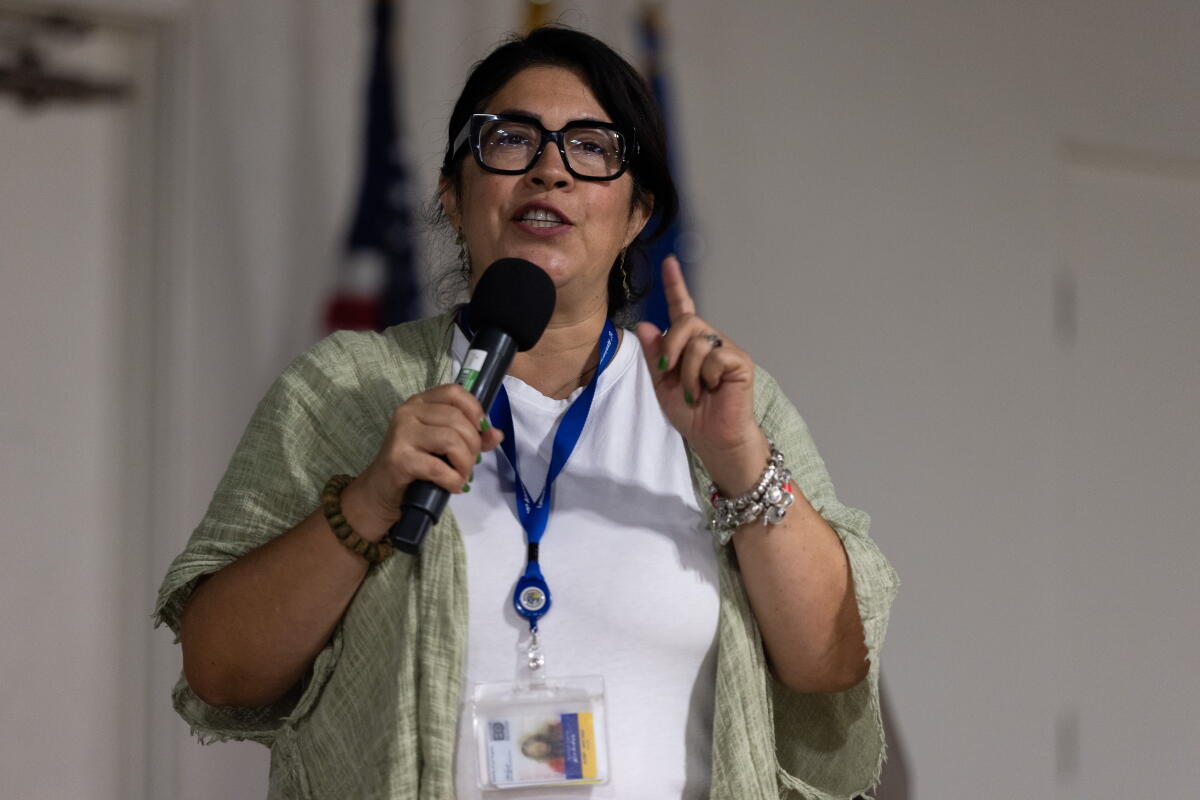
“We modeled 100-year patterns of wind, fire and flood so that when we build back, we are building back with resistance, and that is able to guide how we plant [and] what type of plants, and how we build, [including] how we build back trails,” García-Gonzalez said.
Norma Edith García-Gonzalez, director of L.A. County Department of Parks and Recreation, speaks during an Eaton Canyon design meeting in mid-September.
(Kayla Bartkowski / Los Angeles Times)
The biggest impediment to rebuilding, though, is funding. The county has about $16.2 million in state money, about half of what county officials think is needed to build a new nature center, she said. García-Gonzalez said she hopes the philanthropic community will step up to fill the gaps, but county leaders have noticed that “philanthropy goes from one hot issue to another,” and interest to donate to fire recovery is cooling.
In this week’s edition of The Wild, our weekly outdoors newsletter, I will provide an update on the design plans for the new nature center and when we can expect to hike again in Eaton Canyon — and how you can help with the canyon’s restoration too.
You are reading The Wild newsletter
Sign up to get expert tips on the best of Southern California’s beaches, trails, parks, deserts, forests and mountains in your inbox every Thursday.
By continuing, you agree to our Terms of Service, which include arbitration and a class action waiver. You agree that we and our third-party vendors may collect and use your information, including through cookies, pixels and similar technologies, for the purposes set forth in our Privacy Policy such as personalizing your experience and ads.
First, let’s discuss a little bit of the history of the area.
The Eaton Canyon Natural Area, managed by L.A. County Parks and Recreation, is a 190(ish)-acre swath of land at the foothills of the San Gabriel Mountains near Altadena.
“Originally called ‘El Precipicio’ by the Spanish settlers because of its steep gorges, it is now named after Judge Benjamin Eaton, who built the first Fair Oaks Ranch House in 1865 not far from Eaton Creek,” according to the Eaton Canyon Nature Center Associates, a volunteer-run education and stewardship group. “Judge Eaton was the first to use irrigation from the creek to grow grapes on the slopes.”
The canyon has long been a fascination of adventuresome L.A. residents.
The hike to Eaton Canyon Falls in the San Gabriel Mountains before the Eaton fire last January.
(Myung J. Chun / Los Angeles Times)
In 1921, writer Frances Mathilda Purdy wrote for The Times that few people knew of the “hidden, but very easily accessible waterfall” in Eaton Canyon. Purdy outlined a few ways to access the canyon and reach the falls, including a shorter route where visitors “after alighting from motor, or stage,” could take a small flight of stone steps near the Mt. Wilson Toll Road bridge.
I chuckled when I read Purdy’s suggestion that this particular route was “perfectly comfortable for those who have arrived on the scene in city garb.” Apparently, underprepared hikers have been coming to Eaton Canyon for more than 100 years. What do you think was the 1920s version of hiking in flip-flops?
For the more rugged adventurer, Purdy laid out a “serpentine trail” that leads to “such lovely possibilities for the pleasure-seeking jaded worker, who, from only one afternoon spent in this quietly entrancing corner of the great outdoors, will return, refreshed and invigorated to meet the daily grind with a mind stored full of the charm of Lower Eaton Canyon.”
Architect Anne Mooney of Sparano + Mooney Architecture speaks about a site plan for the next Eaton Canyon Nature Center.
(Kayla Bartkowski / Los Angeles Times)
It wasn’t until 1930 that Pasadena set aside property that the city owned for a bird and game sanctuary in Eaton Canyon and Eaton Wash, preserving the land from development, according to a historical record compiled by the nature center associates.
There was interest in doing more.
Pasadena Park Superintendent Gilbert Skutt, who served from 1923 to 1936, wanted to see a large scenic public park in Eaton Canyon similar to what the city had built along the Arroyo Seco, according to city records. “He sought to correct the imbalance in the distribution of park space in Pasadena, which favored the west side of town,” according to a historical document. “During the Depression, however, the city could not afford to purchase the land.”
Over time, the city started working with county officials on Eaton Canyon Regional Park, eventually giving the entire project to the county.
In 1931, the L.A. County Board of Supervisors considered financing a 1,000-acre “gigantic regional park system” for the area, according to The Times’ archives, but that idea apparently never fully came to fruition.
Thankfully, in 1950, landowner Mary Beatrice Fox sold the canyon portion of her property to L.A. County to use for a park, “with a provision that mammals are not to be kept in cages,” according to a park history compiled by the Eaton Canyon Nature Center Associates.
A hiker slips in a creek in Eaton Canyon after a 2023 storm.
(Wally Skalij / Los Angeles Times)
Then, in 1958, naturalist Louise A. Luckan moved her “nature appreciation operation from the Eaton Canyon Golf Course to Eaton Canyon Park,” according to the organization’s history.
Soon, L.A. County officials set aside $154,797 — about $1.7 million in today’s dollars — for the Robert M. McCurdy Nature Center. They had big plans for the facility, which was to include two classrooms, an office, museum, library, display area, gift shop, laboratory and an auditorium that could seat 200.
“This park will be an outstanding facility — the only one of its kind in magnitude this side of Chicago,” Supervisor Warren Dorn said in a 1962 Times story.
The nature center opened in 1963, and became popular among scouting and school groups, to whom naturalists taught about the local flora and fauna. By the early 1970s, more than 2,000 school children were regularly attending lectures at the nature center, according to Times archives. The students wrote thank-you notes to the park staff, including one that read, “I think it was nice of you to buy this park instead of someone buying it for houses and factories. Because if they did, it would ruin this beautiful land.”
L.A. County sustainability policy director Rebecca Ferdman talks with community stewards about how to educate and engage the public about the goldspotted oak borer, a pernicious invasive beetle that destroys oak trees, during a meeting at Eaton Canyon Nature Center in 2024.
(Brian van der Brug / Los Angeles Times)
But, in 1993, the canyon’s first nature center was destroyed by the Kinneloa fire. The next nature center didn’t reopen until 1998.
Karen Mateer, vice president of the Eaton Canyon Nature Center Associates, said for more than 25 years, that nature center served as a meeting place and an educational hub for the millions who visited the canyon over the years.
Mateer, who started volunteering in 1998, said many local schoolchildren first experienced the concept of “nature” at Eaton Canyon on field trips. Volunteers would regularly hear from adults, who pursued recreation- or nature-focused careers, that the first place they ever hiked or learned about their natural habitat was at Eaton Canyon.
“Eaton Canyon also, for the community, for those of us up here who lost so much, it is familiar and is a place you often go for recreation, for solace,” Mateer said. “It means a lot.”
At a presentation last week, architect Anne Mooney said her firm analyzed where to best place the new nature center, and not wanting to destroy any existing habitat or take down any of the area’s oaks or other trees, recommended the new building be placed east of the previous site.
It was easy for visitors to miss the previous nature center, because it was situated in a thick stand of oaks, and the new location will allow the nature center to serve as a gateway to the park, as it will be near the canyon’s trailhead.
“The nature center has always been more than just a building,” Mooney said. “It’s really been a gateway to an experience of learning about nature, experiencing a connection to the wildlands and developing stewardship of the canyon. We want to continue that tradition.”
A diagram of the wind analysis conducted by architects as they assessed where to place Eaton Canyon’s new nature center.
(Kayla Bartkowski / Los Angeles Times)
The new nature center, as shown in the current design plan, is horseshoe-shaped with a covered entryway. It will be constructed using durable, fire-resistant materials, including stone and steel. Builders would also construct curved walls to serve as windbreaks, which would not only slow gusts but also divert airborne embers during a fire.
The proposed designs also include roof and eave sprinklers that could pre-wet the building and nearby surrounding area with a specialized firefighting foam during a wildfire.
“We recognize that the fire is a recurring part of the ecology, and we will have another fire,” Mooney said. “We’re working to design something that allows us to be more prepared in the future.”
The Eaton Canyon Nature Center, a 7,600-square-foot building, was destroyed in the Eaton fire. It housed live animals, exhibits, classrooms, a gift shop and more.
(Jaclyn Cosgrove / Los Angeles Times)
The design also includes a research lab, a learning lab or classroom, a large multipurpose space that can fit an estimated 150 people when seated (or 300 people when standing), an exhibit space, a gift shop and a large courtyard in the center with shade, seating and live animal enclosures.
Officials stressed that the design is preliminary and dependent on funding. Anyone who wants to see the design for themselves and provide their feedback can attend the next public meeting, From Ashes to Action: Reimagining Eaton Canyon, from 5 to 7 p.m. Oct. 7 at the L.A. County Arboretum.
Kevin Singleton, center, points to the Eaton Canyon Nature Center design during a recent county event where officials discussed the future of Eaton Canyon.
(Kayla Bartkowski / Los Angeles Times)
In terms of when hikers will return to the canyon’s trails, García-Gonzalez said the county needs an estimated $8 million to reestablish the trail system. The county has fundraised and received only $900,000 of that.
“We already put that money to work,” García-Gonzalez said, partnering with L.A. Conservation Corps to start rebuilding trails. “But there are some [trails] that really need significant and heavy engineering.”
The county also has to plan its work around the strong winter storms forecasted as a result of El Niño, she said. “We are bracing ourselves for even more damage,” García-Gonzalez said.
A map of the proposed courtyard of the new Eaton Canyon Nature Center.
(Kayla Bartkowski / Los Angeles Times)
Since the fire, volunteers have donated hundreds of hours to work on restoring the canyon’s habitat.
You can join them. Volunteers meet from 8 to 11:30 a.m. every Friday and the second and fourth Saturday of every month. Participants remove invasive plants that zap up resources for native plants trying to reestablish themselves. Training and tools are provided. You can sign up by visiting signupgenius.com.
“The love, the care, the stewardship, the commitment, the hope, the inspiration of the volunteers is unparalleled,” García-Gonzalez said. “They’re driving us to build back because they’re so committed. They’re all in.”
3 things to do
“MASH,” a military dramedy that aired on CBS from 1972 to 1983, is one of several Hollywood productions filmed at Malibu Creek State Park.
(Courtesy of California State Parks, 2026.)
1. Celebrate 50 years of public land in Calabasas Malibu Creek State Park will celebrate its past 50 years from 4:30 p.m. to 10 p.m. Saturday at 1925 Las Virgenes Road in Calabasas. Attendees can touch fossils, explore the park‘s trees and make art, all while listening to music and eating from local food trucks. At Stories Under the Stars at 6:30 p.m., a diverse cast of storytellers will teach visitors about the park’s history, culture and science. The L.A. Astronomical Society will host a star party at 8 p.m. Guests are encouraged to carpool or use the free shuttle from Juan Bautista de Anza Park to the park. The event is free, but parking is not. Register at eventbrite.com.
2. Repair the river near Azusa Volunteers are needed from 8 a.m. to noon Saturday, which is National Public Lands Day, at the Oaks Picnic Area near the San Gabriel River for a cleanup effort. Organized by five community conservation corps groups, including San Gabriel Valley Conservation Corps, volunteers will pick up trash and help clean the river. Register at docs.google.com.
3. Cast a line under a full moon in Castaic Friends of Castaic Lake will host the organization’s final Moonlight Madness event of the year from 6 p.m. to 12:30 a.m. Saturday at Castaic Lake. Guests can fish from the shore, from a boat or not fish at all as they enjoy an evening in the outdoors. Tickets start at $23. Glow sticks required for each participant. Register at givebutter.com.
The must-read
Jim Crouch stands in a field with Englemann oaks at the Santa Ysabel Open Space Preserve.
(Sandy Huffaker / For The Times)
Jim Crouch, a retired science teacher near San Diego, noticed how the oak trees around him were disappearing, succumbing to disease, drought and development. Times contributor Jessie Schiewe wrote that Crouch, moved to action, collected acorns and gave away the resulting potted seedlings to others. Now, after planting 10,000 acorns, he dreams of the day he completes his 20,000th seedling. “I’ve never been so ambitious,” he says, “and I’ve never done a project with as much love in it and as little ego.”
Happy adventuring,
P.S.
Torrey Pines State Natural Reserve will be closed until March as construction workers upgrade gas, water, wastewater and communication lines. They also will install new accessible parking stalls and an accessible pedestrian path from the upper parking lot to the restroom and park’s lodge. Times staff writer Christopher Reynolds wrote that the park’s 1,750-acre Torrey Pines reserve attracts about 4 million visitors each year (about the same number as visit Yosemite National Park). Torrey Pines State Beach will remain open through the closure. If you’d hoped to visit this particular park in the fall, consider instead one of 13 places in California that Reynolds recently wrote are ideal to check out in autumn. Warning: As I read the piece, I felt the immediate urge to book campsites at several spots around our state! I am so ready for cozy season.
For more insider tips on Southern California’s beaches, trails and parks, check out past editions of The Wild. And to view this newsletter in your browser, click here.
Trump has also been meeting Ukrainian President Volodymyr Zelensky, British Prime Minister Andy Burnham and leaders from Saudi Arabia, the United Arab Emirates, Qatar, Kuwait, Bahrain and Oman.
Earlier, Guterres gave his farewell speech as UN secretary general, urging unnamed superpowers to recognise “that their power isn’t so super”.
“The fault lines in our world are widening,” Guterres said, citing geopolitical rivalries, wars, climate change and artificial intelligence.
By contrast, Trump criticised international institutions, accusing the UN of a “far-left agenda of globalist bureaucrats who nobody ever elected”.
The US president instead emphasised national sovereignty and “unmatched” American military power.
“There is no global government,” he said.
He also warned that the US would not allow threats to establish themselves anywhere in the Western hemisphere.
“If necessary, we will use our unmatched military might to secure the vital national interests of the United States,” he said.
Trump accused Cuba’s communist government of cultivating ties to left-wing groups in the US, including the Communist Party USA, Antifa and the Democratic Socialists of America.
The Cuban delegation also appeared to walk out of the assembly chamber as Trump turned his sights on them, referring to the island as a “failed state”.
US President Donald Trump has told reporters at the United Nations that US officials had a “very good” three-hour meeting with the Iranian delegation.
“They had a very good meeting, a very productive meeting,” Trump said, adding that the meeting on the sidelines of the UN General Assembly in New York lasted about three hours.
“They have another one scheduled in the very near future.”
DAKAR: Health officials battling the Ebola outbreak in eastern Democratic Republic of Congo are using anonymised mobile-phone data to map population movements and identify areas where the virus could spread next, according to the World Health Organization and researchers working with it.
The approach, which has not been used before in an Ebola response, comes as authorities struggle to contain what the WHO has described as the fastest-growing Ebola outbreak on record. Cases have been confirmed in six provinces, with more than 6,250 people infected and 3,039 killed since the outbreak was declared on May 15, according to the latest government data.
The outbreak, Congo’s 17th, is caused by the Bundibugyo species of Ebola, for which there are no approved vaccines or treatments.
As the virus spreads, health officials are looking for ways to anticipate where cases could emerge next and direct limited surveillance and response resources.
“Population movements have always been a factor in outbreaks, but they are particularly important in the current epidemic,” said Olivier Le Polain, head of epidemiology and analytics for response at the WHO Health Emergencies Programme.
Traditional risk assessments focus on outbreak hotspots and assume the virus is most likely to spread to surrounding areas.Analizing mobility data allows responders to identify risks in places that may be geographically distant but closely connectedthrough travel patterns.
“It gives us a more nuanced understanding of risk,” Le Polainsaid, citing the example of Ituri province, in the northeast, where the virus is believed to have started circulating.
“There are very significant population movements in Ituri linked to mining activities and trade. Understanding those movements is crucial to understanding how the outbreak spreads.”
The analysis is produced by Swedish non-profit Flowminder, using anonymised records generated when mobile phone users connect to telecommunications networks. As people move around the country, their phones connect to different antennas on the network, generating records that show where those connections took place. Researchers use those records to estimate how people travel between different areas.
The data is provided free of charge by Vodacom, Congo’s largest operator. Vodacom did not respond to a request for comment.
Flowminder says it receives aggregated and anonymised records and does not have access to information identifying individual subscribers.
“We seek to provide estimates of how people move, which in turn is a predictor of how infectious people move,” Flowminderfounder Linus Bengtsson said.
Flowminder’s first analysis, published in early June, focused on the three areas where the outbreak is believed to have started: Bunia, Mongbwalu and Rwampara. Researchers tracked where people who had spent time in those areas between April 3 and April 23 later traveled.
The largest flows were to nearby areas in Ituri province and North Kivu province. By the end of June, all 10 of the destinations receiving the largest flows of travelers from the original outbreak areas had reported confirmed Ebola cases.
Organisers in Japan say they had ‘neither the manpower nor the budget’ to deal with the accommodation shortage.
Published On 14 Sep 202614 Sep 2026
Accommodation at the Asian Games, which start this week in Japan, is the “worst ever”, say South Korean officials, warning of “a serious shortage” of rooms.
Beds in shipping container-style huts are too short for players to stretch out, the South Korean basketball chief said on Monday, while officials from the Philippines resorted to Airbnb.
Recommended Stories
list of 4 itemsend of list
There is no dedicated athletes’ village for the games, with organisers instead relying on a cruise ship, temporary wooden cabins and hotels to cut costs.
The games in the city of Nagoya in Aichi prefecture officially open on Saturday, but football and basketball are already under way.
Jung Jae-yong, vice president of the Korea Basketball Association (KBA), expressed his displeasure with the cabins where the men’s basketball team is staying.
“Based on my experience, this is the worst it has ever been,” he said.
“Athletes who are over two metres tall cannot even stretch their legs out on the beds. It’s unreasonable.”
Byeon Jun-hyeong, from the basketball team, posted a video on social media showing a leaking sink and a soaked floor in his hut.
“Please help us,” he posted.
The huts are set to be home to 2,000 athletes and officials over the more than two weeks of the games.
Worried about their athletes, Indian sports officials built replicas of cabins to help them get used to the games’ accommodation.
KBA’s Jung accused organisers of failing to respond to South Korea’s concerns.
“The organisers have still not said anything,” he said.
“We are very concerned and discussing extensively with the Korean Sport and Olympic Committee what to do about this.”
Hundreds of athletes were briefly evacuated from their accommodation last week as record rainfall lashed Nagoya.
More rain has been forecast in the coming days.
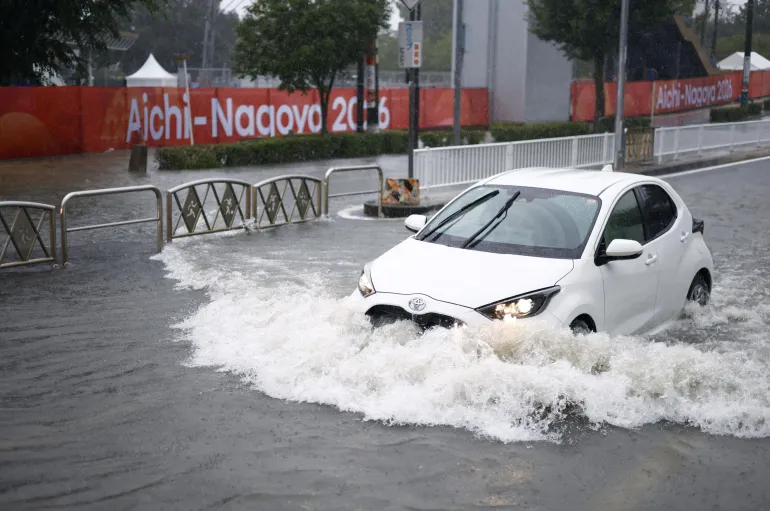
A car drives along a road flooded by heavy rain while banners for the Aichi-Nagoya Asian Games are visible in the background in Nagoya, central Japan [File: Kyodo via Reuters]
‘Serious shortage’ of accommodation
More than 17,000 athletes and officials are expected at the games — a bigger number than the Olympics.
Organisers were initially expecting 15,000 and argued last month that they had “neither the manpower nor the budget” to deal with ballooning numbers.
The Olympic Council of Asia later said everyone would get a place to stay.
Star cricketers have voiced fears about a lack of top-notch hotels.
A Korean Sport & Olympic Committee (KSOC) official agreed that problems persist with the games just days away.
“At the moment, there is a serious shortage of accommodation not only for the entire South Korean delegation to the Asian Games, but for delegations from around the world in the Aichi-Nagoya area,” the official said.
“We are doing everything we can to resolve the issue and ensure there are no such problems.”
Philippine Olympic Committee president Abraham Tolentino said all athletes from his country had been given a room. However, “some officials, like coaches, were moved to different hotels and Airbnb”.
The Italian cruise ship Costa Serena is due to arrive in Nagoya on Tuesday. Between 4,000 and 5,000 athletes will stay on the vessel.
The rest will be accommodated in hotels, including in Tokyo, where swimming, diving and equestrian events will take place.
WASHINGTON — An Afghan woman who was accused of supporting an Islamic State-inspired plot in the United States and whose case was the first for an obscure and long-dormant court has been deported, the Justice Department said Friday.
Nazira Haji Zada, 47, was arrested in July at her Fort Worth home and brought before the Alien Terrorist Removal Court on a Justice Department application to deport her from the U.S. On Friday, the department said that she had waived her rights to challenge her detention and had agreed to be deported to Afghanistan.
Haji Zada’s attorneys said her decision to consent to removal “should not be seen as an endorsement of this court’s legitimacy.”
“Dragging lawful permanent residents into court but refusing to show them or their attorneys the evidence that will be used against them is a plain violation of due process,” the defense lawyers said in a statement Friday. “We are confident that the Alien Terrorist Removal Court will be struck down as unconstitutional as soon as a judge is asked to address the issue.”
Court filings about Haji Zada’s deportation, including a judge’s Aug. 20 removal order, remained under seal until after she reached her destination.
The swift resolution averts what could have been a protracted legal fight testing the authority of the court, which was established in 1996 but until July had not received any petitions, as well as the strength of allegations against Haji Zada.
Atty. Gen. Todd Blanche said the case’s outcome is “a win for national security and the rule of law.”
“Those who support and condone terrorism should not be living in the United States, and this first-ever case before the [court] shows how the Department will use every tool at its disposal to protect our country,” Blanche said in a statement.
The Justice Department has described Haji Zada as a supporter of the Islamic State and identified her at the time as the mother and mother-in-law of two Afghan men who were convicted in Oklahoma of plotting an attack in the U.S. on election day in 2024. The plans were foiled before any attack took place.
Her lawyers at the time of the deportation had been pressing the court to force the Justice Department to share information and other evidence to support the allegations in the case.
The court has specific authority to conduct deportation proceedings for people whom the Justice Department classifies as “alien terrorists.” The court is composed of five federal judges from different districts across the country who are appointed by the U.S. chief justice.
“Those who plot acts of terrorism against the United States have no place in our country,” Homeland Security Secretary Markwayne Mullin said in a statement. “We will find them, and we will use every lawful tool available to remove them.”
On July 30, Judge Joan Ericksen presided over the first hearing for the court’s first case since its creation 30 years ago.
One of Haji Zada’s attorneys argued at the hearing that the Trump administration’s activation of the court violates her constitutional rights. Attorney Matthew Farley urged the judge to dismiss the case and immediately release his client.
An FBI memo dated July 15 said it “developed information” that Haji Zada is an Islamic State supporter who had her children pledge their loyalty to the terrorist group. Her son, Abdullah Haji Zada, was sentenced in November to 15 years in prison and court records show he previously agreed to be removed from the U.S. after his release.
Her son-in-law, Nasir Ahmad Tawhedi, previously worked as a security guard for an American military installation in Afghanistan. He pleaded guilty to conspiring and attempting to provide material support to the Islamic State group. Prosecutors have said he took steps to advance his attack plans by ordering AK-47 rifles, liquidating his family’s assets and buying one-way tickets for his wife and child to travel home to Afghanistan.
Tucker and Kunzelman write for the Associated Press.
GAZA: An Israeli strike in Gaza on Thursday killed a family including two children, Palestinian hospital and security sources said.
“The bodies of four members of the Ahmad family were recovered in pieces after an Israeli strike hit a house in the Beit Lahia Project area in the northern Gaza Strip,” an official at Al-Shifa hospital in Gaza City said, identifying the children as aged 12 and eight.
The Israeli military, contacted by AFP, said it was checking.