Nicolas Maduro

US to allow Venezuelan government to cover Maduro’s lawyer fees | Nicolas Maduro News

Defence lawyers had asked for case to be thrown out, claiming Maduro’s rights were violated following US abduction.

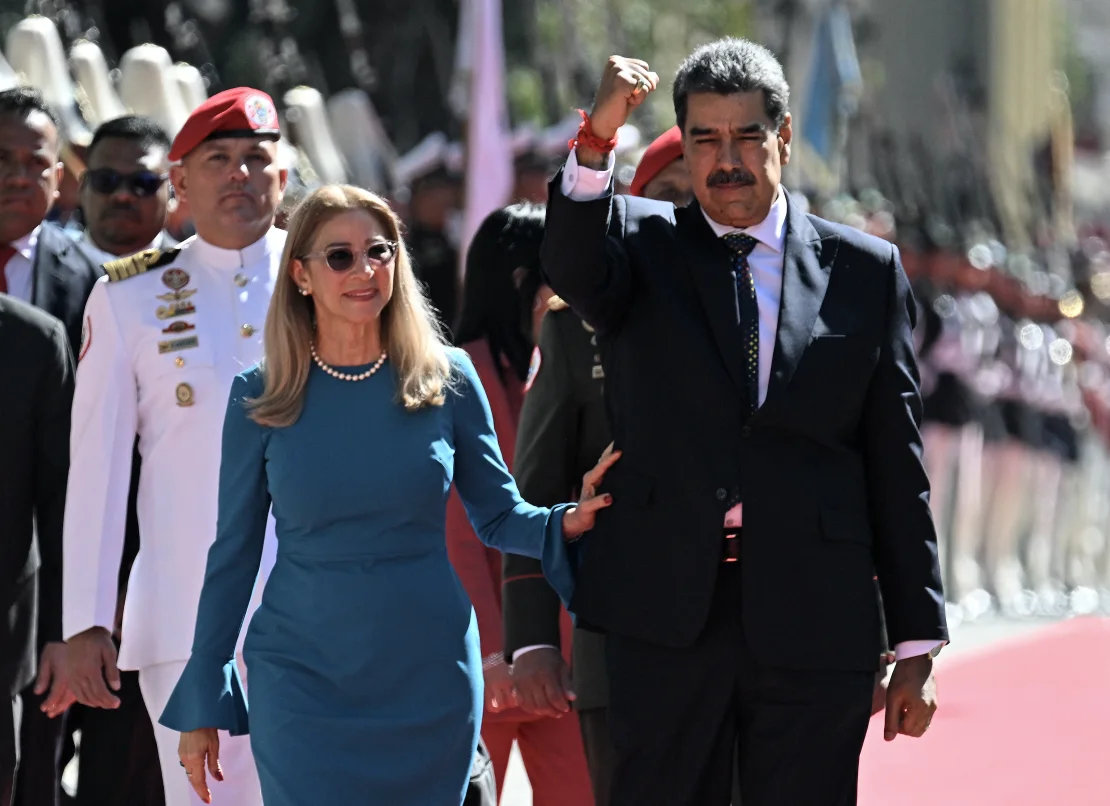
The United States has agreed to ease certain sanctions on Venezuela in order to allow the country’s government to cover the legal fees for ex-president Nicolas Maduro, who is on federal trial in New York City for drug trafficking charges after being abducted by US forces in January.

Maduro’s lawyer, Barry Pollack, had asked the Manhattan-based US District Judge Alvin Hellerstein to toss out the case in February, arguing that a prohibition on the government in Caracas paying the legal fees constituted a violation of Maduro’s legal right to the counsel of his choice.

Recommended Stories

list of 3 itemsend of list

In a court filing, US Department of Justice lawyers agreed to modify US sanctions so that the Venezuelan government could pay Maduro’s defence lawyer. They said the change makes the defence’s motion to throw out the case “moot”.

The pivot is the latest update in a closely watched trial that has raised a series of legal questions based on Maduro’s status as a former head of state and how he was taken into US custody.

Critics have condemned the proceedings as fundamentally illegitimate, pointing to the extraordinary US military operation to abduct Maduro and his wife, Cilia Flores, from Venezuela. Legal experts have called the raid a blatant violation of international law.

The Trump administration has maintained that the abduction was a law enforcement operation supported by the military. It has argued that Washington does not recognise Maduro as the legitimate leader of Venezuela following several contested elections.

Under the international law concept of “head of state immunity”, sitting world leaders are typically granted immunity from foreign national courts.

After being spirited to the US, Maduro and Flores pleaded not guilty and remain jailed in Brooklyn, New York. Maduro has rejected the US charges as a false pretext for seizing control of the South American country’s natural resources.

US President Donald Trump has repeatedly expressed his desire for foreign companies to access Venezuela’s vast oil reserves.

During a hearing on March 26, Judge Hellerstein did not signal that he would throw out the trial, but did question whether the sanctions preventing the Venezuelan government from covering Maduro’s legal fees were a violation of constitutional rights.

All criminal defendants in the US have constitutional rights, regardless of whether or not they are US citizens.

Prosecutors, at the time, argued that the sanctions were based on national security interests and asserted that the executive branch, rather than the judiciary, oversees foreign policy.

They further argued that Maduro and Flores could use personal funds to pay for a lawyer of their choice.

“The defendant is here, Flores is here. They present no further national security threat,” said Hellerstein.

“The right that’s implicated, paramount over other rights, is the right to constitutional counsel.”

Source link

Soldier charged with using classified information to bet on Maduro capture

April 23 (UPI) — A U.S. Army special forces soldier who participated in capturing Venezuelan leader Nicolas Maduro has been charged with using classified information about the operation to make bets on Polymarket, a decentralized prediction platform, federal prosecutors said Thursday.

Gannon Ken Van Dyke, stationed at Fort Bragg in Fayetteville, N.C., is alleged to have profited by more than $400,000 through wagers he made on Polymarket concerning the future of Venezuela, Maduro and U.S. military intervention.

“Our men and women in uniform are trusted with classified information in order to accomplish their mission as safely and effectively as possible, and are prohibited from using this highly sensitive information for personal financial gain,” Acting Attorney General Todd Blanche said in a statement.

Polymarket is one of several crypto-based prediction markets that grew in popularity during the 2024 general election, allowing users to make wagers on seemingly anything, from who will be drafted first overall in the NFL Draft to when President Donald Trump will announce the war in Iran is over.

In the indictment unsealed Thursday, federal prosecutors alleged that starting from around Dec. 8, Van Dyke participated in the planning and execution of Operation Absolute Resolve.

On Dec. 26, Van Dyke allegedly created a Polymarket account, which he used to make 13 bets from Dec. 27, wagering a combined $33,034 on contracts concerning U.S. military involvement in Venezuela.

Before dawn on Jan. 3, U.S. military forces conducted a clandestine operation in Venezuela, resulting in the capture of Maduro and his wife, who were brought back to the United States to face narco-trafficking charges.

After Trump announced the operation that night, Van Dyke allegedly made $409,881 off his bets, which he withdrew to a foreign cryptocurrency vault before depositing them into a newly created online brokerage account, federal prosecutors said.

After the operation, news broke that one user had wagered $32,000 that Maduro would be ousted by the end of January, netting the multi-hundred-thousand-dollar payout.

Prosecutors alleged that as reports of the unusual wager spread, Van Dyke asked the platform on Jan. 6 to delete his account and he allegedly changed the email address registered to his cryptocurrency exchange account.

The indictment charges him with use of confidential government information for personal gain, theft of nonpublic government information, commodities fraud, wire fraud and making an unlawful monetary transaction.

If convicted, Van Dyke faces up to 10 years in prison for each of the three Commodity Exchange Act counts, 20 years for the one wire fraud count and 10 years for the unlawful monetary transaction charge.

The charges come amid concern about such decentralized markets that allow for betting on real-world events and calls for them to be regulated

In late March, dozens of lawmakers called on the Commodity Futures Trading Commission and the Office of Government Ethics to address illegal insider trading on these platforms by federal employees following the Polymarket payout on the capture of Maduro and other suspicious trades.

Asked about the development and if he is concerned about bets being placed on the Iran war, Trump told reporters at the White House that he will look into it.

“The whole world, unfortunately, has become somewhat of a casino. And you look at what’s going on all over the world, in Europe and every place, they’re doing these betting things,” he said.

“I was never much in favor of it. I don’t like it, conceptually, but it is what it is.”

Source link

Jorge Vilalta: ‘We Must Put Differences Aside to Confront Fascism and US Imperialism’

Vilalta is an activist with El Otro Beta and ALBA Movimientos. (Venezuelanalysis)

Jorge “Toti” Vilalta is a political spokesperson for the Otro Beta social movement, and also a member of the ALBA Movimientos platform. He works for La Ceiba, a Latin American and Caribbean outlet focused on stories from the territories. A longtime Bolivarian and Chavista activist, he specializes in cultural, communications, and productive processes, as well as international solidarity initiatives. In this interview, Vilalta offers his views on the present challenges for Venezuelan popular movements and international solidarity initiatives, and argues that there is a need to articulate a clear narrative for the Chavista grassroots.

In the wake of the US attacks on January 3, which followed years of the blockade, what are the challenges to sustaining morale and keeping hope alive?

It is an important question. Maintaining high morale is essential for everything we need to do in the country. Venezuela needs to increase oil production to boost the economy. With the possibility that US sanctions and the oil blockade will be lifted, there is some hope. Additionally, the market upheaval due to the war against Iran has raised hydrocarbon prices, so that could improve our conditions to negotiate with our “kidnapper,” which is the US government.

The United States, despite being the world’s largest oil producer, still needs our crude. Its refineries in the South are geared to receive Venezuelan crude. Therefore, the US-Israeli war against Iran could help us negotiate sanctions relief, and that will help improve living conditions in the country.

Venezuelans need better jobs, healthcare, education, and access to culture. I believe this is also the priority for Acting President Delcy Rodríguez.

Politically, to sustain the revolution, our goal as grassroots movements is to advance the communal state as a Bolivarian socialist model. The regular national consultations make democracy stronger by creating direct connections between the government and the people, bypassing bureaucracy. We must keep working in the communities.

Another objective is maintaining peace. The multiple dialogue processes, under President Maduro and now with Acting President Rodríguez, have exposed and isolated neo-fascism and the far-right.

What is your take on the multiple and often competing narratives that have emerged since January 3?

There is a lot of work to be done in terms of communication and culture. There is no unified narrative on our side. The only Chavista version comes from the government. We need to explain what we’re doing and where we’re going. On January 3, we had a big chance to tell all the people of Venezuela: “Here is the enemy, clearer than ever; let’s unite.”

That work wasn’t finished. Many people today are confused and see no clear goals. People are still dealing with the trauma of the bombings, they fear not knowing what will happen. There is a lot of speculation on issues like early elections, not to mention the generalized perception that Trump is calling the shots. and the country’s commitment to following the US president’s dictates.

The Bolivarian Revolution has always had a weakness in communication. We do a lot, but we explain little about everything we do. It is hard to counter all the mainstream media propaganda. So in the end we feel trapped under bombings and blockades without being able to provide convincing explanations to the people. We need to create new communications channels, not just copy influencers from other countries.

Venezuelans have taken to the streets to demand the release of Maduro and Flores. (Archive)

What role does international solidarity play in the present circumstances? In particular, what are grassroots movements doing to press for the release of kidnapped President Maduro and First Lady Cilia Flores?

International solidarity is going strong. We have cultivated internationalist practices in Venezuela for over a decade. 

Concerning the kidnapping of President Nicolás Maduro and Congresswoman Cilia Flores, here in Venezuela we had near-daily demonstrations all over the country in the first two or three weeks after the kidnapping. El Otro Beta and ALBA Movimientos were present in many of them. We have also been working with solidarity brigades that have arrived since the bombing and kidnapping.

Around the world, every third of the month there are concrete actions to push the “Bring Them Back” (“Los queremos de vuelta”) campaign. We have coordinated activities, rallies, webinars, and more with grassroots movements from other countries. ALBA Movimientos, the International People’s Assembly and the Simón Bolívar Institute have been at the forefront of this campaign.

In the US, solidarity collectives have been protesting at the New York prison where the president is being held. They’ve been marching, chanting, and holding signs with information, challenging the false narratives of drug trafficking and “narcoterrorism.” We also saw street actions outside the court, and in many cities around the world, on March 26 to coincide with the latest court hearing.

In Latin America, we are witnessing the rise of the far right, with deeply reactionary agendas. What, in your opinion, is the strategy for resisting and fighting back?

That’s a million-dollar question. I wish we had a definite answer. We missed our chance to unite Latin America and the Caribbean in the first ten years of this century.

Now, there are more reactionary and far-right governments, it feels like we are surrounded. We are seeing the launch of the “Shield of the Americas,” a new version of the Plan Condor from the 1970s. 

With this worrying scenario, one priority would be for leftist and progressive governments to stop fighting among themselves. Beyond governments, the people of Latin America and the Caribbean must also set aside their differences, including ideological ones. If there’s one thing we all have in common, it’s our opposition to fascism. We are facing an advance of neocolonialism, fascism, and US imperialism.

If we do not put our differences aside to work together towards a common goal, which is to protect the 99% against the 1% of billionaire pedophiles and genocidal Zionists, who are leading us towards a totalitarian dictatorship of AI surveillance and robot police, we are doomed.

Comandante Chávez and the other revolutionary leaders said it: we must unite and fight together. The people of Latin America and the Caribbean are starting to understand this. It is also great to see US citizens standing up against war and the neo-fascism seen in ICE and immigration enforcement practices. And the demonstrations in support of Cuba and Palestine have been inspiring. More and more people are realizing that they live under a racist and war-mongering state.

We know that the masses bring about change. The Bolivarian Revolution had its genesis in the 1989 Caracazo uprising. The Vietnam War ended because people refused to fight, and a massive anti-war movement emerged. We are in a similar situation in history: the US faced serious setbacks in Iran, wasting taxpayers’ money, and losing soldiers in a war driven by Zionism. The imperialist defeat in this war can create new possibilities for left-wing governments, and for the global struggle for sovereignty. We must provide tools to popular power organizations and for mass mobilizations.

Solidarity movements held a vigil outside the Iranian embassy in Caracas. (EFE)

On February 28, the Venezuelan government issued and then deleted a statement regarding the US and Israeli airstrikes on Iran, which sparked controversy. How did you interpret this incident? And beyond the government’s stance, what position should Latin American movements take regarding the war that is spreading in the Middle East?

I do not believe that this was the government’s position. That is exactly why the statement was removed, even before people started criticizing it. It was the position of someone who was not politically affiliated, not of the government or the Venezuelan people.

The most important thing to know about the war in West Asia is that Iran is currently the world’s most significant anti-imperialist beacon. Its people are on the frontlines resisting against sanctions, global criminalization, and constant attacks by the genocidal state of Israel.

Iran has responded with full force, politically and militarily. It has well-trained leaders and a very clear narrative. Furthermore, Iran is taking advantage of its strategic ability to influence the global economy. With its control over the Strait of Hormuz, it aims to break the petrodollar dictatorship and the US’ ability to impose its will.

The dictatorial Gulf monarchies, which violate human rights but get a free pass on Western media, are paying the price. And we have seen the immediate impacts on energy markets. If the war continues, the balance of power between countries will change quickly and there are prospects of things improving for people in the Global South.

We must thank Iran and mourn its thousands of dead because they have stood up not only for their Islamic revolution and their nation-state, but also opened a window for the rest of the Global South’s peoples to fight against imperialism.

In Cuba, food and fuel shortages are worsening due to the US’ escalating blockade and sanctions. What are ALBA Movimientos and grassroots organizations across the continent doing to get concrete aid to the island?

ALBA Movimientos has been collecting supplies and goods for Cuba. The same people who were part of the flotilla for Cuba are the ones organizing this effort. We are sending aid from Venezuela, Mexico, and Colombia.

Several Latin American countries are supporting this movement through their local communities. Brazil works with the MST, in Argentina it is via several social organizations. The Nuestra América Flotilla was the first of its kind, and it will happen again. There is an open humanitarian channel from Mexico to continue sending humanitarian supplies.

In Venezuela, we started the campaign “Love is Repaid with Love” (“Amor con amor se paga”). It has three phases. The first one, which was for donating medicines, was organized regionally, with collection centers in each state and in Caracas. The second phase, now underway, involves raising funds through various events (street fairs, a concert, and more) because what’s coming next is more expensive.

The third phase is purchasing supplies, primarily solar panels, which are very expensive, along with wiring and batteries, and other essential items. The information is available on our social media channels, and the shipments will happen at some point. They are not scheduled yet.

ALBA Movimientos has launched solidarity initiatives to support Cuba. (ALBA Movimientos)

Against the backdrop of ongoing US sanctions against Cuba and Venezuela, how can solidarity organizations navigate the tension between the need to accommodate pressure from Washington and the defense of sovereignty and anti-imperialism?

Let me focus on the Venezuelan case because I believe the situation in Cuba is different right now. 

In my view, the historic, Bolivarian project continues. Communes continue their work toward a communal state even if this is not evident in other territories or at the institutional level. Social movements are working hard, staying true to anti-imperialism, and the acting government is following President Maduro’s line.

Acting President Delcy Rodríguez has made it clear that Venezuela should be able to make its own decisions and that the US should recognize Venezuela as an independent nation.

But it is necessary to explain this to the entire country, not just to the hardcore chavista base. The US government ultimately wants Chavismo to disappear. The best way to achieve this right now is not to bomb it, but to destroy it from within.

We understand that the government must keep negotiating with the US, and that Delcy Rodríguez has a gun pointed to her head. We have to be honest: we are negotiating with a kidnapper, and the conditions are not equal.

Still, internally, we need a narrative that explains to the country what happened, where we are, and where we are headed. Chavismo needs answers. In communities, people are asking questions that the media, including state outlets, are not answering, and this is a problem. To continue with our program, we need to have a shared understanding, a common narrative with which to influence national public opinion.

Beyond what the government does, we in the popular power organizations must battle for common sense. We need to explain that we are living through an extraordinary situation and that only a united country can overcome it. We cannot just wait for the right time to act; we need to keep moving forward, even though the circumstances are much more difficult.

Source link

Democratic lawmakers end Cuba trip, urge U.S. to end ‘economic bombing’

April 6 (UPI) — Two Democratic lawmakers concluded a trip to Cuba on Monday by calling for the United States and Cuba to begin “real negotiations” and denouncing the Trump administration’s “economic bombing” of Havana.

Democratic Reps. Pramila Jayapal, of Washington, and Jonathan Jackson, of Illinois, returned to the United States following a five-day visit to Cuba. They said they spoke with officials and witnessed the effects of President Donald Trump‘s monthslong de facto oil blockade of the island nation.

The lawmakers said they saw premature babies in incubators put at risk due to Cuba’s energy crisis, children out of school because teachers have no fuel to travel to school and cancer patients being denied treatment because of a lack of medicine.

“This is cruel collective punishment — effectively an economic bombing of the infrastructure of the country — that has produced permanent damage,” the lawmakers said in a joint statement.

“It must stop immediately.”

The Trump administration has been enforcing a monthslong policy of choking off oil supplies to Cuba, plunging the socialist nation into a worsening energy and humanitarian crisis. On Jan. 29, President Donald Trump declared a national emergency with respect to Cuba and created a process to penalize countries that provide it with oil. According to a recent U.N. system action plan, citing Cuban authorities, no fuel imports have been recorded since Dec. 13.

“This disruption has triggered a severe energy shock, characterized by a critical fuel shortage affecting electricity generation, transportation and essential logistics across the country,” the U.N. report published last week said.

Widespread blackouts, fuel rationing and electricity shortages have been reported, it said.

The two Democratic lawmakers said they met with Cuba leaders in religion, civi society and the government, as well as dissidents, and all agreed that the blockade — which they called illegal — must end.

“We do not believe that the majority of Americans would want this kind of cruelty and inhumanity to continue in our name,” they said.

The pair met with President Miguel Diaz-Canel Bermudez, who said in a statement that he denounced to them the “energy siege decreed by the current U.S. government” and reiterated “the willingness of our Government to sustain a serious and responsible dialogue and to find solutions to the existing differences.”

Foreign Minister Bruno Rodriguez of Cuba said in a statement that he also told the lawmakers about the situation facing his country and their “willingness for serious and responsible dialogue to try to find solutions to bilateral problems.”

The Democrats said the Cuba government has sent signals that the country is ready for reform, pointing to its pardoning last week of more than 2,000 prisoners and efforts to liberalize its economy, while arguing the remaining obstacles to its progress is U.S. policy, which they called “outdated” from the Cold War-era.

“True reform will only come from charting a new course,” they said.

Trump has turned his attention to Cuba after detaining Venezuela’s authoritarian leader, Nicolas Maduro, in early January in a clandestine military operation.

He has said it is “a failing nation” and described it as on the precipice of collapse.

“As we achieve a historic transformation in Venezuela, we’re also looking forward to the great change that will soon be coming to Cuba,” he said on March 7 during the Shield of the Americas Summit.

“Cuba’s at the end of the line.”

Source link

Maduro’s Lawyers: To Pay or Not To Pay

As has been widely reported, Nicolás Maduro has moved to dismiss the criminal charges of narco-terrorism conspiracy, cocaine importation conspiracy, and weapons-related offenses brought against him in the Southern District of New York, because the Bolivarian Republic of Venezuela has not been able to pay the fees of the high-profile lawyer Maduro has chosen: Barry J. Pollack. At this point, Maduro is not asking the federal court in Manhattan to declare him innocent. What he is asking for right now is something narrower, but still potentially powerful: he wants the court to dismiss the criminal charges against him because, according to his lawyers, the United States is blocking the money he says is needed to pay the lawyer he chose to defend him.

That sounds technical, but not necessarily complicated. In a criminal case in the US, a defendant has a constitutional right to a fair chance to defend himself. Part of that right, in many circumstances, includes the right to be represented by counsel of his own choosing, so long as that lawyer is qualified and there is no conflict. Maduro says the government, through OFAC sanctions, first allowed his lawyer, Pollack, to be paid by the Venezuelan state and then quickly reversed itself, leaving him unable to fund the defense he wants. Maduro’s motion to dismiss the charges says that this kind of interference violates the Sixth Amendment and due process (protected by the Constitution of the United States).

The criminal case itself is serious and very concrete. It alleges that for years senior Venezuelan officials worked with major criminal and armed organizations to move large quantities of cocaine toward the United States. The indictment also names Cilia Flores de Maduro, Diosdado Cabello Rondón, Ramón Rodríguez Chacín, Nicolás Ernesto Maduro Guerra, and Héctor Rusthenford Guerrero Flores (the main leader of Tren de Aragua).

The present legal dispute is over whether the United States can prosecute Maduro while at the same time prevent the funding arrangement on which his chosen defense depends. That is why Maduro’s motion relies so heavily on the case of United States v. Stein, the Second Circuit case decided in 2006, cited as 435 F.Supp.2d 330 (S.D.N.Y. 2006), which affirmed dismissal after government pressure effectively cut off payment of legal fees by a third party. That precedent does not mean Maduro automatically wins, but it is not a frivolous citation either. It is the strongest case he has at this point.

An unusual case

Barry Pollack, Maduro’s lawyer, is not just any lawyer. He is a well-known white collar and national security defense attorney, and he represented Julian Assange and negotiated the plea agreement that secured Assange’s release. Maduro is not complaining about the quality of available appointed counsel (public defenders) in the abstract. He is claiming a right to keep the specific lawyer he retained.

Still, Maduro’s argument has an obvious weakness. The money he wants to use is not his own personal money. It is money that the current Venezuelan authorities, i.e., Delcy Eloina Rodriguez et al., say they are willing to use for his defense, and Maduro’s defense says Venezuelan law and practice require that support.

But that underlying proposition is not something the New York court necessarily has to decide in any definitive way. The judge may conclude that even if there is a dispute under Venezuelan public law about whether the Republic should pay to defend a former ruler accused of running a criminal enterprise, that is not the immediate federal constitutional question before him. The immediate question is narrower: has the United States, by its own OFAC sanctions, interfered with Maduro’s ability to have the lawyer of his choice?

Can the Executive Branch of the United States selectively block a payment source in a way that undermines the fairness of the criminal process?

That distinction is crucial. A Venezuelan lawyer, taxpayer, legislator, or court might frame the issue one way: can public money legally be used to defend a former head of state accused of crimes that, if true, look personal, corrupt, and far outside any legitimate official duty? Things could be different for acts like war crimes or crimes against humanity carried out through the use of state power, such as directing the armed forces. Those types of conduct are often treated as acts performed in an official capacity for purposes of attribution to the State, even though they can also give rise to individual criminal responsibility. Maduro is not currently being prosecuted for those.

A US federal judge, however, may frame the question entirely differently: once the United States has brought this defendant into an American courtroom, can the Executive Branch of the United States selectively block a payment source in a way that undermines the fairness of the criminal process?

Public law systems generally do not treat the treasury as an open-ended insurance policy for any conduct by any officeholder. A serious argument can be made that the state should defend officials for acts tied to the exercise of public office, but not for allegedly private criminal enterprises carried out under cover of office. If the accusation is that an official used the state as a shell for drug trafficking, bribery, or cartel protection, then the argument for mandatory public funding becomes much weaker. That does not make the issue easy. It just means it is not nearly as obvious as Maduro’s motion to dismiss suggests.

There is another layer too. The legitimacy of Maduro’s political authority matters in the background, even if it may not control this problem. The Carter Center said the 2024 Venezuelan presidential election did not meet international standards and could not be verified or corroborated. Reuters reported the same at the time. There are strong public grounds to reject the idea that Maduro’s continued hold on power after the 2024 election reflected a democratic mandate.

But even that does not end the question. US courts often care less about democratic theory than about practical recognition and real-world control. And here the geopolitical situation moved quickly. Washington recognized Delcy Rodríguez’s government in March 2026 and then lifted personal sanctions on her on April 1, 2026. That change is relevant because it undercuts any simplistic claim that all Venezuelan state funds remain equally untouchable in all contexts.

The cleanest way out for the government would be to authorize payment from a clearly identified, untainted funding source subject to tight conditions and reporting. 

That is part of why Judge Alvin Hellerstein pressed the government at the March 26 hearing. Public reports show that he did not dismiss the indictment on the spot. In fact, he signaled the opposite. But he also questioned the coherence of the government’s position and wanted more explanation for why a government now being courted for commercial engagement by the Trump afdministration could not fund a criminal defense. The judge was not ready to throw the case out, but was also not fully satisfied with the prosecution’s answer.

OFAC’s public conduct cuts both ways. Sanctions law often does restrict dealings with blocked governments and blocked persons. However, OFAC publicly issued a series of Venezuela related general licenses in February 2026, including General License 47 on diluents, updated General Licenses 30B, 46A, and 48 on port and airport operations, Venezuelan origin oil, and oil and gas support, and then General Licenses 49 and 50 on contingent investments and certain oil and gas sector operations. Maduro’s lawyers use that sequence to say, in essence: if the Treasury Department can authorize business, investment, and energy transactions involving Venezuela, why can it not authorize payment for criminal defense fees that implicate an express constitutional concern?

The prosecutors, of course, have their own answer. Public reporting says they argued Maduro and Flores could use personal funds, but not Venezuelan state funds, because those public funds are tied to the sanctions framework and, in their view, to illicit proceeds or national security concerns. That position is not irrational. If the government believes the Venezuelan state under Maduro was itself part of the alleged criminal machinery, then letting that same state bankroll the defense may look, from the prosecution’s perspective, like forcing the United States to tolerate the use of tainted sovereign resources to resist prosecution in an American court.

Even so, the government’s position has vulnerabilities. The strongest is not political but doctrinal. The U.S. Supreme Court has treated wrongful denial of counsel of choice as a structural problem, not just an ordinary trial error. And Stein remains a serious Second Circuit precedent where government interference with third party fee payments led to dismissal. Maduro’s legal team is therefore not asking for some exotic new rule. It is trying to fit this unusual case into an existing line of Sixth Amendment and Due Process law.

Maduro’s case involves sanctions, foreign policy, blocked sovereign funds, and a defendant accused of using state power as part of the criminal conduct itself. A judge could reasonably decide that the Stein precedent is relevant but not controlling. A judge could also decide that the proper remedy, if there is a constitutional problem, is not dismissal now but some narrower effort to clarify what funding sources are actually available, whether untainted personal or third-party funds exist, and whether appointed counsel would eliminate any immediate prejudice. That appears to be why Judge Hellerstein has so far resisted the defense’s request for instant dismissal.

This is where the “indigent defendant” point needs to be stated carefully. If Maduro truly had no usable money at all, the court could appoint a public defender under the Criminal Justice Act. That would solve one problem, but not necessarily the one Maduro wants to litigate. His claim is not merely that he wants a lawyer. It is that the government unlawfully blocked the lawyer he picked. Those are related but different ideas. In constitutional terms, appointed counsel is not always a complete answer to an alleged denial of retained counsel of choice.  At the March 26, 2026 hearing, judge Hellerstein offered Maduro’s lawyer an easy off-ramp: should Pollack quit the case, the judge would simply appoint a public defender and carry on with the proceeding.  Pollack, naturally, did not take that off-ramp. And here, again, what Maduro and Delcy are saying is that they (or rather, Venezuelan taxpayers) indeed have the funds, but are being improperly prevented from using such funds.

A process under the American rule of law

So where does that leave matters? In practical terms, somewhere in the middle. Maduro has not shown, at least not yet in public, that dismissal is proper. But the government also has not made the issue disappear by pointing to the possibility of appointed counsel (a public defender). The more OFAC authorizes broad commercial re-engagement with Venezuela while continuing to refuse this narrow defense related authorization, the more uncomfortable the constitutional optics become. I do not believe that Venezuela should pay for Maduro’s legal defense; the problem, however, is that Venezuela wants to pay.

The cleanest way out for the government would be to authorize payment from a clearly identified, untainted funding source subject to tight conditions and reporting. That would preserve the prosecution, avoid turning this pretrial funding dispute into the central drama of the case, and reduce the risk that any eventual conviction is shadowed by a serious Sixth Amendment (Due Process) fight. If the government refuses to do that, it keeps feeding the argument that it wants to control not only the prosecution but also the defense.

The larger irony is hard to miss. Maduro now invokes constitutional protections that his own regime routinely denied to political prisoners, dissidents, and disappeared persons. But American courts are not supposed to ration constitutional rights according to moral sympathy. If the United States has chosen to bring him before a federal court, it must be prepared to give him the process the Constitution requires. The real question is not whether Maduro deserves indulgence.

At least for now, Judge Hellerstein seems unwilling to end the case on that basis alone. But he also seems unwilling to accept a lazy answer. And that may be the most important point of all. This is no longer just a sanctions issue or a Venezuela issue. It is a rule of law issue inside an American courtroom.

Source link

Venezuela’s ‘Chavismo’ movement faces a crossroads after US attack | US-Venezuela Tensions News

A new economic partner?

Libertad Velasco, a Chavista who grew up in the 23 de Enero neighbourhood, was only a teenager when Chavez came to power.

She went on to become one of the founding members of the youth wing of Chavez’s party, the United Socialist Party of Venezuela (PSUV). Eventually, she became the head of a government agency to expand access to higher education to members of vulnerable communities.

Still, Velasco described the period after Maduro’s abduction as a sort of awakening.

“It’s like we’re looking at ourselves without makeup,” Velasco said. “Now, everything is laid bare, revealed in its purest state, and we are beginning to recognise ourselves again.”

Since the US attack and Maduro’s removal, Velasco has thought deeply about her “red lines”: the ideals she feels should not be violated under the new government.

Standing up against invasive foreign powers remains one of her top priorities.

“I refuse to be colonised,” Velasco said. “For me, we shouldn’t have relations with Israel, and abandoning anti-imperialism is non-negotiable.”

Yet Velasco does not believe that the Venezuelan government has crossed that line yet. Rather, she is open to the prospect of the US as a trading partner to Venezuela, paying for access to its natural resources.

“It is a customer who should pay market price for the product they need. If Venezuela must act as a market player to lift people out of suffering, I can go along with that,” Velasco said.

Delia Braches in her home in Caricuao, Venezuela
Delia Bracho of Caricuao, Venezuela, says she has grown disillusioned with the Chavismo movement [Catherine Ellis/Al Jazeera]

But it is unclear whether that is happening. Critics point out that the Trump administration has demanded greater control over Venezuela’s natural resources. It has even claimed that Chavez stole Venezuelan oil from US hands.

Already, Venezuela has surrendered nearly 50 million barrels of oil to the US, with the Trump administration splitting the proceeds between the two countries.

Rodriguez, Venezuela’s interim president, has also agreed to submit a monthly budget to the US for approval.

Among Chavistas, there remains debate about whether the relationship with the US is beneficial or exploitative.

But economic recovery is an overwhelming priority for many Venezuelans of all political leanings. Under Maduro, Venezuela entered one of its worst economic crises in history. Inflation is currently at 600 percent, and living standards remain low.

Many Chavista loyalists blame US sanctions for their economic woes. Yet, analysts credit a combination of factors, including declining oil prices, economic mismanagement and pervasive corruption.

Delia Bracho, 68, lives in a district of Caracas called Caricuao, where water is delivered just once a week. Once a committed Chavista, she said her faith in the movement has faded.

Today’s movement, she explained, has been “ruined”, and she no longer wants anything to do with it.

“It’s like when you put on a pair of shoes,” she said. “They break, and you throw them away. Are you going to pick them up again, knowing they are no longer useful?”

Despite her initial fear after the US intervention, Bracho said she now feels cautiously optimistic that Venezuela might change for the better.

“It’s not that everything is fixed, but there is a different atmosphere — one of hope.”

Source link

Venezuela: Judge Refuses to Dismiss Maduro Case, Challenges US Blocking of Defense Funding

Solidarity activists gathered outside the courthouse and demanded the release of Maduro and Flores. (Katrina Kozarek / Venezuelanalysis)

Caracas, March 26, 2026 (venezuelanalysis.com) – US Judge Alvin Hellerstein ruled out dismissing the case against Venezuelan President Nicolás Maduro and First Lady Cilia Flores in a hearing on Thursday in Brooklyn.

The defense team for Maduro and Flores—who face charges including drug trafficking conspiracy and weapons possession—requested that the case be thrown out after the US Treasury’s Office of Foreign Assets Control (OFAC) denied them authorization to use Venezuelan state funds to pay for legal counsel. OFAC had initially granted the license on February 9 but revoked it three hours later.

New York Southern District Judge Hellerstein declined to throw out the charges due to the blockaded funds, calling it “a serious step based on hypotheticals.” However, he did not formally rule and left the door open to revisit the decision in the future. 

US Justice Department prosecutor Kyle Wirshba argued that allowing access to Venezuelan state funds would undermine existing sanctions policy, adding that if the defendants are unable to hire private attorneys, court-appointed counsel could be assigned. Maduro attorney Barry Pollack countered that such a measure would violate their Sixth Amendment right to choose their own legal representation.

During the hearing, Hellerstein challenged the prosecutors’ arguments, adding that OFAC’s personal sanctions against Maduro and Flores would also block them from using personal funds. The judge likewise disagreed with the prosecution’s claims that the blocking of funding for the defense was a matter of national security, stating that Maduro and Flores “no longer represent a threat.” 

He further remarked that “things have changed” and that the United States is already “doing business” with Venezuela.

According to observers in the courthouse, Maduro and Flores, both in beige prison uniforms and handcuffed, appeared calm throughout the hearing, using headphones for simultaneous translation. Neither spoke. Observers noted that Maduro appeared thinner. Flores’ attorney, Mark Donnelly, made an urgent request for a medical evaluation, specifically an electrocardiogram, citing a pre-existing condition. The judge approved the request.

Hellerstein will set a new court date in the coming days. Maduro and Flores have not requested bail and were returned to the Metropolitan Detention Center in Brooklyn after the hearing.

Maduro and Flores, who is also a lawmaker, were kidnapped by US special forces during a military attack against Caracas on January 3. They pleaded not guilty at their arraignment two days later. Despite recurring “narcoterrorism” accusations over the years, US officials have not presented evidence tying high-ranking Venezuelan leaders to narcotics activities. Specialized agencies have consistently found Venezuela to play a marginal role in global drug trafficking.

Trump calls for additional ‘charges’

Prior to the hearing, US President Donald Trump argued before reporters that additional charges should be brought against the Venezuelan president. 

“He emptied his prisons into our country, and I expect that at some point he will be charged for that,” he said. Trump has repeatedly raised unfounded claims that the Venezuelan government “emptied” prisons and mental institutions into US territory.

Outside the courthouse, a heavy police presence separated Venezuelan opposition supporters from solidarity activists demanding the release of Maduro and Flores and an end to US attacks against the Caribbean nation.

In Caracas, social movements gathered at Plaza Bolívar to express support for the president and first lady. The demonstration followed another mobilization earlier in the week demanding the lifting of US economic sanctions against Venezuela.

Speaking at the rally, lawmaker Nicolás Maduro Guerra—the president’s son and also facing US Justice Department charges—described his father as “a worker” who identifies “as a son of God above any political office.” Days earlier, in a social media post, Maduro Guerra had said his father would appear “in high spirits” and “in good shape” due to regular exercise.

He was joined by Caracas Mayor Carmen Meléndez, while the ruling United Socialist Party of Venezuela (PSUV) also called for Maduro’s release in a public statement

For her part, Acting President Delcy Rodríguez has yet to comment on Thursday’s hearing. Venezuelan authorities have also not publicly addressed US efforts to block the funding of Maduro and Flores’ legal expenses. 

Since January 3, the Rodríguez administration has led a diplomatic rapprochement with Washington, with several White House officials visiting Venezuela in recent weeks. A Venezuelan government delegation arrived in the US capital on Thursday, led by Vice Minister Oliver Blanco, who reported meetings with State Department officials to boost “mutually beneficial” relations.

Edited by Ricardo Vaz in Caracas.

Source link

US judge weighs Trump decision to bar Venezuelan funds for Maduro’s defence | Nicolas Maduro News

A United States judge has said that he will not dismiss the drug-trafficking and weapons possession charges brought against former Venezuelan President Nicolas Maduro and his wife Cilia Flores.

But in a Thursday court hearing, Judge Alvin Hellerstein questioned whether the US government has the right to bar Venezuela from funding Maduro’s legal expenses.

Recommended Stories

list of 3 itemsend of list

The hearing was the first for Maduro and his wife since a brief January arraignment, where they pleaded not guilty.

Maduro and Flores have sought to have the charges against them thrown out. Hellerstein declined to do so, but he pressed the prosecution on some of the issues Maduro’s legal team raised in its petition to dismiss the case.

Among them was a decision by the administration of US President Donald Trump to prevent the Venezuelan government from financing Maduro’s defence.

Federal prosecutors argued that national security reasons prevented the US from allowing such payments. They also pointed to ongoing sanctions against the Venezuelan government.

But Hellerstein pushed back against that argument, noting that Trump had eased sanctions against Venezuela since Maduro’s abduction on January 3. He also questioned how Maduro might pose a security threat while imprisoned in New York.

“The defendant is here. Flores is here. They present no further national security threat,” said Hellerstein. “I see no abiding interest of national security on the right to defend themselves.”

Hellerstein emphasised that, in the US, all criminal defendants have the right to a vigorous defence, as part of the Constitution’s Sixth Amendment.

“The right that’s implicated, paramount over other rights, is the right to constitutional counsel,” he said.

Maduro, who led Venezuela from 2013 to 2026, has been charged with four criminal counts, including narco-terrorism conspiracy, conspiracy to import cocaine, the possession of machine guns and the conspiracy to possess machine guns and other destructive devices.

He and his wife were taken into US custody on January 3, after Trump launched an attack on Venezuela.

The Trump administration has framed the military operation as a “law enforcement function”, but experts say it was widely considered illegal under international law, which protects local sovereignty.

Maduro has cited his status as the leader of a foreign country as part of his push to see the case dismissed.

When he last appeared in court, on January 5, he told the judge, “I’m still the president of my country.”

In a February hearing, his defence team sought to dismiss the charges on the basis that preventing Venezuela from paying his legal fees was “interfering with Mr Maduro’s ability to retain counsel and, therefore, his right under the Sixth Amendment to counsel of his choice”.

In an interview with the news agency AFP on Thursday, Maduro’s son, Venezuelan lawmaker Nicolas Maduro Guerra, said that he trusts the US legal system but believes that his father’s trial has been mishandled.

“This trial has vestiges of illegitimacy from the start, because of the capture, the kidnapping, of an elected president in a military operation,” Maduro Guerra said in Caracas.

Protests and counter-protests took place in front of the New York City courthouse on Thursday, with some condemning the US’s actions and others holding signs in support of the trial with slogans like, “Maduro rot in prison.”

Trump himself weighed in on the proceedings during a Thursday cabinet meeting, hinting that further charges could be brought against Maduro.

“He emptied his prisons in Venezuela, emptied his prisons into our country,” Trump said of Maduro, reiterating an unsubstantiated claim.

“And I hope that charge will be brought at some point. Because that was a big charge that hasn’t been brought yet. It should be brought.”

Trump has had an adversarial relationship with Maduro since his first term in office, when he issued a bounty for the Venezuelan leader’s arrest. He has frequently repeated baseless claims that Maduro intentionally sent immigrants and drugs to the US in a bid to destabilise the country.

Those claims have served as a pretext for Trump claiming emergency powers in realms such as immigration and national security. On Thursday, Trump emphasised that, while he expected a “fair trial”, he expected more legal action to be taken against Maduro.

“I would imagine there are other trials coming because they’ve really sued him just at a fraction of the kind of things that he’s done,” Trump said. “Other cases are going to be brought, as you probably know.”

Source link

Nicolas Maduro to appear in court for hearing on lawyer fees

March 26 (UPI) — Former Venezuelan President Nicolas Maduro is scheduled to appear for a court hearing Thursday in New York to argue that the U.S. government is preventing him from paying his lawyer.

The hearing was originally scheduled by Judge Alvin Hellerstein to allow lawyers time to review evidence and possibly set a trial date. But Maduro’s attorney, Barry Pollack, said last month that he will have to withdraw because the U.S. government won’t allow the Venezuelan government to pay his legal fees. Pollack said the Maduros do not have any money.

Maduro and his wife, Cilia Flores, were captured by the American government in early January. They were taken to New York and charged on federal drug trafficking and weapons charges. The U.S. government then installed Delcy Rodriguez as the new president of Venezuela.

Since then, Maduro has been held at the Metropolitan Detention Center in Brooklyn in a unit that gives him “special administrative measures.” The SAMs unit doesn’t allow him access to the outside world and keeps him isolated, CBS News reported. Flores is in a different unit in the same facility.

Pollack said the Treasury Department’s Office of Foreign Assets Control granted then revoked a license that would allow Maduro to pay his legal fees. The Maduros and the Venezuelan government are sanctioned by the United States. That means anyone who wants to receive payment must get a license to do so legally.

Pollack argues that not allowing him to pay his fees is a violation of Maduro’s constitutional right to defend himself. Flores’ lawyer has joined the motion.

Prosecutors have said the initial license was an “administrative error” and the Maduros can still use their personal funds.

“OFAC, however, has denied the defendants’ request for an additional exception: to allow them to pay their legal fees from a slush fund controlled by a sanctioned government. That is because OFAC regulations expressly prohibit using a sanctioned entity’s funds to pay a separate sanctioned person’s attorneys’ fees,” prosecutors wrote in a court filing.

Duncan Levin, a former prosecutor who specializes in sanctions law, told CNN that Maduro would still be entitled to a court-appointed attorney.

“Because he is not recognized as the leader of Venezuela and the whole sanctions regime is meant to cut him off, it’s unlikely that the court is going to feel that he’s entitled to any of the money to help fund his criminal defense,” Levin said.

Pollack has also said he intends to challenge the legality of Maduro’s arrest because he was president at the time of the alleged crimes.

“Under the U.S. Constitution, it’s the president who gets to determine who to recognize as head of state, and I am 100% certain a U.S. court is not going to second guess a U.S. determination that Maduro is no longer head of state,” William Dodge, an international law professor at George Washington University’s law school, told CNN.

“Snatching him was illegal under international law,” he said, but “it’s quite well established in the U.S. the illegality of bringing someone into court doesn’t affect the jurisdiction of the court.”

Dodge added: “Drug trafficking isn’t an official act.”

First lady Melania Trump speaks during the Fostering the Future Together Global Coalition Summit roundtable event in the East Room of the White House on Wednesday. Photo by Bonnie Cash/UPI | License Photo

Source link

Rubio testifies he didn’t know of allegations an ex-lawmaker was lobbying for Venezuela’s Maduro

Secretary of State Marco Rubio testified in court that he had no knowledge that former Florida congressman David Rivera was lobbying on behalf of Venezuela’s government — as prosecutors later alleged — when he met with his longtime friend to discuss U.S. policy toward the South American country several times at the start of the first Trump administration.

“I would’ve been shocked” had I known, Rubio said in almost three hours of testimony Tuesday at Rivera’s federal trial in Miami.

Rivera and an associate were charged in 2022 with money laundering and failing to register as a foreign agent after being awarded a $50-million lobbying contract by Nicolás Maduro’s government.

Prosecutors allege that the goal of the lobbying effort was to persuade the White House to normalize relations with Venezuela, while Rivera’s attorneys argue that the three-month contract, which ended before Rivera met with Rubio, was focused exclusively on luring Exxon Mobil back to Venezuela — commercial work that is generally exempt from the Foreign Agents Registration Act.

As part of his work, Rivera and his co-defendant are accused of trying to arrange meetings for then-Foreign Minister Delcy Rodríguez — now Venezuela’s acting president — in Dallas, New York, Washington and Caracas, Venezuela, with White House officials, members of Congress and the chief executive of Exxon.

Rubio testifies, an unusual move

In sometimes deeply personal testimony Tuesday, Rubio discussed at length friendships that date back to the start of his political career as an aide to Bob Dole’s 1996 presidential campaign and a West Miami council member.

Testifying in a packed courtroom with heightened security, Rubio said he and Rivera became “very close” when they overlapped as members of the Florida Legislature. The two Cuban American Republicans co-owned a house in Tallahassee, celebrated family events together and ardently opposed Venezuela’s socialist government when both went to Washington at the same time — Rubio elected to the Senate, Rivera to the House.

So when Rivera texted Rubio in July 2017 that he needed to see him urgently to discuss Venezuela, they agreed to meet the next day, a Sunday, at a friend’s home in Washington where the then-senator was staying with his family, Rubio said.

At the meeting, Rivera informed Rubio that he was working with Raul Gorrín, a media magnate in Venezuela, on what he described as a plan for Maduro to step aside.

“I was skeptical,” said Rubio, adding that the Maduro government was full of “double dealers” constantly pitching unrealistic plans to unseat Maduro. “But if there was a 1% chance it was real, and I had a role to play alerting the White House, I was open to doing that.”

Rubio said he had no knowledge Rivera was himself working for Maduro, as prosecutors would later allege. Rubio said he doubted Gorrín would betray Maduro even when the former congressman opened his laptop and showed millions of dollars in a Chase bank account that he was told were payments from the businessman to Venezuela’s opposition.

“It was an impressive amount,” Rubio said. “He didn’t tell me whose account it was. He said it was to support the opposition.”

Two days later, borrowing talking points provided by Rivera, Rubio wrote and delivered a speech on the Senate floor signaling the U.S. would not retaliate against Venezuelan insiders who worked to push Maduro from power.

“He provided me with insight into some of the key phrases that regime insiders would’ve wanted to hear to know this was serious,” Rubio testified. “No vengeance, no retribution.”

Rubio also spoke to Trump, alerting the president in his first term that there may be something “brewing” with Venezuela.

‘A total waste of my time’

But the peacemaking effort collapsed almost immediately. At a second meeting at a Washington hotel, Gorrín failed to produce a promised letter from Maduro to Trump that he wanted Rubio to hand-deliver to the president.

“It was a total waste of my time,” Rubio testified.

Shortly afterward, Trump imposed heavy sanctions on Maduro and members of his inner circle for their decision to go forward with what Rubio called a “fake election” to empower a constituent assembly that undercut the opposition-controlled legislature.

By that time, the senator hewed closely to the Trump administration’s hard line. He taped a rare 10-minute address to the Venezuelan people in July 2017, a day after the divisive election, that was broadcast exclusively on Gorrín’s Globovision network.

“For Nicolás Maduro, who I am sure is watching, the current path you are on will not end well for you,” Rubio said in the televised address.

On the stand, Rubio said that had he known Rivera was working with Gorrín on behalf of Maduro, he never would have agreed to deliver the address on the network.

But Rivera said Rubio’s testimony backed his defense that as a lifelong opponent of communism he never worked to strengthen Maduro’s grip on power.

“Marco Rubio made it abundantly clear today that everything we worked on together in 2017 was meant to remove Maduro from power in Venezuela,” he said in a statement.

Throughout his testimony Rubio, a lawyer, spoke calmly and in command of granular details of U.S. policy toward Venezuela over the past decade, even as he struggled to recall the specifics of his text exchanges with Rivera on Venezuela matters.

His testimony was highly unusual. Not since Labor Secretary Raymond Donovan testified at a Mafia trial in 1983 has a sitting member of the president’s Cabinet taken the stand in a criminal trial.

As if to underscore the uniqueness of his appearance in federal court, Rivera’s attorney, Ed Shohat, asked Rubio to sign a copy of his 2012 autobiography, “An American Son,” at the conclusion of his testimony.

Rivera and his co-defendant, political consultant Esther Nuhfer, are among a small number of friends and family Rubio thanks in the acknowledgment section of his memoir.

Goodman writes for the Associated Press.

Source link

U.S. eases Venezuela oil sanctions as Trump seeks to boost world oil supply during Iran war

U.S. companies will be allowed to do business with Venezuela’s state-owned oil and gas company after the Treasury Department eased sanctions, with some limitations, on Wednesday as the Trump administration looks for ways to boost world oil supplies during the Iran war.

The Treasury issued a broad authorization allowing Petróleos de Venezuela S.A, or PDVSA, to directly sell Venezuelan oil to U.S. companies and on global markets, a massive shift after Washington for years had largely blocked dealings with Venezuela’s government and its oil sector.

Separately, the White House said President Trump would waive, for 60 days, Jones Act requirements for goods shipped between U.S. ports to be moved on U.S.-flagged vessels. The 1920s law, designed to protect the American shipbuilding sector, is often blamed for making gas more expensive.

The moves highlight the increased pressure that the Republican administration is under to ease soaring oil prices as the United States, along with Israel, wages a war with Iran without a foreseeable end date. Global oil prices have since spiked as Iran halted traffic through the narrow Strait of Hormuz, where one-fifth of the world’s oil typically passes through from the Persian Gulf to customers worldwide.

The Treasury’s license is designed to incentivize new investment in Venezuela’s energy sector and is intended to benefit both the U.S and Venezuela, while increasing the global oil supply, a Treasury official told the Associated Press. The official was not authorized to discuss the matter publicly and spoke on condition of anonymity.

Since the ouster and arrest of Nicolás Maduro as Venezuela’s president during a U.S. military operation in January, Trump has said the U.S. would effectively “run” Venezuela and sell its oil.

The U.S. license provides targeted relief from sanctions, but does not lift the penalties altogether. The license allows companies that existed before Jan. 29, 2025, to buy Venezuelan oil and engage in transactions that would normally be banned under American sanctions, reopening trade for a major oil producer to global markets.

There are some limits.

Payments cannot go directly to sanctioned Venezuelan entities such as PDVSA, but must be sent instead to a special U.S.-controlled account. In other words, the U.S. will allow the oil trade but will control the cash flow.

Additionally, deals involving Russia, Iran, North Korea, Cuba and some Chinese entities will not be allowed. Transactions involving Venezuelan debt or bonds will not be allowed.

The license is expected to give a massive boost to Venezuela’s oil-dependent economy and help encourage companies that have been apprehensive to invest. The decision is part of the Trump administration’s phased-in plan to turn around Venezuela. But critics of the acting Venezuelan government argue that the move rewards Venezuela’s leadership — all loyal to Maduro and the ruling party — while repression, corruption and human rights abuses continue.

Many public sector workers survive on roughly $160 per month, while the average private sector employee earned about $237 last year, when the annual inflation rate soared to 475%, according to Venezuela’s central bank, and sent the cost of food beyond what many can afford.

Venezuela sits atop the world’s largest oil reserves and used them to power what was once Latin America’s strongest economy. But corruption, mismanagement and U.S. economic sanctions saw production steadily decline from the 3.5 million barrels per day pumped in 1999, when Maduro’s mentor, Hugo Chávez, took power, to less than 400,000 barrels per day in 2020.

A year earlier, the Treasury Department under the first Trump administration locked Venezuela out of world oil markets when it sanctioned PDVSA as part of a policy punishing Maduro’s government for corrupt, anti-democratic and criminal activities. That forced the government to sell its remaining oil output at a discount — about 40% below market prices — to buyers such as China and in other Asian markets. Venezuela even started accepting payments in Russian rubles, bartered goods or cryptocurrency.

The new license does not allow payments in gold or cryptocurrency, including the petro, which was a crypto token issued by the Venezuelan government in 2018.

Meantime, White House press secretary Karoline Leavitt said the Jones Act waiver would help “mitigate the short-term disruptions to the oil market” during the Iran war and would “allow vital resources like oil, natural gas, fertilizer, and coal to flow freely to U.S. ports.”

Hussein and Cano write for the Associated Press. Cano reported from Caracas, Venezuela. AP writer Seung Min Kim contributed to this report.

Source link

Venezuela: US Defends Blocking Funding of Maduro and Flores Legal Defense

Maduro and Flores will have a court hearing on March 26. (AFP)

Caracas, March 17, 2026 (venezuelanalysis.com) – The Trump administration has opposed a motion from Venezuelan President Nicolás Maduro and First Lady Cilia Flores for the dismissal of US criminal charges on the grounds of the US Treasury blocking their legal defense funds.

In a court filing, US Justice Department prosecutors argued that “the defendants and their former regime” have been sanctioned by the US government for several years and that regulations from the Office of Foreign Assets Control (OFAC) “expressly prohibit” that funds from a “sanctioned entity” be used to pay a “sanctioned person’s” legal expenses.

“OFAC’s denial of that request does not mean the [US] government violated the defendants’ due process rights. The motions to dismiss should be denied,” the statement read.

Last month, Maduro and Flores’ legal teams urged Judge Alvin Hellerstein to throw out the cases over the US government’s interference with their “ability to retain counsel.” Defense attorney for the Venezuelan president, Barry Pollack, argued that Washington’s actions violated Maduro’s Sixth Amendment rights.

In a sworn statement handed to the court, Maduro declared that under Venezuelan law he is “entitled” to have his legal expenses covered by Caracas and confirmed that Pollack is his “counsel of choice.”

Pollack further added that, on January 9, OFAC issued permission for the Venezuelan government to cover Maduro and Flores’ legal fees, only to withdraw it hours later. The high-profile attorney has announced plans to invoke Maduro’s immunity as a sitting president as part of his legal strategy.

US prosecutors have claimed that the defendants are allowed to use “personal funds” to pay their attorneys’ fees. However, both Maduro and Flores, as well as multiple immediate relatives, are under OFAC sanctions, making it illegal for US persons and entities to engage in financial transactions with them.

The Venezuelan Communications Ministry did not immediately respond to a request for comment. Venezuelan officials, including Acting President Delcy Rodríguez, have yet to weigh in on the Trump administration’s efforts to hamper Maduro and Flores’ defense efforts.

President Maduro and his wife, who is also a National Assembly deputy, were kidnapped by US Special forces on January 3 amid a bombing campaign against Caracas and nearby areas. Rodríguez, as sitting vice president, assumed the presidency on an acting basis after the Venezuelan Supreme Court decreed that Maduro’s abduction constituted a “temporary absence.”

Maduro was indicted on charges of “narcoterrorism conspiracy, cocaine importation conspiracy, possession of machineguns and destructive devices, and conspiracy to possess machineguns and destructive devices against the United States.” Flores faces the latter three counts. Both pleaded not guilty in their arraignment hearing on January 5. The next hearing is scheduled for March 26.

Despite reiterated “narcoterrorism” accusations, US officials have not presented evidence tying Maduro and other high-ranking officials to narcotics activities. Specialized reports have likewise found Venezuela to play a marginal role in global drug trafficking.

Following the January 3 attacks and presidential kidnapping, Rodríguez has fast-tracked a diplomatic rapprochement with the Trump administration. The acting president has hosted several US officials in Caracas while promoting a pro-business overhaul of the country’s oil and mining laws aimed at courting  Western corporations.

Caracas and Washington reestablished diplomatic ties on March 5 following a seven-year hiatus, with the White House formally recognizing Rodríguez as Venezuela’s “sole leader” last week. 

Since January 3, Venezuelan government supporters have staged multiple demonstrations to condemn the US attacks and demand the immediate release of the Venezuelan president and first lady. 

US-based solidarity movements have also organized rallies in support of Maduro and Flores, including outside the Metropolitan Detention Center in Brooklyn where they are detained.

Edited by Lucas Koerner in Fusagasugá, Colombia.

Source link

Venezuela: Rodríguez Welcomes US Recognition, Trade Agreements

The US Justice Department reiterated its non-recognition of Maduro since 2019 ahead of a March 26 hearing. (AFP)

Caracas, March 13, 2026 (venezuelanalysis.com) – Venezuelan Acting President Delcy Rodríguez welcomed on Wednesday the formal recognition granted by the United States government to her administration as the South American country’s “sole” and legitimate authority.

Rodríguez argued that Washington’s decision goes beyond any individual figure or government. 

“It is not recognition of a person or a government; it is recognition of a country so that it is able to recover its life,” she said during a televised broadcast, referring to the impact of wide-reaching US unilateral coercive measures imposed since 2015.

The Venezuelan leader affirmed that the diplomatic move could help advance “national unity” and contribute to the “normalization” of the country’s political, economic, and social life. “What matters to me is that this can bring a process of reordering and normalization,” she added.

The recognition was communicated by Manhattan US Attorney Jay Clayton in a “statement of interest” addressed to federal Judge Sarah Netburn. Clayton is likewise heading the prosecution in the US Justice Department’s case against Venezuelan President Nicolás Maduro.

Maduro was kidnapped by US special forces alongside First Lady Cilia Flores on January 3 during a military operation. The pair has pleaded not guilty to charges including drug trafficking conspiracy and will face a hearing on March 26. US officials have not provided evidence tying Venezuelan high-ranking officials to narcotics activities, while specialized reports have consistently found Venezuela to play a marginal role in global drug trafficking.

Clayton’s missive referenced a letter from State Department official Michael Kozak which identified Rodríguez as Venezuela’s “sole Head of State.” Kozak’s letter expressed the Trump administration’s argument that the recognition will help advance US interests in the Caribbean nation.

Trump publicly acknowledged Washington’s recognition of the Venezuelan government for the first time during the Shield of the Americas Summit on March 7. The White House argued that its stance would contribute to Venezuelan stability and economic recovery, as well as create the conditions for “a peaceful transition toward a democratically elected government.”

Caracas and Washington reestablished diplomatic ties on March 5 and have taken steps to reopen their respective embassies and consulates. The Maduro government severed ties with the first Trump administration in 2019 when the latter recognized then–National Assembly president Juan Guaidó as Venezuela’s “interim president.”

Kozak reiterated in his letter that since January 23, 2019, the US has not recognized Maduro as Venezuela’s head of state and that this position had not changed. 

“Maduro is an accused narco-terrorist awaiting trial in a US federal court for his crimes,” the document read. The Venezuelan president’s defense team is expected to argue that Maduro should be entitled to immunity from prosecution as a sitting head of state.

Washington’s formal recognition of the acting government in Caracas could also have implications for Venezuelan assets abroad. Since 2019, several bank accounts and US-based Venezuelan refiner CITGO have been frozen or under the control of the US-backed opposition.

The White House’s move will also pave the way for renegotiations surrounding Venezuela’s sizable sovereign debt, with creditors eager for a potential windfall after buying defaulted bonds at very depressed prices.

While Clayton’s address identified Rodríguez as the only person “able to take action on behalf of Venezuela,” US authorities have not clarified whether the Venezuelan government will retake control of its US-based assets.

In addition, the Justice Department attorney declined to take a position regarding “which counsel is authorized to represent certain Venezuelan state-owned entities.” On Thursday, Judge Netburn requested further clarification from the administration regarding the representation of Venezuelan interests before US courts before March 26.

In her Wednesday address, Rodríguez went on to acknowledge “daily exchanges” with US counterparts and expressed “gratefulness” for the reestablishment of trade relations. The acting president stated that Venezuela has imported medical equipment and medicines from US companies in recent weeks.

Since early 2026, the Trump administration taken direct control of revenues generated by Venezuelan oil exports, depositing funds into accounts held by the US Treasury. Around a quarter of an initial US $2 billion crude sale agreement has reportedly been returned to Caracas.

Recently issued US licenses allowing transactions in the Venezuelan oil and mining sectors likewise mandate that proceeds be deposited in Treasury-run accounts.

US officials have claimed that Venezuelan authorities need to submit a “budget request” to access the country’s funds and will only be allowed to import goods and services from US manufacturers.

Edited and with additional reporting by Ricardo Vaz in Caracas.

Source link

ICC prosecutor clears U.S. in sanctions against Venezuela case

The International Criminal Court in The Hague, the Netherlands, has cleared the United States of crimes against humanity against Venezuela for sanctions. File Photo by Robin Utrecht/EPA

March 12 (UPI) — The International Criminal Court Office of the Prosecutor announced Thursday that the United States did not commit crimes against humanity with its sanctions against Venezuela.

The investigation, called Venezuela II by the court, was referred to the court by Venezuela’s government in 2020, alleging that sanctions against the country had caused suffering and hardship.

The referral from now-deposed President Nicolas Maduro alleges the suffering of Venezuelans from “the application of unlawful coercive measures adopted unilaterally by the government of the United States of America against Venezuela, at least since the year 2014.”

Venezuela alleged that “murder, extermination, deportation, persecution and other inhumane acts constituting crimes against humanity” were committed, the OTP said.

The ICC prosecutor determined that the “evidential requirements of causation and intent are not met.”

The evidence “must provide a reasonable basis to believe that sanctions by the United States of America led to murder, displacement or other alleged crimes,” the OTP said.

The decision is unrelated to the January 2026 events in Venezuela, the prosecutor noted.

In January, the United States invaded Venezuela, arrested Maduro and his wife and took them to Manhattan, where they await trial on drug trafficking charges.

The ICC prosecutor said it is still investigating “Venezuela I,” a case that doesn’t involve the United States.

Supporters of ousted Venezuela’s President Nicolas Maduro carry his portrait during a rally outside the National Assembly in Caracas, Venezuela, on January 5, 2026. Photo by Jonathan Lanza/UPI | License Photo

Source link