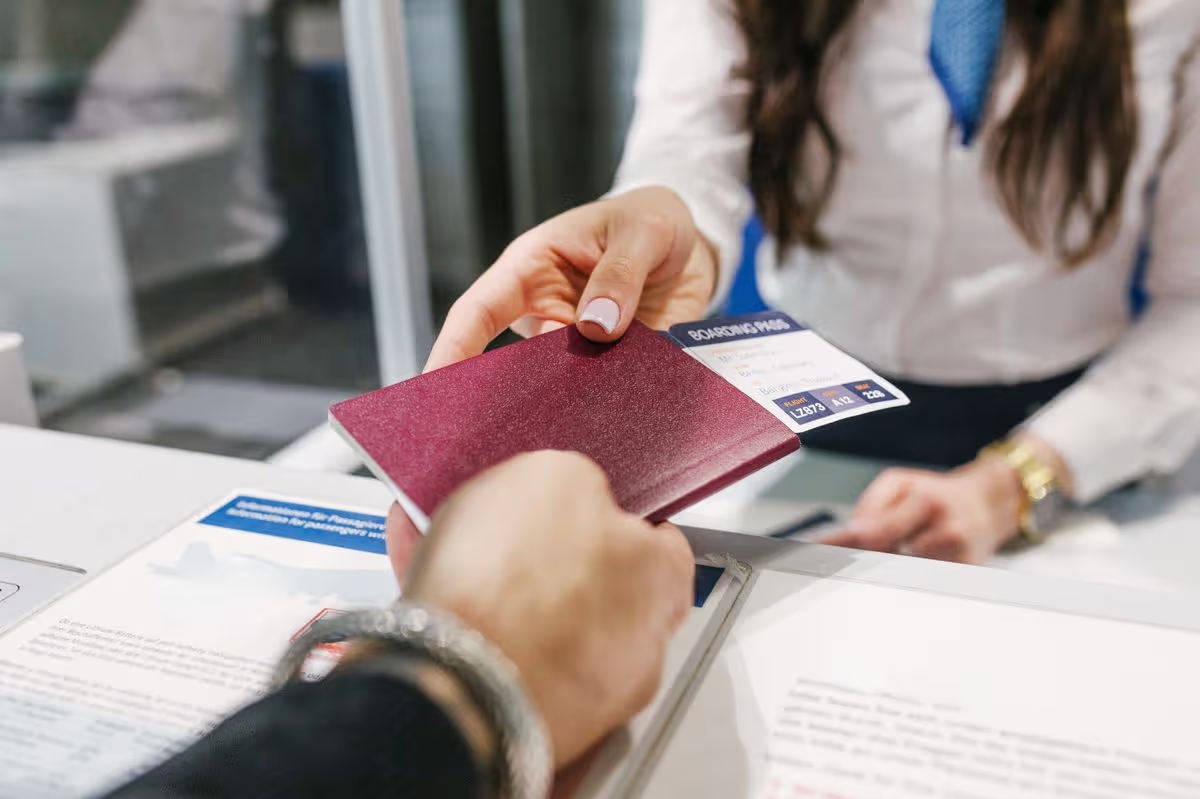
A travel expert has shared five vital passport checks Brits should make before jetting off on holiday this summer – and failing to do so could mean being denied boarding at the airport

Many people will be going on a holiday soon(Image: Getty Images)
Many people will be counting down the days until their next holiday. With children set to wrap up for the school year, many families are gearing up for a summer of fun. Now a travel business owner has called on all British passport holders to carry out five crucial checks before jetting off abroad this summer.
Kate Donnelly, who posts travel advice on TikTok, urged her followers to take action now to prevent being turned away at the departure gate. While some of her guidance might appear straightforward to experienced travellers, she insists certain issues continue to trip up numerous Brits and wreck their holiday plans at the eleventh hour.
Passport validity
Her initial recommendation is to verify the expiry date – as the majority of European destinations require at least three months’ validity remaining from the date you depart the country.
“This is slightly different if you are travelling to Turkey where you have to have a validity of 150 days on the day you actually arrived,” Kate explained. “So it’s really important you check the country you are travelling to and see what their rule is.”
10-year rule
Following this, Kate alerted her followers to the 10-year rule, which she states is applicable to most of Europe. “On the day that you enter [the country] your passport has to be less than 10-years-old – so it’s important you check the issue date as well as the expiry, especially if your passport was renewed before 2018 because unused months from your old passport will have likely been added on to your new on meaning that your passport is probably 10-years plus,” she said. “This is catching so many people out.”
Blank pages
Third on Kate’s list is the matter of blank pages in your passport. “This isn’t as important as due to the new Entry-Exit System (EES) in Europe we are slowly phasing out passport stamping,” she admitted. “But the reality is lots of countries are bringing in measures, which means the EES is paused.”
Regrettably, when travelling to such destinations, you won’t discover whether the EES is operational or not until you get there. “Therefore if the airline checks your passport and you have no empty pages left, they are well within their right to refuse boarding,” Kate warned.
Condition
Kate proceeded to emphasise the physical state of your passport is something that is frequently neglected and could present a genuine obstacle to your travel arrangements. “If it has water damage, if it has fake tan on it, if it is torn or you can’t read any of the writing for whatever reason, this is also enough grounds for the airline to deny you boarding,” she elaborated.
Dual-nationals
Kate directed her final piece of advice at dual-nationals, who are impacted by a rule modification that came into effect in the UK in February. “UK citizens have to ensure they have a UK passport or a certificate of entitlement when they are entering or exiting the UK,” she continued. “This means that you can no longer use your non-UK passport – even if you are recognised as a British citizen.
She closed by advising the certificate of entitlement is £589 and therefore it is more “cost-effective” for dual-nationals to apply for their UK passport to keep alongside their non-UK one at all times. “This means you have the two to use freely depending on which country you are travelling to,” Kate said.