

checks

Florida and Mississippi enact voter citizenship checks, sparking a lawsuit in the Sunshine State

Governors in Florida and Mississippi signed into law measures that require officials to verify the citizenship of voters, just as similar legislation being pushed by President Trump has stalled in Congress.

The law signed Wednesday by Florida Gov. Ron DeSantis was immediately challenged in court by civil rights organizations that said it will make it harder for Floridians to vote.

The citizenship provision of the law goes into effect Jan. 1. It requires voters to provide a birth certificate, passport or naturalization certificate as proof of citizenship if their eligibility to vote is challenged by government officials through cross-referencing voter registration applications with motor vehicle records.

“Many eligible voters do not have these documents and cannot obtain them for a variety of reasons — including because they were born without a birth certificate in the segregated South, because their documents were destroyed in a hurricane, or because they cannot afford the hundreds of dollars it costs to replace them,” the civil rights groups said in a lawsuit filed in federal court in South Florida.

The voting legislation being pushed aggressively by Trump in Congress would mandate that people provide documentary proof of citizenship to register to vote in federal elections, such as a U.S. passport, citizen naturalization certificate or a combination of a birth certificate and government-issued photo identification. It passed the House but was stalled in the Senate before lawmakers took a spring recess.

Under the Florida law, credit cards, student IDs and retirement community identifications can no longer be used as IDs when voting, and the citizenship status of a driver must be reflected on driver’s licenses starting in July 2027.

DeSantis said the law improves the security and transparency of Florida’s election system.

“In Florida, we will always stand up for election integrity,” the Republican governor said.

The new Mississippi law signed Wednesday requires local officials registering people to vote to run additional citizenship checks if applicants don’t have or can’t provide driver’s license numbers on their voter application. The law, which takes effect July 1, also requires the secretary of state to run annual checks of the voter rolls against an online database from U.S. Immigration and Customs Enforcement to flag any potential noncitizens who could be asked to provide proof of their eligibility.

“This is another win for election integrity in Mississippi [and America],” Mississippi Gov. Tate Reeves, a Republican, said in a social media post. “We will continue to do everything in our power to make it infinitely harder — with a goal to make it impossible — to cheat in our elections!”

The Southern Poverty Law Center has said that the law could disenfranchise hundreds of thousands of Mississippians who don’t have a passport, lack a birth certificate or whose last names don’t match their birth certificates because of name changes due to marriage.

Four Republican-led states — Florida, Mississippi, South Dakota and Utah — have enacted laws this year to strengthen proof-of-citizenship requirements for voters. In Michigan, supporters of voter citizenship documentation have submitted 750,000 petition signatures in a bid to get a constitutional amendment on the November ballot.

The Republican-led Kansas Legislature also has passed legislation, though it still must go before the Democratic governor. Gov. Laura Kelly has until next week to decide whether she’ll sign the bill and hasn’t said publicly what she will do, though she has regularly vetoed past GOP-election bills. Supporters would need a two-thirds majority to override a veto — and thanks to Republican dissenters, the bill appeared to be a few votes short of that in the House.

Any efforts in Kansas to prevent noncitizens from registering to vote are shadowed by one of the state’s biggest political fiascos in recent memory — a requirement imposed in 2013 that people registering to vote in the state for the first time provide documentation of their U.S. citizenship.

That law ended up blocking the voter registrations of more than 31,000 U.S. citizens who were otherwise eligible to vote, or 12% of everyone seeking to register in Kansas for the first time. Federal courts ultimately declared the law an unconstitutional burden on voting rights, and it hasn’t been enforced since 2018.

Schneider writes for the Associated Press. AP writers David A. Lieb in Jefferson City, Mo., and John Hanna in Topeka, Kan., contributed to this report.

Source link

Anyone driving abroad this summer urged to make ‘five checks’ by Green Flag

With the summer holidays on the horizon, travel lovers are preparing for their getaways

An insurance provider has shared a checklist for drivers planning a European getaway. Ahead of summer, many families and adventurers are preparing for road trips or holidays abroad. For anyone planning to drive their car in Europe, Green Flag recommends checking five things before setting off.

Sharing advice for motorists online, Green Flag said: “It’s worth taking a few minutes to make sure everything is properly arranged before you head off on your European travels. A quick check, a few weeks before you go, means you’ll have time to address anything that’s not already in place. Take a few minutes and check:

  1. Whether any existing breakdown cover includes European travel
  2. Which countries are covered under the policy
  3. You have your vehicle insurance documents
  4. Your driving licence and passport are valid
  5. Any local driving requirements, such as safety equipment rules and items you’re expected to have in your car.”

The motoring experts explained that drivers should know their breakdown cover options, which could help them decide whether to take out European breakdown cover for the trip. Green Flag said the insurance helps drivers if their car develops a fault or breaks down during a trip outside of the UK but within Europe.

If drivers don’t take out insurance and then experience difficulties, it could prove costly. Green Flag said: “If you don’t have European breakdown cover and your car develops an issue while travelling abroad, you’d need to call up a breakdown and rescue service that operates in the country you’re in.

“This usually means contacting a local recovery operator and paying for roadside help and towing directly. Costs vary depending on the country, time of day and distance involved.

“In many cases, payment is required upfront, and getting English-speaking help may be difficult depending on where you are.” Green Flag added that you might also need to arrange accommodation and pay the costs to return your car to the UK if it can’t be repaired locally.

Despite this, some drivers might decide to go ahead without additional breakdown cover. The blog advised: “Whether it’s worth getting breakdown cover for your trip to Europe depends on how much of a risk you consider breaking down abroad to be.

“If you’re happy to figure things out should they happen, then maybe European breakdown cover isn’t for you. But if you’d rather set off knowing you’re covered should your car break down, then you’ll probably want to consider getting European breakdown cover.”

Nonetheless, knowing your options ahead of travel means you’re prepared in case of an emergency. For drivers considering European cover, insurers often offer single-trip or multi-trip cover.

Source link

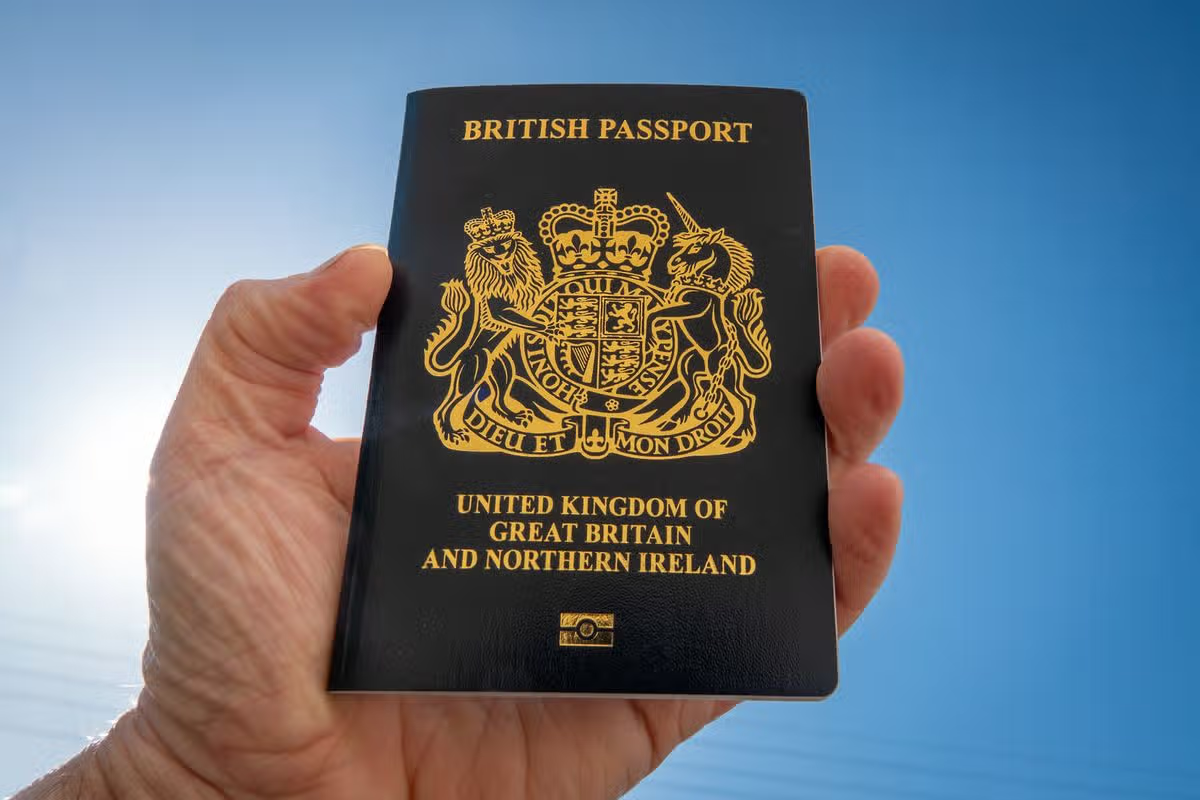
HM Passport Office warning for Brits – 3 key checks to do now ahead of summer

The HM Passport Office has issued a warning to Brits about passport checks they must carry out well in advance of any impending holidays over spring and summer

HM Passport Office has issued a warning to Brits ahead of the peak travel season.

With the Easter half-term just weeks away and plans already made for a summer getaway, thousands of holidaymakers will be jetting off abroad during one of the busiest travel periods. To ensure their journey gets off to a flying start, Brits are being urged to check their passports; otherwise, they risk being turned away at the airport.

In a stark reminder, the HM Passport Office advised Brits to “check your passport now” in a post shared on X, ahead of any spring or summer trips. A link in the post directed travellers to the government website, where they can apply online to renew, replace, or update their passports.

READ MORE: UK Foreign Office updates Egypt travel advice amid Middle East tensionsREAD MORE: Easter passport warning for Brits as common mistake could see you turned away at the airport

There are two key dates you should check on your document; the expiry date, and the issue date, especially if you’re planning to head to a European hotspot such as France, Spain or Greece. This is because of a post-Brexit regulation on travel to the European Union or Schengen countries, which stipulates that UK passports must have been issued less than 10 years before your departure and must be valid for at least 3 months after your return.

Meanwhile countries such as Australia, China, Thailand, the United Arab Emirates, Indonesia, and India require at least 6 months of passport validity from the date of arrival. It’s vital to check any entry requirements and passport validity before making any travel plans.

You must also ensure your passport has not been physically damaged, as this may render it invalid. This could include ripped pages, water damage, separated covers, or anything else that might make the personal information difficult to read.

Travel expert Jamie Fraser at Wild Packs warned that the general wear and tear of a passport can also be problematic when passing through automated scanners or at airport border control points. So it’s vital to check that your passport is in good condition, or if you need to apply for a replacement.

There must also be a blank page at the back of the passport for any necessary stamps or visas. If the passport is crammed with stamps from past trips, it could create problems at the border if there aren’t enough blank pages, leaving you unable to travel.

If your passport has expired or needs to be replaced, you can apply for a new one through the government website. However, it’s crucial to do it well in advance, as it can take around three weeks and sometimes longer.

There are fast-track passport services available, but Jamie cautioned that these are not “always guaranteed and appointments can be limited during peak travel periods”. HM Passport Office also advised: “Do not book travel until you have a valid passport – your new passport will not have the same number as your old one.”

To renew or replace your standard passport online, it will cost £94.50, or £107 if you opt for a paper application. Meanwhile, a child’s passport will cost £61.50 online or £74 by post.

Do you have a travel story to share? Email webtravel@reachplc.com

Source link