SACRAMENTO — Cori Close’s candid remarks about the growing challenges of coaching in modern college athletics sparked a reaction nationwide among her peers.
On Thursday, the UCLA women’s basketball coach was asked about the rapid changes shaping college sports ahead of her Bruins’ Sweet 16 matchup against Minnesota on Friday night. The No. 1-seeded Bruins (33-1) entered the Sweet 16 round considered a strong Final Four contender, powered by one of the deepest starting lineups in the nation.
“I’ve never been as tired as I’ve been in the last two years, and it’s made me think how much longer I can do this,” Close said. “And I’m just being transparent with you about that. There are so many things that are harder, and we keep losing incredible people on the men’s and the women’s side.”
UCLA has dominated throughout the season, entering the Sweet 16 on a 27-game winning streak that dates to late November. Three starters — Lauren Betts, Charlisse Leger-Walker and Gianna Kneepkens — began their college careers elsewhere before transferring into the program.
“How do we now figure out this transfer portal? Let’s not complain about it,” Close said. “Let’s have solutions about what’s right and what adjustments need to be made. … I’m a huge advocate for NIL. It should have happened 20 years ago. And we need boundaries. We need infrastructure. We need competitive equity. We need transparency.”
In contrast, Louisville coach Jeff Walz offered a more critical perspective when addressing the same topic during a NCAA news conference in Fort Worth, Texas.

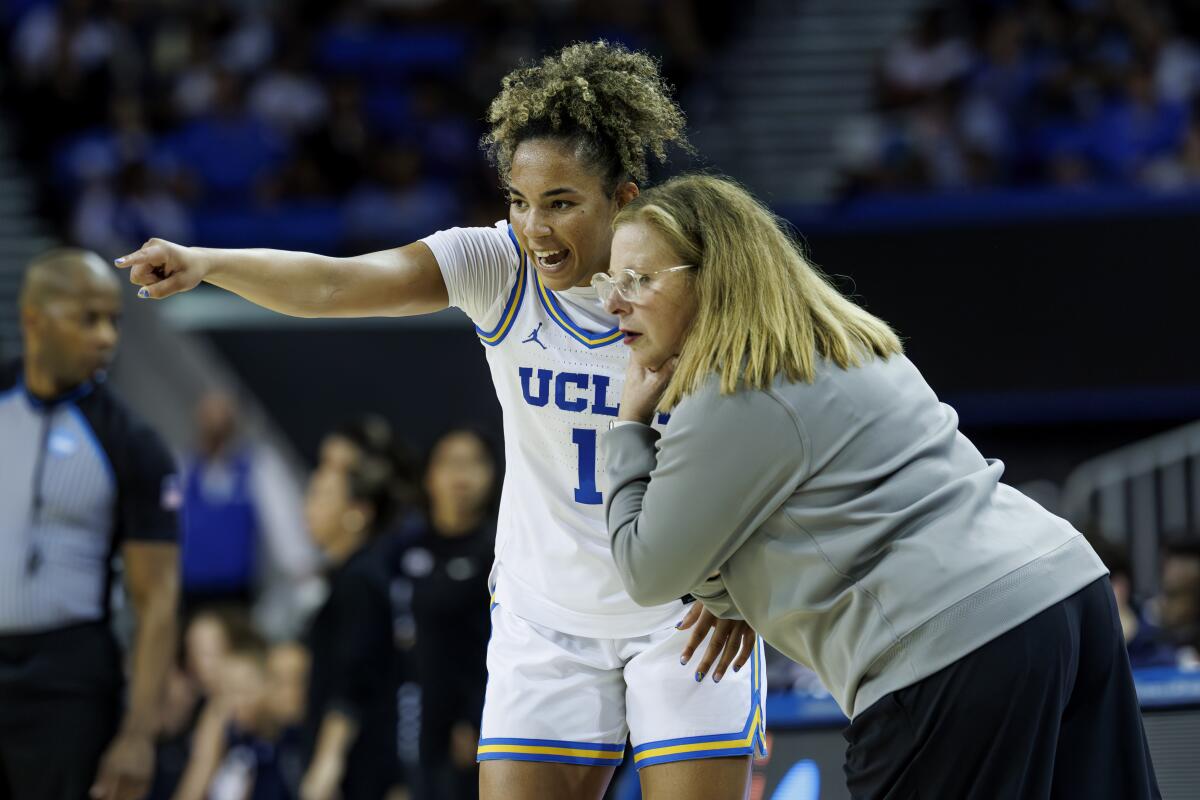
UCLA guard Kiki Rice points across the court while talking with Bruins coach Cori Close during an NCAA tournament win over California Baptist at Pauley Pavilion on March 21.
(Gina Ferazzi/Los Angeles Times)
“I’m friends with Cori,” Walz said. “My favorite line, I would tell her, if you don’t like your job, find a new job. I mean, I’m listening this morning at 4:20 as the workers outside my window at the hotel in the street are working. I mean, you choose your profession. If you don’t like it, find a new profession.”
No. 3-seeded Louisville will face No. 2 Michigan on Saturday after falling short against Duke in the ACC championship game.
Close, who has spent 33 years in coaching, including 15 at UCLA, has navigated an evolving landscape shaped by name, image and likeness compensation policies and the transfer portal, just like everyone else. Last season, she earned national coach of the year and led the Bruins to the program’s first Final Four. UCLA has now reached at least the Sweet 16 during four consecutive seasons and eight times during Close’s tenure in Westwood.
This year, the Bruins swept through Big Ten play undefeated and once again secured a No. 1 seed in the NCAA tournament.
“I mean, of course, it’s a lot of work, but we chose to do it and we get compensated for it,” Walz said. “I don’t think anybody is going to feel too sorry for us that you might be tired. I’m tired, too, but who is not?”
Several longtime coaches have stepped away from the game in recent years, amid, though not always directly attributed to, the sport’s ongoing transformation. Hall of Fame Stanford coach Tara VanDerveer retired in 2025, while Georgia Tech’s Nell Fortner, Iowa’s Lisa Bluder and Harvard’s Kathy Delaney-Smith stepped down during the past three seasons.
“It’s ever-changing, and that’s the frustrating part, because you can never get a grasp on any of it,” Kentucky coach Kenny Brooks said. “You think that you have it. Then all of a sudden, it’s like somebody pulls a rug out and says, ‘No, we’re changing it,’ and now it’s going to be this way now. We want to get out ahead of everything, but we can’t. We always seem like we’re one step behind because there are so many changes.”
Ultimately, Close’s message centered on the need for structural support in a rapidly shifting environment.
“If there’s one thing I would ask of our governing bodies and the NCAA and our administrations is please develop infrastructure and boundaries that create an opportunity to have sustained excellence and sustainable pace,” she said. “Otherwise, we are going to continue to lose some of our best coaches, and I do not think our game can afford to do that.”