no .

Rosalind Ashford, original Martha and the Vandellas singer, dies at 83

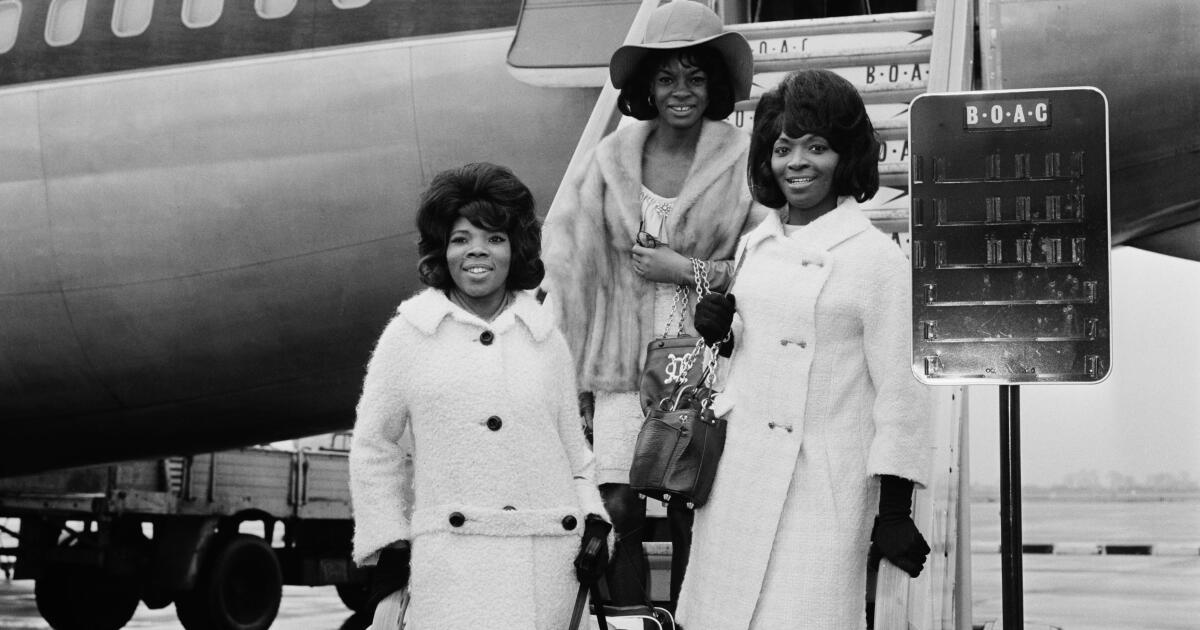
Rosalind Ashford, the soprano behind hits from Martha and the Vandellas including “Dancing in the Street” and “Heat Wave,” has died. She was 83.

The singer died of natural causes on Tuesday in the Michigan suburb of Redford Township, per the Detroit Free Press.

Ashford was an original member of the Motown girl group Martha and the Vandellas, best known for their timeless soul pop songs. She sang on more than 20 of the group’s top 40 singles on Billboard’s R&B chart, including “Heat Wave,” which hit No. 1, and “Dancing in the Street,” which peaked at No. 2 on the U.S. Billboard Hot 100 chart.

“I am deeply saddened to hear about the passing of Rosalind Ashford,” Martha Reeves said in a statement. “Rosalind played an important part in the early days of Martha and the Vandellas. Her voice will forever be with us through our great recordings together, and she will be missed, but never forgotten. Our Motown Family has just gotten a little smaller. My heart is heavy.”

In 1995, Martha and the Vandellas were inducted into the Rock & Roll Hall of Fame, becoming the second all-female group to land the acclaim.

Born on Sept. 2, 1943, to John and Mary Ashford, the budding soprano developed her chops singing in the church choir and then in the glee club at Wilbur Wright High School in Detroit. In 1957, the musically inclined teen landed an audition at the Detroit YMCA, and it was there that she, Annette Beard and Gloria Williams linked up with local music manager Edward “Pops” Larkins, and formed the girl group the Del-Phis.

According to the Motown Museum, the Del-Phis invited Reeves — then a secretary to William “Mickey” Stevenson, Motown’s Artists and Repertoire director — to join their girl group. Together, they took on gigs as backup singers, including on Marvin Gaye’s early songs “Hitch Hike” and “Pride and Joy.”

The Del-Phis became Martha and the Vandellas when “My Guy” singer Mary Wells missed a fortuitous recording session. Reeves, with the Del-Phis singing backup, filled in for Wells, and Motown was so impressed, the label signed the group to the Gordy label in 1962, sans Williams, who left the group around this time.

The trio’s breakout hit, “Come and Get These Memories,” was released in 1963 and performed well on the Billboard charts, reaching No. 6 on the R&B singles chart. “(Love Is Like a) “Heat Wave” dropped the same year and topped the charts, followed by “Quicksand,” which also became a top-10 hit. The 1967 song “Jimmy Mack” went to No. 1 on the Billboard R&B singles chart and was the final top-10 hit in the U.S. for the group.

“Heat Wave” scored the group a Grammy nomination for best R&B recording for 1964 and made the trio the first Grammy-nominated Motown group.

Ashford left the group and the music business behind in 1969, and worked at the Michigan Bell Telephone Co., though she would occasionally reunite with former Vandellas members for reunion performances.

Classic Motown posted a tribute to the singer on Thursday, writing that her harmonies served as the soundtrack to a generation. “The Motown family mourns the passing of a true icon, Rosalind Ashford,” read the statement. “As an original founding member of Martha and the Vandellas, Rosalind’s vocal talent helped define the golden era of the Motown sound.

“Rosalind’s contribution to American music and Motown history will never be forgotten. Rest in power, Rosalind. Thank you for the music.”


Source link

Prep talk: Big day for girls’ sports on Saturday

It’s a day and night to celebrate women in sports.

MaxPreps is hosting an 18-team flag football tournament in San Diego. No. 1 JSerra is competing.

In the evening, Nike has flown in a custom-made outdoor volleyball court so Sherman Oaks Notre Dame can host Harvard-Westlake in a 7 p.m. girls’ volleyball match played on the Notre Dame baseball field. There will be food trucks, music and other surprises.

There’s also the Venice girls volleyball tournament taking place at Venice High and the Woodbridge Classic cross-country meet at the Great Park in Irvine.

This is a daily look at the positive happenings in high school sports. To submit any news, please email eric.sondheimer@latimes.com.


Source link

Ray LaMontagne topples over onstage in Nashville, where the high hits 101

Folk singer Ray LaMontange was treated for heat-related dehydration after collapsing onstage during a weekend performance amid triple-digit heat in Nashville.

On Saturday, the 53-year-old toppled to the side while performing his popular track “Jolene” in front of a sold-out,crowd at Ryman Auditorium, according to recorded fan footage.

There were reports that LaMontagne had lost his place earlier in his set when performing “Hannah,” per Consequence. According to the National Weather Service, temperatures in the Nashville area reached a high of 101 degrees.

Later that night, LaMontagne’s management released a statement through his Instagram stories, sharing that the Grammy winner was in “good hands with local EMS” and that he was being treated for “heat-related dehydration.”

LaMontagne returned to the stage the following night, performing at the Louisville Palace in Kentucky, where he made no mention of the incident.

Last month, the Americana singer — best known for tracks “You Are the Best Thing” and “Hold You in My Arms” — had kicked off his 20th anniversary tour.

The tour is named after his 2004 debut album, “Trouble,” which is platinum certified in both the United States and United Kingdom; though the album reached only No. 164 on the Billboard 200 chart, it hit No. 5 on the U.K. Albums chart.

Known for his gruff vocals, LaMontagne first came to the scene in the early aughts as a timid troubadour. The New Hampshire-born, Utah-raised artist was once a former shoe factory worker from Maine whose singer-songwriter journey began when he woke up one morning to Stephen Stills’ “Treetop Flyer” on his clock radio.

All nine of LaMontagne’s albums — with the exception of his independently released 2024 LP, “Long Way Home” — have charted in the Billboard 200.

LaMontagne will continue on with his Trouble tour — which features special guest the Weather Station — through Oct. 3, closing out at New York City’s Beacon Theatre.


Source link

Venus, Serena Williams’ success backs science on younger siblings

Whenever Venus and Serena Williams decide to permanently close the door on their storied careers — the duo are competing in the U.S. Open’s women’s doubles this week after receiving a wild-card invitation — the extraordinary tale of two sisters from Compton, just 15 months apart, who both reached No. 1 and won bushels of major titles will continue to reverberate. It might be the most implausible sports story of the last 50 years.

Although Serena’s career accomplishments exceed her older sister’s by considerable margins, including a 23-7 advantage in singles majors, what if Venus had been the baby of the Williams bunch? Would those numbers have evened out?

It’s a fair question.

Research has shown that younger siblings often benefit from being last in the birth order, sometimes called a “younger-sibling effect.” Turns out, the proverbial runt of the litter may have an edge. And while the Williams sisters remain the gold-standard example in tennis, the sport has no dearth of cases, from Alexander Zverev and Andy Murray to Naomi Osaka and Tracy Austin, to name a few.

The birth-order advantage

Serena and Venus Williams hold their trophies after winning the women's doubles final at Wimbledon on July 9, 2016.

Serena and Venus Williams hold their trophies after winning the women’s doubles final at Wimbledon on July 9, 2016.

(Tim Ireland / Associated Press)

To researchers, Serena’s rise is not an isolated miracle of genetics, but a classic expression of family dynamics. Dr. Joseph Baker, a sports scientist at the University of Toronto, has found that elite athletes are statistically far more likely to be later-born children. “The birth-order effect means there’s some kind of social or genetic element in the family environment that’s driving it,” Baker says.

Dr. Frank Sulloway, a psychology research associate at the University of California, Berkeley, has found that the younger-sibling effect is a modest but reliable and statistically significant trend. While not deterministic — elite firstborns like John McEnroe and Novak Djokovic remain towering counter-examples, and both had younger siblings that played professionally — the later-born tilt repeats across the athletic landscape.

The backyard crucible

Some investigators trace the younger sibling effect to “situated learning.” That is, developing mastery through hands-on engagement, social modeling, and “vicarious experience,” according to Baker.

“Seeing someone from the same family unit achieve greatness gives the younger sibling the confidence to achieve the same,” he says.

For Serena, who is the youngest of five sisters in the blended Williams family, that meant learning to return Venus’s blistering serve on Compton’s public courts. It meant watching her more heralded older sibling navigate a mostly white women’s tour as a teenager. Because Venus was more experienced and stronger, Serena was forced to accelerate her development just to compete. And since their father, Richard Williams, largely kept them out of junior tournaments, that interdependent learning likely proved especially potent.

“I was able to learn, so I didn’t make the same mistakes she made,” Serena said in 2009. Now 44, Serena returned to compete at Wimbledon in singles and has teamed up for several doubles events this season, including in Cincinnati last month with 46-year-old Venus, after saying she was “evolving away from tennis” following her last appearance at the 2022 U.S. Open.

Sisters  Jessica Korda and Nelly Korda walk on the ninth green at the Aramco Championship on April 3  in Las Vegas.

Sisters Jessica Korda and Nelly Korda walk on the ninth green at the Aramco Championship on April 3 in Las Vegas.

(Harry How / Getty Images)

This crucible is not unique to tennis.

Michael Jordan famously credited his older brother, Larry, with igniting his competitive fire. Golfer Nelly Korda followed older sister Jessica onto the LPGA Tour before surpassing her with major titles and an Olympic gold medal, while Peyton and Eli Manning grew up amid the backyard competition of a football-obsessed family that produced two Super Bowl-winning quarterbacks.

The “rough draft” of parenting

Beyond hardwood or turf battles, younger siblings can benefit from a profound shift in parental behavior, a phenomenon Louisiana Tech University sport and exercise psychology professor Dr. Jordan Blazo calls the “rough draft hypothesis.”

Firstborn children are often a parent’s athletic test drive. Parents often face a steep, expensive learning curve when navigating youth sports with older children, overscheduling them and committing developmental mistakes. By the time a younger sibling arrives, parents know the ropes and the pathways to pursue, according to Blazo, who studies sibling relationships and social comparison in sports. They are more attuned to financial and other feasibilities, which gives them a clearer road map to success.

Southern California native Austin, the youngest of three accomplished tennis children and the youngest U.S. Open champion in history at 16 years and 9 months, says her physicist father maintained healthy boundaries. When Tracy once invited him to watch her play German great Steffi Graf, he declined because of a computer club meeting. “Having a parent that wasn’t overly engrossed in my winning and losing was the healthiest thing,” Austin says.

Meanwhile, her mother, having navigated four older siblings’ athletic careers, was free to travel with 14-year-old Tracy because the nest was empty.

Russia’s Mirra Andreeva, 19, agrees. The reigning French Open winner followed her sister, Erika, three years older, onto the pro tour. “I had more benefits because I’m younger,” said fifth-ranked Mirra of her sister, who has been ranked as high as No. 65. “[My] parents obviously knew what to do. Tennis-wise… maybe that saved me some time.”

Zverev, who followed brother Mischa, 9 years his senior, says traveling to pro events as a kid helped normalized the ATP Tour early. “Maybe I wasn’t as nervous… because I’ve seen them and known them for years,” says Germany’s Zverev, who captured his first major title at this year’s French Open and is the top seed in New York.

Swing for the fences: Risk-taking

This competitive ecosystem also shapes how younger siblings play. Sulloway’s research on birth order and risk-taking reveals that later-borns are more psychologically wired to take strategic risks to carve out their own niche and stand out in the family.

Sulloway’s 2010 study of Major League Baseball brothers, conducted in collaboration with psychologist Richard Zweigenhaft, found that later-born siblings were vastly more likely to attempt to steal bases (and were more successful at it) than their first-born brothers. They were also far more likely to strike out because they were literally swinging for the fences, a high-risk, high-reward strategy. In tennis, this could translate to a willingness to play more aggressively, such as going for more on second serves rather than playing it safe, according to Sulloway.

Warmth over hostility

Yet, this sibling incubator seems to work best with one critical condition: the familial relationship is based on warmth and companionship. Blazo’s research shows that when sibling dynamics are colored by hostility and toxic comparisons, younger siblings experience “differentiation.” They can suffer from lower perceived competence, burn out, and ultimately quit or flee to other sports to escape the older sibling’s shadow, which isn’t necessarily a negative course correction. Sometimes it works out best for both.

In other words, the most successful sporting siblings preserve their emotional bonds. Richard and Oracene Williams famously enforced a sisters-first rule, allowing Venus and Serena to battle on court but walk off as best friends. Mirra Andreeva says her parents taught them that sisters are “the closest people we’re gonna have in life,” and to protect that bond they rarely practice together to keep emotions from getting “messy.”

Sisters Venus and Serena Williams hold the U.S. Open doubles winners' trophy on Sept. 12, 1999.

Sisters Venus and Serena Williams hold the U.S. Open doubles winners’ trophy on Sept. 12, 1999.

(Al Bello / Getty Images)

When Venus and Serena were leapfrogging each other early in their careers, often clashing in Grand Slam finals across continents and surfaces, Serena insisted their competition existed in a supportive environment. Certainly it did in doubles, where they teamed up to win three Olympic gold medals and 14 major titles, including two at the U.S. Open in 1999 and 2009.

At the 2001 U.S. Open, where Venus beat Serena in the first all-Williams Grand Slam final, Serena said: “If anything I prefer to play Venus because that means that we have reached our maximum potential and that we’ll both go home winners. So for me, I always want to see Venus do well. I never want to see Venus lose.”

The long shadow

The McEnroe brothers, John and Patrick, separated by seven years, also saw their supportive relationship boost Patrick’s career. When Patrick, the youngest of three boys, was struggling in college and his mother pressured him to take the law boards, John stepped in, telling her to let Patrick chase his pro tennis dreams. Patrick eventually cracked the top 30 in singles and reached No. 3 in doubles, though he never reached the heights of John, who won seven Grand Slam titles and reached No. 1 in both singles and doubles.

“I think it holds water,” Stanford University alum Patrick said of his last-born experience, citing other examples such as Andy Roddick, whose older brother John was an accomplished collegiate player, and Hall-of-Famer Arantxa Sánchez Vicario, the youngest of four whose two older brothers, Emilio and Javier, were top ATP players. “It just so happened that my brother was exponentially more talented than I was as an athlete, but it’s definitely what at least got me into tennis.”

John McEnroe and his brother Patrick compete during in a doubles match in Richmond, Va., on Sunday, Feb. 6, 1984.

John McEnroe, left, and his younger brother Patrick compete during in a doubles match in Richmond, Va., on Sunday, Feb. 6, 1984.

(Joanna Pinneo / Associated Press)

The comparisons to John, however, played both ways. Patrick said they motivated him as a junior, but felt like a burden when he was trying to establish himself on tour.

With many physical, emotional and psychological variables in play, researchers admit it’s hard to pinpoint where DNA ends and drive begins when it comes to sibling dynamics. Ultimately, genetics and talent establish the ceiling, but the evidence suggests a supportive sibling ecosystem helps alchemize raw potential into greatness, and the sibling that benefits most is the one that comes later.

For Serena, the competitive yet protective shield provided by Venus was critical to her own success. Venus went first. She absorbed the bulk of pressure, provided the model and set the standard her younger sister spent a lifetime chasing, and eventually surpassing.

“Just everything that she does inspires me,” Serena said.

Source link

Scottie Scheffler breaks Tiger Woods’ career PGA Tour earnings record

Tiger Woods was going for his seventh straight PGA Tour victory when he tied for second at Torrey Pines. He earned $264,000 that day to move to No. 1 in career tour earnings.

That was Feb. 13, 2000, and Woods stayed there ever since — until Sunday.

Scottie Scheffler won the Tour Championship to capture his second FedEx Cup title and the $10 million prize — now considered official money — to raise his career total to $130,390,661.

Woods had been at $120,999,166 since he made his last cut on the PGA Tour at the 2024 Masters.

This is an entirely different era of golf, and Scheffler finally topping Woods in career earnings was inevitable. That it happened so quickly is a testament to Scheffler’s dominance. He has been No. 1 in the world since May 2023.

The popularity and momentum Woods brought to the sport 30 years ago generated enormous spikes in prize money. And then with the arrival of Saudi-funded LIV Golf in 2022, the PGA Tour responded with even greater increases to keep more players from defecting.

There were 15 prize funds of $20 million or more this season on the PGA Tour schedule. Woods never played for a $10 million purse during his peak years from 1997 through 2009.

Woods won the FedEx Cup twice when it was worth $10 million, all in bonus money. Scheffler earned $23 million in bonus money last week by leading the FedEx Cup in points. The FedEx Cup finale has counted as official the last two years.

Most telling about the rapid increase in money was the 2024 Masters. Woods, at age 48 and trying to recover from multiple back surgeries and a 2023 car crash that shattered his right leg and ankle, finished in last place and made $44,000.

Scheffler won the Masters that year and moved to No. 12 on the career earnings list at $57,658,464. He has earned just over $72.7 million in his last 50 tournaments over two years and four months.

It was a matter of time, and it really doesn’t matter to Scheffler.

“The reason our purses are so large today is because of the influence and impact that Tiger had on the game,” Scheffler said before the Tour Championship started. “I wouldn’t really consider that a Tiger record being broken. I think it just shows one of the many effects he had on the game of golf in a positive way.”

Scheffler indicated last week in St. Louis the Tiger number he cares about his victories. Scheffler won for the 22nd time Sunday at East Lake. Woods shares the PGA Tour record at 82 victories.

Ferguson writes for the Associated Press.

Source link

Dolly Parton dead: Country music legend and national treasure dies at 80

Dolly Parton, the singer and songwriter from Locust Ridge, Tenn., who willed herself into being the very symbol of country music stardom, has died in Nashville.

Parton died peacefully Tuesday, her nephew Bryan Seaver announced in a press release shared with The Times. Seaver also announced her death in a video shared to the singer’s Instagram page. She was 80.

The fabled entertainer died after a series of health issues that led her to postpone several performing commitments. In September 2025, she missed the announcement of a Dollywood attraction to recover from a kidney stone. Later that month she delayed her residency at Caesars Palace — her first residency on the Las Vegas Strip in more than 30 years — due to unspecified “health challenges.”

Over the course of a flamboyant 50-plus-year career as a songwriter, recording artist, actor and businesswoman, Parton reinvented the American success story through a combination of grit and wit, faith and sex appeal, virtuosity and plainspokenness, empathy for the human condition and plastic surgery.

She seized on the roles that American culture allowed for women in the spotlight — waif, trollop, fallen woman, country girl in over her head — and played them to the hilt, achieving artistic and financial heights few female performers have ever reached. By the time of her death, she was said to be one of the few things that Americans of most every persuasion could agree on.

One of the most honored musicians in modern history, Parton earned 10 Grammy Awards, two Academy Award nominations, a Primetime Emmy, 10 Country Music Assn. awards, and in 1999 she was enshrined in the Country Music Hall of Fame.

In 2005 President George W. Bush presented Parton with the National Medal of the Arts, and a year later she was given a Kennedy Center for the Arts Award for her lifetime contribution to the arts. Parton logged some 25 gold or platinum records and 25 No. 1 songs on the country chart. Parton also won a Liseberg Applause Award, the biggest prize in the theme park industry, for her fabled tourist attraction Dollywood.

Parton’s rags-to-riches tale reads like a classic country music story-song. But before it became mythical, it was only incredibly hard.

Dolly Rebecca Parton was born in Locust Ridge, Tenn., in the Great Smoky Mountains, on Jan. 19, 1946. Her father was a tobacco sharecropper and she was the fourth of 12 children. In her autobiography, “Dolly: My Life and Other Unfinished Business,” Parton related how her parents were so poor they paid the doctor who delivered her with a sack of cornmeal.

Raised in a one-room cabin with no electricity, she listened to the Grand Ole Opry on a battery-powered radio. When she was 7 she started writing songs; a year later she picked up the guitar. At 10 she was singing on a Knoxville radio and TV program, “Cas Walker Farm & Home Hour.”

The Parton family was musical, and there were always banjos, fiddles, mandolins and guitars around the cabin. Her voice, a birdlike soprano with an animated trill, hadn’t changed much from her youth: “I sound like a little girl singing all these Lord-awful songs,” she told “Fresh Air’s” Terry Gross in 2001.

On a Friday night in 1964, Parton became the first in her family to graduate from high school. The next afternoon she was on a bus heading for Nashville, targeting a career in country music.

Dolly Parton and Bob Hope dressed in reindeer costumes with a stage hand making adjustments

Bob Hope gets an adjustment to his reindeer costume as he and Dolly Parton prepare to tape a 1988 Christmas special on a cruise ship docked in Miami.

(Kathy Willens / Associated Press)

Women had little real power in Nashville at the time, and though rural women were a growing part of the country music audience, they were marginalized as artists. Parton signed to the Monument label, but felt that they wanted a pop singer more than they wanted her. An early breakthrough came when singer Bill Phillips heard a demo version of her “Put It Off Until Tomorrow”; not only did he want to record the song, but he recorded it with Parton singing harmony on it. The song went to No. 6 on the country chart in 1966.

In 1967 she recorded Curly Putman’s “Dumb Blonde,” her first charting song as a singer and a savvy choice that spoke to her as both an image and as flesh and blood, as she sang:

Just because I’m blond
Don’t think I’m dumb
‘Cause this dumb blond ain’t nobody’s fool

Nashville noticed. That year, country music star Porter Wagoner was looking for a new “girl singer” for his popular TV show, after Norma Jean left. Parton got the gig, and for weeks, legend has it, was greeted by the studio audience shouting “Norma Jean” when Parton opened her mouth. It was the kind of challenge she lived for. Carefully deferential to the star, Parton carved out a foothold for herself.

They were a complicated team. Tall, gaunt and calculating, Wagoner’s angles had angles, but somehow standing next to her, his pompadour dwarfing her considerable bouffant, it worked. At their peak, they had a weekly TV viewership of over 3.5 million, and recorded numerous hit duets, “Holding on to Nothin” (1968), “If Teardrops Were Pennies” (1973) and “Please Don’t Stop Loving Me” (1974) among them.

On her solo recordings at the time, Parton included a raft of songs about poor children in trouble. These gothic, occasionally autobiographical compositions, including “Coat of Many Colors,” “My Blue Ridge Mountain Boy,” “Evening Shade,” “Daddy Come and Get Me” and “Down From Dover,” would have been more than enough to make her, if not a star, at least a country music legend. But the kind of attention even her lesser work with Wagoner enjoyed continued to elude her own material.

Dolly Parton and Kenny Rogers laugh together on a stage

Dolly Parton and Kenny Rogers laugh together backstage at an April 2010 show honoring her “Islands in the Stream” singing partner.

(Rick Diamond / Getty Images)

By 1973, Parton realized that if she was going to be her own star she would have to be on her own. Wagoner fought and threatened, and finally, Parton wrote a song as a way to help him understand both her gratitude and her need for independence, “I Will Always Love You.” He liked the song, but it didn’t convince him. Wagoner sued her for $20 million over breach of contract and settled for $1 million.

But Parton had won her freedom, and she made the most of it. Her album from that year, “My Tennessee Mountain Home,” was a reintroduction to her audience, an autobiographical cycle of songs telling the story of a singer leaving home to make it on Music Row. And in 1974, “Jolene” became her chart-topping breakthrough.

The title was the name of a red-haired, green-eyed young fan Parton met signing autographs, and the story of a woman begging a rival to leave her man alone. Parton said she made it up after discovering a bank teller had a crush on her husband. With a beveled chord progression and a haunting repetition of the name, it became perhaps her most requested song, and was covered by many, including the White Stripes, Candi Staton, Reba McEntire and Olivia Newton-John.

“I wanted to be seen, I wanted to be recognized, I wanted to be a star,” she explained. The last part was now coming into focus.

In 1976 she hosted a short-lived variety TV series, “Dolly!” Her name was her brand, and so, too, was her profile: the full bosom and tiny waist, platinum wig and baubles like sprinkles on an ice cream cone, 5 feet tall standing in five-inch heels. She was a disarming contradiction: manufactured and utterly sincere.

“A country girl’s idea of what glamour was,” she explained.

“I didn’t have any money to have stuff and I’ve often joked about it, but it’s the real truth that I patterned myself after what they considered the trash in our hometown.” She took shame and made it a flag, one big enough for all sorts of Americans to settle beneath.

Dolly Parton looks at sparkling costumes in a museum display case

Dolly Parton checks out an exhibit honoring her life and career at the Country Music Hall of Fame and Museum in May 2025.

(Jason Kempin / Getty Images)

Building on her fame, in the mid-’70s Parton decided to reinvent herself by reaching beyond the confines of country music. She signed with L.A.-based talent manager Sandy Gallin, who had made Mac Davis a country crossover star and would soon work with Cher and Michael Jackson.

Parton laid off her longtime Traveling Family Band and sought out musicians and songs that were more purely pop. Hits that followed included “Here You Come Again” (No. 20 on the pop chart, 1977), “Heartbreaker” (No. 37, 1978) and duets with Kenny Rogers like “Islands in the Stream” (No. 1, 1983).

The pop move was muttered over and seen by gatekeepers as a rejection of Southern-based authenticity. It was the era of “Urban Cowboy” and purity was being policed. “I love country music. It’s my first love,” she told the SoHo News. “But it was confining. You can only go so far in a circle.”

The movie “9 to 5” from 1980 settled her broadening stardom; acting alongside Jane Fonda and Lily Tomlin in a comedy about three office workers who get even with an abusive boss, Parton charmed viewers. It was her first acting role, and Roger Ebert called her “a natural born movie star.” She wrote and sang the movie’s theme song, which topped Billboard’s pop and country charts.

A black and white photo of Jane Fonda, Dolly Parton and Lily Tomlin at a 1980 news conferene

Dolly Parton and her “9 to 5” castmates Jane Fonda, left, and Lily Tomlin assemble at a 1980 news conference to promote the movie.

(Wally Fong / Associated Press)

Parton would go on to act in “The Best Little Whorehouse in Texas” (1982), “Rhinestone” (1984), “Steel Magnolias” (1989), the “Hannah Montana” TV series (she was Miley Cyrus’ godmother in real life too), and in many more films and TV shows. But her biggest cinematic moment came with a song she’d written years before; “I Will Always Love You” was sung by Whitney Houston in the 1992 film “The Bodyguard,” turning her air kiss to Porter Wagoner into a No. 1 hit for 14 weeks.

In the mid-1980s, Parton suffered a number of setbacks. She experienced depression. “I was just broken down,” she said later. In 1982, abdominal pain and bleeding forced her to cancel a tour, and in 1984 she had a partial hysterectomy. There were bouts of binge eating, and when she hit bottom she considered suicide. A series of conversations with God were instrumental in her recovery, Parton said.

Underscoring her connection to her origins while also illustrating how far she had gone, in 1986 she bought an old amusement park in Pigeon Forge, Tenn., and reinvented it as Dollywood, a booming theme park, resort and theater. Other businesses included Sandollar Productions, a film and TV company. In the 1990s Parton formed her own label, Blue Eye Records.

Success meant she could settle into being Dolly. A trio of beloved bluegrass albums, “The Grass Is Blue,” “Little Sparrow” and “Halos & Horns,” around the turn of the millennium reestablished her as a performer with extensive roots in rural America. She recorded with everyone from Linda Ronstadt and Emmylou Harris to Ladysmith Black Mambazo. Her 2019 cover of John Hiatt’s “Faith,” made with Swedish duo Galantis, topped the EDM charts.

She embraced her Christian and LGBTQ+ fans, and perhaps no American artist had more of each. Inclusivity mattered to Parton. She was an icon to the LGBTQ+ community. In 2002 at the House of Blues in Los Angeles, Parton replaced the name Jolene with “drag queen” and sang her famous song as a roster of drag performers looked on.

A woman in a yellow cowboy hat plays a guitar onstage at an awards show

Dolly Parton at the 57th Academy of Country Music Awards in 2022.

(John Locher / Associated Press)

Just two years later, in 2004, the Library of Congress presented Parton with the since-retired “Living Legend Medal,” which sought to recognize those that made significant creative contributions to American life.

Singer and songwriter Brandi Carlile called Parton “an angel on my shoulder and also the devil on my other shoulder.”

“When I was 15 years old I read the back of Dolly Parton’s book when she became the first country artist ever to speak out in support of LGBTQ people. And I can tell you that as a queer kid from a small town, getting love from Dolly is second only to God.”

Parton has been honored in musical tributes by Carrie Underwood, Alison Krauss and Shania Twain. “Jolene” became the subject of the short story “Jolene: A Life,” by E.L. Doctorow. In 2019 WNYC and Jad Abumrad presented “Dolly Parton’s America,” a nine-segment podcast devoted to, and with the cooperation of, Parton; it examined her persona and impact on American life.

That same year Netflix presented “Dolly Parton’s Heartstrings,” an anthology series in which each episode presents a fictional narrative built around a Parton song; the series features appearances by Kathleen Turner, Delta Burke and Melissa Leo.

Dolly Parton meets President Jimmy Carter and First Lady Rosalynn Carter at the White House

Dolly Parton and President Carter embrace as First Lady Rosalynn Carter looks on before a White House luncheon in October 1979.

(Georges / Associated Press)

Her influence was so vast she has even been proposed as a field of academic study, and scrutinized in the 2018 academic study from Leigh H. Edwards, “Dolly Parton, Gender, and Country Music.”

She was married to the same man, Carl Thomas Dean, for over 50 years. They met on the day she arrived in Nashville in 1964, as she stood outside a laundromat. Parton and Dean were rarely seen in public together, and renewed vows in 2016. Dean died at age 82 in March 2025.

“Carl and I spent many wonderful years together,” Parton said in a statement at the time. “Words can’t do justice to the love we shared for over 60 years. Thank you for your prayers and sympathy.”

Parton remained a source of interest and fascination, and though few if anyone could really claim to know her, many thought they did. As she once put it: “I look one way and am another. It makes for a good combination.”


Source link

50 memorable moments from 50 years covering high school sport

This is my 50th year covering high school sports in Southern California. Here are my most memorable moments since 1976.

Former Crespi quarterback Captain Randy Redell (left) and sportswriter Eric Sondheimer in 1998.

Former Crespi quarterback Captain Randy Redell (left) and sportswriter Eric Sondheimer (right) prepare to board an F–16 fighter jet for their 82-minute flight at Shaw Air Force Base in Sumter, S.C., in 1998.

(Freelance)

1: It’s 1998. I’m in Sumter, S.C., invited to fly in an F-16 with former Crespi quarterback Randy Redell, an Air Force graduate, captain and pilot. To get cleared, I have to pass a pre-flight instruction class how to use a parachute and an explanation what to do with the barf bag. Randy, apparently at the egging on by his father, Bill, the football coach at St. Francis, takes the F-16 straight up. The G force is like a roller-coaster ride on steroids. Later he tells me to take control of the plane with the stick as I wear my helmet and oxygen mask and hear his instructions on the radio. Yes, it’s like riding a magic carpet. How can anything top an F-16 ride?

Bret Saberhagen pitched a no-hitter for Cleveland in the 1982 City final at Dodger Stadium.

Bret Saberhagen pitched a no-hitter for Cleveland High School during a 13-0 win over Palisades for the City Section championship at Dodger Stadium in 1982.

(Courtesy of Linda Saberhagen)

2: It’s June 14,1982. The City Section championship baseball game is at Dodger Stadium, where Bret Saberhagen of Cleveland High pitches the first and only no-hitter in championship game history. He retired 21 of 22 batters in a 13-0 win over a Palisades team that included an infielder named Steve Kerr. Saberhagen would go on to win two Cy Young Awards.

Associated Press Sports Editors award in 1988 for Eric Sondheimer story on Kentucky basketball recruit.

Associated Press Sports Editors award in 1988 for Eric Sondheimer story on Kentucky basketball recruit.

(Eric Sondheimer / Los Angeles Times)

3.: The lead story on ESPN’s 11:30 p.m. SportsCenter on April 13, 1988, was a report from the Los Angeles Daily News detailing a package that accidentally opened at an air freight service containing 20 $50 bills addressed to a high school basketball star at Fairfax and sent from the University of Kentucky. It led to NCAA sanctions against Kentucky and lots of resignations. My work gave me a lesson on the impact dedicated local journalism can have with a single story.

In 2001, Marcedes Lewis tries to get past De La Salle defenders.

In 2001, Marcedes Lewis tries to get past De La Salle defenders.

(David Kawashima)

4: The game of the century that changed high school football forever was Long Beach Poly vs. Concord De La Salle in 2001 before 17,321 fans at Veterans Stadium and a national TV audience. It was 11 days after the 9/11 terrorist attack. It was No. 1 De La Salle, coached by Bob Ladouceur, with a 116-game winning streak and running back Maurice Drew. No. 2 Poly had coach Raul Lara, tight end Marcedes Lewis and many other future college players. De La Salle won 29-15. From that game on, TV games featuring high school football multiplied and schools began to travel around the country for marquee matchups.

Dorsey coach Paul Knox celebrates miracle win in 2001 City championship game at Coliseum.

Dorsey coach Paul Knox celebrates miracle win in 2001 City championship game at Coliseum.

(Robert Gauthier / Los Angeles Times)

5: Never has there been an ending quite like the 2001 City Section football final at the Coliseum. Taft leads Dorsey 14-13 with seven seconds left. A fourth-down punt from the 32-yard line will run out the clock. But Dorsey’s Jesus Jimenez blocks the punt and Henry Badge picks up the bouncing ball in the end zone with no time left for a 19-14 win. “The ending was the craziest I’ve ever had,” Dorsey Hall of Fame coach Paul Knox said.

.The Northridge Little League All-Star team from 1994 was honored with a ticker-tape parade down Disneyland's Main Street.

.The Northridge Little League All-Star team from 1994 was honored with a ticker-tape parade down Disneyland’s Main Street.

(Kari Rene Hall/The Los Angeles Times)

6.: The Earthquake Kids from Northridge Little League made it to the championship game of the Little League World Series in Williamsport, Pa., after the destructive 1994 Northridge Earthquake. Some of these 11- and 12-year-olds had unbelievable personalities, like a player named Matt Cassel. I got to see what a Northeast thunderstorm was like and see the big hill that kids slide down.

Former Granada Hills quarterback John Elway from the 1979 yearbook.

Former Granada Hills quarterback John Elway from the 1979 yearbook.

(Los Angeles Times)

7: It’s a 1977 City Section football playoff game that has gone into overtime. John Elway is the quarterback for Granada Hills. Jay Schroeder is the quarterback for Palisades. Both would become Super Bowl quarterbacks. But on this day, they had to try to deliver victory in a California tiebreaker, with the ball placed on the 50-yard and the team that advanced the ball farthest after alternating plays wins. On the seventh of eight plays, Elway completed a 28-yard pass to Scott Marshall to clinch victory.

Crespi's Russell White carries the ball during a game against St. John Bosco on Nov. 7, 1986.

Crespi’s Russell White carries the ball during a game against St. John Bosco on Nov. 7, 1986.

(John McCoy / Los Angeles Times)

8: In 1986, a sophomore running back with stunning skills, Russell White, leads Crespi to the San Fernando Valley’s first and only Southern Section Division 1 football championship with a 49-14 win over St. John Bosco. He goes on to star at Cal and gets drafted by the Rams. He becomes the commissioner of the Oakland Section, then football coach at Flintridge Prep. Forty years later, his son, Zachary, was a star basketball player at Sherman Oaks Notre Dame.

9: I rarely go to City Section Division III championship basketball games — unless my alma mater, Sun Valley Poly, is involved. It was 2019, and right before the start, I learned that Roybal coach Danny O’Fallon was dying of cancer. As the buzzer sounded and Roybal won, 51-47, O’Fallon collasped onto the gym floor in tears. Players came back to form a huddle around him and comfort him. It’s the most emotional, gut-wrenching scene. I get tears each and every time I watch video of the moment. He’d die a year later in 2020 at the age of 49. Bill Plaschke wrote a heart-warming column.

Anaheim Canyon players celebrate after winning the 2015 Division 2AA championship with a 28-point comeback win over Lawndale.

Anaheim Canyon players celebrate after winning the 2015 Division 2AA championship with a 28-point comeback win over Lawndale.

(Eric Sondheimer / Los Angeles Times)

10: The 2015 Southern Section Division 2AA championship basketball game at Honda Center produced the greatest comeback I’ve witnessed, with Anaheim Canyon rallying from a 28-point deficit in the third quarter and 22-point deficit in the fourth quarter to defeat Lawndale 103-98 in double overtime. Nick Anderson scored 37 points. Canyon coach Nate Harrison was exhausted and exhilarated afterward.

Harry Welch, the only football coach to win three state titles at three different schools, w

Harry Welch, the only football coach to win three state titles at three different schools _ Canyon Country Canyon, Santa Margarita and St. Margaret’s.

(Eric Sondheimer / Los Angeles Times)

11: When it comes to upsets, few were bigger than Canyon Country Canyon beating the nation’s No. 1-ranked football team, De La Salle, 27-13, in the inaugural CIF Division I state championship bowl game in Carson in 2006. Coach Harry Welch, on his way to a Hall of Fame career, orchestrated everything with a little help and belief from his players.

Brisket, ribs and mac and cheese at Pecan Lodge in Dallas.

Brisket, ribs and mac and cheese at Pecan Lodge in Dallas.

(Eric Sondheimer / Los Angeles Times)

12: I always wanted to see what Texas high school football was like after reading the book, “Friday Night Lights,” and experience Texas barbecue. It happened in 2021 when Mater Dei played Duncanville. I spent two days traveling around, seeing Allen High’s $62-million stadium, watching a game at AT&T Stadium and tasting BBQ. All the reports were true _ Texas is one of a kind.

13: One of my first experiences with writing a story about transfers happened in 1981, when a tiny guard, Zach Lieberman, went from Montclair Prep to Taft to Granada Hills Kennedy. Then two 6-10 players suddenly showed up at Kennedy, provoking a City Section investigation. Twenty-one years later, Lieberman revealed the truth in what proved to be an early peek at the current state of affairs in high school basketball.

Harvard-Westlake's twin towers Jarron (left) and Jason Collins in 1994.

Harvard-Westlake’s twin towers Jarron (left) and Jason Collins in 1994.

(For the Times)

14: In the 1990s, the Collins twins, 7-foot Jason and 6-11 Jarron, arrived at Harvard-Westlake, and the rest is history. They’d win state championships, star at Stanford and play in the NBA. In 1999, while they were at Stanford, I wrote a story about their special bond. Former UCLA coach John Wooden said of their progress, “I think they’ve improved. I’m sorry [UCLA] didn’t get them. It’s nice to get twins who are talented and good students.” Jarron’s two daughters are playing for Harvard-Westlake and a son is in eighth grade. Jason died May 12, 2026, of brain cancer. He was 47.

Masaki Matsumoto coaching at Bernstein High in 2013.

Masaki Matsumoto coaching at Bernstein High in 2013.

(Cheryl A. Guerrero / Los Angeles Times)

15: People were telling me in 2013 about an innovative, creative football coach named Masaki Matsumoto at Bernstein High in Hollywood. I found out the coach sent home letters to parents asking them to write a letter to their son and say something positive while expressing their love. Reading the letters myself and seeing players read out loud with tears in their eyes provided a powerful example what can happen when parents express their true feelings. It led to a story that became an ESPN documentary. Matsumoto now coaches at Lincoln High in Tacoma, Wash.

In 2014, Caleb Wilson of Gardena Serra tries to make a catch in a playoff game won by Corona Centennial 68-64.

In 2014, Caleb Wilson of Gardena Serra tries to make a catch in a playoff game won by Corona Centennial 68-64.

(Marcus Yam / Los Angeles Times)

16: Trying to keep statistics when Corona Centennial is using its no-huddle offense is challenging, but doing it in a wild 2014 playoff game against another no-huddle offense run by Gardena Serra was mind-boggling. Centennial won 68-64 in a game that had 15 lead changes and 12 touchdown passes.

Birmingham's Peyton Waters, center, tries to outjump Del Norte defenders for a Hail Mary pass in the final seconds of a game.

Birmingham’s Peyton Waters, center, tries to outjump Del Norte defenders for a Hail Mary pass in the final seconds of the Division 3-AA regional bowl game. It went off his hands and was caught by teammate Devyn Taylor with no time left for the win.

(Craig Weston)

17: It’s not every night you get to see a miracle play work. In a 2023 regional playoff game in San Diego, Birmingham trailed Del Norte 28-24. Birmingham had one final play from its 48-yard line. Quarterback Kingston Tisdell avoided the rush and threw the ball down the middle. It went off the hands of Peyton Waters and landed in the hands of Devyn Jackson for a game-winning touchdown.

18: The pandemic was about to shut down high school sports in 2020. The final high school basketball game turned out to be a memorable Open Division regional final between Sierra Canyon and Etiwanda at Cal State Northridge. Sierra Canyon rallied from 11 points down in the fourth quarter to win 63-61 on a shot at the buzzer by future NBA player Ziaire Williams. The state championships were canceled.

Former Akron St. Vincent-St. Mary High School basketball teammates, from left, LeBron James, Dru Joyce III, and Willie McGee

Former Akron St. Vincent-St. Mary High School basketball teammates, from left, LeBron James, Dru Joyce III, and Willie McGee, appear in their high school gym on Friday, Aug. 21, 2009.

(Amy Sancetta / Associated Press)

19: On Jan. 4, 2003, Los Angeles got its first look at a teenage basketball player everyone said was destined for greatness. The hype was so big he sold out Pauley Pavilion. LeBron James scored 21 points to help St. Vincent-St. Mary’s defeat Mater Dei 64-58. I was not impressed with his three-point shooting, but his work ethic changed that. He’d be drafted No. 1 overall by the Cleveland Cavaliers. He’s entering his 24th NBA season and is the all-time NBA scoring leader. But my biggest memory was the family sending someone to get him food from Burger King instead of Lawry’s at a media event that week.

Chino Hills guard LaMelo Ball pulls up for a shot over Mater Dei’s Michael Wang and Matthew Weyand (21).

Chino Hills guard LaMelo Ball pulls up for a shot over Mater Dei’s Michael Wang and Matthew Weyand (21).

(Allen J. Schaben / Los Angeles Times)

20: In 2017, a sold-out crowd of more than 10,000 showed up at USC’s Galen Center to witness an astounding basketball doubleheader featuring a playoff semifinal matching Chino Hills against Mater Dei and Bishop Montgomery against Sierra Canyon. It was an electric atmosphere and the games lived up to expectations. Mater Dei, led by future NBA player Bol Bol, beat Chino Hills and LaMelo Ball in overtime. Bishop Montgomery upset No. 1-seeded Sierra Canyon and future NBA first-round draft pick Marvin Bagley Jr. Anyone who attended will say it was the best two games of high school playoff basketball they’ve seen.

Los Angeles Angels starting pitcher Jered Weaver

Los Angeles Angels starting pitcher Jered Weaver throws to the plate during the second inning of his no-hitter against the Twins in 2012.

(Uncredited/ASSOCIATED PRESS)

21: Major League Baseball beat writers need occasional breaks during the season, so on May 2, 2012, I was recruited to fill in for Mike DiGiovanna to report on the Angels-Twins game from Angel Stadium. I was excited to get to see former Simi Valley pitcher Jered Weaver on the mound. I’m also the good-luck writer. Whenever I cover a pro game, strange things happen. Sure enough, Weaver threw a no-hitter in my only Angel game of the year. Maybe Shohei Ohtani should invite me to his next start for the Dodgers.

: Right–hand pitcher Lucas Giolito (right) and left–hander Max Fried (left) of Harvard–Westlake in 2012.

: Right–hand pitcher Lucas Giolito (right) and left–hander Max Fried (left) of Harvard–Westlake in 2012.

(Los Angeles Times)

22: I’m sitting in the Harvard-Westlake dugout in January 2012 interviewing Max Fried and Lucas Giolito, two future first-round draft picks. Fried arrived after Montclair Prep canceled its sports program. They’d go on to be major league pitchers after each endured arm surgeries. Somehow, they got placed in the same classes, starting a friendship that will last a lifetime. Here’s video of that moment.

Crenshaw football coach Robert Garrett.

Crenshaw football coach Robert Garrett.

(Robert S. Helfman)

23: Covering the City Section is about telling stories of overcoming road blocks, dealing with adversity and rising up to lead. In 2012, I told the story of three lifers as football coaches — Robert Garrett of Crenshaw, Paul Knox of Dorsey and Mike Walsh of San Pedro.

Former Granada Hills football and baseball coach Darryl Stroh (right)

Former Granada Hills football and baseball coach Darryl Stroh (right) with his former co-football coach Tom Harp.

(Eric Sondheimer / Los Angeles Times)

24: The legend of coach Darryl Stroh was proven in 1987 when Granada Hills upset unbeaten Carson in the City Section championship football game. He and co-coach Tom Harp would win more City titles in baseball and volleyball, respectively.

Sherman Oaks Notre Dame baseball coach Tom Dill with his former pupil, Giancarlo Stanton.

Sherman Oaks Notre Dame baseball coach Tom Dill with his former pupil, Giancarlo Stanton.

(Eric Sondheimer / Los Angeles Times)

25: I never thought I’d run into a better all-around athlete than John Elway. Then Mike Stanton, now known as Giancarlo Stanton, showed up at Sherman Oaks Notre Dame and by his senior year in 2007, he was All-CIF in football, basketball and baseball. As baseball coach Tom Dill said, “He’s a highlight reel every three or four games.” The only thing he couldn’t do was make free throws. He would lose a contest to Shaquille O’Neal.

Jon Garland pitching for Kennedy High.

Jon Garland pitching for Kennedy High.

(Los Angeles Times)

26: The reason I like baseball best among all the sports in Southern California is because it produces the most pro prospects every year, and it’s not even close. There’s so many top pitchers I’ve seen before they were household names. Paul Skenes. Gerrit Cole. Jack McDowell. Bret Saberhagen. Max Fried. It goes on and on. Here’s a story from 2024 looking at the best pitchers through the years.

Brentwood coach Ryan Bailey.

Brentwood coach Ryan Bailey.

(Eric Sondheimer / Los Angeles Times)

27: In 2018, the basketball championships in the City Section and Southern Section became a breakthrough season for Black coaches. It was time to offer thanks to the likes of Willie West at Crenshaw and Reggie Morris of Manual Arts for paving the way for the next generation of Black head coaches.

Hall of Fame basketball player Gail Goodrich returns to Sun Valley Poly High for a ceremony to name the gym after him.

Hall of Fame basketball player Gail Goodrich returned to Sun Valley Poly High for a ceremony to name the gym after him in 2025.

(Eric Sondheimer / Los Anges Times)

28: In 1999, I got to talk to two of my favorite people all-time — John Wooden and Gail Goodrich. Wooden told the story of how he spotted Goodrich at a high school basketball game. I spoke to Wooden numerous times calling him at his Encino condo. Every time he picked up, he was friendly and made me feel so lucky speaking with a living legend. Goodrich became a Hall of Famer out of my alma mater, Poly High in Sun Valley, where the gym was named in his honor last year.

Nine months after brain surgery for a football injury, Nathan Santa Cruz of Venice ran the anchor leg in the 4x400 relay

Nine months after brain surgery for a football injury, Nathan Santa Cruz of Venice ran the anchor leg in the 4×400 relay and helped the Gondoliers finish second at the City Section championships and earn spot in state championships.

(Craig Weston)

29: On the opening night of the 2022 high school football season, 15-year-old sophomore Nathan Santa Cruz of Venice suffered a head injury that resulted in emergency brain surgery to save his life. Thanks to the fast action of medical personnel at the game and at the hospital, he was back running track nine months later. It took months of being patient waiting for people to be willing to talk about the emotional scene to explain how his life was saved. He returned to play football in 2023 and 2024.

Long Beach Poly coach Sharrief Metoyer throws his hands up in an act of exasperation along the sidline.

Long Beach Poly coach Sharrief Metoyer throws his hands up in an act of exasperation along the sidline.

(Los Angeles Times)

30: The frustration with CIF transfer rules reached an unprecedented moment in a 2013 state basketball playoff game between Long Beach Poly and Mater Dei. Poly coach Sharrief Metoyer chose to put into the game an ineligible player in protest. I watched in horror knowing the consequences. He’d never coach another game for Poly. It was sad that a young, promising coach had made a terrible mistake. He was suspended for a year and then resigned.

31: In 2015, I learned a valuable lesson: Don’t tweet that a game is over until it’s really over. With San Marino down 21 points in the fourth quarter to Sierra Canyon in a state football playoff game I tweeted, “Start warming up the bus to Sacramento for Sierra Canyon.” Well, San Marino rallied for a 36-35 victory. I don’t think Sierra Canyon coach Jon Ellinghouse will ever forgive me for the jinx.

Servite coach Troy Thomas, in 2009, is congratulated by assistant coach Ken Foersch, now the president of Crespi.

Servite coach Troy Thomas, in 2009, is congratulated by assistant coach Ken Foersch, now the president of Crespi.

(Christine Cotter/Los Angeles Times)

32: I still think Edison had the best football team in 2009. Unfortunately, it rained and rained and Angel Stadium became a soggy field more suitable for ducks. The surfer team couldn’t handle it, with Servite beating the Chargers 16-6 in the Pac-5 championship game. It was Edison’s only loss of the season and the Chargers had beaten Servite in the regular season. I remember walking on the field afterward and ruining my shoes and seeing Servite players love every moment of playing in the rain.

With downtown in the background, Contreras football coach Manuel Guevara stands on his school's field.

With downtown Los Angeles in the background, Contreras football coach Manuel Guevara prepares for another obstacle this season — ICE raids that strike fear among his players and their parents.

(Eric Sondheimer / Los Angeles Times)

33: In the summer of 2025, immigration agents, dressed in tactical gear and riding on horses and in armored vehicles, made a show of force through MacArthur Park trying to strike fear into the immigrant community. And they did. More than 20 players skipped football practice at Contreras in downtown Los Angeles. I went there and saw the fear on the faces of players wondering if their parents would even show up to games in the fall. It resulted in an important story how teenagers were being affected by ICE.

34: The Wolf brothers, Jim and Randy, from El Camino Real, were destined to do what they loved best — umpire and pitch, respectively, in the major leagues. Their dreams came true. In 1997, as each was doing the hard preparation work to fulfill their goals, I wrote a story, “Brothers of Summer.” “It’s like trying to get on the Supreme Court,” Randy said of his brother’s umpire journey. “It’s just sticking it out and not giving up,” Jimmy said.

Quarterback Josh Rosen, in a 2013 photo, celebrating St. John Bosco going 16-0.

Quarterback Josh Rosen, in a 2013 photo, celebrating St. John Bosco going 16-0.

(Gina Ferazzi / Los Angeles Times)

35: St. John Bosco finished 16-0 in 2013 with a 20-14 win over De La Salle before a record crowd of 16,791 in Carson to win the Open Division state championship bowl game. The game had drama and excitement but what really stayed in my memory was quarterback Josh Rosen jumping into the stands and getting his photo taken with St. John Bosco fans and students.

In 1992, Eric Sondheimer presents Taft High grad Quincy Watts a gift from winning the 400 meters at the Olympic Games.

In 1992, Eric Sondheimer presents Taft High grad Quincy Watts a gift from winning the 400 meters at the Olympic Games.

(Eric Sondheimer / Los Angeles Times)

36: It’s 1992, and Taft High graduate Quincy Watts won the 400 meters at the Olympic Games in Barcelona. He came home with two gold medals and his alma mater honored him. I got to present him a framed newspaper copy of his achievement. Twenty years later, I wrote a story with the headline: Quincy Watts is a role model for what is possible.

Former Taft standout Steve Smith had his No. 2 jersey number retired and brought his three sons.

Former Taft standout Steve Smith had his No. 2 jersey number retired in 2023 and brought his three sons, Jordan (left), Theo and Carter.

(Craig Weston)

37: Steve Smith was a prodigy at Taft High in football and basketball. He made amazing receptions and dunked against anybody. He had his football jersey retired in 2023. He joined the City Section Hall of Fame in 2025. He became a standout receiver for USC and a Super Bowl champion with the New York Giants. He and his brother, Malcolm, a linebacker and another Super Bowl winner, were examples of all the good that can happen when raised by parents to be respectful and humble.

Serra High School receiver Robert Woods in 2008.

Serra High School receiver Robert Woods in 2008.

(Los Angeles Times)

38: In 2008, I met a promising receiver at Gardena Serra, Robert Woods, and learned what his motivation would be for years — make his older sister, Olivia, proud after she had died of cancer in the spring at the age 17. He’d become an All-American at USC and Super Bowl winner with the Rams.

39: Rodrick Pleasant of Gardena Serra was fast. He was so fast that in 2022, I was there at Moorpark High to see him run the fastest wind-legal 100 meters time in state history, 10.14 seconds, as he let out a primal scream.

Windward freshman Juju Watkins could be a trendsetter in women's basketball. She's averaging 21 points as a 14-year-old.

Windward freshman Juju Watkins could be a trendsetter in women’s basketball. She’s averaging 21 points as a 14-year-old.

(Eric Sondheimer / Los Angeles Times)

40: First there was Cheryl Miller, then Lisa Leslie. They were the faces of high school girls’ basketball in Southern California. Along came JuJu Watkins, a 14-year-old freshman at Windward who her coach, Vanessa Nygaard, told me in 2020, “Her potential is unknown.” She became The Times’ player of the year as a freshman. Her skills were off the charts, as was her personality. Her great-grandfather, Ted Watkins, was a revered leader in Watts in the 1960s. In the era of NIL, she got an agent, signed a shoe deal, transferred to Sierra Canyon and became the No. 1 player in the country before signing with USC and becoming a national figure.

Jim Toring, then a Harvard-Westlake High School senior, is photographed in the campus pool in Studio City.

Jim Toring, then a Harvard-Westlake High School senior, is photographed in the campus pool in Studio City on May 25, 1993.

(Brian Vander Brug/For The Times)

41: It’s May 3, 1998, and I have tears at the celebration of life for Jim Toring, one of America’s greatest athletes in the sport of water polo. I met him when he was a freshman at Harvard-Westlake. His coach, Rich Corso, told me how great he’d become. He led UCLA to two NCAA titles and was destined to be a star for the U.S. Olympic water polo team in 2000. He was killed at the age of 23 in a bus accident in Paris.
`

Former Campbell Hall and Northridge Little Leaguer Michael Frost poses for a photo at home.

Former Campbell Hall and Northridge Little Leaguer Michael Frost.

(Los Angeles Times)

42: In 2000, Michael Frost was a senior at Campbell Hall and asked to look back at what happened to him as a 12-year-old. He struck out to end Northridge Little League’s 4-3 loss to Venezuela in the 1994 Little League World Series. I wrote: “He was only 12, too young to think his life was ruined but old enough to understand he had gone through a life-changing experience.” Six years later: “It was very hard to get over that. I learned how to deal with it and it became one of the best life experiences I’ve ever had, to come back from a failure and strive to be better.” The power of moving forward. He ended up pitching in college.

Carson coach Elijah Asante addressing players in the locker room in 2010 before 14-10 upset of Mater Dei.

Carson coach Elijah Asante addressing players in the locker room in 2010 before 14-10 upset of Mater Dei.

(Eric Sondheimer / Los Angeles Times)

43: It was the first football game of the 2010 season, and Carson coach Elijah Asante invited me to be a passenger on the bus to and from Santa Ana Stadium for a game against Mater Dei. He wore a microphone in the locker room and allowed me to give readers a behind-the-scenes look. Incredibly, Carson defeated Mater Dei 14-10 and it was my favorite video ever shot.

Riding in a jeep on a muddy road in Kenya is sportswriter Eric Sondheimer, right and basketball coach Steve Miller.

Riding in a jeep on a muddy road in Kenya, sportswriter Eric Sondheimer and former North Hollywood basketball coach Steve Miller do a podcast in 2018.

(Eric Sondheimer / Los Angeles Times)

44: Before Zoom, before podcasts became big, I was taping a weekly show for YouTube with former North Hollywood basketball coach Steve Miller entitled, “Sondy and the Coach.” In 2018, one episode was taped in a jeep while driving on a muddy road in Kenya and shaking back and forth. It was safari time.

Brothers, Jrue and Justin Holiday of the Campbell Hall basketball team in 2005.

Brothers, Jrue and Justin Holiday of the Campbell Hall basketball team in 2005.

(Robert Lachman / Los Angeles Times)

45: In 2014, Jrue Holiday of Campbell Hall acted like he was a most normal high school student even though everyone predicted NBA stardom was ahead. The lead of a column was: “Standing at the entrance to the gymnasium at North Hollywood Campbell Hall and wearing a Disneyland hat with the name ‘Grumpy’ emblazoned on its front, a smiling and playful Jrue Holiday hardly fit the profile of an All-American high school basketball player who, in a couple of years, could be playing with or against Kobe Bryant.” He was the manager for the girls’ tennis team and did the dishes at home.

Jack McDowell sent a signed plaque of his 1993 Cy Young Award to Eric Sondheimer.

Jack McDowell sent a signed plaque of his 1993 Cy Young Award to Eric Sondheimer, who covered him in 1984 at Sherman Oaks Notre Dame.

(Eric Sondheimer / Los Angeles Times)

46: Jack McDowell was one of the best and most competitive high school athletes ever. In 1984, he helped pitch Sherman Oaks Notre Dame to a 27-1 record. He became an All-American at Stanford and Cy Young Award winner with the Chicago White Sox. His battle with umpires was legendary. “There were umpires in the Valley who trembled at the thought of being behind home plate with McDowell on the mound,” I wrote. “He might have been only a teenager, but he wasn’t afraid to bark out an expletive if he didn’t like a pitch call.” He sent me a framed and autographed plaque of his 1993 Cy Young Award. It showed me that a journalist can be fair and critical at the same time and earn an athlete’s respect.

47: Sherman Oaks Notre Dame opened its new $3-million baseball field in 2014, and the highlight besides unveiling the field was Neil Diamond showing up to sing, “Sweet Caroline,” with Larry King and Pete Rose watching.

Pablo Suarez, a former Chaminade athlete, owned 30 thoroughbreds in 2006.

(Myung J Chun / Los Angeles Times)

48: It was one of the strangest stories told in 1986. Chaminade student Pablo Suarez pulled off the charade of the year. His mother refused to sign a permission slip for him to play football. His father agreed to sign, and for nine months they kept the secret he was playing quarterback. One time his mother went to clean his closet. “We had a long hallway, and I sprinted down the hallway and opened the window,” he said. “I think I busted the screen to throw the [football] stuff out.” The secret was discovered when a courtesy phone call was made telling his mom about an injury. “My dad spent a couple days sleeping on the couch,” Suarez said.

Pete Crow-Armstrong of Harvard-Westlake poses for a photo.

Pete Crow-Armstrong, formerly of Harvard-Westlake, is now a star player for the Chicago Cubs.

(Eric Sondheimer / Los Angeles Times)

49: It’s the spring of 2020. The pandemic has shut down all high school sports. I’m sitting at home frustrated and bored. Then-sports editor Chris Stone suggests doing a video series using the new Zoom technology to interview seniors about how they are dealing with the pandemic. It was entitled, “Season Interrupted.” Suddenly, I’m fired up and interviewing athletes every day. The first was future major leaguer Pete Crow-Armstong. It helped save my sanity and re-charge my enthusiasm while keeping high school sports going at a time of uncertainty.

50: It’s late into the night at Dodger Stadium in the 1985 City Section final. Neither Kennedy nor Banning is budging. It’s the bottom of the seventh inning with the score tied at 9-9. Up comes sophomore Kevin Farlow of Kennedy with two outs. He hits a game-winning home run down the left-field line. It’s bedlam for the fans who stayed. It’s stunning to see a high school kid hit a walk-off home run in a major league park.

Eric Sondheimer, right, interviews Dominic Dent during his days at Corona Centennial.

Eric Sondheimer interviews Dominic Dent during his days at Corona Centennial.

(/Nick Koza)

It’s been a great run. Thank you to the many photographers, some of them freelancers who worked for no pay, just wanting to be part of the high school sports experience. And thank you to those who still read newspapers. They may one day go away unless community members, young and old, provide support. There’s many more stories to tell. And I’m not retiring anytime soon.

Eric Sondheimer plays golf in the 1990s with Simi Valley and UCLA star Don MacLean and legendary sportswriter Pete Kokon.

Eric Sondheimer plays golf in the 1990s with Simi Valley and UCLA star Don MacLean and legendary sportswriter Pete Kokon, who gave Eric his first job at $15 a story for the San Fernando Sun.

(Eric Sondheimer / Los Angeles Times)


Source link

St. John Bosco’s rally falls short in loss to Bishop Gorman

Call it St. John Bosco’s Nightmare on South Hualapai Way on Friday night.

Why St. John Bosco traveled on three buses to the desert to play in 104 degree temperature against Bishop Gorman was on everyone’s mind, because the Braves were either unprepared or uninterested at the outset for a high school football team ranked No. 1 in the nation by several national publications. A sold-out crowd of 5,000 was surprised when the Braves were down by 21 points at halftime and the offense looked deader than Elvis.

“It was almost like the moment was too big,” Braves coach Jason Negro said.

Then the real St. John Bosco team came out of the locker room after halftime and almost pulled off a Hollywood ending, rallying to tie the score before losing 38-28.

“We showed a lot of resolve, a lot of fight,” Negro said.

The Braves didn’t get a first down until 7:35 left in the second quarter. Their first offensive play from scrimmage was a botched snap landing quarterback Koa Malau’ulu on the three-yard line. The third play resulted in Malau’ulu getting sacked and losing the ball on a fumble in the end zone for a Bishop Gorman touchdown.

The Gaels (2-0) cruised to a 21-0 halftime lead. They’re ranked No. 2 nationally and repeatedly hurt the Braves with the mobility and decision-making of quarterback Ace Amina, who finished with 212 yards passing and four touchdowns. He guided the offense on an 80-yard drive to start the game. St. John Bosco struggled to adjust covering Bishop Gorman running backs going out for passes.

In the third quarter, everything changed. A 10-yard touchdown catch by fiery sophomore Kuika Moaalii on fourth down was the moment St. John Bosco got its mojo back. Then DJ Tubbs followed with a touchdown catch to make it 21-14. Bishop Gorman went back up 28-14 on a 53-yard touchdown reception by Zyren Menor. But the quarter ended with the Braves’ Maliq Allen scoring on a 29-yard run. The noise in the stadium was rising on both sides.

The Braves finally tied it 28-28 on Tubbs’ punt return for a touchdown with 9:52 left after Dillon Davis’ third-down sack.

As if the fourth quarter weren’t wild enough, the Gaels regained the lead with 6:49 left on a 54-yard touchdown reception by Corey Hinton. And what a game-changer it turned out to be. Hinton played for St. John Bosco the last two seasons until returning to Las Vegas, the city he grew up in.

Asked if he wanted to leave, Hinton said, “I didn’t but it looks like God did this.”

On the winning touchdown, Hinton said, “It was surreal. It was something I prayed for and it meant everything.”

Afterward, he was hugging former teammates. “No hate. Those are my boys,” he said.

Bishop Gorman’s Maximiliano Fuentes clinched the win with a 49-yard field goal late in the fourth quarter.

Negro said all the mistakes made by his team are fixable, so he believes the Braves can get back on the winning track. “We just have to execute better,” he said.

Malau’ulu was under duress much of the night. He had two passes intercepted, was sacked three times and did not look comfortable throwing on the run. He did rally the Braves and ended up with 210 yards passing.

There was an “extreme heat warning” on Friday, with the daytime temperature reaching 109 degrees. St. John Bosco began its preparation to be hydrated and avoid cramps on Monday with constant reminders on taking fluids all week by athletic trainer Daisy Martinez.

“It’s 108 out there. It’s good for us,” a Bishop Gorman coach told players 3 1/2 hours before kickoff during their pregame meal in a room on the second floor of their gymnasium complex. Players began to eat in total silence focused on their task at hand.

The Braves hadn’t faced Bishop Gorman in Las Vegas since their 34-31 loss in 2014 to the Gaels amid thunder, lightning, wind and a downpour of rain. They were ranked No. 1 and No. 2 in the nation just like Friday’s matchup.

Bishop Gorman (2-0) looks talented and executed well, but the Braves, like their final game of 2025 when they were upset as the No. 1 seed in the first round of Division 1 playoffs by Orange Lutheran, have plenty to work on.

St. John Bosco is starting the season without its two prized transfer students, offensive tackle Elisha Mueller and defensive back Kingston Fatu, who will will be eligible on Sept. 28. It still hasn’t been determined if Mueller will be a sit-out period player.


Source link